
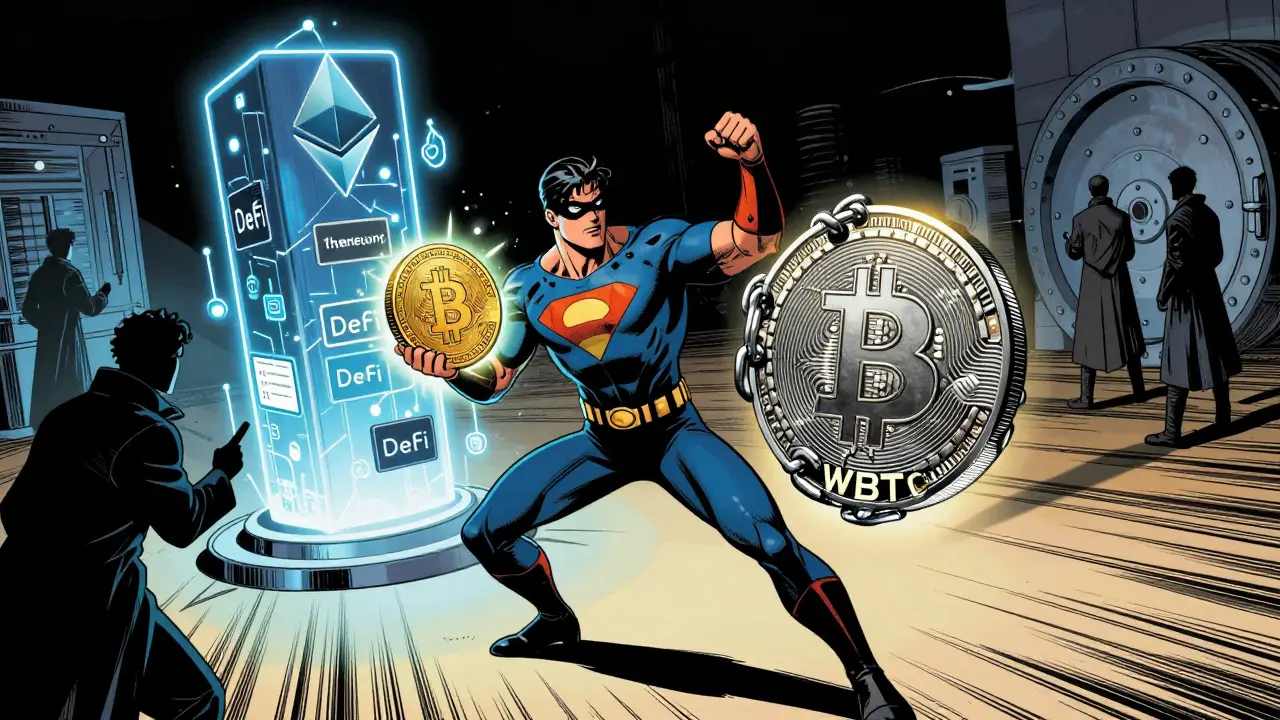
Imagine you own Bitcoin, but you want to earn interest on it in a DeFi app that only accepts Ethereum tokens. You can’t just send BTC into that app-it won’t recognize it. That’s where wrapped tokens come in. They let your Bitcoin act like an Ethereum token, unlocking access to thousands of DeFi protocols. But here’s the catch: you’re no longer just holding Bitcoin. You’re holding a version of it that depends on someone else to keep your original coins safe. This is the core tension between wrapped tokens and native tokens-and why it matters more than ever in 2026.
What Are Native Tokens?
Native tokens are the original cryptocurrencies built on their own blockchain. Bitcoin (BTC) lives on the Bitcoin network. Ether (ETH) runs on Ethereum. Solana (SOL) is native to Solana. These aren’t copies. They aren’t bridges. They’re the real thing-the backbone of their networks.
Native tokens do more than just trade. They power the chain itself. Bitcoin miners get rewarded in BTC. Ethereum validators stake ETH to secure the network. Governance votes on Ethereum upgrades? You need ETH to cast your ballot. These tokens are secured by thousands of nodes spread across the globe, all working together to validate transactions.
But here’s the problem: native tokens can’t talk to other blockchains. If you try to send ETH directly into a DeFi contract that expects ERC-20 tokens, it fails. Why? Because ETH isn’t an ERC-20 token-it’s the native currency of Ethereum. Smart contracts can’t “pull” ETH like they can pull USDC or DAI. That’s why, even on Ethereum, you need WETH.
What Are Wrapped Tokens?
Wrapped tokens are digital representations of native assets on foreign blockchains. Think of them as IOUs backed by real crypto. Wrapped Bitcoin (WBTC) is BTC locked up in a vault, and in return, you get an ERC-20 token that behaves exactly like BTC-but on Ethereum.
The wrapping process is simple in theory: you send your BTC to a custodian. They lock it. Then they mint an equal amount of WBTC on Ethereum and send it to you. When you want your BTC back, you burn the WBTC, and the custodian releases your original coins.
WBTC isn’t the only one. Wrapped Ether (WETH) turns ETH into an ERC-20 token so it can be used in DeFi apps like Uniswap or Aave. WAVAX wraps Avalanche’s AVAX for use on Ethereum. There are even wrapped versions of Litecoin, Dogecoin, and more.
As of September 2023, over $14.7 billion in wrapped assets were locked across blockchains. WBTC alone accounted for $5.2 billion of that. That’s not small change-it’s infrastructure.
Key Differences: Wrapped vs Native
Here’s how they stack up side by side:
| Aspect | Native Tokens | Wrapped Tokens |
|---|---|---|
| Blockchain Location | Only on their own chain | On foreign chains (e.g., WBTC on Ethereum) |
| Security Model | Secured by native blockchain consensus | Secured by custodians or smart contracts |
| Liquidity Access | Limited to native ecosystem | Access to multiple DeFi ecosystems |
| Token Standard | Not ERC-20 (unless it’s ETH via WETH) | Usually ERC-20 or equivalent |
| Trust Required | None-fully decentralized | Yes-custodians or DAOs hold your asset |
| Use Case | Network fees, staking, governance | DeFi, cross-chain trading, lending |
Native tokens are pure. Wrapped tokens are practical. One is about sovereignty. The other is about access.
Why Wrapped Tokens Exist
The crypto world isn’t one big, connected network. It’s a patchwork of isolated chains. Bitcoin has security. Ethereum has DeFi. Solana has speed. But none of them can directly talk to each other.
Wrapped tokens were created to fix that. Without them, Bitcoin holders couldn’t lend their BTC on Aave. Ethereum users couldn’t trade BTC against ETH on Uniswap. The entire DeFi economy would be stuck in silos.
That’s why WBTC launched in January 2019. It was the first major attempt to bridge Bitcoin’s value into Ethereum’s DeFi world. And it worked. Today, over 95% of Ethereum-based DeFi protocols accept ERC-20 tokens. WETH lets ETH behave like one. That’s why even Ethereum users wrap their ETH-it’s not optional if you want to use most DeFi tools.
The Risks You Can’t Ignore
Wrapped tokens aren’t magic. They come with trade-offs.
First, trust. WBTC is backed by a group of custodians-including BitGo, a centralized company. If they get hacked, go rogue, or freeze withdrawals, your WBTC becomes worthless. There’s no blockchain consensus to reverse it. You’re relying on human institutions, not code.
Second, complexity. Wrapping and unwrapping isn’t always smooth. Users report delays of up to 22 minutes during custodian verification. Failed transactions happen when slippage settings are wrong. Some have lost funds by selecting the wrong token type during the wrap process.
Third, systemic risk. In August 2022, the Nomad Bridge hack stole $190 million in wrapped assets. The vulnerability wasn’t in Bitcoin or Ethereum-it was in the bridge logic that connected them. That’s the danger of wrapping: you’re adding another layer between your asset and its security.
Even Ethereum co-founder Vitalik Buterin has said wrapped tokens “introduce additional trust assumptions that go against the spirit of decentralization.”

What’s Changing in 2026?
The future of wrapped tokens isn’t about more of them-it’s about fewer.
Ethereum is working on EIP-3668 and EIP-3607 to let native ETH be used directly in smart contracts. If that rolls out by 2025, WETH might become obsolete. That’s huge. It means Ethereum users won’t need to wrap ETH anymore.
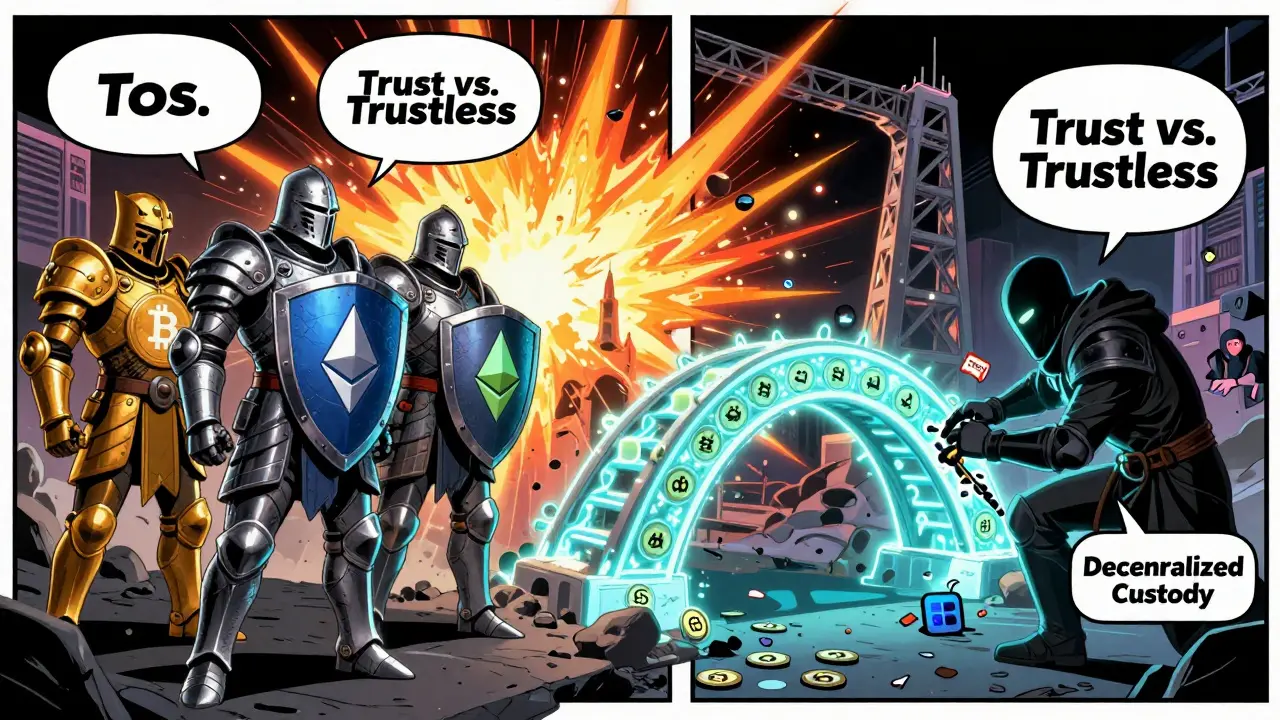
Chainlink’s Cross-Chain Interoperability Protocol (CCIP), launched in September 2023, is another game-changer. Instead of relying on centralized custodians, CCIP uses decentralized oracles to verify asset locks across chains. No single company holds your BTC. No single point of failure. It’s a step toward truly trustless wrapping.
Galaxy Digital predicts that by 2026, 40% of wrapped asset volume will shift to decentralized custody models. That’s not just a trend-it’s a rewrite of the rules.
And yet, Gartner still expects wrapped assets to handle 18-22% of all cross-chain value through 2027. Why? Because even with better tech, the transition takes time. Millions of users still rely on WBTC, WETH, and other wrapped tokens today. They’re not going away overnight.
What Should You Do?
If you’re new to DeFi: start with native tokens when you can. Use ETH on Ethereum, SOL on Solana. Avoid wrapping unless you need to access a specific protocol.
If you need cross-chain access: use official wrappers. Stick with WBTC from the official portal, not random bridges. Check who the custodians are. Look for transparency reports. Avoid obscure wrapped tokens with no audit history.
And always remember: when you hold a wrapped token, you’re not holding the original asset. You’re holding a promise. That promise depends on people, contracts, and systems outside the blockchain you think you’re using.
Wrapped tokens are the glue holding today’s multi-chain world together. But they’re also the weakest link. As native cross-chain tech improves, the need for them will shrink. Until then, know what you’re really holding-and who’s holding your money behind the scenes.
Are wrapped tokens the same as the original crypto?
No. Wrapped tokens are digital representations of native assets on a different blockchain. For example, WBTC represents Bitcoin on Ethereum, but the original BTC is locked in a vault. You’re not holding Bitcoin-you’re holding a token that claims to be backed 1:1 by Bitcoin. The value is the same, but the security and control are different.
Can I use native ETH in DeFi without wrapping it to WETH?
Most DeFi protocols on Ethereum require ERC-20 tokens. Native ETH isn’t an ERC-20 token, so it can’t be directly used in lending, staking, or trading contracts. WETH solves this by converting ETH into an ERC-20 format. While Ethereum is working on changes to allow native ETH use in smart contracts, as of 2026, WETH is still required for nearly all DeFi interactions.
Is WBTC safe?
WBTC is one of the most audited and widely used wrapped tokens, but it’s not risk-free. It’s backed by a group of custodians-including BitGo, a centralized company. If those custodians are compromised or act maliciously, your WBTC could be frozen or stolen. It’s safer than random bridges, but less secure than holding Bitcoin on the Bitcoin blockchain.
What happens if the custodian of a wrapped token goes bankrupt?
If the custodian fails, your wrapped token becomes a claim on a locked asset you can’t access. Unlike native tokens, there’s no blockchain mechanism to force the release of your original crypto. You’d have to rely on legal recourse or the custodian’s bankruptcy proceedings-which could take years, if they even recover anything. This is why decentralized custody models like Chainlink’s CCIP are being developed.
Do I pay gas fees to wrap a token?
Yes. Wrapping requires two transactions: one to send your native asset to the custodian (on its native chain), and another to receive the wrapped token on the target chain. You pay gas fees on both chains. For example, wrapping BTC to WBTC on Ethereum requires paying Ethereum gas fees for the minting transaction. As of 2026, average Ethereum gas fees for wrapping range from $1 to $3, depending on network congestion.
Sarah Zakareckis
March 19, 2026 AT 16:15Let’s be real - if you’re not using WETH right now, you’re leaving DeFi on the table. The fact that ETH isn’t natively ERC-20 is such a weird oversight, and wrapping it isn’t a hack - it’s a necessity. I’ve been staking through Aave and lending on Compound for years, and WETH is the only way to make it work. The gas fees? Worth it. The trust? Minimal. And honestly? The ecosystem runs on this glue. Stop acting like wrapped tokens are some kind of compromise - they’re the reason DeFi isn’t just a bunch of isolated islands.
Christopher Hoar
March 20, 2026 AT 20:23lol at people acting like WBTC is ‘safe’ lmao. BitGo? A centralized company? Bro. You think Bitcoin is decentralized but you’re trusting a corp to hold your coins? That’s not crypto, that’s banking with extra steps. If you’re holding WBTC, you’re not a degenerate - you’re a renter. Own your chain or get out.
Robert Kunze
March 22, 2026 AT 18:17wait so if i wrap my btc to wbtc and the custodian gets hacked… i just lose it? no chain recovery? no way to prove i owned the original? this feels like putting your cash in a bank and then the bank says ‘oops, we lost it but we’re insured’ - except there’s no insurance. i just lost my bitcoin. why do we still do this? 🤦♂️
Heather James
March 23, 2026 AT 16:52Wrapped tokens = digital IOU. Native = real cash. Why are we still using IOUs?
Sarah Hammon
March 25, 2026 AT 04:27just want to say i started using WETH last year and honestly didn’t realize how much smoother everything got. i was scared at first - like ‘is this legit?’ - but after checking the auditors and seeing how many protocols rely on it, i got chill. it’s not perfect, but it’s the best we’ve got until ETH 2.0 fully unlocks native usage. also, gas fees are way lower now than in 2021. peace 🙏
Marie Vernon
March 26, 2026 AT 14:33As someone who grew up in a country where banking is unstable, I see wrapped tokens as a bridge - not a trap. I don’t trust banks. But I do trust that WBTC lets me earn yield on BTC while staying in the DeFi world. It’s not ideal, but it’s better than watching my assets sit idle. Maybe one day we won’t need it. Until then? I’ll take the access.
Jesse Pals
March 28, 2026 AT 11:30WETH is the OG wrapper 😎. Even Ethereum needed it. Think about it - ETH is the fuel, but WETH is the fuel pump. Without it, DeFi is just a car with no engine. And yeah, CCIP is cool, but it’s not live yet. Until then? Wrap it. Use it. Profit. 🚀
Shreya Baid
March 30, 2026 AT 03:03Thank you for this thoughtful breakdown. As someone who teaches blockchain fundamentals to students in India, I’ve seen how wrapped tokens confuse beginners. The idea that ‘you’re not holding Bitcoin’ is hard to grasp. We use analogies like ‘a digital promissory note’ - but the real lesson is sovereignty. Native tokens preserve autonomy. Wrapped tokens enable participation. Both have value. We must teach the trade-offs, not just the mechanics. The future isn’t about eliminating wrapped assets - it’s about making them trustless. And that’s where CCIP, or similar decentralized custody models, will matter most.
anshika garg
March 30, 2026 AT 18:36Wrapped tokens are the quiet tragedy of crypto. We built this world to escape intermediaries… and then we built new ones out of code and custodians. It’s poetic. We wanted to be gods of our own money - but we’re still begging for permission from a few centralized vaults. WBTC is a miracle and a curse. I hold it. I use it. But I never forget - I’m not holding Bitcoin. I’m holding a promise written in Solidity. And promises? They break. 💔
Diane Overwise
April 1, 2026 AT 06:50Ohhhh so WETH is required because ETH isn’t ERC-20… wait. WHAT? 😭 Like, the *Ethereum* blockchain doesn’t let ETH act like a token on its own chain? That’s like having a Ferrari and being told you can’t drive it unless you put a trailer hitch on it. Someone please explain why this wasn’t fixed in 2015. I’m not mad. I’m just… disappointed. 🤷♀️
Bruce Doucette
April 1, 2026 AT 19:45you people are still using WBTC?? 😭 i mean, i get it, but like… did you not read the part where the custodians are centralized? you’re literally trusting a company with your BTC. that’s not crypto. that’s a bank with a blockchain logo. i use CCIP bridges now. no custodians. no middlemen. just oracles. if you’re still wrapping, you’re 2020. upgrade. 🤡
Anastasia Danavath
April 3, 2026 AT 11:45lol i wrapped my btc once and forgot to select WBTC and sent it to a random erc20 address. lost 0.5 btc. never again. 🤡
Jerry Panson
April 3, 2026 AT 21:37The notion that wrapped tokens are ‘practical’ is dangerously misleading. Practicality without sovereignty is a trap. If Ethereum successfully implements EIP-3668 and eliminates the need for WETH, it won’t be a win for DeFi - it will be a win for decentralization. The fact that we’ve normalized reliance on centralized custodians for over five years is a failure of our community’s values. We should be building interoperability that doesn’t require trust. Not more wrappers. More bridges. More protocols. Not more vaults.
iam jacob
April 5, 2026 AT 21:20so i just lost $3k in wrapped usdt because the bridge went down for 3 days… and now i’m just sitting here wondering if i’m ever getting it back… i feel so used. why do i even try… 😭