
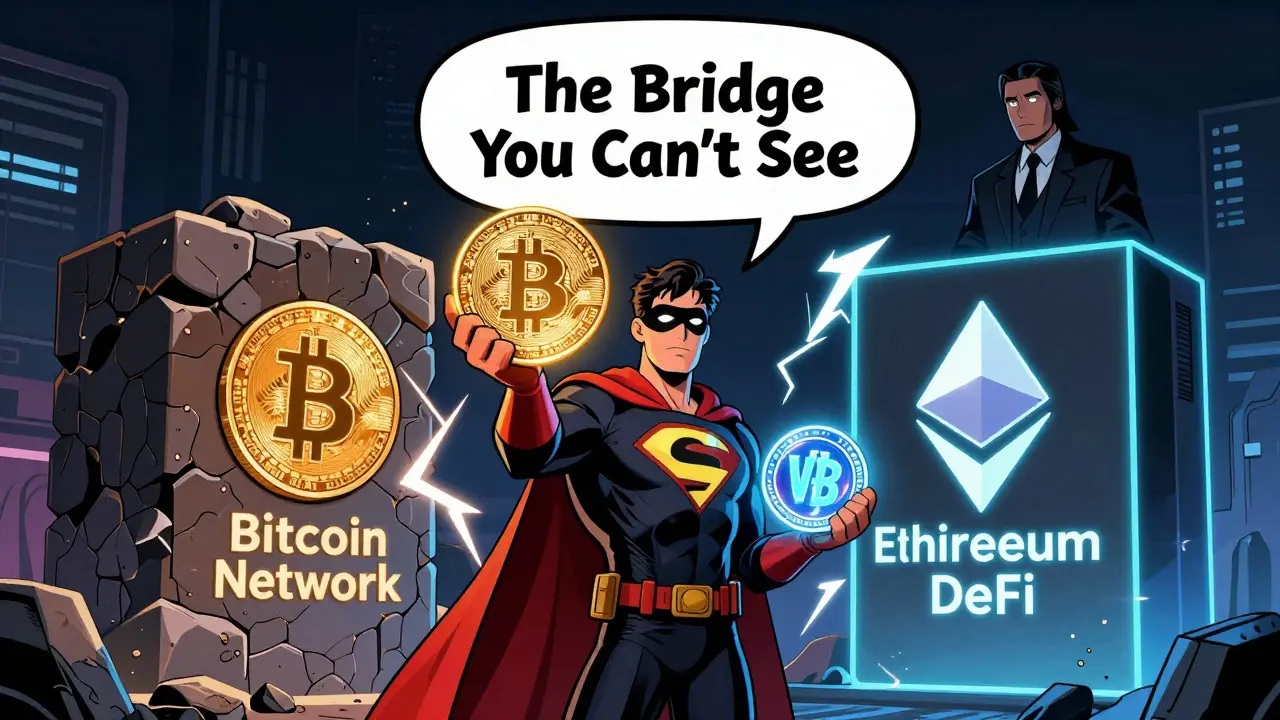
When you hold Bitcoin but want to use it in a DeFi app on Ethereum, you can’t just send BTC directly. It won’t work. That’s where wrapped tokens come in. But before you wrap your crypto, you need to understand what’s really happening - and whether it’s safe. This isn’t just about technical jargon. It’s about control, risk, and real money.
What Are Native Tokens?
Native tokens are the original coins built into their own blockchains. Bitcoin (BTC) runs on the Bitcoin network. Ether (ETH) runs on Ethereum. These aren’t copies. They’re the real thing - created by the network’s consensus rules, secured by its miners or validators, and used for everything from paying fees to voting on upgrades.
Native tokens don’t need intermediaries. When you send ETH, the Ethereum network verifies it. No third party holds your coins. No vault. No custodian. Just code and consensus. That’s why they’re considered the most secure form of ownership in crypto.
But here’s the catch: native tokens often can’t interact with smart contracts. Ethereum’s DeFi apps - like Aave, Uniswap, or Compound - were built expecting ERC-20 tokens. ETH itself isn’t an ERC-20 token. It’s a native asset. So even though ETH is the backbone of Ethereum, you can’t use it directly in most DeFi protocols without converting it first.
What Are Wrapped Tokens?
Wrapped tokens are digital stand-ins. They represent a native asset on a different blockchain. The most famous example is Wrapped Bitcoin (WBTC). It’s a token on Ethereum that’s worth exactly 1 BTC. But WBTC isn’t Bitcoin. It’s a token that says, “I’m backed by Bitcoin locked somewhere else.”
The wrapping process works like this: you send your BTC to a trusted custodian. They lock it in a secure vault. Then, they mint an equal amount of WBTC on Ethereum and send it to you. Now you can use WBTC in DeFi apps, trade it on DEXs, or lend it out. When you want your BTC back, you burn the WBTC, and the custodian releases your original Bitcoin.
Other common wrapped tokens include WETH (wrapped Ether), WAVAX (wrapped Avalanche), and WBETH (wrapped staked ETH). Each one lets you take a native asset and use it where it normally couldn’t go.
Why Do Wrapped Tokens Exist?
Blockchain networks used to be islands. Bitcoin couldn’t talk to Ethereum. Ethereum couldn’t talk to Solana. But DeFi exploded on Ethereum, and people wanted to use their Bitcoin there. So wrapped tokens became the bridge.
By 2023, over $14.7 billion in wrapped assets were locked in DeFi protocols. WBTC alone accounted for $5.2 billion of that. That’s not small change. It means thousands of Bitcoin holders are using their BTC in Ethereum lending, trading, and yield farming - all because of wrapping.
Without wrapped tokens, cross-chain DeFi wouldn’t exist. You’d be stuck. If you owned BTC and wanted to earn interest, you’d have to sell it, buy ETH, and hope the price didn’t crash while you waited. Wrapped tokens remove that friction.
Security: Native vs Wrapped
This is where things get risky.
Native tokens are secured by the full power of their blockchain. Bitcoin has over 500,000 mining nodes. Ethereum has over 1 million validators. The system is designed to be trustless. No single entity controls it.
Wrapped tokens? They rely on custodians. WBTC is managed by a group of 22 custodians, including BitGo and Kyber. If one of them gets hacked, or if they go rogue, your wrapped asset could be at risk. There’s no blockchain consensus backing it - just a group of companies holding your coins.
And it’s not just about theft. In 2022, the Nomad Bridge hack lost $190 million in wrapped assets because of a flawed smart contract. That wasn’t a native token. That was a wrapped one. The vulnerability wasn’t in Bitcoin or Ethereum - it was in the bridge.
Some argue that decentralized custodians (like DAOs) solve this. But as of 2026, most wrapped tokens still use centralized or semi-centralized models. Even WETH, which is widely trusted, still depends on a smart contract that could be upgraded or exploited.

Use Cases: When to Use Which
Use native tokens when:
- You’re holding long-term and want maximum security
- You’re interacting with your own blockchain’s native tools (like staking ETH on Ethereum)
- You’re avoiding third-party dependencies
Use wrapped tokens when:
- You need to use your BTC in Ethereum DeFi
- You want to earn yield on assets that don’t natively support smart contracts
- You’re trading across chains and need liquidity on DEXs that only accept ERC-20
For example: If you’re a Bitcoin holder and you want to lend your BTC on Aave, you have to wrap it into WBTC. No other way. But if you’re already on Ethereum and just want to stake ETH, stick with native ETH. There’s no benefit to wrapping it.
Real-World Examples
Let’s say you have 1 BTC. You want to use it in DeFi. Here’s what happens:
- You go to the WBTC portal (like the official one from BitGo)
- You send your BTC to their custody address
- They lock it and mint 1 WBTC on Ethereum
- You receive WBTC in your MetaMask wallet
- You connect to Aave and deposit WBTC as collateral
- You start earning interest
When you want your BTC back:
- You withdraw your WBTC from Aave
- You send WBTC back to the WBTC portal
- You request redemption
- They burn the WBTC and release your BTC
- You get your Bitcoin back - usually within 24 hours
That’s the process. It works. But notice how many steps rely on someone else. That’s the trade-off.
What’s Changing in 2026?
The future of wrapped tokens is uncertain - and that’s why you should care.
Ethereum is working on EIP-3668 and EIP-3607, which would let native ETH interact directly with smart contracts. If that ships by 2025, WETH might become obsolete. No more wrapping needed.
Chainlink’s CCIP protocol, launched in late 2023, is trying to build a decentralized wrapping system. Instead of trusting a company like BitGo, you’d trust a network of independent nodes. This could reduce centralization risk.
But here’s the kicker: Galaxy Digital predicts that by 2026, only 40% of wrapped assets will use decentralized custody. That means 60% will still rely on centralized entities. That’s a huge risk.
And regulators are watching. In 2023, the U.S. Office of the Comptroller of the Currency ruled that custodians of wrapped assets must follow the same rules as banks holding digital assets. That means WBTC custodians now need licenses, audits, and insurance. It’s a step toward legitimacy - but also more control.
What Do Users Say?
On Reddit, users debate WBTC vs renBTC. Some say, “I’d never use WBTC - BitGo has too much power.” Others reply, “I’ve used it for two years. Never had an issue.”
A 2023 Twitter poll by DeFi researcher @DefiantIntel showed 68% of 1,243 respondents preferred native assets when available. The main reason? Security.
But developers on Ethereum Magicians say: “WETH is the reason I can build DeFi apps. Without it, 95% of protocols wouldn’t work.”
The truth? Most people don’t care about the mechanics. They care about results. Can I earn yield? Can I trade? Can I get my money back? If the answer is yes, many will use wrapped tokens - even if they know it’s not perfectly decentralized.
How to Stay Safe
If you’re using wrapped tokens, here’s what to do:
- Use official wrapping services - like WBTC’s official portal, not random bridges
- Check the custodians - how many are there? Are they reputable?
- Don’t wrap more than you can afford to lose
- Keep track of redemption times - some take hours, others take days
- Watch for audits - reputable wrapped tokens get them regularly
And if you’re unsure? Stick with native assets. They’re simpler. Safer. More predictable.
Final Thought
Wrapped tokens are a temporary fix. They’re not the future - they’re the bridge to it. As blockchains get better at talking to each other, we won’t need to wrap things anymore. We’ll just send them.
But until then? Wrapped tokens are essential. They’ve unlocked billions in value. They’ve let Bitcoiners join DeFi. They’ve made crypto more useful.
Just remember: when you wrap your crypto, you’re not just converting tokens. You’re trusting someone else with your money. And in crypto, that’s the biggest risk of all.
Shreya Baid
March 18, 2026 AT 07:11Wrapped tokens are a necessary evil. I've used WBTC for over two years now to participate in Ethereum DeFi, and while I know the risks, the utility outweighs them. The fact that I can earn yield on my Bitcoin without selling it is revolutionary. Still, I always keep a portion in native BTC for long-term holding - never put everything in wrapped assets.
For anyone new to this: stick to official portals like BitGo. Never use random bridges. I lost a friend to a scam bridge last year - total nightmare. Do your homework.
Christopher Hoar
March 18, 2026 AT 22:30lol why are we still using WBTC? it's 2026 and we're still trusting bitgo like some kind of medieval banker. if you're not using chainlink ccip or something decentralized you're basically handing your crypto to a startup with a website and a linkedin page. lol.
Robert Kunze
March 18, 2026 AT 22:48wait so weth is still centralized? i thought it was fully on chain? i just assumed… like… everyone uses it so it must be safe? this is kinda scary. i’ve had like 3k in weth staked for months. maybe i should move it out?
Sarah Zakareckis
March 20, 2026 AT 02:28YESSS this is such an important breakdown! 🙌 Wrapped tokens are the unsung heroes of cross-chain DeFi. Without them, we’d be stuck in silos. Native assets are king for security - but wrapped tokens? They’re the bridge that lets Bitcoiners join the party. And honestly? That’s why crypto keeps growing.
Pro tip: Always check the custodian count. WBTC’s 22-member multisig is way better than some 3-of-5 setups. Transparency matters. And if a project doesn’t publish quarterly audits? Run.
Heather James
March 20, 2026 AT 06:35Native for holding. Wrapped for using. Simple.
Sarah Hammon
March 20, 2026 AT 17:43just learned that weth is technically wrapped eth? i always thought eth was native on eth. wow. that makes me nervous. i’ve been using it in uniswap for years. is it safe? i guess if the contract doesn’t get upgraded maliciously? but what if someone gets admin keys? 😬
iam jacob
March 20, 2026 AT 20:32so… you’re telling me i’m trusting a company with my bitcoin? like… a company? lol. i thought crypto was about removing trust. now i feel kinda used. 🥺
Jesse Pals
March 21, 2026 AT 13:40wrap it, trade it, earn it, then unwrap it when you’re ready 🤝💸 i’ve been doing this since 2022 and honestly? never had an issue. just don’t be greedy. don’t wrap your life savings. keep 10-20% native. chill vibes.
Diane Overwise
March 22, 2026 AT 09:01How darling. We’ve turned decentralized finance into a bank with better UX. 🤦♀️
And yet, we still call it ‘decentralized.’
Next, we’ll have a DAO-run IRS. Oh wait… we already do.
Jerry Panson
March 23, 2026 AT 21:59The regulatory landscape for wrapped assets is evolving rapidly. In 2023, the OCC explicitly classified custodians of wrapped tokens as money transmitters under the Bank Secrecy Act. This means that entities like BitGo must now maintain AML/KYC protocols, insurance coverage, and undergo regular audits - the same as traditional financial institutions.
This is not a minor compliance shift. It is a structural realignment. Wrapped tokens are no longer a gray area. They are now subject to the same fiduciary obligations as any regulated financial instrument. This increases systemic safety - but also increases centralization.
Anastasia Danavath
March 25, 2026 AT 05:02lol i wrapped my btc for yield and now it’s stuck bc the portal is down 😭
anshika garg
March 26, 2026 AT 20:38It’s funny… we built blockchain to escape intermediaries. And now we’ve built a whole ecosystem around them. Wrapped tokens are like a mirror - they show us how much we still crave trust, even in a trustless system. We don’t want to be free. We want to be safe. And so we hand our keys to a company with a logo and a whitepaper.
Is this progress? Or just a new kind of prison - with better UI?
Bruce Doucette
March 28, 2026 AT 19:22you’re all being naive. if you’re using wbtc, you’re already compromised. bitgo could just stop minting. or worse - they could collude with the fed. this isn’t crypto. it’s crypto cosplay. 🤡
Marie Vernon
March 30, 2026 AT 10:58I love how we’ve created these bridges between chains - but we never really asked if we should’ve built them in the first place. Maybe we shouldn’t be trying to make Bitcoin work on Ethereum. Maybe we should’ve built better Bitcoin L2s instead.
It feels like we’re trying to force a square peg into a round hole… just because the hole has more users.
Ross McLeod
March 31, 2026 AT 15:38There’s a deeper philosophical issue here that most people overlook. The very act of wrapping a native asset introduces a layer of abstraction that fundamentally alters the ontological status of that asset. Bitcoin, as a native token, is not merely a unit of value - it is a cryptographic proof of work consensus. When you wrap it, you are no longer interacting with that proof - you are interacting with a representation of it, mediated by a third-party entity. This transforms the asset from a decentralized, permissionless, trustless object into a centralized, permissioned, custodial liability. The fact that this is widely accepted as ‘normal’ speaks volumes about the erosion of crypto’s original ethos. We are not building a new financial system - we are rebuilding the old one, with different fonts.
rajan gupta
April 2, 2026 AT 12:49bro i wrapped 50 btc in 2023 and now i can’t get it back bc the portal says ‘maintenance’ for 3 months 😭 my mom cried when i told her. this is not crypto. this is a scam. they’re all in on it. the fed, bitgo, eth devs - they all want you to think you’re free. but you’re just a number in their database. 🤡💔
Billy Karna
April 2, 2026 AT 21:08One thing that’s rarely discussed: wrapped tokens create liquidity asymmetries. WBTC dominates Ethereum DeFi, but renBTC, tBTC, and other variants exist. Why? Because some users distrust BitGo. But those alternatives have lower liquidity, higher slippage, and worse security audits. So you’re forced into WBTC - not because it’s best, but because it’s the only one with enough depth to move large amounts. This is monopolization disguised as utility.
And it’s not just WBTC. WETH has over 95% market share among wrapped assets on Ethereum. That’s not competition - that’s de facto centralization. The system incentivizes reliance on a single provider. That’s a red flag.
Cheri Farnsworth
April 3, 2026 AT 08:27The regulatory clarity introduced by the OCC in 2023 has significantly de-risked the wrapped token ecosystem. Custodians are now legally accountable. Insurance requirements have increased capital reserves. Audit transparency is now mandatory. This is not a regression - it is maturation.
Wrapped tokens are not a compromise. They are a necessary evolution of interoperability. The future of DeFi does not lie in isolated chains. It lies in connected ecosystems. And those ecosystems require standardized, regulated, audited bridges. We are not abandoning decentralization. We are scaling it responsibly.
Gene Inoue
April 4, 2026 AT 17:13you people are so gullible. wrapped tokens are just a way for dev teams to charge fees and then disappear. remember the nomad hack? $190m gone. and now? same thing. they’ll keep building bridges until one day, poof. no one’s accountable. you’re not investing. you’re gambling with someone else’s code.
Ricky Fairlamb
April 4, 2026 AT 23:44Let’s be clear: wrapped tokens are a betrayal of the Satoshi whitepaper. Bitcoin was designed to be sovereign, non-repudiable, and independent. Wrapping it on Ethereum turns it into a liability of a foreign chain - one with a governance model that can be altered by a handful of developers. This isn’t innovation. It’s surrender. And those who defend it are not builders - they are apologists for centralized control.
If you truly believe in decentralization, you should be building Bitcoin L2s, not begging Ethereum for scraps. The fact that we’ve normalized this is the death knell of crypto’s original promise.
Arlene Miles
April 5, 2026 AT 09:35You’re all missing the point. Wrapped tokens aren’t about trust - they’re about access. They let people who were locked out of DeFi finally participate. A farmer in Nigeria with BTC can now lend it. A single mom in Texas with ETH can now earn yield. That’s not evil. That’s empowerment.
Yes, there are risks. But we don’t stop progress because it’s imperfect. We fix it. We demand better custodians. We push for decentralized bridges. We don’t abandon the tool because the tool has flaws.
Be the change. Don’t be the critic who does nothing.
Jessica Beadle
April 5, 2026 AT 10:59Everyone’s acting like this is a new problem. It’s not. This is exactly what happened with gold-backed ETFs in the 90s. People thought they were holding gold. They weren’t. They were holding a promise. And when the system cracked? They lost everything. History repeats. Always.
WBTC is the gold ETF of crypto. And we’re all just waiting for the crash.
Tony Weaver
April 6, 2026 AT 20:20Let’s cut the PR nonsense. Wrapped tokens are a hack. A temporary, ugly, centralized hack. And the fact that we’ve normalized them - that we’ve stopped questioning them - is the most dangerous thing in crypto right now.
We’re not building the future. We’re building a casino with better graphics. And the house always wins.
Patty Atima
April 7, 2026 AT 06:00just use native when you can. wrap when you have to. easy 😊
Lucy de Gruchy
April 8, 2026 AT 01:52Of course they’re pushing wrapped tokens. It’s the perfect way to funnel assets into centralized exchanges. The real goal? Control. Regulation. Surveillance. Wrapped assets are the Trojan horse. You think you’re earning yield. You’re actually giving up your financial sovereignty. And you’re celebrating it.