

Imagine a world where you don't have to scroll through endless Twitter threads or read fifty different newsletters to know what's happening in crypto. Instead, an AI-generated voice gives you a natural-sounding podcast episode with the latest breaking news, tailored exactly to your interests. That is the pitch behind Podflow AI is an AI-powered cryptocurrency podcast service that transforms web and social data into engaging audio content. It is designed to help enthusiasts keep up with the breakneck speed of the blockchain world without spending hours manually researching every single trend. However, behind the innovative tech lies a digital asset that has seen a wild, and largely painful, ride in the markets.
The Engine Behind the Audio: How Podflow AI Works
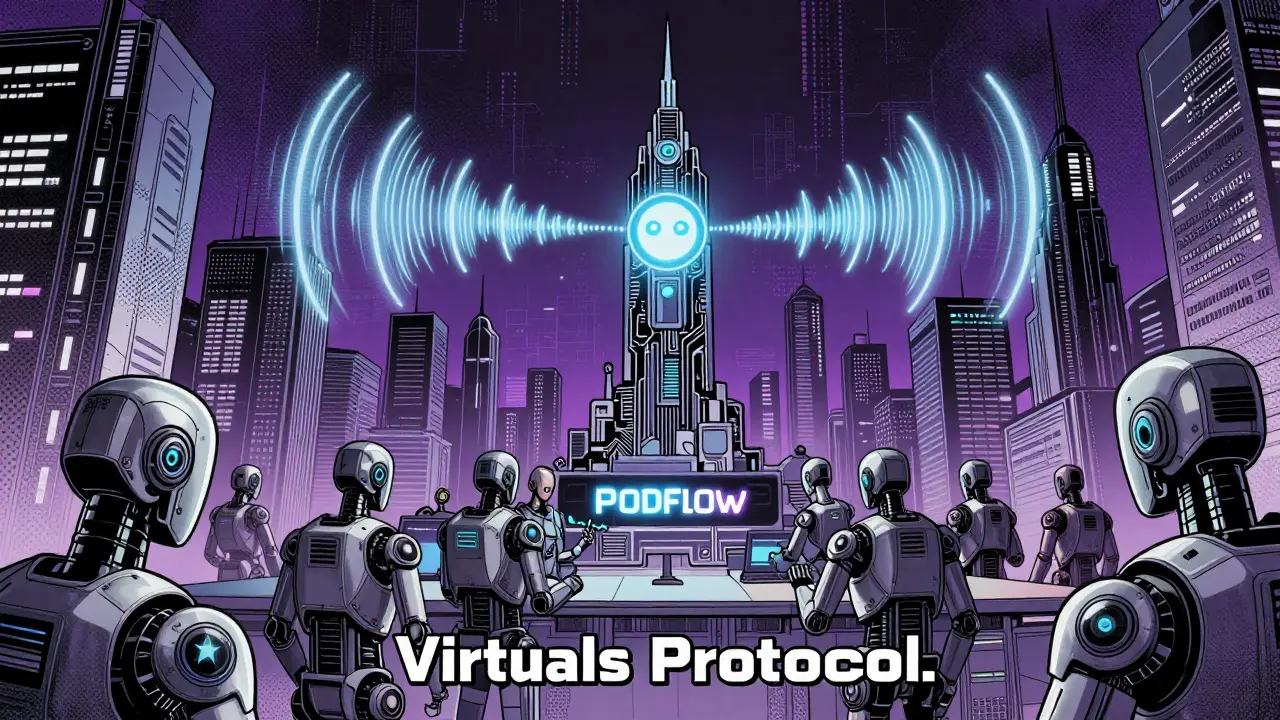
Podflow AI isn't just a bot reading a RSS feed. It utilizes advanced artificial intelligence to source data from across the web and social platforms, distilling complex crypto updates into a format that feels like a human-hosted show. The goal is to remove the friction of information gathering. Instead of hunting for the latest alpha, you just hit play.
This project doesn't exist in a vacuum. It is a key part of the Virtuals Protocol, which is an ecosystem consisting of productive AI agents designed to create services and autonomously engage in onchain commerce. In simpler terms, Virtuals Protocol wants to create a society of AI bots that can actually "work" and earn, and Podflow AI is the specialized agent tasked with content creation and news delivery.
Understanding the POD Token
To participate in this ecosystem, the project launched the POD token. As the native cryptocurrency of the Podflow AI project, POD was intended to fuel the growth and utility of the AI podcasting service. In theory, tokens like these are meant to align the interests of the users and the developers, often providing governance rights or access to premium features.
If you're looking at the numbers, the POD crypto coin has a total supply of 989.67 million tokens. Interestingly, the circulating supply is reported to be equal to the total supply, meaning all tokens are currently out in the wild. However, the holder base is relatively small, with about 4.98K unique wallets holding the coin. This tells us that while the idea is niche, the community hasn't yet exploded into the mainstream.
| Attribute | Value |
|---|---|
| Total Supply | 989.67 Million POD |
| Approx. Market Cap | $42,690 USD |
| Unique Holders | 4.98K |
| All-Time High (ATH) | $1.41 USD (Nov 30, 2024) |
| All-Time Low (ATL) | $0.0000358 USD (Feb 18, 2026) |
Market Reality: Volatility and Price Action
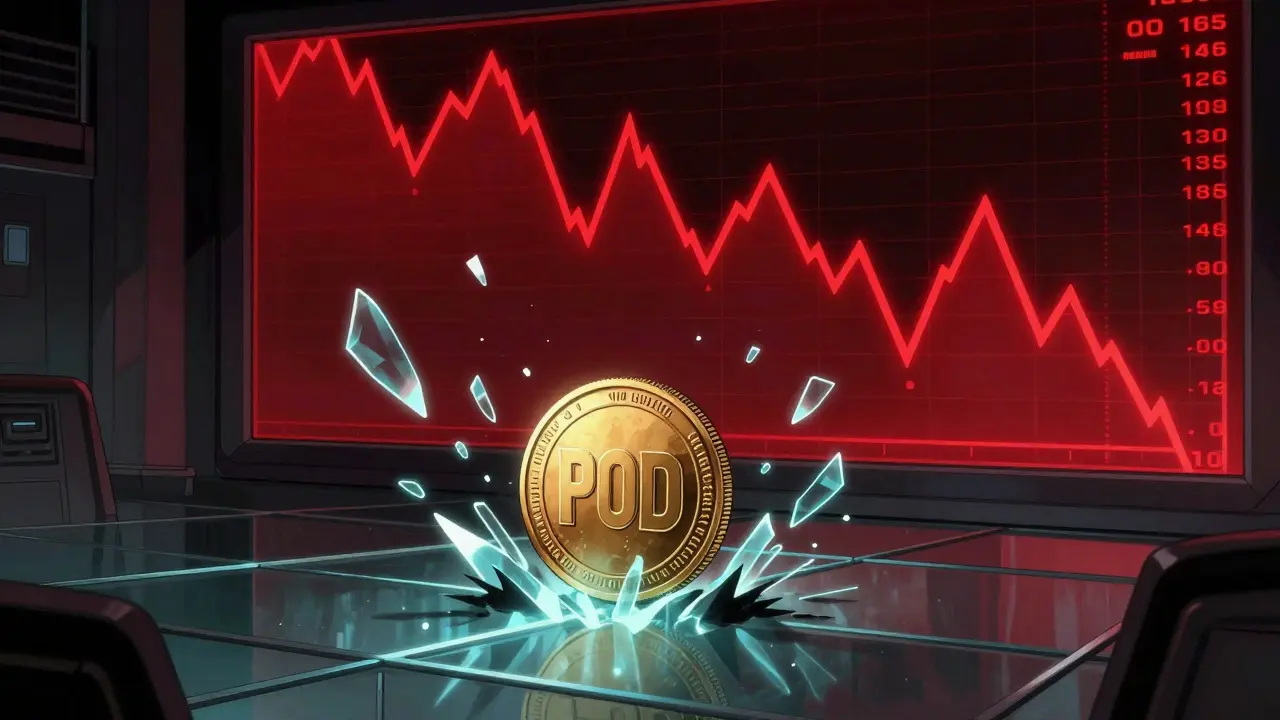
Let's be honest: the price chart for POD is a cautionary tale. If you bought at the peak on November 30, 2024, when the coin hit $1.41, you've witnessed a near 100% decline in value. By early 2026, the token had plummeted to fractions of a cent. Even with a small recovery of about 20% from its February 2026 low, the token remains in a deep hole.
What's more concerning than the price drop is the liquidity. If you look at the 24-hour trading volumes on platforms like CoinMarketCap or TradeSanta, you'll see numbers as low as $0 or $17.44. In the crypto world, this is a massive red flag. Low liquidity means that if you try to sell a significant amount of POD, you might not find a buyer, or your own sell order could crash the price even further. This is often referred to as a "slippage" risk.
We also see a strange disconnect in pricing across exchanges. At one point, Binance reported POD at $0.000127, while other sources showed it closer to $0.000041. This kind of variance usually happens when a coin isn't traded enough to keep the prices synchronized across different platforms, further proving that the market for POD is currently very thin.
The Pros and Cons of AI-Driven Content Tokens
The idea of an AI-driven news pod is genuinely cool. It solves the problem of "information overload" by using a Large Language Model (LLM) and voice synthesis to curate the most important bits of the day. However, the business model for the accompanying token is where things get tricky. Many projects launch a token to raise money, but if the token doesn't have a real use case beyond speculation, it eventually crashes when the hype dies down.
- The Good: Automated news delivery, seamless integration with Virtuals Protocol, and the ability to consume crypto news hands-free.
- The Bad: Extreme price volatility, dangerously low trading volume, and a lack of a clear, sustainable roadmap to bring in new users.
- The Ugly: A 91% loss in value over a 90-day window, suggesting that early investors have largely abandoned ship.
How This Fits into the Broader AI-Crypto Trend
Podflow AI is part of a wider trend where developers are trying to merge Artificial Intelligence with Blockchain Technology. The theory is that AI can handle the "labor" (like researching and hosting a podcast) and the blockchain can handle the "payment" and "ownership" (via tokens).
When this works, you get highly efficient services that run 24/7 without human fatigue. When it fails, you get "ghost tokens"-coins that have a fancy AI premise but no actual trading activity or community growth. Currently, POD looks like it's struggling to move from the "fancy premise" phase to the "actual utility" phase.
Is Podflow AI (POD) a safe investment?
Based on current market data, POD is extremely high-risk. It has experienced a near-total loss of value from its all-time high and suffers from critical liquidity issues, meaning it is very difficult to buy or sell without causing massive price swings. Always do your own research and never invest more than you can afford to lose.
What exactly does the POD token do?
The POD token is the native asset of the Podflow AI project within the Virtuals Protocol ecosystem. It is intended to support the AI-driven podcasting service that generates crypto news and insights from social media and web sources.
Where can I listen to Podflow AI podcasts?
Podflow AI provides AI-generated episodes available anytime and anywhere, typically accessed through their platform or integrated Virtuals Protocol interfaces, focusing on high-quality, natural-sounding audio updates.
What is the Virtuals Protocol?
Virtuals Protocol is a framework for creating a "society" of productive AI agents. These agents are designed to autonomously produce services, create products, and engage in onchain commerce, with Podflow AI serving as one such agent focused on media generation.
Why is the price of POD so different on different exchanges?
This usually happens due to low liquidity. When there aren't enough trades happening, the price doesn't "sync" across platforms. A single small trade on one exchange can move the price significantly without affecting the price on another exchange.
What Now? Next Steps for Interested Users
If you are a tech enthusiast who just wants the podcasts, you can explore the Virtuals Protocol ecosystem to see how the AI agents are performing. The technology itself is an interesting experiment in automated media, regardless of what the token is doing.
If you are a trader looking at POD, the first thing to check is the volume. If the 24-hour volume is under $1,000, be extremely careful. You might be able to buy the token, but getting out of the position can be a nightmare. Look for signs of a "pivot"-such as a new partnership, a major update to the AI's voice quality, or a sudden increase in the holder count-before considering any entry.
Rob Mitchell
April 12, 2026 AT 07:01Liquidity is the only metric that matters here.
Tyler Webb
April 13, 2026 AT 19:22It's honestly heartbreaking to see people lose so much on these AI hype cycles. Just be careful out there everyone 😔
Samson Selleck
April 14, 2026 AT 07:15The systemic asymmetry in the liquidity pools is simply a byproduct of an underdeveloped order book. We're seeing a classic case of adverse selection where the token's utility function is completely decoupled from its market capitalization, leading to this catastrophic volatility. It's an elementary mistake to conflate an LLM wrapper with a sustainable fiscal ecosystem. Most of these so-called AI agents are just glorified scripts with a token attached to justify a VC exit strategy. The delta between the perceived value and the actual on-chain activity is an absolute chasm. If you can't see the inherent fragility of a project with a $42k market cap and zero volume, you're simply not operating on a professional level. The slippage isn't just a risk, it's a mathematical certainty for any meaningful position. This is pure financial theatre for the retail masses who love the word 'AI' but don't understand basic market microstructure. Honestly, it's exhausting watching people gamble on these ghost tokens while ignoring the lack of a viable revenue model. The Virtuals Protocol is just another layer of abstraction over a void. I've seen this pattern a thousand times in high-frequency trading environments and it always ends with the retail bagholders getting liquidated. Truly pathetic.
James Bone
April 14, 2026 AT 14:40Look at the 'philosophy' of this token. It's basically just a digital lottery ticket for people who think a robot voice equals progress. We're just automating our own greed now.
Lane Montgomery
April 15, 2026 AT 23:51You still holding this?
Omotola Balogun
April 17, 2026 AT 22:59Actually, the issue is that most users don't realize how slippage works in low-cap assets. Its not just about the price but the actual depth of the pool which is non-existent here. I've studied similar protocols in the Nigerian market and the result is always the same when there's no real organic growth, only speculation.
EDOZIEM MICHAEL
April 18, 2026 AT 03:32money is just a collective hallucination anyway so why stress about a chart that goes down
Rebecca Violette
April 19, 2026 AT 07:10omg i litle bit bought this and now im literally cryin my money is gone like just poof’d away i cant believe this hapened to me 😭
Adam Auksel
April 20, 2026 AT 22:25Stay positive! Maybe they'll find a way to pivot. 🚀 Keep learning and stay safe! 🌟
Alan Seiden
April 22, 2026 AT 03:02Typical rubbish. Another useless coin that does nothing but waste energy. Absolute joke of a project.
Chidinma Sandra okafor
April 23, 2026 AT 01:16Oh wow, another "revolutionary" AI project that crashes 91%. Truly a miracle of modern finance. I'm so impressed by the genius of whoever bought the top.
Stanly Hayes
April 24, 2026 AT 08:15This is why we need real standards, not this chaotic mess! Get it together or get out of the market!
Akshay Gorad
April 24, 2026 AT 10:45I believe it is prudent to avoid such volatile assets until the utility is proven.
logan bates
April 25, 2026 AT 09:34Whatever, just more junk from the tech bubble.