

Imagine buying a ticket to a theme park that’s mostly empty, where the rides are still being built, and the admission price has dropped 99% since you bought your pass. That’s roughly the current reality for Playcent (PCNT). If you’ve stumbled upon this token while scrolling through obscure crypto lists or niche gaming forums, you’re probably asking: what does it actually do, and is it worth a second look in late 2026? It’s not Bitcoin, and it’s certainly not Ethereum. It’s a micro-cap utility token trying to carve out a space in the crowded world of decentralized gaming and social tokens.
This guide breaks down exactly what Playcent is, how the PCNT token functions within its ecosystem, and why its market performance tells a stark story about the risks of small-cap crypto projects. We’ll skip the hype and look at the hard numbers, the technical setup, and the practical steps if you decide to interact with it.
The Core Concept: A Decentralized WIX for Gaming?
Playcent is a multichain protocol designed to let users create, manage, and monetize interactive web applications, games, NFTs, and social tokens without needing deep coding skills. The team behind it pitches it as a "decentralized WIX"-a platform where remix culture meets blockchain technology. Instead of just playing games, users can build them. Think of it as a sandbox where gamers become creators, and their creations are secured and traded on-chain.
The vision is appealing: democratize game development by removing gatekeepers. But here’s the catch. While the concept aligns with the broader "creator economy" trend, Playcent operates in a fiercely competitive sector. By September 2026, the project hasn’t achieved the mainstream breakout many hoped for during the 2021 bull run. It remains a niche player, ranked around #3251 on major aggregators like CoinMarketCap, with a market capitalization hovering near $57,000. That’s tiny. For context, that’s less than the annual budget of some local sports clubs, yet it represents the total value of all circulating PCNT tokens.
Understanding the PCNT Token Utility
At its heart, PCNT is a core utility token. It isn’t a stock; owning it doesn’t give you dividends or voting rights in the traditional sense. The whitepaper explicitly states that ownership carries no implied rights other than the ability to use the token within the Playcent ecosystem. So, what can you actually do with it?
- Payment Currency: You use PCNT to pay for services, features, or assets within Playcent’s dapps and games.
- Staking Asset: Holders can stake their tokens to help secure the network and earn rewards generated from gameplay and content creation.
- Reward Mechanism: Creators who publish successful games or NFT collections can earn PCNT from user interactions.
This structure ties financial incentives directly to engagement. If you play more, or if your game gets popular, you potentially earn more. However, because the token is strictly utility-based, its value depends entirely on the platform’s activity. If people stop using Playcent, the demand for PCNT evaporates. As of late 2026, trading volumes are thin, sometimes dropping to zero on certain platforms, suggesting that real-world usage might be struggling to keep pace with the initial promise.
Technical Architecture and Tokenomics
Technically, PCNT is an ERC-20 token deployed on both Ethereum and Polygon (formerly Matic). This dual-chain approach aims to balance security and cost. Ethereum provides the robust settlement layer, while Polygon offers lower transaction fees, which is crucial for a gaming platform where users might make dozens of small transactions daily.
The tokenomics are fixed and finite. There will never be more than 60,000,000 PCNT. No inflationary minting events are planned beyond this cap. Here’s a snapshot of the supply distribution as of September 2026:
| Metric | Value / Status | Notes |
|---|---|---|
| Total Max Supply | 60,000,000 PCNT | Hard cap, no additional emissions |
| Circulating Supply | ~36.7 Million PCNT | Approximately 61% of total supply |
| Current Price | ~$0.00157 USD | As of Sept 2026 |
| All-Time High | $2.17 USD | Reached early in project lifecycle |
| Drawdown from ATH | -99.93% | Significant capital erosion |
| Primary Chains | Ethereum, Polygon | Multichain compatibility |
A critical detail often missed by new investors is the circulating supply discrepancy. Data sources vary slightly, but most agree that over 60% of the max supply is now in circulation. In August 2025, only about 45% was circulating. This increase suggests that vesting schedules for early investors and team members have unlocked more tokens, flooding the market with sellable assets while demand remained flat or declined. This oversupply pressure is a classic cause of price stagnation in micro-cap tokens.
Market Performance and Liquidity Risks
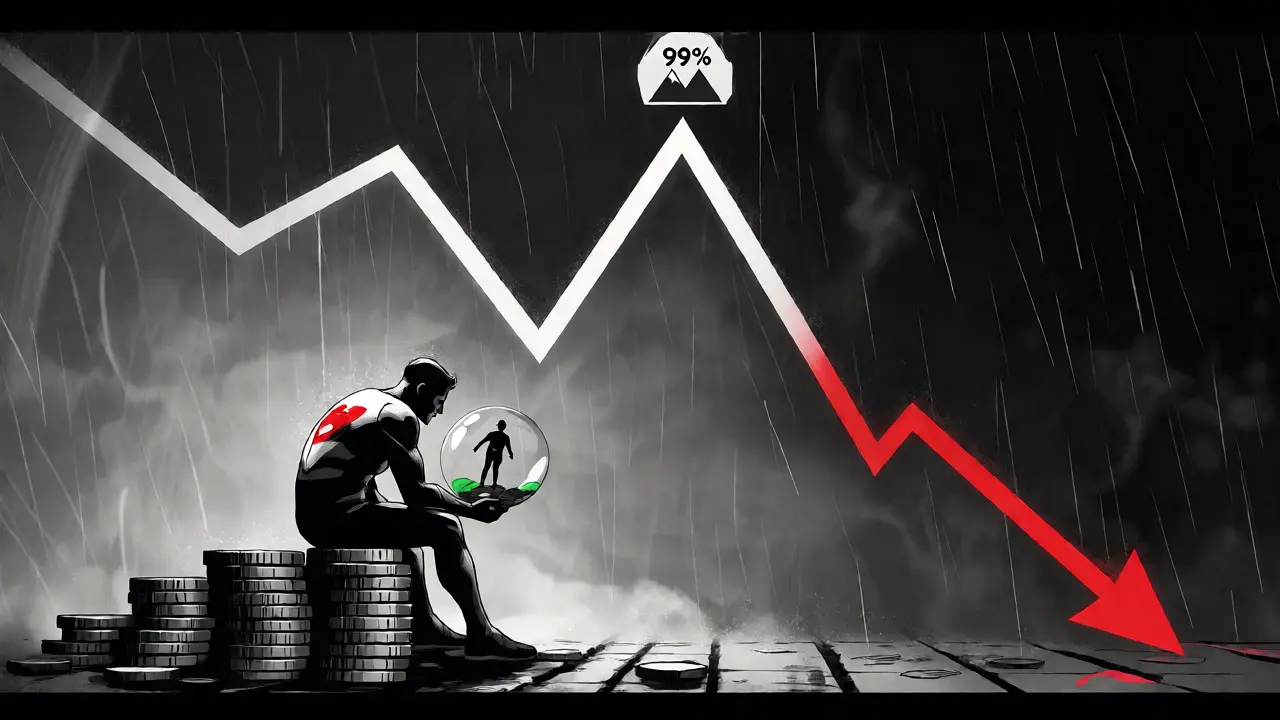
If you’re looking at the charts, the picture is sobering. PCNT hit an all-time high of approximately $2.17 shortly after its launch in March 2021. Today, it trades around $0.00157. That’s a drawdown of nearly 99.9%. Why did this happen?
Liquidity is the primary culprit. Unlike Bitcoin or Solana, you can’t buy PCNT on Coinbase. In fact, Coinbase explicitly lists it as "not tradable." Major regulated exchanges have largely ignored it. Instead, trading happens on smaller, regional venues like Bitbns and Gate.com. On some days, the 24-hour trading volume drops below $20,000. In extreme cases, volume has been recorded as $0 on specific tracking pages.
Low liquidity creates two dangerous scenarios for investors:
- High Slippage: Even a modest sell order can crash the price temporarily because there aren’t enough buyers on the other side.
- Exit Difficulty: Getting out of a position can be harder than getting in. You might find yourself holding tokens you can’t easily convert back to fiat currency without accepting a significant discount.
The market dominance of Playcent is effectively 0.0000039% of the entire crypto market. It’s a rounding error in the global landscape. This status means it lacks the safety net of broad market sentiment. When the general crypto market rises, micro-caps like PCNT don’t always lift evenly; they often lag or drop further due to lack of interest.
How to Buy and Use PCNT
So, if you’re intrigued by the "decentralized WIX" idea and want to test the waters, how do you actually get involved? Since Coinbase and Binance spot listings are inconsistent or absent, you’ll need to navigate the secondary markets carefully.
Step 1: Choose Your Exchange. As of late 2026, Bitbns is frequently cited as the primary active exchange for PCNT. Gate.com also supports it. Always verify the pair (e.g., PCNT/USDT) before transferring funds.
Step 2: Set Up a Compatible Wallet. Because PCNT exists on Ethereum and Polygon, you need a wallet that supports both networks. MetaMask is the standard choice here. Ensure you have some ETH or MATIC (POL) in your wallet to cover gas fees, even though Polygon fees are negligible.
Step 3: Deposit and Trade. Send stablecoins (like USDT) to your chosen exchange account. Execute a buy order for PCNT. Due to low volume, use limit orders rather than market orders to avoid paying excessive slippage.
Step 4: Interact with the Ecosystem. To truly understand the utility, move your tokens to a wallet and try using them within the Playcent platform. Can you stake them? Can you access premium features? If the platform feels empty or buggy, the token’s utility proposition weakens significantly.
Verdict: Is Playcent Worth Your Attention?
Playcent represents a fascinating case study in crypto longevity-or the lack thereof. The technology is sound, the multichain approach is smart, and the "remix culture" angle is culturally relevant. However, the market data paints a picture of a project that failed to capture sustained mass adoption.
For aggressive speculators willing to risk small amounts on lottery-ticket outcomes, PCNT might offer a high-beta play if the gaming sector revives dramatically. But for conservative investors seeking steady growth or reliable utility, the risks outweigh the potential. The combination of near-zero liquidity, massive drawdown from highs, and limited exchange support makes it a fragile asset. It requires active monitoring and a tolerance for volatility that most casual crypto users simply don’t possess.
Is Playcent (PCNT) available on Coinbase?
No, Playcent is not currently tradable on Coinbase. Users typically need to use smaller exchanges like Bitbns or Gate.com to purchase the token.
What is the maximum supply of PCNT?
The maximum supply of PCNT is capped at 60,000,000 tokens. No new tokens can be minted beyond this limit.
Which blockchains does Playcent operate on?
Playcent operates as a multichain protocol, with the PCNT token deployed on both the Ethereum and Polygon (Matic) networks.
Does holding PCNT give me governance rights?
Generally, no. The whitepaper describes PCNT as a utility token for payments and staking within the ecosystem, explicitly stating it carries no express or implied governance or profit-sharing rights.
Why has the PCNT price dropped so much?
The price decline is primarily due to low liquidity, reduced trading volumes, increased circulating supply from vesting unlocks, and a lack of major exchange listings compared to larger competitors.