
When you see a coin with "block" in the name and hear it’s tied to gambling or lotteries, your first instinct might be excitement. But if you are looking at Lucky Block v1, that excitement needs a heavy dose of caution. This isn't just another altcoin promising the moon; it is a legacy token from a platform that has largely moved on.
Lucky Block v1 (LBLOCK) is the original cryptocurrency token powering a decentralized lottery and gaming ecosystem, launched in 2021 on the Binance Smart Chain. It was designed to let users buy lottery tickets, play games, and earn rewards using blockchain technology instead of traditional banking rails. However, as we move through mid-2026, the reality of holding or trading this specific token looks very different from its early hype days.
The Core Concept: Blockchain Meets Lottery
To understand why Lucky Block exists, you have to look at the problem it tried to solve. Traditional lotteries are opaque. You hand over cash, hope for the best, and trust a centralized authority to pick the winners fairly. There is no proof, no transparency, and often high fees.
Lucky Block attempted to fix this by putting the lottery on the blockchain. The idea was simple: use smart contracts to automate the drawing process. Since blockchains are immutable and public, anyone could theoretically verify that the winner was chosen fairly. The LBLOCK token acted as the fuel for this system. You would hold LBLOCK, use it to enter draws, and potentially win more LBLOCK or other cryptocurrencies.
This model appealed to crypto natives who value privacy and speed. The platform supported instant withdrawals and anonymous deposits, which are big selling points for people tired of KYC (Know Your Customer) hurdles at traditional casinos. At its peak, the vision included NFT competitions and play-to-earn mechanics, trying to blend gaming culture with financial speculation.
V1 vs. V2: Why the Distinction Matters
If you are researching this project, you will quickly run into two versions: V1 and V2. Confusing them is the most expensive mistake you can make. They are not interchangeable.
Lucky Block V1 is the original token built on the Binance Smart Chain (BSC), also known as BNB Chain. It launched in 2021. BSC was chosen because it offered fast transactions and low fees compared to Ethereum at the time. For a lottery where people want quick results and cheap ticket prices, this made sense initially.
However, the project later introduced Lucky Block V2 is an upgraded version of the token deployed on the Ethereum network as an ERC-20 token. This shift wasn't just cosmetic. Moving to Ethereum signaled a desire for greater decentralization, security, and access to the broader DeFi (Decentralized Finance) ecosystem. V2 promised better liquidity and wider exchange listings.
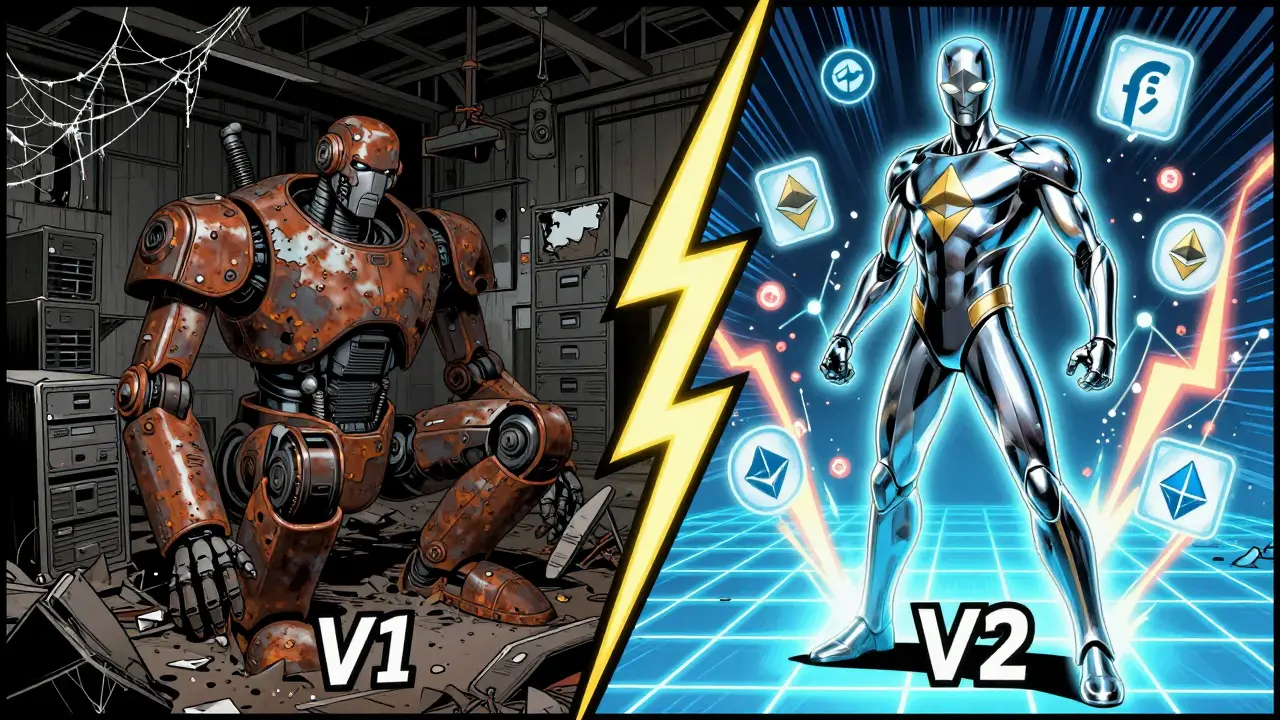
Here is the critical part: V1 is essentially the legacy asset. While it still exists and technically functions, the development focus, marketing energy, and user base have migrated toward V2. Holding V1 today is like owning a first-generation smartphone when the second generation is already obsolete. It might still turn on, but it doesn’t get the updates, and the resale value has cratered.
| Feature | Lucky Block V1 (LBLOCK) | Lucky Block V2 |
|---|---|---|
| Blockchain Network | Binance Smart Chain (BSC) | Ethereum (ERC-20) |
| Launch Year | 2021 | Post-2021 Upgrade |
| Primary Utility | Legacy lottery/gaming entries | Current ecosystem governance & payments |
| Liquidity Status | Extremely Low / Illiquid | Higher relative to V1 |
| Major Exchange Listings | None (Not on Binance/Crypto.com) | Limited (Check current listings) |
| Risk Profile | Very High (Abandoned/Legacy) | High (Speculative Gaming) |
Market Reality Check: Price and Volume
Let’s talk numbers, because they tell a stark story. As of May 2026, the market metrics for Lucky Block V1 are concerning for anyone looking for investment stability or growth.
The total supply sits at approximately 100 billion tokens. That is a massive number. When you combine a huge supply with low demand, the price per token becomes microscopic. Current data shows LBLOCK trading in the range of $0.0000001191 to $0.00000871 USD, depending on which fragmented exchange you look at. Some sources even report it effectively at zero.
Compare this to its all-time high of roughly $0.009617 USD. That represents a depreciation of over 99.99%. In crypto terms, this is a "rug pull" level of loss, even if the team didn't intentionally steal funds. It indicates that the market has completely lost confidence in the V1 token's value proposition.
Trading volume is equally telling. On any given day, the 24-hour volume ranges from $0 to about $9,710 USD. For context, major cryptocurrencies trade billions daily. A volume under $10k means there are almost no active traders. If you decide to buy a significant amount, you might not find enough sellers to fill your order without spiking the price. Conversely, if you try to sell, you could crash the price instantly because there is no liquidity buffer.
Furthermore, LBLOCK is not listed on major centralized exchanges like Binance or Crypto.com. Crypto.com explicitly states that LBLOCK is not tradable on their platform. This absence is a red flag. Major exchanges perform rigorous due diligence. If they don't list a token, it usually means the project lacks the community size, regulatory compliance, or technical robustness required for mainstream adoption.
Security and Transparency Claims
Proponents of Lucky Block argue that its blockchain foundation ensures fairness. Theoretically, this is true. Smart contracts execute code automatically, removing human bias from lottery draws. The distributed nature of the blockchain means transaction history is immutable-you can't go back and change who won.
However, "transparent code" does not mean "safe investment." The security of the platform depends on the quality of the smart contracts themselves. If there were bugs or vulnerabilities in the V1 contracts, users could lose funds regardless of the lottery outcome. More importantly, the lack of recent audits or public security reports for the V1 iteration raises questions. As development shifted to V2, did the V1 infrastructure stop receiving security patches? We don't know, but the silence suggests it.
Additionally, while anonymity is a feature for some, it is a liability for others. Regulatory bodies worldwide are cracking down on unlicensed online gambling and lottery operations. Because Lucky Block operates in a gray area-promising global access without clear licensing-it faces constant legal risk. This regulatory uncertainty likely contributes to the lack of major exchange support and the general investor apathy.
Who Is This Token For? (And Who Should Avoid It)
Given the current state of Lucky Block V1, it is crucial to define who might actually interact with this token versus who should steer clear.
You might consider interacting with LBLOCK only if:
- You are a long-term holder from 2021: You bought in early and are holding out for a potential revival or migration event. Be aware that such events are speculative and unlikely based on current trends.
- You are a crypto collector: You want to own a piece of early BSC gaming history for sentimental or portfolio diversity reasons, accepting that it may never gain value.
- You actively use the V1 platform: Despite the decline, if you personally enjoy the specific games available on the V1 interface and want to avoid converting to V2, you need the token to play. Treat this as spending money on entertainment, not investing.
You should absolutely avoid LBLOCK if:
- You are looking for profit: The chart is flatlining or declining. There is no catalyst visible in 2026 to drive price appreciation.
- You want easy access: Without major exchange listings, buying and selling requires navigating decentralized exchanges (DEXs) or peer-to-peer markets, which carry higher risks of scams and slippage.
- You are new to crypto: This token requires advanced knowledge of wallet management, gas fees on BSC, and understanding the difference between token versions. It is not beginner-friendly.
The Verdict on Lucky Block V1
Lucky Block V1 started with an ambitious goal: to democratize lotteries using blockchain transparency. Technically, it succeeded in creating a functional system on the Binance Smart Chain. However, commercially, it has failed to maintain relevance.
The migration to V2 on Ethereum was a necessary step for the brand's survival, but it left V1 behind as a stranded asset. With negligible trading volume, extreme price depreciation, and no major exchange support, LBLOCK serves as a cautionary tale in the crypto space. Just because a project launches on a popular chain like BSC doesn't guarantee longevity. Community engagement, continuous development, and regulatory clarity are what keep projects alive.
If you encounter offers to buy LBLOCK at discounted rates, proceed with extreme skepticism. Liquidity traps are common with illiquid tokens. Always verify the contract address, ensure you are not confusing V1 with V2, and remember that in the world of crypto gaming, the house often wins-and sometimes, the house closes down entirely.
Is Lucky Block V1 (LBLOCK) a scam?
It is difficult to label it a direct "scam" in the legal sense if the platform originally delivered its promised services. However, it exhibits many characteristics of failed projects: extreme value loss, lack of liquidity, and abandonment by major exchanges. Investors should treat it as a high-risk, likely worthless asset rather than a legitimate investment opportunity.
Can I convert Lucky Block V1 to V2?
There is no automatic 1:1 conversion mechanism widely advertised or supported by major platforms. Typically, when projects migrate chains, they provide a bridge or swap tool during a specific window. As of 2026, V1 and V2 operate as separate entities. You cannot simply swap V1 for V2 on an exchange; you would need to sell V1 (if possible) and buy V2 separately.
Why is the price of LBLOCK so low?
The price is low due to a combination of factors: a massive total supply (100 billion tokens), extremely low demand, and the fact that the project has moved its focus to V2 on Ethereum. With minimal trading volume and no major exchange listings, there is little buyer pressure to support the price.
Where can I buy Lucky Block V1?
You cannot buy LBLOCK on major centralized exchanges like Binance or Crypto.com. You would likely need to use a decentralized exchange (DEX) on the Binance Smart Chain, such as PancakeSwap, or find peer-to-peer sellers. Be aware that liquidity is very low, meaning you may face high slippage fees or inability to execute trades.
Is Lucky Block legal?
The legality of Lucky Block varies by jurisdiction. Online lottery and gambling regulations differ significantly across countries. While the blockchain technology itself is legal, operating or participating in unlicensed gambling platforms may violate local laws. Users should consult their local regulations before engaging with the platform.