

Stablecoins have long been a paradox in the cryptocurrency world. On one hand, they offer the stability of fiat currency like the US dollar, which traders desperately need to avoid volatility. On the other hand, traditional stablecoins rely heavily on centralized banks and opaque reserves, reintroducing the very trust issues that blockchain technology aims to solve. This tension has given rise to innovative alternatives, with Ethena being one of the most prominent examples. But what exactly is Ethena, and why does its native token, ENA, matter to your portfolio?
Ethena is not just another coin; it is a protocol built on the Ethereum blockchain designed to create a "synthetic dollar." Unlike Tether (USDT) or Circle’s USDC, which are backed by cash and government bonds held in traditional banks, Ethena uses a decentralized mechanism involving perpetual futures markets to maintain its peg. The result is USDe, a stablecoin that offers yield without relying on centralized custodians. In this guide, we will break down how Ethena works, the role of the ENA token, and whether this new model is safe for your money.
How the Synthetic Dollar Works
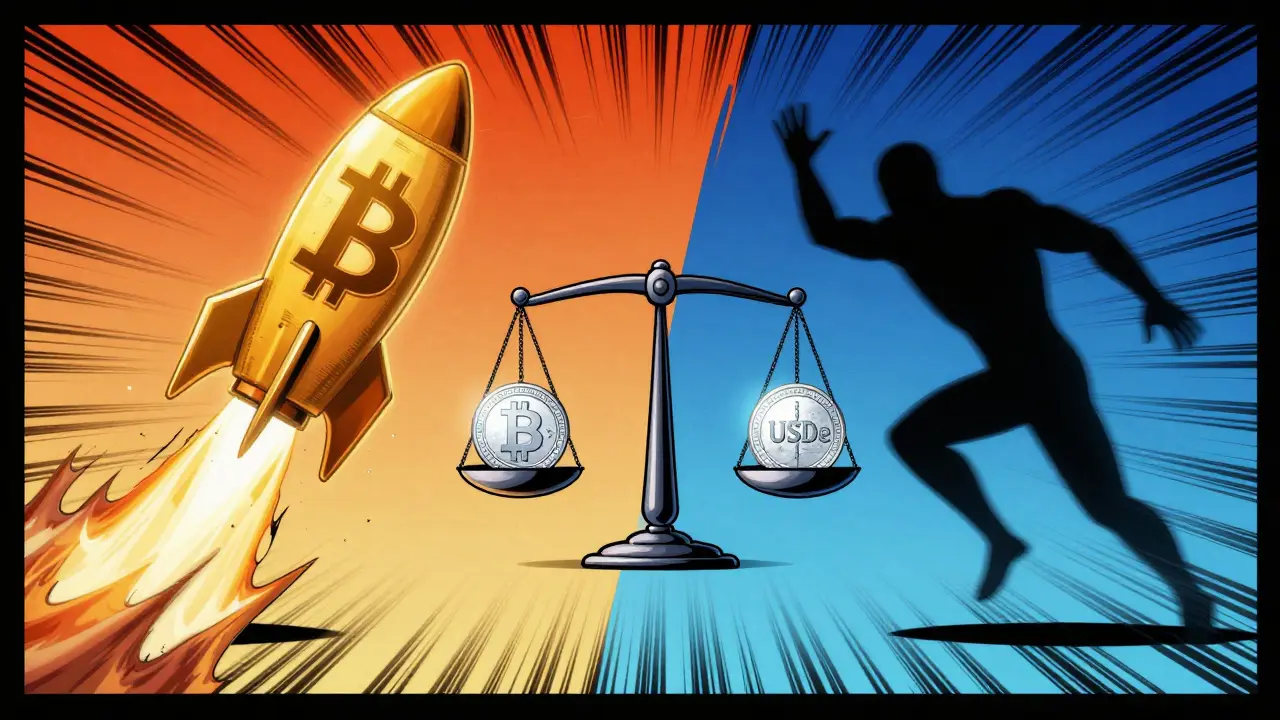
To understand Ethena, you first need to forget how traditional stablecoins operate. When you buy USDC, you trust that Circle actually holds the dollars in a bank account. With Ethena, there is no bank involved. Instead, the protocol uses a strategy called delta-neutral hedging. Here is the simple version: when you deposit cryptocurrency collateral (like Bitcoin or Ethereum) into the Ethena smart contract, the protocol simultaneously opens a short position on perpetual futures contracts for the same amount.
Imagine you deposit $100 worth of Bitcoin to mint $100 of USDe. Ethena then bets against Bitcoin’s price movement in the derivatives market. If Bitcoin goes up, your collateral gains value, but the short position loses money. If Bitcoin crashes, your collateral loses value, but the short position profits. These two movements cancel each other out, keeping the net value of your USDe at exactly $1. This is what "delta-neutral" means-your exposure to price direction is neutralized.
The real magic happens in the funding rates. In perpetual futures markets, traders who hold long positions often pay those holding short positions to keep their bets open, especially during bull markets. Ethena captures these payments as yield. This yield is then distributed to holders of sUSDe (the staked version of USDe). Essentially, you earn interest not from a bank lending your money, but from the structural imbalances of the crypto derivatives market.
The Three Pillars of the Ethena Ecosystem
The Ethena ecosystem is built around three distinct tokens, each serving a specific function. Understanding the difference between them is crucial for anyone looking to interact with the platform.
| Token | Function | Yield | Risk Profile |
|---|---|---|---|
| USDe | The synthetic dollar stablecoin | No direct yield | Low (pegged to USD) |
| sUSDe | Staked USDe | Yes (from funding rates) | Medium (smart contract risk) |
| ENA | Governance token | Variable (market driven) | High (volatile asset) |
USDe is the core product. It is the digital dollar you use for transactions or as a store of value within DeFi. You can mint it by providing collateral or swap it on exchanges. sUSDe is what you get when you stake your USDe. By locking up your USDe, you agree to let the protocol manage the hedging strategies more aggressively, and in return, you receive the yield generated from the funding rates. Finally, ENA is the governance token. It does not represent value in the same way USDe does; instead, it gives you voting rights over the future of the protocol.
The Role of the ENA Token
If USDe is the engine, ENA is the steering wheel. As the native governance token of the Ethena DAO (Decentralized Autonomous Organization), ENA holders have the power to shape the protocol's development. This is not just a theoretical benefit; governance decisions directly impact the security and profitability of the system.
What can ENA holders vote on? They decide which collateral assets are accepted (for example, should Solana be added?). They adjust risk parameters, such as the minimum collateralization ratio required to mint USDe. They also approve community grants and determine how revenue is distributed across the ecosystem. Because Ethena operates without a central company making unilateral decisions, this democratic process ensures the protocol remains adaptable to changing market conditions.
It is important to note that holding ENA does not guarantee you will earn yield from the protocol’s operations. Unlike some other DeFi projects where governance tokens capture fees, ENA’s value is primarily derived from its utility in governance and its speculative market performance. Its total supply is 15 billion tokens, distributed among team members, investors, the community, and treasury reserves.
Ethena vs. Traditional Stablecoins
Why would you choose Ethena over USDT or USDC? The answer lies in decentralization and transparency. Traditional stablecoins are centralized. If regulators freeze Circle’s bank accounts, USDC could become inaccessible. If Tether faces legal scrutiny, USDT’s peg might wobble. Ethena eliminates this counterparty risk by removing banks from the equation entirely.
However, this comes with trade-offs. Traditional stablecoins are simpler to understand and often cheaper to transact with due to established infrastructure. Ethena’s delta-neutral strategy is complex and relies on the liquidity of perpetual futures markets. If the derivatives market dries up, the yield disappears, and the hedging mechanism could face stress. Additionally, while Ethena is transparent on-chain, it still requires sophisticated smart contracts, which introduces different types of technical risks compared to holding cash in a regulated bank.
Another key difference is accessibility. Ethena has expanded beyond Ethereum to include Solana and Arbitrum, using LayerZero for cross-chain communication. This allows users on different blockchains to participate in the same unified liquidity pool, offering greater flexibility than many single-chain competitors.

Risks and Considerations
No financial product is without risk, and Ethena is no exception. While the delta-neutral model is innovative, it is not foolproof. One major concern is oracle risk. The protocol relies on price feeds to determine the value of collateral and execute hedges. If an oracle is manipulated or fails, the smart contracts could make incorrect trades, potentially leading to losses.
There is also the risk of extreme market volatility. During a flash crash, liquidation mechanisms might struggle to keep up, potentially causing slippage or impermanent loss for the protocol’s reserve. Furthermore, regulatory uncertainty looms over all crypto-native assets. Governments may view synthetic dollars as securities or unregistered banking instruments, which could lead to restrictions on access or operation.
Users should also be aware of the complexity barrier. Understanding funding rates, basis trading, and smart contract interactions requires a higher level of financial literacy than simply buying USDC on an exchange. For beginners, the learning curve can be steep, and mistakes in interacting with the protocol could result in permanent loss of funds.
Who Should Use Ethena?
Ethena is best suited for crypto-savvy individuals who want to park their capital in a stable asset while earning yield, without trusting centralized intermediaries. It appeals to DeFi enthusiasts who value censorship resistance and transparency. If you are already active in perpetual futures markets or understand how leverage works, Ethena’s mechanics will feel familiar.
For casual investors or those seeking a simple backup currency for everyday spending, traditional stablecoins like USDC or USDT may still be more practical due to their widespread acceptance and ease of use. However, as Ethena continues to expand its integrations and user base, it is becoming a viable option for a broader audience.
Is Ethena (ENA) a good investment?
Whether ENA is a good investment depends on your belief in the growth of decentralized finance and synthetic stablecoins. ENA is a volatile governance token, not a stable asset. Its value rises if the protocol grows and demand for USDe increases, but it can drop significantly if market sentiment shifts or if better competitors emerge. Always do your own research and never invest more than you can afford to lose.
Can I lose my money using Ethena?
Yes. While USDe is designed to stay pegged to $1, smart contract bugs, oracle failures, or extreme market conditions could lead to depegging or loss of funds. Additionally, the yield on sUSDe is variable and not guaranteed. If funding rates turn negative, you might even lose principal value over time.
How is Ethena different from TerraUSD (UST)?
TerraUSD was an algorithmic stablecoin that relied on arbitrage incentives to maintain its peg, which failed catastrophically in 2022. Ethena uses a delta-neutral hedging strategy backed by real cryptocurrency collateral and short positions in derivatives markets. It does not rely on reflexive loops or burning/minting mechanisms to stabilize its price, making it structurally different and generally considered safer by experts.
Where can I buy ENA tokens?
ENA is available on major centralized exchanges like Binance, Coinbase, and Kraken, as well as decentralized exchanges (DEXs) on Ethereum, Arbitrum, and Solana. You can also mint USDe directly through the Ethena interface if you hold eligible collateral assets like ETH or BTC.
Does Ethena require KYC (Know Your Customer)?
Interacting with the Ethena protocol directly via smart contracts does not require KYC, as it is permissionless. However, if you buy ENA or USDe through a centralized exchange like Binance or Coinbase, you will likely need to complete identity verification according to their regulations.