
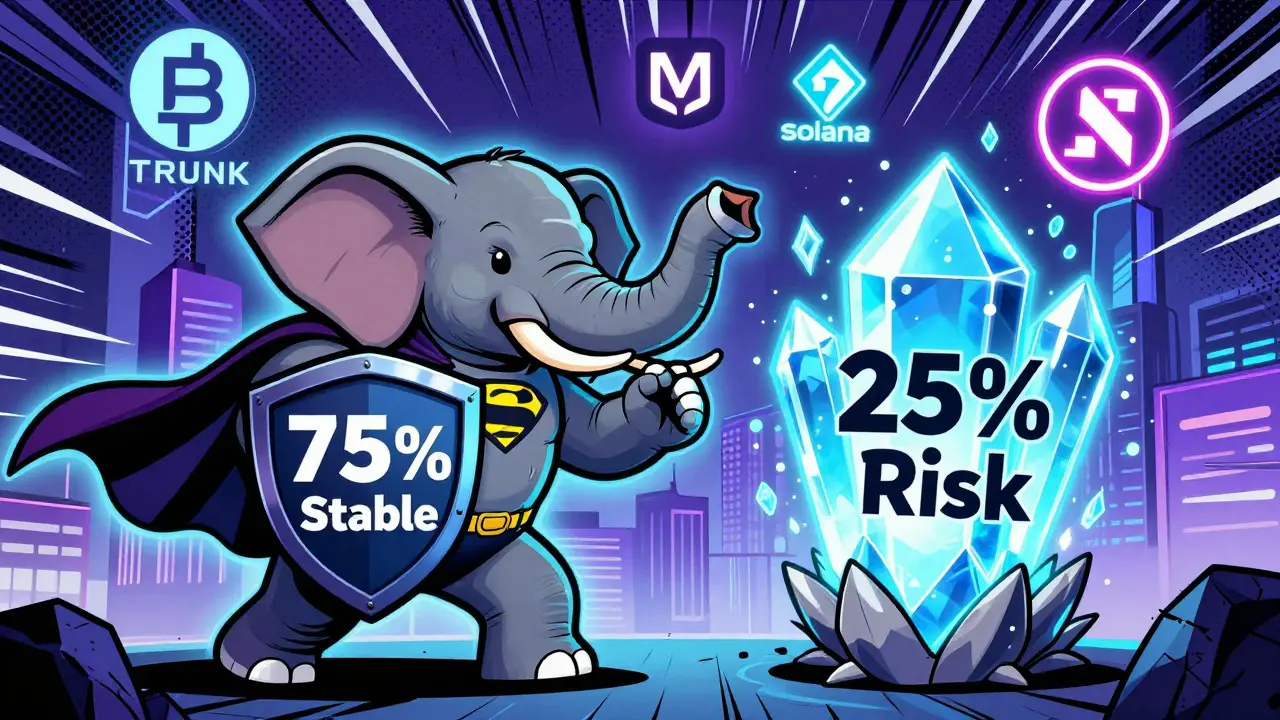
Ever heard of a stablecoin that is only 75% backed by cash? That is the core concept behind Elephant Money (TRUNK), a hybrid cryptocurrency token that functions as both a partially-collateralized stablecoin and a deflationary utility asset within the Elephant Money DeFi protocol. If you are looking for a rock-solid dollar peg like USDC or USDT, TRUNK is probably not it. But if you are curious about experimental DeFi mechanics, cross-chain utility on BNB Chain and Solana, or just want to understand why this token exists despite a massive security breach in 2022, you are in the right place.
As of June 2026, TRUNK trades at roughly $0.03, far from its intended $1.00 peg. It has a market cap of around $4 million and sits in the long tail of crypto assets. This article breaks down how TRUNK works, what happened during the infamous April 2022 hack, and whether it still has any use today.
The Quick Takeaways
- Hybrid Collateral: TRUNK was designed to be 75% backed by BUSD (stable) and 25% by ELEPHANT (volatile protocol token).
- Major Security Breach: In April 2022, attackers exploited oracle manipulation via flash loans, draining approximately $22.2 million from the protocol.
- Current Status: TRUNK remains active but niche, trading well below parity with the US dollar and serving primarily as collateral for derivative products like Trumpet (EMT).
- Cross-Chain Presence: Originally on BNB Chain, TRUNK has expanded to Solana, positioning itself as a deflationary utility token.
How Elephant Money (TRUNK) Actually Works
To understand TRUNK, you have to look past the "stablecoin" label. Most people expect a stablecoin to be 1:1 backed by fiat currency held in a bank account. TRUNK takes a different, riskier approach called partial collateralization.
Here is the mechanic: When users wanted to mint TRUNK, they deposited BUSD into a reserve contract. The protocol kept 75% of that value in BUSD. For the remaining 25%, the system automatically swapped some of the BUSD into Wrapped BNB (WBNB) and then used that to buy the protocol’s native governance token, ELEPHANT.
The theory was clever on paper. As the Elephant Money ecosystem grew, the price of ELEPHANT would rise. This appreciation would effectively increase the value of that 25% collateral slice, pushing the overall collateralization ratio closer to 100%. In return, users got TRUNK tokens pegged to $1.00, which they could use in other DeFi protocols or hold for yield.
This design created a tight loop between the stability of TRUNK and the performance of ELEPHANT. If ELEPHANT went up, TRUNK looked safer. If ELEPHANT crashed, the backing for TRUNK evaporated rapidly. This dependency became the protocol's biggest weakness.
The April 2022 Flash Loan Exploit
You cannot talk about Elephant Money without addressing the disaster of April 2022. On April 12, 2022, hackers executed a sophisticated attack that drained millions from the protocol. This event is now a textbook case study in flash loan attacks and oracle manipulation.
Here is what happened, step-by-step:
- The Setup: Attackers borrowed a massive amount of funds using a flash loan (a loan that must be repaid in the same transaction block).
- Price Manipulation: They used these funds to aggressively buy ELEPHANT tokens on decentralized exchanges. Because the liquidity pools were relatively small, this artificial buying pressure spiked the price of ELEPHANT dramatically.
- Minting Inflated TRUNK: The Elephant Money protocol relied on an on-chain price oracle to determine the value of the collateral. Seeing the artificially high price of ELEPHANT, the smart contract calculated that the attacker’s deposit was worth much more than it actually was. The attacker then minted a huge amount of TRUNK tokens against this inflated value.
- The Drain: Once they had the TRUNK, they redeemed it back into BUSD and WBNB through the protocol’s reserve. Since TRUNK was supposed to be worth $1, they walked away with real, liquid assets.
- The Crash: After the transaction closed, the flash loan was repaid, and the artificial demand for ELEPHANT vanished. The price of ELEPHANT plummeted by roughly 75% almost instantly.
The total loss was estimated at $22.2 million when including the value of the stolen ELEPHANT tokens. The audit firm responsible, Solidity Finance, failed to catch this specific oracle vulnerability. The incident highlighted a critical flaw in relying on single-source price feeds for complex collateral calculations.

TRUNK Today: Price, Supply, and Utility
Fast forward to June 2026. Elephant Money survived, but it never recovered its former glory. The token is no longer seen as a reliable store of value pegged to the dollar. Instead, it has pivoted toward being a deflationary utility token and a meme coin with cross-chain capabilities.
| Metric | Value |
|---|---|
| Current Price | $0.0335 USD |
| Market Cap | $4.08 Million |
| 24h Volume | $22,791 USD |
| Circulating Supply | 120,000,000 TRUNK |
| Primary Chains | BNB Chain, Solana |
The price hovering around 3 cents shows that the market does not trust the $1 peg anymore. Liquidity is modest, with daily volumes in the tens of thousands. However, the token is still active. You can find it on major aggregators like CoinGecko and CoinMarketCap, and trade it on decentralized exchanges like PancakeSwap.
Ecosystem Products: Trumpet (EMT)
If you hold TRUNK, what do you actually do with it? The Elephant Money team developed a product called Trumpet (EMT). EMT is described as a store-of-value asset that is fully backed by TRUNK.
Here is how EMT works:
- Linear Growth: EMT is designed to grow in value linearly over time.
- Fees: There is a 5% fee applied when you mint or redeem EMT.
- No Transfer Fees: Moving EMT around costs nothing in terms of protocol fees.
- Backing: Every EMT token is backed 1:1 by TRUNK deposited in a vault contract.
This creates a layered financial instrument. You take the volatile TRUNK, lock it up, and get EMT, which theoretically appreciates. It’s a way for the protocol to keep users engaged with TRUNK even though the token itself isn’t holding a dollar peg. It turns TRUNK from a spending money substitute into a base collateral for yield-bearing derivatives.
Is Elephant Money Safe?
Let’s be direct: Elephant Money carries significant risk. It is not insured, it is not regulated, and it has a history of catastrophic failure.
Compared to giants like USDC or USDT, TRUNK is tiny. Even compared to newer entrants on BNB Chain like USD1, which added billions in reserves recently, TRUNK’s $4 million market cap is negligible.
The primary risks include:
- Smart Contract Risk: While patches were applied after 2022, DeFi code is complex. New vulnerabilities can always emerge.
- Collateral Volatility: The 25% exposure to ELEPHANT means that if the protocol token crashes again, the backing for TRUNK weakens immediately.
- Liquidity Risk: With low daily volume, large trades can slip significantly, meaning you might not get the price you see on screen when selling.
Security analysts generally advise extreme caution with partially collateralized stablecoins. The model requires constant growth to remain solvent. If growth stalls, the math breaks. Elephant Money proved this point in 2022.
Who Should Use TRUNK?
TRUNK is not for everyone. Here is who it might make sense for, and who should stay away.
It might fit you if:
- You are a DeFi degenerate looking for high-risk, high-reward opportunities.
- You believe in the long-term vision of the Elephant Money ecosystem and want to support the project.
- You understand how to manage wallet security on BNB Chain and Solana using tools like MetaMask or Trust Wallet.
Stay away if:
- You need a stablecoin to preserve capital or pay bills.
- You are uncomfortable with the possibility of losing your entire investment due to smart contract bugs or market crashes.
- You prefer audited, transparent, and heavily regulated financial products.
Final Thoughts
Elephant Money (TRUNK) is a fascinating case study in DeFi innovation and fragility. It tried to solve the efficiency problem of stablecoins by using algorithmic leverage and partial collateralization. It failed spectacularly in 2022, teaching the industry a hard lesson about oracle security. Today, it lives on as a niche utility token, stripped of its stablecoin pretensions but still offering speculative utility within its own ecosystem. Treat it with respect, do your own research, and never invest more than you can afford to lose.
What happened to Elephant Money in 2022?
In April 2022, Elephant Money suffered a major security breach where hackers used flash loans to manipulate the price of the ELEPHANT token. This allowed them to mint excessive amounts of TRUNK stablecoins and drain approximately $22.2 million from the protocol's reserves. The attack exposed flaws in the protocol's price oracle and minting logic.
Is TRUNK still pegged to the US Dollar?
No. As of 2026, TRUNK is no longer reliably pegged to $1.00. It trades at approximately $0.03. While it was originally designed as a stablecoin, the market now treats it as a volatile utility token and meme coin due to the collapse of its collateral backing during the 2022 exploit.
How is TRUNK collateralized?
Originally, TRUNK was partially collateralized with 75% BUSD (a stablecoin) and 25% ELEPHANT (the protocol's native token). This hybrid model meant that the stability of TRUNK depended heavily on the price performance of ELEPHANT. If ELEPHANT dropped in value, the collateralization ratio fell, risking the peg.
Can I buy TRUNK on Coinbase or Binance?
TRUNK is not listed on major centralized exchanges like Coinbase or Binance. It is primarily traded on decentralized exchanges (DEXs) such as PancakeSwap on the BNB Chain. To buy it, you need a Web3 wallet like MetaMask or Trust Wallet connected to the appropriate blockchain network.
What is the difference between TRUNK and EMT?
TRUNK is the base utility token of the Elephant Money protocol. EMT (Trumpet) is a derivative asset backed by TRUNK. EMT is designed to grow in value linearly over time, whereas TRUNK is subject to market volatility. Minting or redeeming EMT incurs a 5% fee.