
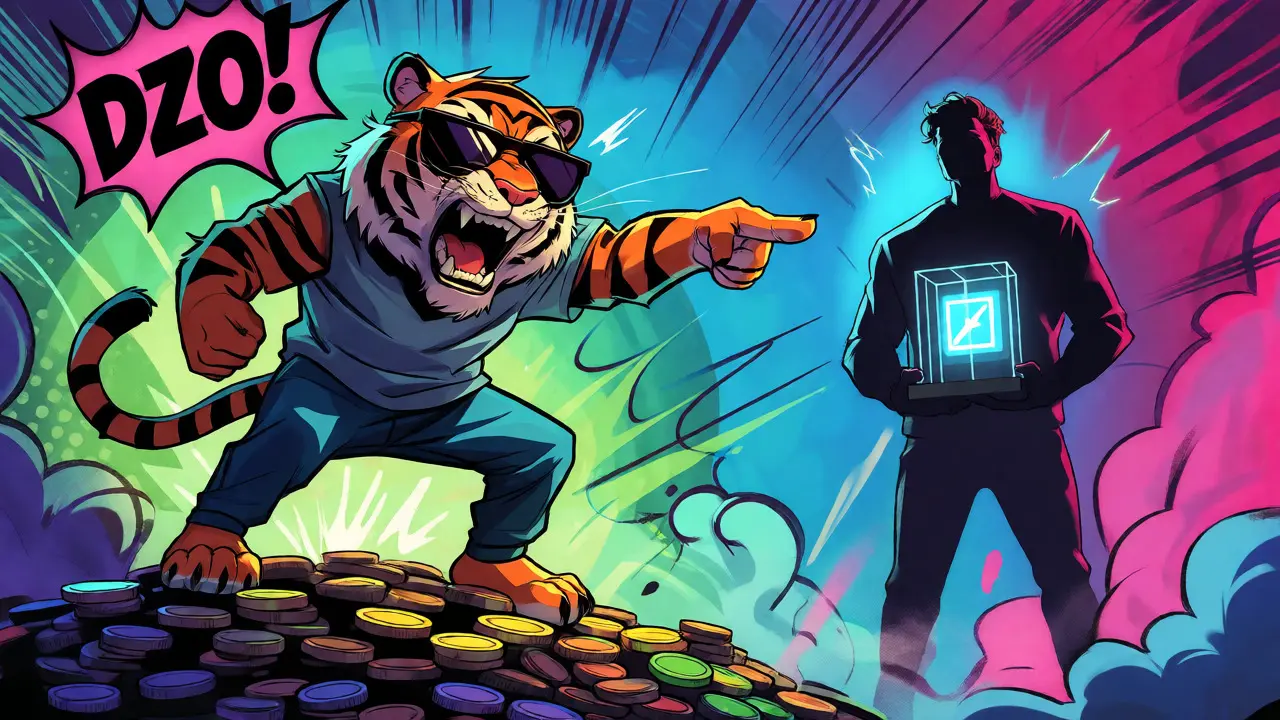
You’ve probably heard of Degen Zoo (DZOO) if you spent any time in the meme coin trenches around early 2023. It wasn’t just another dog-themed joke or a cat with sunglasses. This was a direct slap in the face to Logan Paul’s Crypto Zoo. The creators called that project "total fraud," and they built DZOO to prove a point: real money can actually help endangered animals, not just line celebrity pockets.
But here’s the thing about protest tokens-they burn bright and fast. If you’re looking at DZOO today, wondering if it’s still alive or worth your gas fees, you need to look past the hype. As of late 2025, this ERC-20 token on the Ethereum blockchain exists, but barely. It’s a ghost of its former self, trading with volumes so low they might as well be zero. Let’s break down what Degen Zoo actually is, why it launched, and whether it has any future beyond being a cautionary tale.
The Origin Story: Spite as a Business Model
Degen Zoo didn’t start because someone had a brilliant tech breakthrough. It started because people were angry. In late 2022 and early 2023, Logan Paul launched his own NFT collection, Crypto Zoo, promising huge returns and community engagement. Many investors felt burned by the execution-or lack thereof. Enter the Degen Zoo team, who claimed they built their entire ecosystem in just 30 days. Their mission? To simulate real-world financial incentives that contribute to animal deaths while donating 100% of profits to endangered animal charities.
This wasn’t just marketing fluff. The project launched an Initial Coin Offering (ICO) from March 7-10, 2023. They raised $1.65 million at a price of $0.006 per token. That sounds impressive until you realize how quickly that momentum evaporated. Official trading kicked off on March 15, 2023. For a few weeks, it was the darling of Twitter/X, with the official account tweeting about charitable impact. But unlike established charity coins like Pinkcoin, which have years of operational history, DZOO was born out of a momentary cultural flashpoint. Once the anger faded, so did the buyers.
Technical Specs and Supply Confusion
If you try to dig into the hard data for DZOO, you’ll hit a wall of conflicting information. This is a red flag in itself. Reliable projects publish clear, immutable supply schedules. Degen Zoo seems to have different numbers depending on where you look.
KuCoin, one of the major exchanges that listed the token, reports a maximum supply of 1 billion DZOO tokens. They state that as of May 2025, roughly 334 million are in circulation. However, other trackers like Cryptorank list a total supply of only 800 million. CoinLore agrees with the 1 billion max supply figure but shows slightly different circulating metrics. Why does this matter? Because in crypto, supply dictates scarcity, and scarcity drives price. When your core economic model isn’t consistent across major data aggregators, trust takes a hit.
| Metric | KuCoin Data | Cryptorank Data | CoinLore Data |
|---|---|---|---|
| Max Supply | 1 Billion | 800 Million | 1 Billion |
| Circulating Supply | ~334 Million | ~270 Million | Data varies |
| Market Cap | $329,960 | N/A | $9 Million* |
| 24h Volume | Low/Zero | Low/Zero | $0 |
The market capitalization is perhaps the most confusing part. CoinLore lists it at $9 million, which would put it in a respectable position among small-cap altcoins. But KuCoin shows a market cap under $330,000. Stoic AI puts it even lower. How do you get such wildly different numbers? Usually, it’s because some platforms calculate market cap using the full max supply (including locked or unvested tokens), while others use only the liquid circulating supply. Regardless of which number is "correct," the trading volume tells the true story: nobody is buying or selling this token in significant amounts.

The Charity Angle: Does It Actually Work?
The heart of Degen Zoo’s pitch was philanthropy. They promised that 100% of profits would go to animal welfare causes. On paper, this is noble. Who doesn’t want to buy a meme coin and save a panda? But in practice, verifying these donations is tough. Unlike traditional charities with audited financial statements, many crypto projects operate with limited transparency unless they provide regular, verifiable proof of transfers.
There’s no active, public dashboard showing exactly how much DZOO has donated since launch. You won’t find press releases from major animal rights organizations thanking Degen Zoo for recent contributions. Compare this to World Food Chain or other established charity blockchains, which often partner with NGOs and publish quarterly impact reports. Without that external validation, the "charity" aspect remains a claim rather than a proven track record. And when your trading volume is effectively zero, there are no profits to donate anyway.
Market Performance and Liquidity Crisis
Let’s talk numbers, because they don’t lie. Since its ICO price of $0.006, DZOO has struggled to maintain value. Depending on the source, the all-time high (ATH) ranges from $0.028 to $0.086. Even at the higher end, the current price (hovering around $0.0016-$0.0017) represents a drop of over 98%. Yes, you read that right. A 98% drawdown from peak means that if you bought at the top, you lost almost everything.
The bigger issue isn’t just the price drop; it’s the liquidity. CoinGecko reports a 24-hour trading volume of $1.16. Stoic AI says $2. CoinMarketCap sometimes shows $0. Think about that. You could buy the entire daily trading volume of this token with the change in your pocket. This creates a dangerous situation for holders. If you hold 10,000 DZOO tokens, trying to sell them might crash the price further because there aren’t enough buyers on the other side of the trade. This is known as slippage, and in illiquid markets, it’s brutal.
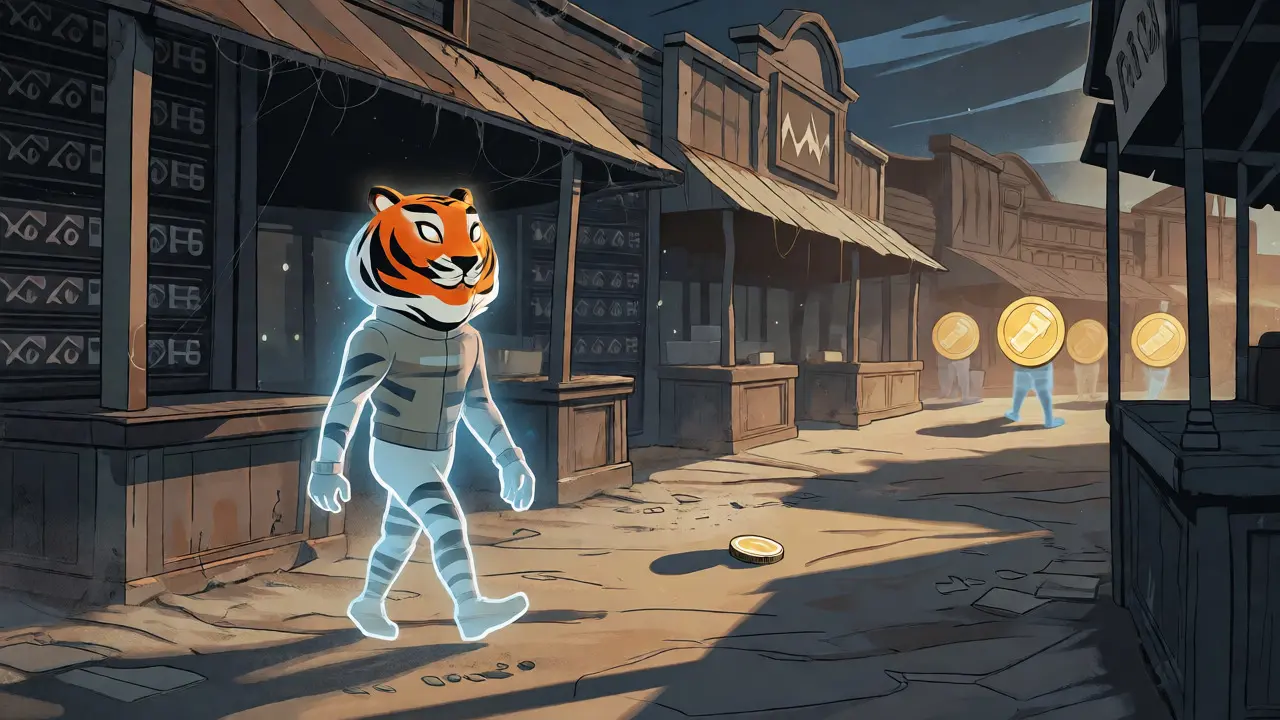
Why is the volume so dead? Partly because the narrative died. Meme coins live and die by attention. When the Logan Paul drama cooled off, traders moved on to newer, shinier objects. There’s been no major development news, no new partnerships, and no roadmap updates documented on GitHub or social media channels since the initial launch frenzy. The project appears to be in a state of dormancy.
How to Buy and Store DZOO Today
So, if you’re stubborn enough to want to buy DZOO now, how do you do it? First, check your exchange. It’s not on Coinbase or Binance. You’ll likely need to look at smaller decentralized exchanges (DEXs) or niche centralized exchanges that still support it. Given the low volume, you might struggle to find a pair with decent depth.
Since DZOO is an ERC-20 token, you can store it in any Ethereum-compatible wallet. This includes MetaMask, Trust Wallet, or hardware wallets like Ledger or Trezor. Just make sure you’re on the correct network (Ethereum Mainnet). Don’t forget about gas fees. While Ethereum gas prices fluctuate, sending a tiny amount of DZOO might cost more in ETH for gas than the value of the tokens themselves. Always calculate the transaction cost before moving funds.
- Step 1: Acquire ETH to pay for gas and swap.
- Step 2: Connect your wallet to a DEX aggregator (like 1inch or Uniswap) or a supported CEX.
- Step 3: Search for the DZOO contract address carefully to avoid scams.
- Step 4: Execute the swap, checking the slippage tolerance due to low liquidity.
- Step 5: Withdraw to a self-custody wallet for better security.
The Verdict: Investment or Artifact?
Is Degen Zoo a good investment? Probably not. It lacks the fundamentals of a sustainable business: consistent revenue, active development, and growing user base. It’s more of a historical artifact-a reminder of a specific moment in crypto culture when anger toward influencers fueled speculative bubbles.
However, the idea behind it remains valid. Using blockchain for transparent charitable giving is a powerful concept. Projects that combine gamification with genuine social impact have long-term potential. DZOO failed to execute that vision consistently. If you’re looking for exposure to charity crypto, look at projects with verified audits, active communities, and measurable impact. DZOO is currently a zombie token-technically alive, but walking without purpose.
For traders, the risk/reward ratio is poor. The upside is capped by low interest, while the downside is infinite (it can go to zero). For collectors of crypto oddities, owning a piece of the "Logan Paul backlash" era might have sentimental value. But for anyone seeking financial return, there are far better options in the market.
What is the main difference between Degen Zoo and Logan Paul's Crypto Zoo?
The primary difference is intent and execution. Logan Paul's Crypto Zoo was a celebrity-led NFT project criticized for lacking substance and utility. Degen Zoo ($DZOO) was created specifically as a protest against that project, branding it as "fraud." DZOO positioned itself as a charity-focused game where 100% of profits were pledged to endangered animal causes, aiming to provide tangible social value versus perceived celebrity cash grabs.
Is Degen Zoo (DZOO) a scam?
It is not necessarily a "scam" in the sense of a rug pull where developers stole funds immediately. However, it exhibits signs of abandonment. With near-zero trading volume, no recent development updates, and conflicting supply data, it is considered a "dead" or highly risky asset. Investors should treat it with extreme caution due to lack of liquidity and transparency regarding actual charitable donations.
Where can I buy DZOO tokens?
DZOO is primarily traded on decentralized exchanges (DEXs) like Uniswap or via aggregators like 1inch. Some smaller centralized exchanges may also list it, but availability is spotty. Due to extremely low liquidity, you must check the order book depth before placing orders to ensure you can exit the position without significant slippage.
Does Degen Zoo actually donate to charities?
The project promised 100% profit donation to animal charities. However, there is limited public evidence or third-party verification of ongoing donations post-launch. Unlike established charity cryptos with audited reports, DZOO's impact is difficult to verify independently, especially given the minimal trading activity generating those profits.
What is the current price and market cap of DZOO?
As of late 2025, DZOO trades between $0.0016 and $0.0017. Market cap estimates vary widely due to supply discrepancies, ranging from approximately $330,000 to $9 million depending on the data provider. Trading volume is negligible, often reported as less than $5 per day.
Claudio Gatlin
September 14, 2026 AT 10:14It is painfully obvious that the average retail investor lacks the intellectual capacity to distinguish between a genuine charitable initiative and a marketing stunt. The fact that people still ask about DZOO implies a fundamental misunderstanding of market mechanics, where liquidity is not just a metric but the very oxygen of a token's survival. When you have conflicting supply data across major aggregators, it signals institutional neglect rather than oversight. This isn't a hidden gem; it is a corpse that hasn't been buried yet because nobody cares enough to shovel dirt on it.