
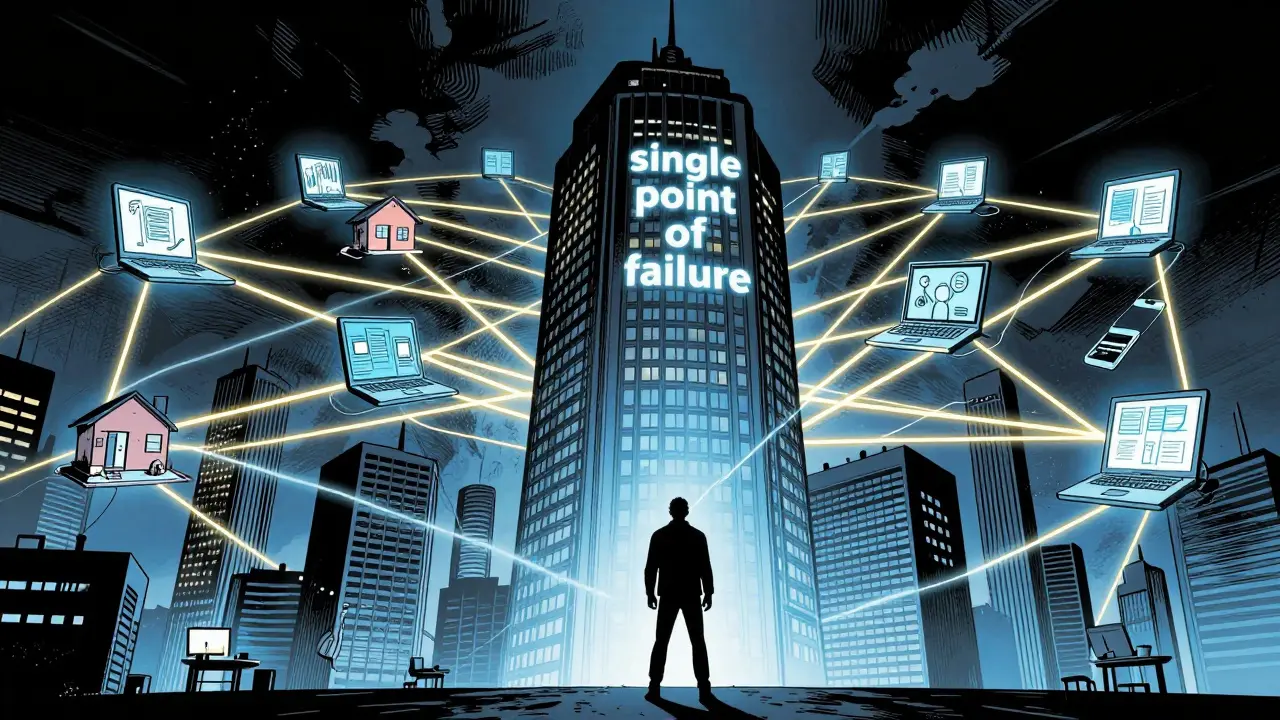
Imagine waking up to find your business files gone because a single cloud provider had a massive server failure or decided to ban your account. It happens more often than we think. For years, we've handed the keys to our digital lives to a few giant companies, trusting them to keep our data safe. But there's a different way. Decentralized Storage is a system that stores files by distributing encrypted data fragments across a global network of independent computers rather than one central server. By removing the middleman, it turns the internet's storage from a few giant warehouses into a massive, shared community effort.
The Core Problem with Centralized Clouds
Most of us use services like Google Drive or Dropbox. These are centralized systems. Your data sits in a physical data center owned by one company. This creates a "single point of failure." If that data center goes offline, or if the company faces a legal subpoena, your data is at risk. You don't actually own the infrastructure; you're just renting space and trusting the landlord.
Decentralized storage flips this script. Instead of one giant server, it uses a Peer-to-Peer (P2P) Network a distributed architecture where participants interact directly without needing a central coordinator . In this setup, no single entity has the power to shut down the network or peek into your files without your permission. It's the difference between keeping all your money in one bank vault versus spreading it across a thousand secure safes worldwide.
How It Actually Works: Sharding and Encryption
You might wonder: "If my file is on someone else's computer, can't they just open it?" The answer is no, thanks to a process called sharding. When you upload a file to a decentralized network, it doesn't stay as one piece. The system breaks the file into tiny, encrypted fragments called shards. These shards are then scattered across different Nodes individual computers or servers that participate in a decentralized network by storing data and validating transactions around the world.
The encryption happens on your end before the file even leaves your device. This means the people hosting the shards only see gibberish. They have no idea if they are storing a family photo, a legal contract, or a secret recipe. To get your file back, you use your private decryption key to pull the shards back together and reassemble the original document. Unless someone has that key, the data is useless to them.
The Role of Blockchain in Data Integrity
If there's no central manager, how does the network know where your shards are? This is where Blockchain a distributed ledger technology that records transactions across many computers in a way that ensures the record cannot be altered retroactively comes in. The blockchain acts as a giant, immutable map. It records exactly which nodes are holding which pieces of your data.
Blockchain also solves the problem of tampering. Every file is given a cryptographic hash-essentially a unique digital fingerprint. If a node operator tries to change even one byte of your data, the hash changes instantly. The network sees the mismatch and knows the data has been corrupted, allowing it to simply pull a clean copy from a redundant node instead.
| Feature | Centralized (e.g., AWS, Google) | Decentralized (e.g., Filecoin, Sia) |
|---|---|---|
| Control | Company-owned | User-owned |
| Failure Point | Single point of failure | Distributed (no single failure point) |
| Privacy | Provider can access data | End-to-end encrypted by user |
| Censorship | Easy for provider to block | Highly resistant to censorship |
| Cost | Subscription-based | Market-driven (often cheaper) |
Major Players and Platforms
Several projects have turned this theory into reality. One of the most influential is IPFS the InterPlanetary File System, a protocol designed to make the web more permanent and decentralized . While IPFS handles the "how" of finding and moving data, Filecoin a decentralized storage network that adds an incentive layer to IPFS, allowing users to pay for storage with tokens adds the economic layer. Filecoin creates a marketplace where people with extra hard drive space can rent it out to those who need it, earning FIL tokens in return.
Then there is Sia a decentralized cloud storage platform that connects renters with hosts worldwide through a peer-to-peer marketplace . Sia focuses heavily on privacy and is often used by developers who want to build apps that can't be shut down by a single corporation. In 2020, Sia launched Skynet, which pushed the technology further into content delivery and file sharing.

Why This Matters in the Real World
This isn't just for tech enthusiasts; it has practical, high-stakes uses. Imagine a law firm archiving legal contracts. By using a blockchain-backed storage system, they can prove that a document hasn't been altered since 2026 because the hash would change. Or consider filmmakers dealing with massive 8K raw footage files. Instead of paying thousands to a single cloud provider, they can spread that data across a global network, ensuring that even if a few nodes go offline, the footage is always recoverable.
For the average person, it's a way to build passive income. If you have a high-capacity hard drive and a stable internet connection, you can lease your unused space to the network. You're essentially becoming a micro-data center, getting paid in cryptocurrency for providing a utility to others.
Potential Pitfalls and Considerations
It's not all sunshine and rainbows, though. Decentralized storage comes with a learning curve. You are your own IT department. If you lose your private decryption keys, there is no "Forgot Password" button. Your data is encrypted so well that without those keys, the files are gone forever. This is the price of true data sovereignty.
Speed can also be a variable. While pulling data from multiple nodes can sometimes be faster (like a CDN), it can also be slower than a dedicated high-speed server if the nodes hosting your shards are in regions with poor connectivity. However, as the network of nodes grows, this efficiency generally improves.
Is decentralized storage more secure than Google Drive?
In terms of data breaches and censorship, yes. Because your data is encrypted and split across many different computers, there is no single database for a hacker to steal. However, the security depends on you keeping your private keys safe; if you lose them, you lose your data.
How do I make money with decentralized storage?
You can act as a storage provider (a node). By installing software from platforms like Filecoin or Sia and allocating a portion of your hard drive space to the network, you earn native tokens as payment from users who rent that space.
What happens if the person hosting my data turns off their computer?
The system uses data redundancy. Your files aren't just in one place; they are mirrored across multiple nodes. If one node goes offline, the network simply retrieves the missing piece from another node that has a copy, ensuring your file remains available.
Is it expensive to use decentralized storage?
It often ends up being cheaper because it removes the profit margins of giant corporations. You are paying the storage providers directly via a market-based pricing system, which tends to drive costs down as more people offer their spare space.
Can the government censor files on a decentralized network?
It's significantly harder. In a centralized system, a government can order one company to delete a file. In a decentralized system, the data is spread across thousands of different jurisdictions and owners. There is no single point of control to target.
Artavius Edmond
April 12, 2026 AT 06:11This sounds like a great way to get everyone involved and actually own our own stuff for once. Love the idea of a community effort over big corporate greed.
Jason Davis
April 12, 2026 AT 21:21The sharding process is realy the key here. Most peeple dont realize how much the encryption prevents the host from seeing anything at all, its basicly a black box for them.
Terrance Hausmann
April 14, 2026 AT 04:05Actually, the long-term viability of these networks depends heavily on the incentive structures, because if the token value crashes, the nodes might just turn off their servers to save on electricity costs, which means the redundancy we rely on for data safety could suddenly vanish if there aren't enough people motivated to keep the hardware running throughout the various cycles of the crypto market. It is a bit risky.
Will Dixon
April 15, 2026 AT 15:04lost my keys once and it sucked. dont ever do that lol
Carroll Foster
April 15, 2026 AT 19:28Oh sure, because nothing says "security" like trusting a Byzantine Fault Tolerant consensus mechanism and hoping your shards don't disappear into a digital void because of some obscure protocol glitch. Pure genius!
ssjuul z
April 17, 2026 AT 12:42We need more of this energy in the tech space! Getting rid of the middlemen is the only way forward. Let's go! 🚀
Rima Dinar
April 19, 2026 AT 10:59I think it is truly inspiring how these systems can empower individuals in developing regions who might not have access to stable centralized infrastructure but do have the means to contribute small amounts of storage to a larger global network, thereby creating a digital economy that is truly inclusive and doesn't depend on the whims of a few Silicon Valley executives who don't understand the local needs of people across the globe.
Hope Johnson
April 20, 2026 AT 18:52The shift from renting space to owning the infrastructure represents a fundamental philosophical change in how we perceive digital existence, moving us from a state of digital serfdom where we toil on land owned by corporations to a state of digital sovereignty where the data is an extension of the self and not a product to be harvested by an algorithm for profit. It is about reclaiming the essence of the early internet where connectivity was about community and freedom rather than surveillance and monetization.
logan bates
April 22, 2026 AT 12:15As long as it keeps the data out of foreign hands, I'm for it.
Tracie and Matthew Hartley
April 23, 2026 AT 19:28lol ppl act like google isnt already leakin everything anyway... who cares if some random guy in india has a piece of my encrypted cat photo
Akshay Gorad
April 24, 2026 AT 00:01The comparison table is quite useful for a quick overview of the benefits.
Lauren Abrams
April 25, 2026 AT 14:47I wonder if the latency issues are actually noticeable for small files or if it only really hits when you're doing something like the 8K footage example.
Samson Selleck
April 27, 2026 AT 06:43The naive assumption that sharding inherently solves the latency problem is laughable; one must consider the overhead of the DHT lookups and the propagation delay inherent in a geographically dispersed peer-to-peer topology. It is fundamentally inefficient compared to a centralized CDN with edge caching.
Rebecca Violette
April 28, 2026 AT 10:45omg imagine losing ur whole life cause u lost a password... i would actually die
Emily H
April 29, 2026 AT 07:10The implementation of cryptographic hashes ensures a level of data integrity that is simply superior to traditional backup methods.
Swati Sharma
April 29, 2026 AT 11:41Using IPFS as the content-addressing layer while Filecoin handles the storage orchestration is a brilliant architectural choice for ensuring persistence.
Jonathan Chamma
April 30, 2026 AT 11:47It is like a giant digital potluck where everyone brings a little bit of space to the table. Really cool way to think about the web!
Mikayla Murphy
May 1, 2026 AT 03:53It is interesting to see how this technology could protect journalists in countries where the government controls the internet.
Stanly Hayes
May 2, 2026 AT 10:24Stop worrying about the speed and start worrying about who owns your brain! Get on a decentralized network now or stay a corporate slave!
Lane Montgomery
May 3, 2026 AT 00:44How much can I make per TB?
jennelle williams
May 3, 2026 AT 19:10just take a breath and keep your keys safe