
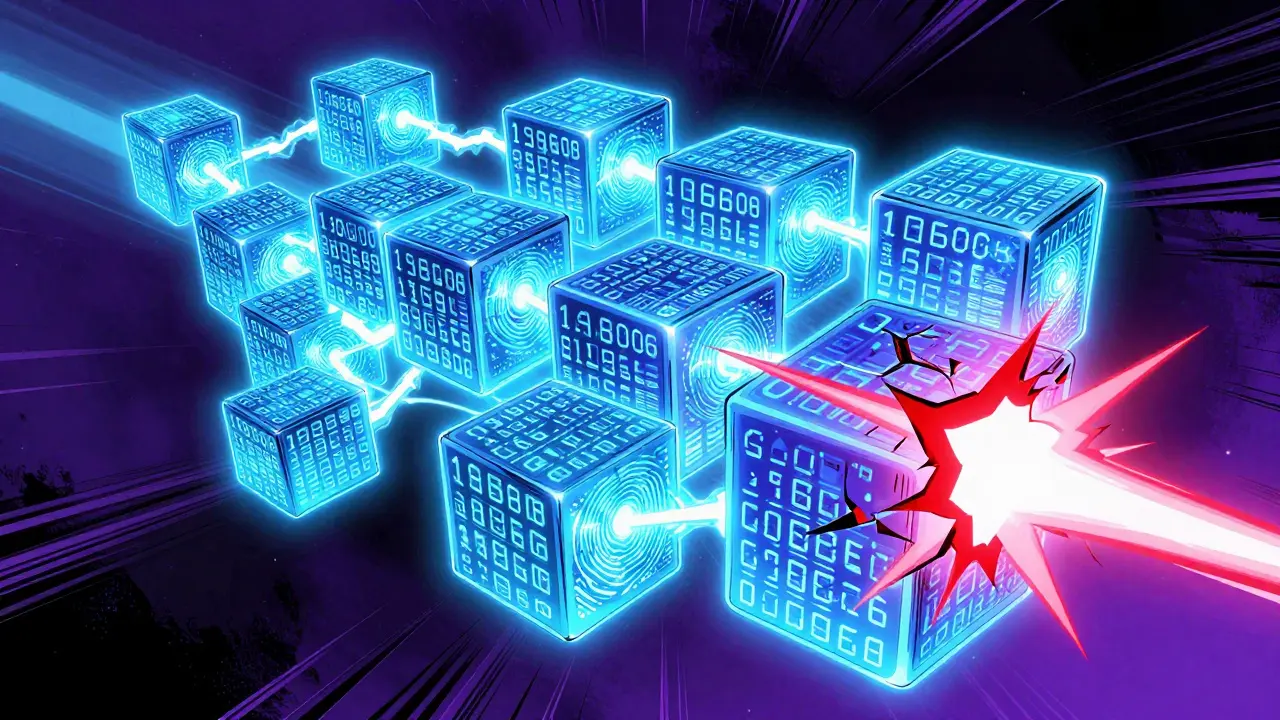
Think of blockchain as a digital ledger that can’t be changed. But how does it know if someone tries to sneak in a fake transaction? The answer is cryptographic hashing. It’s not magic. It’s math. And it’s what keeps Bitcoin, Ethereum, and thousands of other blockchains secure.
Every piece of data in a blockchain - whether it’s a payment, a contract, or a digital identity - gets turned into a unique fingerprint. This fingerprint is called a hash. And once it’s created, you can’t reverse it. You can’t guess the original data just by looking at the hash. And if you change even one letter in the original data, the hash changes completely. That’s the core idea.
How Does a Hash Work?
A cryptographic hash function takes any input - a sentence, a file, a transaction - and turns it into a fixed-size string of letters and numbers. For example, SHA-256, the most common one used in Bitcoin, always produces a 64-character hexadecimal string. No matter if you hash a single word or a 100-page document, the output is always 64 characters long.
Try this yourself: type echo -n 'hello' | openssl sha256 into a terminal. You’ll get 2cf24dba5fb0a30e26e83b2ac5b9e29e1b161e5c1fa7425e73043362938b9824. Now change ‘hello’ to ‘Hello’ - just capitalize the H. The hash becomes f7ff9e8b7bb2e09b70935a5d785e0cc5d9d0abf0e7698e142706469e9d8a8a59. Two completely different hashes. One tiny change. That’s the avalanche effect.
Why Does This Matter in Blockchain?
Blockchain isn’t just a list of transactions. It’s a chain. Each block contains:
- A list of recent transactions
- A timestamp
- The hash of the previous block
That last part is critical. The hash of the previous block is stamped into the next one. So if someone tries to change a transaction in Block 5, they’d have to recalculate the hash of Block 5. Then they’d have to recalculate the hash of Block 6, which depends on Block 5’s hash. Then Block 7, Block 8, all the way to the most recent block. And since every node on the network has a copy of the chain, they’ll immediately spot the mismatch.
This is what makes blockchain immutable. Not because it’s locked. But because changing anything breaks the chain - and breaking the chain means the whole network rejects it.
The 8 Rules of a Good Cryptographic Hash
Not all hash functions are built the same. For blockchain, a hash function must meet eight strict rules:
- Deterministic: The same input always gives the same output. No randomness.
- Fast computation: It must generate a hash quickly. Bitcoin nodes calculate millions per day.
- Avalanche effect: One bit changed? Half the hash changes. Makes tampering obvious.
- Fixed output size: SHA-256 always outputs 256 bits. No exceptions.
- Preimage resistance: You can’t take a hash and work backwards to find the original data.
- Second preimage resistance: Given input A, you can’t find another input B that produces the same hash.
- Collision resistance: It’s practically impossible to find two different inputs that produce the same hash.
- Puzzle friendliness: Even if you know part of the input, you can’t guess the rest.
SHA-256 meets all of these. That’s why it’s been used in Bitcoin since 2009. No successful collision has ever been found. Not even close.
SHA-256 vs. SHA-3 vs. BLAKE2: Which One Wins?
Not all blockchains use SHA-256. Ethereum uses SHA-3. Nano uses BLAKE2. Here’s how they compare:
| Function | Used In | Output Size | Speed (Software) | Security Strength | Energy Use |
|---|---|---|---|---|---|
| SHA-256 | Bitcoin, Litecoin | 256 bits | Medium | Very High (battle-tested) | High (ASIC-optimized) |
| SHA-3 (Keccak) | Ethereum | 256/512 bits | Slower | High (resists length attacks) | Medium |
| BLAKE2b | Nano, Polkadot | 256 bits | Faster | High | Low |
SHA-256 dominates because Bitcoin is the largest blockchain. Its security is proven over 14+ years. But it’s also why Bitcoin mining is dominated by ASIC chips - specialized hardware built just to crunch SHA-256 hashes. This creates centralization. BLAKE2b is faster and more energy-efficient, which is why newer chains prefer it.
What About Quantum Computers?
Here’s the scary part: quantum computers could break SHA-256. Not today. But maybe by 2035. A quantum computer with 1,500+ qubits could theoretically find hash collisions faster than a regular computer.
That’s why researchers are already working on replacements. NIST is testing new hash-based signatures like SPHINCS+, which are designed to survive quantum attacks. Ethereum’s upcoming Verkle trees and Bitcoin’s Taproot upgrades are steps toward future-proofing. But for now, SHA-256 is still unbreakable by any known technology.

Real-World Examples
On Reddit, a Bitcoin node operator once spotted a corrupted block because the hash didn’t match. The system flagged it in under a second. No human needed to check. The math did it.
On the flip side, developers have spent days debugging hash mismatches caused by something as simple as a byte-ordering error - big-endian vs. little-endian systems. One wrong setting, and the hash changes. That’s how sensitive it is.
And it’s not just crypto. Over 67% of Fortune 500 companies using blockchain rely on cryptographic hashing for supply chain tracking, digital IDs, and financial settlements. The EU’s MiCA regulation even requires all compliant blockchain assets to use hashing that meets NIST FIPS 180-4 standards.
How to Get Started
If you want to see hashing in action:
- Install OpenSSL:
brew install openssl(Mac) or use Windows Subsystem for Linux. - Type:
echo -n 'test' | openssl sha256 - You’ll get:
ba7816bf8f01cfea414140de5dae2223b00361a396177a9cb410ff61f20015ad - Now change ‘test’ to ‘Test’ - the hash changes completely.
That’s it. You just created a cryptographic hash. No special tools. No cloud service. Just math.
Common Mistakes
- Thinking hashing = encryption. It’s not. You can’t decrypt a hash.
- Using custom hash functions. Always use standardized ones like SHA-256 or SHA-3.
- Ignoring endianness. Byte order matters in blockchain code. One mistake, and your node rejects valid blocks.
- Assuming hash collisions are impossible. They’re theoretically possible - just astronomically unlikely.
The key takeaway? Cryptographic hashing doesn’t make blockchain perfect. But it makes it trustworthy. Without it, blockchain would be just a fancy database. With it, it’s a tamper-proof record that millions of computers agree on - without needing a central authority.
What is the main purpose of cryptographic hashing in blockchain?
The main purpose is to ensure data integrity and create an immutable chain. Each block’s hash depends on the previous block’s hash, so changing any data forces a chain reaction that’s instantly detectable by the network. This makes tampering practically impossible.
Can you reverse a cryptographic hash to find the original data?
No. Cryptographic hash functions are designed to be one-way. Even if you have the hash, there’s no practical way to reverse it and find the original input. This is called preimage resistance.
Why does Bitcoin use SHA-256 and not SHA-3?
Bitcoin uses SHA-256 because it was chosen by Satoshi Nakamoto in 2008 and has been battle-tested for over 14 years. Its security is proven, and the entire mining ecosystem - including ASIC hardware - is built around it. Switching now would require a massive network overhaul.
How does hashing help with blockchain scalability?
Hashing enables Merkle trees, which let wallets verify transactions without downloading entire blocks. Instead of checking 1MB of data, a wallet only needs a few hundred bytes of hash data. This is called Simplified Payment Verification (SPV) and is key to running lightweight wallets on phones.
Is SHA-256 safe from quantum computers?
Not long-term. Quantum computers could break SHA-256 with enough power - possibly by 2035. But that’s still years away. The blockchain community is already working on quantum-resistant alternatives like SPHINCS+ and Verkle trees to upgrade systems before they become vulnerable.
What happens if two different inputs create the same hash?
That’s called a collision. If it happened on a major blockchain like Bitcoin, the entire system would collapse - because trust in data integrity would be broken. But so far, no collision has been found for SHA-256, even after trillions of attempts. The probability is lower than winning the lottery 100 times in a row.
shreya gupta
March 17, 2026 AT 16:47And we call this 'immutable'?
Remind me again why we don't just use a locked diary with a very strong padlock?
iam jacob
March 18, 2026 AT 21:09Jesse Pals
March 20, 2026 AT 06:44it's like the bouncer at the club - doesn't say much, doesn't need to, but if you try to sneak in a fake ID? BAM.
one letter changed? hash goes full ninja.
no drama. no arguments. just math doing its thing.
and honestly? that's beautiful.
we need more systems like this.
less bureaucracy. more hash.
Diane Overwise
March 20, 2026 AT 23:33And we call this... 'secure'?
That's like saying a house is safe because the door has a lock... made of glitter.
Also... 'SHA-256'? Pronounced 'Shaw-Twenty-Five-Six'?
Or do we just say 'Shaw-256' like it's a new energy drink?
Ann Liu
March 22, 2026 AT 12:21Dionne van Diepenbeek
March 22, 2026 AT 13:31Graham Smith
March 24, 2026 AT 06:58Jerry Panson
March 26, 2026 AT 06:12Katrina Smith
March 27, 2026 AT 05:21also... who made these 8 rules? a committee?
like... did they vote on 'puzzle friendliness'?
because that sounds like a board game rule
Anastasia Danavath
March 27, 2026 AT 18:38anshika garg
March 27, 2026 AT 19:45It reminds me of how a single breath can echo through a canyon - unchanged, unalterable, yet carrying the weight of the whole moment.
Is this what immortality looks like in code?
Not eternal life - but eternal truth?
Bruce Doucette
March 28, 2026 AT 12:31Anyone who thinks hashing is 'just math' hasn't tried debugging a Merkle tree at 3am.
And SHA-256? Please. It's the COBOL of blockchain - outdated, energy-guzzling, and held together by Bitcoin's sheer stubbornness.
Meanwhile, BLAKE2b is out here being efficient and elegant like a Tesla in a gas station.
Why are we still worshipping this fossil?
Marie Vernon
March 30, 2026 AT 06:24It’s rare to see blockchain explained without jargon or hype.
And the global adoption - from EU regulations to Fortune 500 supply chains - shows this isn't just crypto bro tech.
It's infrastructure. Quiet. Unseen. Vital.
Thank you for honoring that.
Arlene Miles
March 30, 2026 AT 19:00Hashing isn’t about hiding data - it’s about proving it didn’t change.
It’s the difference between locking a diary and gluing its pages together so you can’t tear them out.
And yes - quantum computing is coming.
But that’s why we’re already building SPHINCS+ and Verkle trees.
We don’t wait for the storm - we build the roof before the rain.
Tony Weaver
April 1, 2026 AT 13:38Collision resistance is not a theorem - it's an engineering heuristic.
And the notion that 'no collision has ever been found' is a tautology - of course not, because we haven't tried hard enough.
SHA-256 is a statistical artifact, not a mathematical law.
And yet, the entire trillion-dollar edifice of crypto depends on it.
That's not innovation.
That's a gamble with public trust.
Prakash Patel
April 2, 2026 AT 08:59Zachary N
April 4, 2026 AT 04:04When you run a lightweight wallet on your phone, you're not downloading 1GB of block data - you're verifying a Merkle proof that's under 1KB.
That’s how Bitcoin became accessible to billions.
Hashing doesn't just secure the chain - it democratizes access.
Without it, blockchain would be a server farm, not a global network.
And that’s why it’s not just about cryptography - it’s about architecture.
The elegance is in the minimalism.
One hash. One proof. Infinite trust.
Elizabeth Kurtz
April 4, 2026 AT 04:13What’s beautiful here isn’t just the math - it’s how this one function enables trust across cultures, languages, and legal systems.
No bank. No government. Just a shared hash.
That’s the real revolution.
john peter
April 5, 2026 AT 10:01SHA-256 is merely a veil over centralized mining oligarchies.
ASICs are not tools - they are weapons of economic capture.
And yet, we praise this as 'innovation'?
It is merely the redistribution of power - not its abolition.
Marc Morgan
April 5, 2026 AT 13:39no one talks about it but it's the reason your dog pics on the blockchain didn't turn into a cat pic
and yes i know quantum is coming
but so was the internet in 1995 and we didn't panic then
we just built better stuff
so chill out and let the math do its thing
Anastasia Thyroff
April 6, 2026 AT 12:51and now I hate computers...
and also... I'm in love with them...
it's like being in a toxic relationship...
but the hash always stays the same...
so I guess... that's something?