
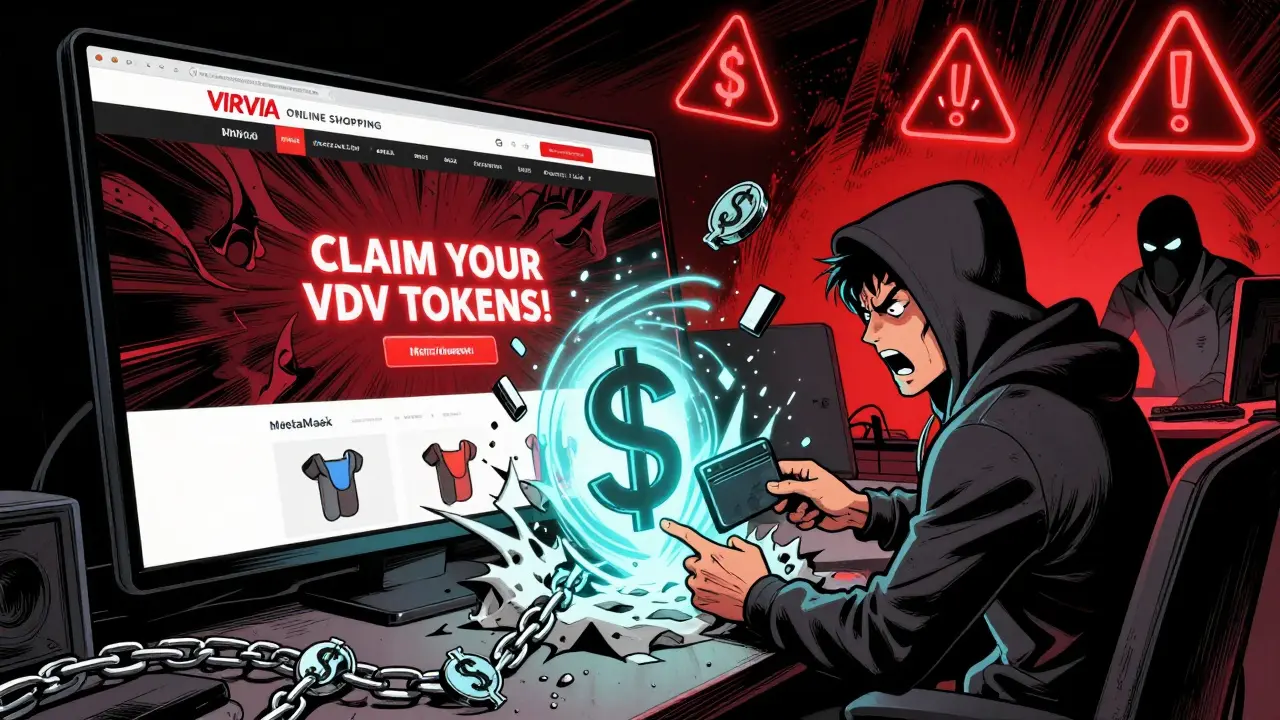
There’s no such thing as a free lunch-especially when it comes to crypto airdrops tied to online shopping sites. If you’ve seen ads promising free VDV tokens just for shopping on VIRVIA ONLINE SHOPPING, stop. This isn’t a reward. It’s a trap.
What Is the VIRVIA Airdrop Claim?
The story goes like this: sign up at VIRVIA ONLINE SHOPPING, make a small purchase, connect your crypto wallet, and you’ll get VDV tokens-some sites even say you’ll earn hundreds or thousands of dollars in free crypto. It sounds too good to be true. And it is. No legitimate blockchain project, exchange, or wallet provider lists VIRVIA or VDV as an upcoming airdrop. Not CoinGecko. Not airdrops.io. Not Nansen. Not even Reddit’s r/CryptoAirdrops community, which tracks hundreds of real opportunities every month. The name doesn’t show up in any blockchain explorer either. Etherscan has zero contracts for VDV. Solscan shows nothing on Solana. No developer activity. No whitepaper. No GitHub repo. No team members. No funding round. Just a website with a .online domain registered in September 2025 and hidden behind privacy protection.How the Scam Works
This isn’t a new trick-it’s a well-worn playbook. Scammers create fake e-commerce sites that look like real online stores. They use Shopify templates, copy product images from Amazon or AliExpress, and add a button that says “Claim Your VDV Airdrop.” When you click it, you’re asked to connect your MetaMask, Phantom, or Trust Wallet. Here’s where it gets dangerous. Once you connect your wallet, the site runs malicious JavaScript that:- Requests approval to spend all your tokens (even ones you didn’t know you had)
- Tricks you into signing a fraudulent transaction labeled “Airdrop Claim”
- Uses social engineering to ask for your seed phrase-often disguised as “wallet verification”
Why This Is a Red Flag
Legitimate airdrops don’t work like this. Real projects like Monad, Hyperliquid, or Meteora spend months building testnets, rewarding early users, and documenting everything publicly. They never ask you to shop first. They never ask for your seed phrase. They never use .shop or .online domains registered days before the “airdrop” goes live. Here are five red flags that prove VIRVIA is a scam:- No blockchain presence-Zero token contracts on any major chain.
- Anonymous domain-virvia.online was registered with private WHOIS info on September 28, 2025.
- Cloned design-Uses stolen product images and Shopify templates modified with phishing scripts.
- No official channels-No Twitter/X account with blue check, no Discord, no Telegram group with verified admins.
- Pressure tactics-“Limited time offer,” “Only 1000 spots left,” “Connect now or lose your reward.”
What Authorities Are Saying
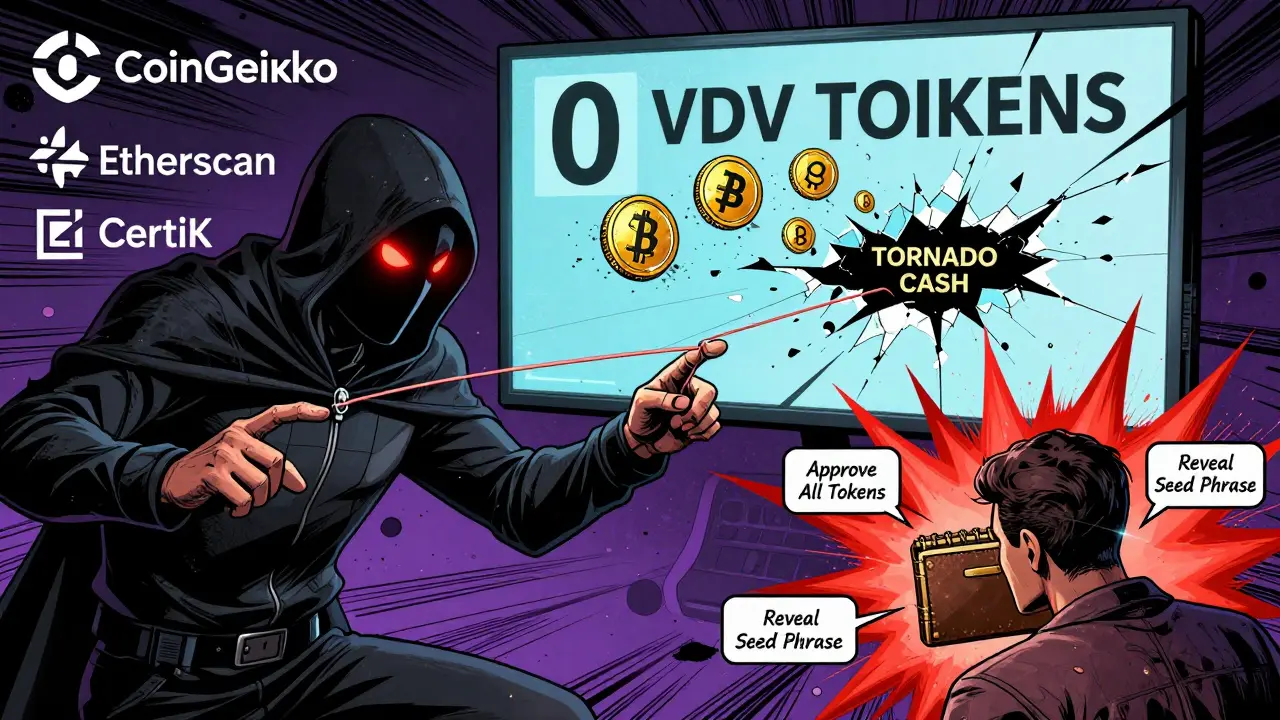
This isn’t just community speculation. The Federal Trade Commission issued Consumer Alert #2025-17 naming VIRVIA as a high-risk scam. The FBI’s IC3 listed it in Public Service Announcement #2025-098. Chainalysis reported that fake shopping airdrops like this made up 31% of all crypto fraud in 2025. And CertiK found that 78% of “too good to be true” airdrops are scams-with 22% of those tied to fake e-commerce sites. Blockchain security firm Halborn analyzed the VIRVIA site and confirmed it matches all 12 known patterns of a crypto phishing operation. Consensys Diligence labeled it a “confirmed scam.” Even the European Union’s anti-fraud office included it in their Q4 2025 priority takedown list.What Happens After You Get Scammed?
Once the scammers drain your wallet, they don’t stick around. They move the funds through mixers like Tornado Cash to hide the trail. Elliptic tracked VIRVIA-linked wallets laundering 18.7 ETH ($62,345) before major exchanges froze the primary collection address. The site has already changed domains twice-from virvia.shop to virvia.online-after Shopify’s security team flagged and shut down the first version. Experts predict it will vanish by mid-November 2025, only to reappear next month as “VIRVIA24” or “VIRVIA Deals” with the same scam code.
How to Protect Yourself
If you’re looking for real airdrops, stick to trusted sources:- Check CoinGecko’s upcoming airdrops page (updated weekly)
- Follow airdrops.io for verified testnet opportunities
- Join official Discord servers of projects you already use (like Arbitrum, zkSync, or Sui)
- Never connect your wallet to a site just because it says “claim free tokens”
- Use a separate wallet with only small amounts of crypto for any testnet or airdrop activity
Real Airdrops Are Transparent. This Isn’t One.
Legitimate crypto projects don’t hide behind fake storefronts. They publish code. They build communities. They reward early supporters with real utility, not empty promises. The VDV airdrop from VIRVIA ONLINE SHOPPING has none of that. It’s designed to steal, not to reward. Don’t be the next victim. If it sounds like free money for doing nothing, it’s a scam. Always verify. Always double-check. And never connect your wallet to a site you don’t fully trust.Is VIRVIA ONLINE SHOPPING a real company?
No. VIRVIA ONLINE SHOPPING is not a real company. The domain virvia.online was registered in September 2025 using privacy protection services. There is no business registration, no physical address, no customer service, and no verified social media presence. It was created solely to trick people into connecting their crypto wallets.
Are VDV tokens real?
No. There are no VDV tokens on any blockchain. Etherscan, Solscan, and other major explorers show zero contract deployments for VDV or VIRVIA. Any token you see labeled as VDV on a website is fake and only exists inside the scammer’s interface to make the scam look real.
Can I get my money back if I got scammed by VIRVIA?
Recovering funds from crypto scams is extremely difficult. Once tokens are moved through mixers like Tornado Cash, tracing them becomes nearly impossible. Your best bet is to report the scam to the FBI’s IC3 and your local financial crimes unit. Some exchanges may freeze known scam addresses, but they won’t return your funds. Prevention is the only reliable protection.
Why do scammers use online shopping sites for airdrop scams?
Because people trust shopping sites. If you’re used to buying things online, seeing a site that looks like Amazon or eBay makes you lower your guard. Scammers exploit this trust. They know most people won’t check if a store has a blockchain presence-they just want to get free stuff. That’s why fake shopping airdrops are one of the fastest-growing scam types in 2025.
What should I do if I already connected my wallet to VIRVIA?
Immediately disconnect the site from your wallet. In MetaMask, go to Settings > Connected Sites and revoke access. If you signed any transactions, assume your wallet is compromised. Move all funds to a new wallet with a new seed phrase. Never reuse the same seed phrase. Monitor your old wallet for any suspicious activity-even if it looks empty now, scammers may try to drain it later.
Are there any real crypto airdrops happening in 2026?
Yes. Projects like Monad, Hyperliquid, and Abstract are preparing for token launches in early 2026. These are legitimate opportunities with public testnets, documented reward structures, and verified teams. Always check CoinGecko or airdrops.io before participating. Real airdrops don’t ask you to shop-they ask you to use their protocol.
Crystal Underwood
February 2, 2026 AT 05:26Oh my god. I can't believe people still fall for this. This isn't even a scam-it's a public service announcement waiting to happen. You connect your wallet to some .online domain that looks like it was built by a high schooler in Canva? Bro. You're giving away your entire digital life for 'free tokens' that don't exist. I've seen wallets drained faster than a soda at a frat party. Stop. Just stop. You're not getting rich-you're getting hacked.
Meenal Sharma
February 3, 2026 AT 20:30It is a matter of profound epistemological concern that individuals, in their pursuit of unearned financial gain, willingly surrender the foundational security of their cryptographic identities. The VIRVIA phenomenon exemplifies the confluence of technological illiteracy and cognitive bias, wherein the allure of instant reward eclipses the imperative of due diligence. One must question the societal structures that permit such predatory architectures to proliferate with impunity.
Freddy Wiryadi
February 5, 2026 AT 11:43bro this is wild 😳 i just saw a post on tiktok saying 'get 10k in vdv for buying a $5 hoodie' and i was like... wait what? like i get that people want free stuff, but this is like handing over your house keys because someone said 'free pizza inside'. i'm not even mad, just sad. we're all just trying to get by and this is what happens. 🤦♂️
Tressie Trezza
February 5, 2026 AT 12:30I’ve been in crypto since 2017 and I’ve seen every flavor of scam. This one’s just dressed up like a Target sale. People think if it looks legit, it is. But the truth is, real projects don’t need to trick you into shopping. They build tools, communities, and value. This? This is just a digital mugging with a Shopify theme. If you’re reading this and you’re still thinking about connecting your wallet-just walk away. You’ll thank yourself later.
Dylan Morrison
February 7, 2026 AT 01:26so many people are scared of missing out on free money... but they don’t realize they’re just giving away their digital soul 🥺 i used to be like that too. i thought 'maybe this time it’s real'. then i lost $800 in a fake airdrop. now i only use a burner wallet. it’s not glamorous, but it keeps me alive. if you’re new to this-just pause. breathe. google it. you’re not late. you’re safe.
William Hanson
February 8, 2026 AT 09:43How is this even a thing? People are so gullible it’s embarrassing. You don’t need to be a crypto expert to know you don’t give your wallet to a site that looks like a 2007 Geocities page. If you got scammed, you deserve it. No sympathy. Just delete your wallet and start over. Maybe next time you’ll think before clicking.
Lori Quarles
February 10, 2026 AT 04:02Y’all need to stop being afraid of missing out. This isn’t a missed opportunity-it’s a trap. I’ve helped three friends recover from scams like this. One cried for hours. Another lost her life savings. Don’t be that person. Share this post. Tag your cousins. Post it on your mom’s Facebook. We need to stop this before it takes more lives.
Jeremy Dayde
February 11, 2026 AT 05:13I’ve been watching this scam unfold for weeks and honestly it’s kind of heartbreaking. I used to work in cybersecurity and I’ve seen how these things are built-fake product images, cloned UI, automated scripts that trigger approval requests the second you connect. The scammers don’t even care if you buy anything. They just want that connection. And once you give it? Game over. I’ve talked to people who thought they were helping a small business. They didn’t even realize they were handing over their keys to a ghost.
Steven Dilla
February 12, 2026 AT 17:57Bro I just got out of a 3-hour call with my cousin who lost $15k to this. She thought it was legit because the site had a 'contact us' page. 😭 I had to walk her through revoking access, making a new wallet, and changing her seed phrase. It’s not just about money-it’s about trust. She doesn’t even want to touch crypto anymore. We gotta protect the newbies. This is why education matters.
josh gander
February 13, 2026 AT 09:59Let me tell you something real: the real airdrops? They don’t scream at you. They don’t have countdown timers. They don’t ask for your seed phrase. They just say ‘hey, here’s a testnet, try it out, we’ll reward you if you stick with us.’ That’s it. No shopping. No fake products. No panic. Just code, community, and consistency. If it feels like a used car lot… it is one. Stay cool. Stay safe. And don’t let FOMO make you stupid.
Sunil Srivastva
February 13, 2026 AT 20:44Hi everyone, I’m from India and I’ve seen many such scams here too. People think because something is in English and has a .online domain, it’s global and trustworthy. But in reality, these are often run from rented servers in Eastern Europe or Southeast Asia. The best way to avoid this? Always check CoinGecko or Airdrops.io. If it’s not there, it’s fake. Also, never connect your main wallet. Always use a separate one with just a little ETH or SOL. Small steps save big losses.
Kevin Thomas
February 15, 2026 AT 11:18Look, I get it. You want free money. I want free money. But you know what’s free? Learning how to spot a scam. Spend 10 minutes reading this post. Bookmark it. Share it. That’s your real airdrop. Real crypto doesn’t come with a shopping cart. It comes with a whitepaper, a dev team, and a GitHub repo that’s actually updated. If you can’t find those? Walk away. You’re not missing out-you’re avoiding a disaster.
Jerry Ogah
February 15, 2026 AT 17:24THIS IS THE WORST THING TO HAPPEN TO CRYPTO SINCE THE TERRA CRASH. I’M NOT EVEN KIDDING. PEOPLE ARE LOSING THEIR RENT MONEY FOR THIS. I SAW A POST ON REDDIT WHERE SOMEONE SAID THEY WERE ‘JUST TESTING IT OUT’ AND ENDED UP LOSE $20K. I’M SO MAD RIGHT NOW. IF YOU’RE READING THIS AND YOU’RE THINKING ABOUT CLICKING THAT BUTTON-STOP. NOW. GO MAKE A SANDWICH. THINK ABOUT YOUR FAMILY. THINK ABOUT YOUR FUTURE.
Andrea Demontis
February 16, 2026 AT 22:33I keep wondering why people don’t just verify the token contract before connecting. It’s literally one click on Etherscan. If there’s no contract, there’s no token. No token, no airdrop. It’s not complicated. But I guess the emotional pull of ‘free money’ overrides logic. Maybe we need to teach this in schools. Not just math and science-crypto literacy. Because right now, the internet is a minefield and most people are walking through it blindfolded.
Edward Drawde
February 17, 2026 AT 07:07lol this is so basic. why are we even talking about this? if you click a link that says ‘claim free crypto’ and you’re not 100% sure it’s legit-you’re already scammed. no offense, but if you need a 1000-word guide to not get hacked, maybe crypto isn’t for you.
Richard Kemp
February 19, 2026 AT 03:01so i just checked virvia.online on wayback machine and it was created on sept 28 2025... and the site looks like it was made in like 2 hours. no wonder it’s gone already. i’ve seen this movie before. they’ll come back as virvia24 or virvia deals. same code. same scam. just new domain. always. always. always.
Christopher Michael
February 20, 2026 AT 20:19Let me be clear: The Federal Trade Commission, the FBI, Chainalysis, CertiK, Halborn, and Consensys Diligence have all independently labeled this as a confirmed scam. This is not a rumor. This is not speculation. This is fact. And yet, people still click. Why? Because they think, ‘It won’t happen to me.’ Well, guess what? It already did. To thousands. And it will again. Unless we stop normalizing this behavior.
Brianne Hurley
February 21, 2026 AT 19:01Ugh. I just saw someone on X say they ‘got 500 VDV tokens’ and are now ‘rich’. They posted a screenshot of a fake balance. I’m so tired of this performative ignorance. You didn’t get rich. You got compromised. And now your wallet is a ghost town with a $12k debt. Please stop glorifying this. You’re not a crypto guru. You’re a cautionary tale waiting to happen.
christal Rodriguez
February 23, 2026 AT 02:18Actually, this post is overblown. Maybe VIRVIA is a real project and the blockchain just hasn’t indexed it yet. Why assume the worst? Maybe they’re just quiet. Maybe they’re building in stealth. Not everything is a scam just because you don’t understand it.
Dahlia Nurcahya
February 23, 2026 AT 09:01Hey, I just want to say-this post saved me. I was about to connect my wallet because I thought, ‘What’s the harm?’ Then I saw someone link this thread. I checked Etherscan. Nothing. I checked the domain registration. September 2025. I freaked out. I didn’t connect. I shared this with my group chat. Thank you for being the voice of reason. We need more of this.
Robert Mills
February 24, 2026 AT 06:02DO NOT CLICK. DO NOT CONNECT. DO NOT BELIEVE. YOU WILL LOSE EVERYTHING. SHARE THIS. NOW. 🚨
Joseph Pietrasik
February 25, 2026 AT 15:03who cares if its a scam if you just wanna try it out its just a little eth
Raju Bhagat
February 25, 2026 AT 23:43bro i lost my whole portfolio to this last week 😭 but now i’m back and i’m telling everyone i know-don’t do what i did. i thought i was smart. i was wrong. now i use a burner wallet and i check every link 3 times. if you’re reading this and you’re thinking about clicking-don’t. i’m begging you.
laurence watson
February 27, 2026 AT 03:02i’ve been helping new people on discord avoid scams like this for years. the hardest part isn’t explaining the tech-it’s getting them to slow down. they’re so excited to ‘get rich’ they forget to think. if you’re new, just take a breath. ask someone. wait 24 hours. you’ll thank yourself. you’re not behind. you’re protected.
Jeremy Dayde
February 28, 2026 AT 08:06Just saw someone reply saying ‘I just tried it with a small wallet’-I want to scream. It doesn’t matter how small. Once you connect, they can drain every token you’ve ever held, even ones you forgot about. I’ve seen wallets with 17 different tokens get wiped because of one click. You’re not ‘safe’ because you only had $50. You’re just lucky you didn’t have more.