

The days of operating a cryptocurrency business in the shadows are officially over. If you are running an exchange, a wallet service, or even a mining operation in Nigeria, you now face a strict regulatory reality. The Investments and Securities Act 2025 is legislation that formally classifies cryptocurrencies as securities under the jurisdiction of the Securities and Exchange Commission (SEC). This means the SEC has full authority to regulate your operations. You cannot ignore this shift. The previous era of informal peer-to-peer trading has been replaced by a structured compliance regime. For crypto businesses, getting a Virtual Asset Service Provider (VASP) license is no longer optional-it is the only way to operate legally.
Who Needs a VASP License?
You might think you are safe because you just help people buy Bitcoin on WhatsApp. Think again. The definition of a Virtual Asset Service Provider (VASP) in Nigeria is broad. It covers any entity that facilitates transactions involving virtual assets. This includes:
- Cryptocurrency exchanges where users trade tokens for fiat or other cryptos.
- Digital wallet providers offering custody services.
- Entities issuing security tokens or conducting Initial Coin Offerings (ICO).
- Mining pools and staking service providers.
- Platforms distributing airdrops.
- Businesses processing payments using crypto.
If your business touches any of these areas, you fall under the SEC’s watch. The regulator wants every node in the crypto ecosystem accounted for. Operating without this license exposes you to severe penalties, including asset freezes and criminal charges. The goal is clear: bring the entire virtual asset economy into the formal financial system.
Financial and Corporate Requirements
The barrier to entry is high, and it starts with money. The SEC requires applicants to demonstrate a minimum paid-up capital of N500,000,000 (Five Hundred Million Naira). As of recent exchange rates, this is approximately $325,000 USD. This requirement is not a suggestion; it is a hard filter to ensure only financially stable entities can handle public funds. Why so high? Because the SEC wants to prevent small, undercapitalized firms from collapsing and leaving investors holding worthless bags.
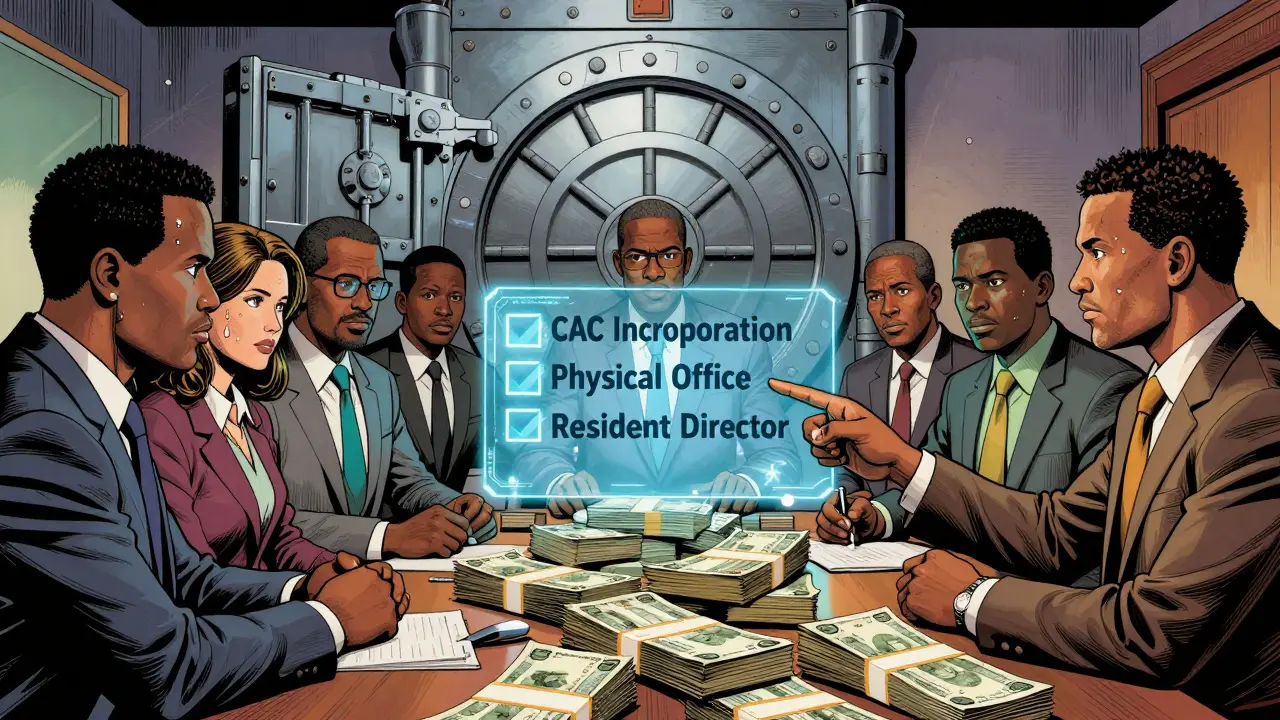
Beyond cash, your corporate structure must be solid. You must be incorporated as a company with the Corporate Affairs Commission (CAC) is the government agency responsible for registering companies and enforcing corporate governance in Nigeria. You will need to submit:
- A valid Certificate of Incorporation.
- Your Memorandum and Articles of Association (MEMART).
- A current Status Report from the CAC proving active standing.
- Audited financial statements. If you are a new startup, you must provide audited statements of affairs prepared by certified public accountants.
You also need a physical presence. Remote-only operations are not accepted. You must maintain a physical office in Nigeria. Furthermore, at least one director must be a resident of the country. This rule ensures accountability. If something goes wrong, regulators know exactly who to hold responsible locally.
| Requirement Category | Specific Detail | Purpose |
|---|---|---|
| Minimum Capital | N500,000,000 (~$325k USD) | Ensure financial stability and investor protection |
| Legal Entity | Incorporated via CAC | Create legal liability and traceability |
| Physical Presence | Office in Nigeria + Resident Director | Facilitate local oversight and enforcement |
| Financial Records | Audited Statements or Affairs | Verify fiscal health and transparency |
Operational Compliance: AML and KYC
Having the money and the papers is just step one. The daily grind of compliance is where most businesses struggle. You must implement robust Anti-Money Laundering (AML) and Know Your Customer (KYC) protocols. These are not just box-ticking exercises; they are mandated by both the SEC and the Central Bank of Nigeria (CBN).
Your systems must identify and verify every customer. Anonymous wallets are dead. You need technology that can scan identities, cross-check against sanctions lists, and monitor transactions in real-time. The SEC expects you to detect suspicious activities, such as rapid movement of funds or patterns indicative of terrorist financing.
Record-keeping is another heavy lift. You must store comprehensive customer records for a minimum of seven years. This includes:
- Identity verification documents (passports, BVNs).
- Complete transaction histories.
- Communication logs with customers.
This aligns with global standards set by the Financial Action Task Force (FATF). But remember, Nigerian regulators have teeth. They will audit these records. If you fail to produce them during an inspection, your license can be revoked instantly.
The Two Pathways: Standard vs. ARIP
The SEC offers two routes to get licensed. Understanding which one fits your situation is critical.
1. Standard Registration Process
This is the traditional path. You gather all documentation, meet all capital requirements, pass all audits, and apply for full registration. It is thorough but slow. You cannot operate until you receive the final license. This path suits established companies with deep pockets and existing infrastructure.
2. Accelerated Regulatory Incubation Program (ARIP)
This is a game-changer for startups and newer entrants. ARIP allows you to obtain preliminary approval "in principle." This means you can start operating under SEC supervision before you complete every single final requirement. Here is how it works:
- Application: File your initial application showing you are incorporated and have a Nigerian office.
- Commitment: Sign an undertaking to follow program conditions.
- Incubation: Begin operations while receiving direct regulatory guidance.
- Reporting: Submit quarterly progress reports to the SEC.
- Review: At month 10, you receive specific feedback on gaps.
- Exit: At month 12, you either secure full registration or cease operations if you failed to comply.
To qualify for ARIP, you must already be actively engaged in securities-related business or have pending applications. It is not a free pass; it is a supervised probation period. Use it wisely to build your compliance muscle.
Documentation Deep Dive
The paperwork for a VASP license is extensive. Do not underestimate the effort required to prepare these documents. Beyond the basic incorporation papers, you need to present a comprehensive business model. The SEC wants to see a unique value proposition. Why should Nigeria need your platform? How do you protect investors?
You must draft detailed internal rules covering:
- Investor Protection Mechanisms: How do you safeguard user funds? Are they segregated from operational accounts?
- Conflict of Interest Policies: How do you prevent insiders from front-running trades?
- Dispute Resolution Frameworks: What happens when a user claims their funds were stolen? Is there a clear refund or investigation process?
Risk management is central. You need a dedicated risk management protocol tailored to virtual assets. This includes cybersecurity plans, data protection measures, and system resilience strategies. The SEC’s Technology Risk Management requirements are strict. You must prove your tech stack can withstand attacks and outages. Hire experienced CISOs (Chief Information Security Officers) early. Do not rely on generic IT support.
Additionally, you must provide sworn undertakings. A director or company secretary must swear to comply with all SEC Rules and the Investment and Securities Act. This personal liability adds weight to the responsibility. If the company fails, individuals can be held accountable.

Navigating the Regulatory Landscape
One of the biggest challenges is coordinating between multiple agencies. You are not just dealing with the SEC. You must also navigate:
- Central Bank of Nigeria (CBN): While the SEC regulates the assets, the CBN still oversees banking relationships. Licensed VASPs can now access bank accounts, which was previously restricted. However, banks will perform their own due diligence.
- Tax Authorities: You must register with the Federal Inland Revenue Service (FIRS) and state tax boards. The government views crypto as a significant revenue stream. Expect regular tax filings and potential audits.
- Financial Intelligence Unit (FIU): You must report suspicious transactions directly to the FIU. Failure to report can lead to severe legal consequences.
For international companies looking to enter Nigeria, the resident director requirement is a hurdle. You may need to hire local executives or partner with Nigerian entities to meet this criterion. This creates opportunities for local talent but adds complexity for foreign firms.
Market Implications and Future Outlook
This regulatory shift changes the market dynamics significantly. The days of unregulated competition are ending. Smaller, non-compliant players will likely exit the market. This consolidation benefits legitimate businesses that invest in compliance. Users gain confidence knowing their platforms are vetted by the SEC. Consumer trust increases when they see official licensing badges.
However, costs will rise. Compliance is expensive. Legal fees, auditing costs, technology upgrades, and staffing for AML/KYC teams add up. These costs will inevitably be passed on to users through higher trading fees or withdrawal charges. Be transparent with your users about these changes. Explain that fees fund security and regulatory adherence.
Looking ahead, the framework is evolving. The 2025 Act laid the foundation, but implementing guidelines are still being refined. The SEC uses a regulatory sandbox approach, learning from early licensees. Expect updates on cross-border transaction rules and potentially adjustments to capital requirements based on market feedback. Stay engaged with industry associations and legal counsel to stay ahead of these changes.
Nigeria’s approach sets a precedent for Africa. Other West African nations are watching closely. If you succeed here, you position yourself as a leader in regional crypto regulation. But failure carries heavy risks. Treat compliance not as a burden, but as your core competitive advantage.
How long does it take to get a VASP license in Nigeria?
The timeline varies depending on the pathway chosen. The standard process can take several months to over a year, depending on document preparation and audit completion. The Accelerated Regulatory Incubation Program (ARIP) offers a faster route, allowing preliminary operations within weeks of acceptance, with a full review cycle completed within 12 months.
Can foreign-owned companies apply for a VASP license?
Yes, foreign-owned companies can apply. However, they must incorporate a local entity with the Corporate Affairs Commission (CAC) and maintain a physical office in Nigeria. Crucially, at least one director must be a Nigerian resident to satisfy local oversight requirements.
What happens if I operate without a VASP license?
Operating without a license is illegal under the Investments and Securities Act 2025. Penalties include heavy fines, seizure of assets, closure of business operations, and potential criminal prosecution for directors. Additionally, banks will freeze accounts associated with unlicensed crypto activities.
Is the N500 million capital requirement negotiable?
No, the N500,000,000 minimum paid-up capital is a statutory requirement set by the SEC. It is not negotiable. This amount is designed to ensure financial stability and protect investors. Startups may consider the ARIP program to begin operations while building up capital, but the final license requires meeting this threshold.
Do I need separate licenses from the CBN and SEC?
You primarily need the VASP license from the SEC for crypto activities. However, you must comply with CBN guidelines regarding banking relationships and anti-money laundering. You do not typically need a separate banking license from the CBN unless you are offering specific financial products like loans or savings accounts, which would require additional approvals.