

Trading crypto on Ethereum mainnet feels like paying rent for a luxury apartment you only visit once a week. The gas fees are high, the wait times are unpredictable, and sometimes you just want to swap tokens without calculating if it’s worth your while. That is exactly why Uniswap V3 on Optimism has become the go-to setup for traders who refuse to overpay. It combines the deep liquidity of the industry's largest decentralized exchange with the blistering speed of a Layer 2 network.
This isn't just about saving a few dollars on gas. It is about accessing a sophisticated trading engine that offers better capital efficiency than almost anything else in decentralized finance (DeFi). But there is a catch. Uniswap V3 is not as simple as clicking "buy" on a centralized app. It requires understanding concepts like concentrated liquidity and impermanent loss. If you get those wrong, you can lose money even when the market goes up. This review breaks down how Uniswap V3 works on Optimism, what it costs, and whether it is right for your portfolio in 2026.
Why Pair Uniswap V3 with Optimism?
To understand why this combination matters, we need to look at the two pieces separately. Uniswap is the leading automated market maker (AMM) protocol on Ethereum. Since its inception, it has processed billions in volume. Version 3, launched in May 2021, introduced concentrated liquidity, allowing providers to allocate funds within specific price ranges rather than across the entire spectrum from zero to infinity. This innovation boosted capital efficiency by up to 4,000% compared to V2.
However, running all that logic on Ethereum Layer 1 is expensive. A single swap could cost $10 to $50 during peak congestion. Enter Optimism, an Ethereum Layer 2 scaling solution that uses optimistic rollup technology. Optimism batches transactions off-chain and posts compressed data back to Ethereum. The result? Transactions settle in seconds for fractions of a cent. By deploying Uniswap V3 on Optimism, you get the security of Ethereum finality with the user experience of a centralized exchange.
In 2025 and into 2026, this multi-chain approach became standard. Uniswap now supports 34 networks, but Optimism remains a top choice due to its mature ecosystem and low latency. For the average trader, this means you can execute dozens of swaps daily without worrying about draining your wallet on network fees.
How Concentrated Liquidity Changes the Game
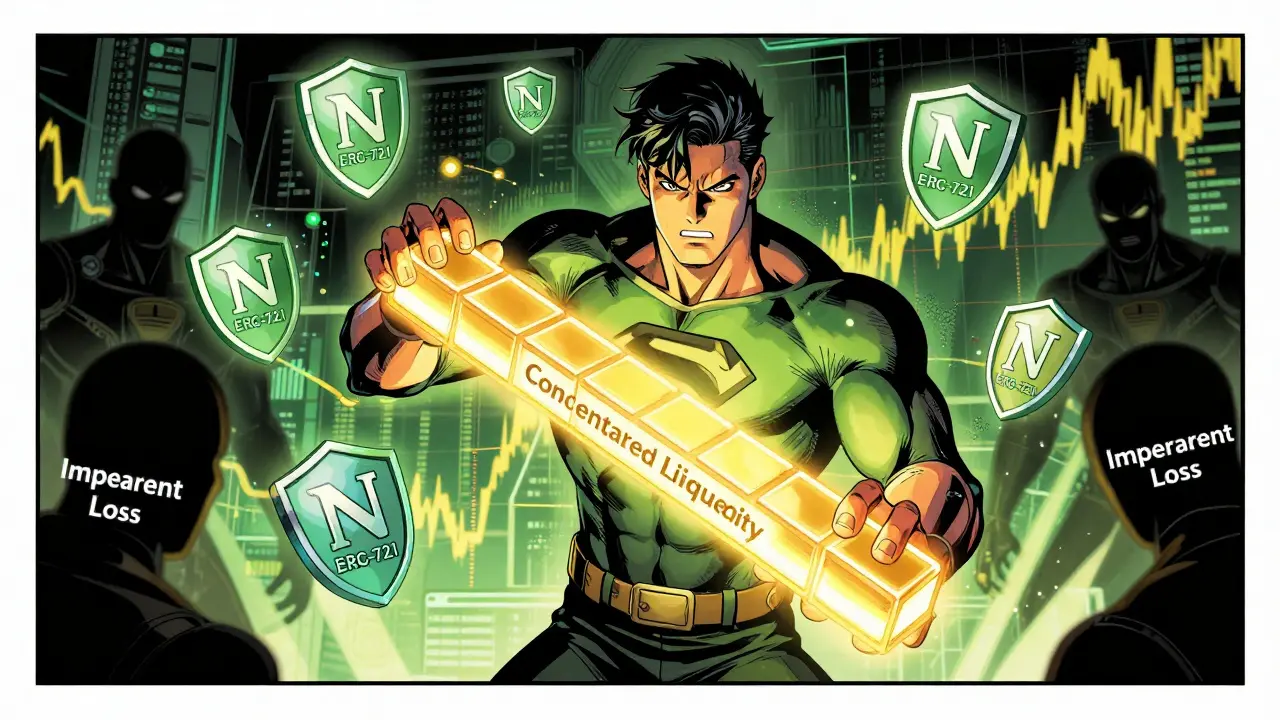
The core feature of Uniswap V3 is concentrated liquidity. In older versions like V2 or SushiSwap, your liquidity was spread thin across every possible price point. If ETH was trading at $3,000, your funds were still sitting idle at $100 and $10,000, earning nothing. With V3, you choose a range-say, $2,800 to $3,200. Your capital works harder because it is focused where the actual trading happens.
For liquidity providers (LPs), this means higher returns. Industry analysts note that V3 enables approximately 54% higher returns compared to V2 through these mechanisms. However, this comes with active management requirements. If ETH moves to $3,500, your position stops earning fees until you adjust the range. Each position is represented as a unique non-fungible token (NFT) using the ERC-721 standard, reflecting the distinct nature of each custom range.
There are also multiple fee tiers to consider: 0.01%, 0.05%, 0.30%, and 1%. Stablecoin pairs usually sit at 0.01% or 0.05%, while volatile assets like ETH/USDC use 0.30%. Exotic pairs might use 1%. Choosing the wrong tier can mean missing out on volume or attracting arbitrage bots that drain your pool. High fee pools capture 58% of liquidity supply but only execute 21% of trade volume, indicating some fragmentation in how users allocate risk.
| Fee Tier | Best For | Risk Level | Liquidity Depth |
|---|---|---|---|
| 0.01% | Identical stablecoins (e.g., USDC/USDT) | Low | Very High |
| 0.05% | Similar stablecoins or major pairs | Low-Medium | High |
| 0.30% | ETH/USDC, BTC/ETH (volatile assets) | Medium | Medium |
| 1.00% | Exotic pairs, new tokens | High | Low |
User Experience: Interface and Navigation
If you have used Coinbase or Binance, you will find Uniswap's interface surprisingly clean. There are no nested menus or cluttered dashboards. You connect your wallet, select the token pair, set your slippage tolerance, and confirm. The search bar is intuitive, and the swap button is prominent. Users often report that even experienced traders prefer Uniswap's streamlined design over the overwhelming interfaces of some newer DEXs.
However, simplicity ends when you start providing liquidity. The LP dashboard requires you to input price ranges, view charts, and manage NFT positions. This is where the learning curve steepens. Newcomers to DeFi often struggle with the concept of "out of range" positions. If you provide liquidity for ETH between $3,000 and $3,100, and ETH drops to $2,900, your ETH is automatically sold for USDC. You hold only stablecoins now, missing out on any potential rebound gains. This is known as impermanent loss.
Data from 2025 highlights the severity of this risk. In one sample covering 43% of total value locked (TVL), liquidity providers earned $199.3 million in fees but suffered $260.1 million in impermanent loss. That is a net deficit of $60.8 million compared to simply holding the tokens. Over 90% of the largest liquidity providers change their positions within a month, showing how dynamic and demanding active management can be.
Security, Trust, and Decentralization
One of the biggest draws of Uniswap is its decentralized nature. There is no central authority, no CEO to blame, and no company to shut down. The code is open-source, and the protocol has been audited extensively since its launch. Uniswap maintains its position as the gold standard among DEXs, holding approximately 19% of the total DEX market share in 2025. Its TVL sits around $3.4 billion, demonstrating significant trust from institutional and retail players alike.
However, decentralization does not mean immunity from risks. Smart contract vulnerabilities remain a threat in DeFi, though Uniswap's core contracts have held strong against attacks. A more immediate concern for users is routing issues and fake liquidity. Some pools may appear deep but lack real buyers, leading to severe slippage. Always check the pool depth before executing large trades. Additionally, because Uniswap is permissionless, anyone can create a token and add liquidity. Scam tokens exist, so verify contract addresses carefully.
Customer support reflects this decentralized ethos. There is no live chat. Instead, Uniswap offers a ticket system that typically responds within an hour, and a Discord server. While helpful for technical issues, the Discord community can be difficult to navigate for beginners. Support replies often assume prior knowledge, directing users to external tools like Uniswap Info or DEX explorers. You are largely on your own to understand the mechanics.
Comparing Uniswap V3 (Optimism) to Centralized Exchanges
Should you use Uniswap instead of Coinbase or Kraken? It depends on your goals. Centralized exchanges (CEXs) offer ease of use, fiat on-ramps, and customer service. They also hold your keys, meaning you do not control your assets directly. Uniswap gives you full custody. You keep your funds in your wallet until you swap them.
On fees, CEXs charge a percentage of the trade amount, often ranging from 0.1% to 0.6%. Uniswap charges the fee tier selected by the pool creator (e.g., 0.30%) plus the minimal Optimism gas fee. For small trades under $100, CEXs might be cheaper if they have free tiers. For larger trades, Uniswap's transparency and lower effective costs win out, especially when factoring in withdrawal fees from CEXs.
Token selection is another differentiator. CEXs list hundreds of tokens but require rigorous listing processes. Uniswap lists thousands, including new and obscure tokens. However, this comes with responsibility. You cannot buy Bitcoin directly on Uniswap; you must use Wrapped Bitcoin (WBTC). Similarly, MATIC is now POL on Polygon, but on Optimism, you interact with native OP tokens and bridged assets. Understanding wrapped assets is crucial for avoiding confusion.

Practical Tips for Trading on Uniswap V3 (Optimism)
Before you dive in, here are some actionable steps to ensure a smooth experience:
- Use a Compatible Wallet: MetaMask, Rainbow, or Coinbase Wallet work well. Ensure you have added the Optimism network to your wallet settings.
- Bridge Funds Carefully: Use official bridges like the Optimism Bridge to move ETH from Layer 1 to Layer 2. Third-party bridges can save time but introduce additional smart contract risk.
- Start Small: Test the interface with a small amount. Verify that you receive the correct tokens and that the transaction confirms quickly.
- Monitor Slippage: Set appropriate slippage tolerance. For stable pairs, 0.5% is fine. For volatile tokens, you may need 1-3%, but be aware of front-running bots.
- Understand Impermanent Loss: If providing liquidity, calculate potential IL using online calculators. Consider using auto-compounding vaults if you cannot manage positions actively.
- Check Pool Authenticity: Always verify the token address on Etherscan or Optimistic Etherscan before swapping. Fake tokens with similar names are common.
In 2026, the DeFi landscape continues to evolve. Total swap volumes have outpaced previous years, with Uniswap leading the charge. The integration of NFT marketplace functionality alongside traditional DEX services adds another layer of utility. However, regulatory scrutiny remains a wildcard. While Uniswap's decentralized structure offers protection, users must comply with local tax laws regarding capital gains and income from liquidity provision.
Final Verdict
Uniswap V3 on Optimism is a powerful tool for crypto traders who value autonomy, speed, and cost-efficiency. It removes the middleman and puts control back in your hands. The concentrated liquidity model rewards knowledgeable participants with superior returns, while the Optimism network ensures that transactions are fast and cheap. However, it is not a set-and-forget solution. Active management, awareness of impermanent loss, and careful navigation of the interface are required.
If you are new to DeFi, start with simple swaps. As you gain confidence, explore liquidity provision. The learning curve is steep, but the rewards-for both traders and providers-are substantial. Just remember: in DeFi, you are your own bank. Act like one.
Is Uniswap V3 safe to use on Optimism?
Yes, Uniswap V3 is considered one of the safest DEX protocols due to its extensive audits and long track record. Optimism adds an extra layer of security by inheriting Ethereum's consensus mechanism. However, users must beware of phishing sites and fake tokens. Always access Uniswap via the official website and verify contract addresses.
What are the fees for trading on Uniswap V3 (Optimism)?
Fees consist of the pool's trading fee (0.01%, 0.05%, 0.30%, or 1%) and the Optimism network gas fee. Gas fees on Optimism are typically less than $0.01 per transaction, making it significantly cheaper than Ethereum mainnet. The trading fee is paid to liquidity providers, not the platform.
Can I lose money providing liquidity on Uniswap V3?
Yes, primarily through impermanent loss. If the price of your deposited tokens changes significantly relative to each other, you may end up with less value than if you had simply held them. Additionally, smart contract risks, though rare, always exist in DeFi. Active management can mitigate some losses but requires effort.
Do I need KYC to use Uniswap?
No. Uniswap is a decentralized protocol that does not require Know Your Customer (KYC) verification. You only need a cryptocurrency wallet. However, you are responsible for reporting any profits or income to tax authorities in your jurisdiction.
How does Uniswap V3 differ from V2?
The main difference is concentrated liquidity. V2 spreads liquidity across all prices, while V3 allows providers to target specific ranges. This increases capital efficiency and potential returns but requires more active management. V3 also introduces multiple fee tiers and NFT-based positions.