
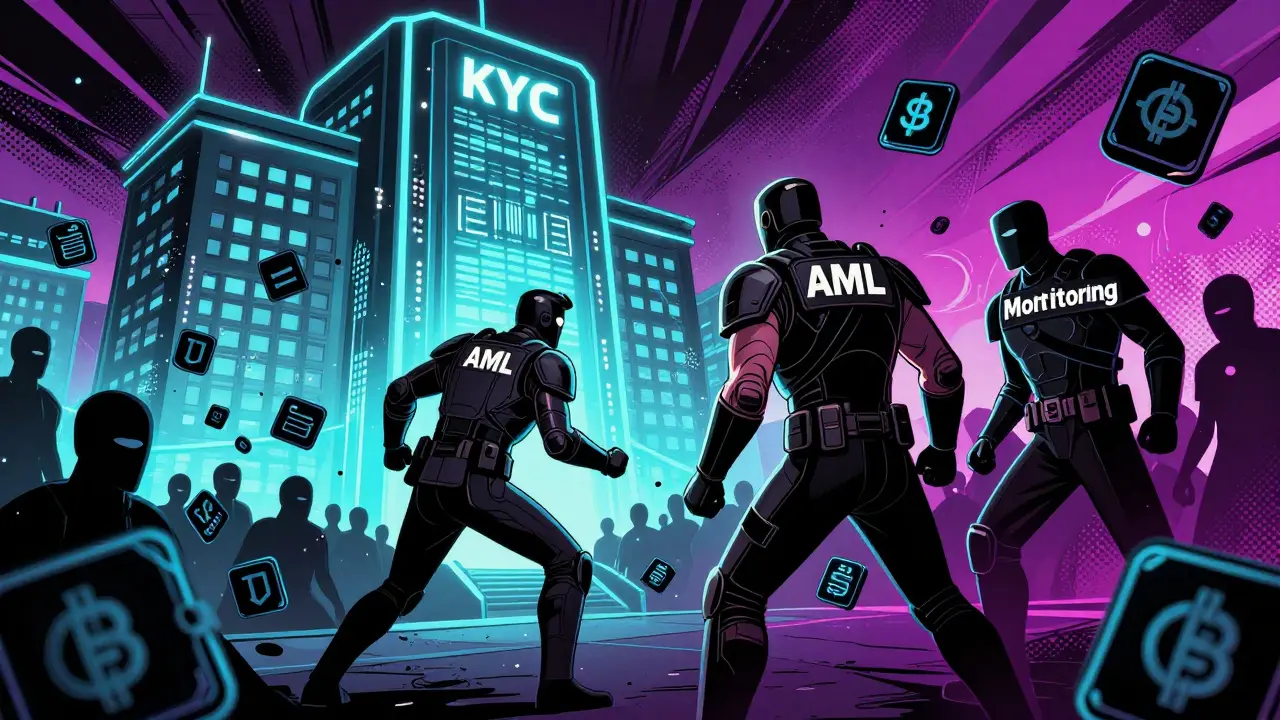
You have built a crypto exchange, launched a DeFi protocol, or opened a digital asset wallet service. The code works. The users are signing up. Then the regulator calls. They don't care about your smart contract efficiency; they care about money laundering, terrorist financing, and sanctions evasion. This is where third-party compliance tools stop being optional luxuries and become your business license.
In 2026, the era of "move fast and break things" in crypto is over. With regulations like MiCA in Europe and strict FinCEN guidelines in the US, you need automated systems to verify identities, screen for risk, and monitor transactions in real-time. Doing this manually is impossible. You need specialized software that connects on-chain behavior to real-world identities.
The Three Pillars of Crypto Compliance
To choose the right tool, you first need to understand what problem it solves. Modern crypto compliance rests on three interconnected pillars. If one fails, your entire system is vulnerable.
Identity Verification (KYC) is the first pillar. It answers the question: "Who is this person?" You cannot trust an anonymous wallet address. Tools in this category use document scanning, facial recognition, and biometric checks to confirm that the user is who they claim to be. Without robust KYC, you are blind to the actors entering your ecosystem.
AML & PEP Screening is the second pillar. Once you know who they are, you must ask: "Should we be doing business with them?" Anti-Money Laundering (AML) screening checks users against global databases of sanctioned individuals, politically exposed persons (PEPs), and known criminals. The challenge here is not just finding matches but managing false positives. A sophisticated tool uses fuzzy matching to catch aliases and near-matches without flooding your analysts with irrelevant alerts for common names.
Wallet & Transaction Monitoring is the third pillar. This answers: "What are they doing?" Even if a user passes KYC and AML checks at sign-up, their behavior can change. They might start interacting with darknet markets or mixing services. Blockchain analytics platforms connect identified users to their on-chain activity, flagging suspicious flows before they cause legal trouble.
These three pillars function as an integrated feedback loop. A high-risk transaction detected by monitoring tools should trigger re-verification of KYC data. A new PEP hit during screening should automatically lower transaction limits. Withdrawals to sanctioned wallets must freeze accounts instantly. Your compliance stack needs to handle these triggers seamlessly.
Leading Blockchain Analytics Platforms
When people talk about crypto compliance, they often mean blockchain analytics. These tools provide the "glass box" visibility into fund flows that regulators demand. Here is how the major players compare in the current landscape.
| Provider | Key Strength | Best For | Transparency Model |
|---|---|---|---|
| Elliptic | Cross-chain tracing, law enforcement-grade forensics | Large exchanges, institutional investors | High (Detailed reporting) |
| TRM Labs | Glass box attribution, transparent confidence levels | Companies requiring audit-ready transparency | Highest (Open sourcing logic) |
| Scorechain | Real-time KYT, smart contract analysis, white-glove support | Mid-market firms needing rapid integration | High (Entity clustering) |
| Chainalysis | Market dominance, broad regulatory acceptance | Global enterprises seeking standard compliance | Medium (Proprietary algorithms) |
Elliptic has long been a battle-tested option. Their platform offers deep insights into transaction monitoring, helping visualize fund flows through wallets and the entire ecosystem. Law enforcement agencies use Elliptic’s toolkit for forensic investigations, which adds a layer of credibility when you present your compliance reports to regulators. Bitget’s security team, for example, relies on Elliptic to maintain platform compliance while conducting accurate forensic investigations.
TRM Labs differentiates itself with a "glass box" approach. Many vendors provide black-box answers-they tell you a wallet is risky but not why. TRM shows you the sourcing and confidence levels for every attribution. This transparency is crucial when you need to explain your decisions to auditors or legal counsel. If your business model depends on proving exactly how you assessed risk, TRM’s architecture is designed for that scrutiny.
Scorechain positions itself as a leader in real-time Know-Your-Transaction (KYT) capabilities. Beyond simple wallet tracking, Scorechain performs smart contract analysis and entity clustering across Bitcoin, Ethereum, BNB Chain, and other networks. What sets them apart operationally is their support model. They offer white-glove support, positioning their compliance experts as partners rather than just ticket responders. For teams building out compliance from scratch, having experts act as extensions of your internal team can significantly reduce the learning curve.
KYC and Identity Verification Solutions
Blockchain analytics monitors the money; KYC tools monitor the person. For startups and mid-sized firms, integrating a dedicated identity verification provider is often more cost-effective than building custom solutions.
Providers like Sumsub, SEON, and ComplyCube specialize in this vertical. They offer APIs that handle document validation, liveness detection, and watchlist screening. Sumsub, for instance, is widely used because of its modular architecture, allowing you to pick only the checks you need. SEON focuses heavily on fraud prevention, combining KYC with device fingerprinting to detect synthetic identities.
For businesses targeting specific regions, local expertise matters. Banxa and MoonPay provide compliant on-ramps that handle much of the KYC burden for fiat-to-crypto conversions. If your primary risk is onboarding bad actors, these embedded finance solutions can offload significant liability.

Security-Focused Monitoring for DeFi
If you are running a Decentralized Finance (DeFi) protocol, traditional centralized compliance tools may not fit your architecture. You need security-focused monitoring that operates on-chain without requiring user identities.
BlockSec Phalcon provides real-time monitoring for DeFi protocols, detecting exploits and anomalies as they happen. Cipher Trace and MistTrack (by SlowMist) focus on crypto-security and fraud investigation, offering tracking capabilities tailored to decentralized environments. These tools are essential for protecting liquidity pools and smart contracts from drain attacks or sandwich attacks, complementing broader AML efforts.
Additionally, smart contract verification tools like ERC-20 Verifier and Scribble (for Solidity testing) help ensure that the underlying code meets security standards, reducing the risk of vulnerabilities that could be exploited for illicit purposes.
Accounting and Tax Compliance
Compliance isn’t just about stopping crime; it’s also about accurate reporting. Regulators require clear audit trails for every transaction. Blockchain accounting software bridges the gap between raw chain data and financial statements.
Solutions like SoftLedger, CoinLedger, and Bitwave specialize in cryptocurrency transaction management, tax report generation, and portfolio tracking. SoftLedger is particularly notable for its regulatory compliance features, providing audit trails that meet IRS and GAAP standards. For enterprises, Ledgible and Gilded offer advanced reconciliation and multi-currency support, ensuring that your books balance even when dealing with complex tokenomics and staking rewards.
How to Choose the Right Stack
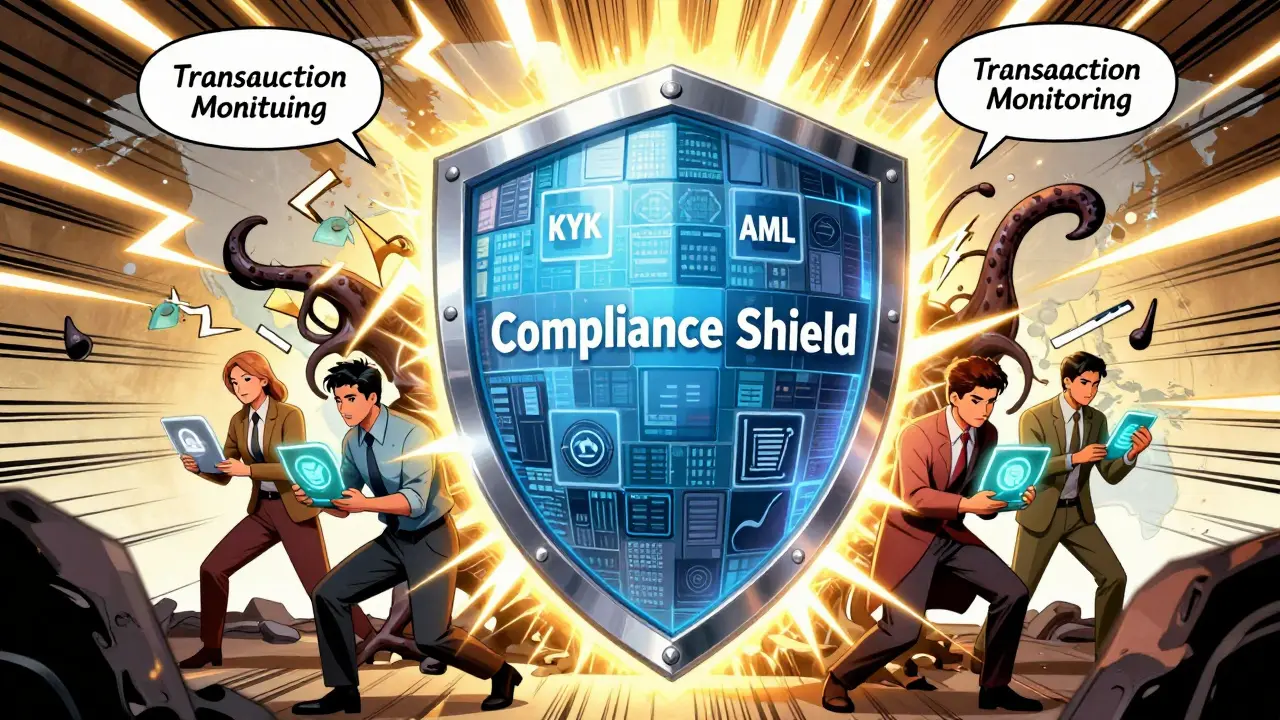
Selecting compliance tools is not a one-size-fits-all decision. You must evaluate based on your specific risk profile, volume, and regulatory jurisdiction. Here is a practical framework:
- Core Functionality (25% weight): Does the tool cover your primary risk areas? If you are an exchange, you need robust KYC and AML. If you are a DeFi protocol, you need on-chain monitoring and smart contract analysis.
- Integration Ease (25% weight): Look for flexible APIs and modular architectures. Scorechain, for example, emphasizes seamless integration so you can scale operations without expensive rebuilds. Check if the tool supports the blockchains you operate on (Bitcoin, Ethereum, Solana, etc.).
- Usability and Support (10% weight): An intuitive dashboard reduces analyst fatigue. False positive management is critical. A tool that floods your team with irrelevant alerts will slow down response times. Look for customizable dashboards and mobile accessibility.
- Regulatory Alignment: Ensure the tool generates reports that meet specific standards like MiCA in the EU or FinCEN in the US. Some tools offer pre-built templates for Suspicious Activity Reports (SARs), saving hours of manual work.
Avoid the temptation to buy the cheapest option. Compliance failures result in fines that dwarf software costs. Instead, look for providers that offer long-term partnership models, including regular updates on emerging threats and regulatory changes.
Future-Proofing Your Compliance Strategy
The regulatory landscape is evolving rapidly. In 2026, we are seeing a shift from basic box-checking to comprehensive reputation management. Regulators want to see proactive risk assessment, not just reactive reporting.
Look for tools that incorporate behavioral analysis and entity clustering. These advanced features allow you to detect sophisticated laundering techniques that involve multiple wallets and cross-chain hops. Additionally, prioritize vendors that participate in industry consortia and share threat intelligence. The more connected your compliance stack is to the broader ecosystem, the better prepared you will be for future regulatory demands.
Finally, remember that technology is only part of the solution. You need trained personnel to interpret alerts and make judgment calls. Choose vendors that offer training and expert support, ensuring your team can leverage the full power of the tools you invest in.
What is the difference between KYC and KYT in crypto?
KYC (Know Your Customer) verifies the identity of the user at onboarding, checking documents and biometrics. KYT (Know Your Transaction) monitors the ongoing behavior of wallets and transactions in real-time to detect suspicious activity after the user has been onboarded.
Which compliance tool is best for small crypto startups?
For small startups, modular solutions like Sumsub for KYC and Scorechain or ComplyCube for transaction monitoring are often ideal. They offer scalable APIs and lower entry costs compared to enterprise suites, allowing you to pay for what you use as you grow.
How do blockchain analytics tools detect money laundering?
They use heuristic algorithms and entity clustering to trace funds across wallets. By identifying patterns associated with mixers, darknet markets, or sanctioned entities, they assign risk scores to addresses and flag transactions that interact with these high-risk clusters.
Is blockchain accounting software necessary for compliance?
Yes, especially for regulated entities. Tools like SoftLedger or CoinLedger provide the audit trails and tax reports required by authorities like the IRS or HMRC. They reconcile on-chain data with financial records, ensuring accuracy and transparency.
What is the role of MiCA in crypto compliance?
MiCA (Markets in Crypto-Assets) is the European Union's comprehensive regulatory framework for crypto assets. It mandates strict KYC, AML, and transparency requirements for issuers and service providers, driving adoption of compliance tools that can generate MiCA-specific reports.
Can I use open-source tools for crypto compliance?
While open-source tools can help with basic block exploration, they lack the proprietary databases, risk scoring algorithms, and regulatory reporting features needed for full compliance. Relying solely on open-source solutions exposes you to significant legal and operational risks.
How often should I update my compliance rules?
You should review and update your compliance rules continuously. Regulatory landscapes change frequently, and new laundering techniques emerge regularly. Automated tools that integrate with live threat intelligence feeds are essential for staying current.
What is a false positive in AML screening?
A false positive occurs when a legitimate customer or transaction is incorrectly flagged as suspicious due to a name match or similar pattern. Effective tools use fuzzy matching and context-aware algorithms to minimize false positives, reducing analyst workload.
Natalie Lucas
July 3, 2026 AT 16:19omg this is so helpful!! i was totally lost on which tool to pick for my small exchange. the part about scorechain having white glove support sounds like a lifesaver since we dont have a huge team yet. thanks for breaking it down so simply!
Steven Briggs
July 5, 2026 AT 02:22the glass box approach from trm labs seems interesting. i like knowing why something gets flagged rather than just trusting a black box. feels safer for audits.
Ruth Williams
July 5, 2026 AT 18:42It is quite amusing that people still believe 'move fast and break things' has any place in regulated finance. The era of cowboy coding is dead. If you cannot afford proper KYC/AML infrastructure, you should not be in business. It is elementary risk management, really. Most startups fail because they ignore these fundamentals until it is too late.
John Harman
July 7, 2026 AT 09:59look, chainalysis is the standard for a reason. sure, elliptic is good for forensics but if you want regulatory acceptance globally, chainalysis is what the suits look for. dont overcomplicate it. just buy the market leader and sleep better at night.
Jackie D
July 7, 2026 AT 11:41i wonder how well these tools handle cross-chain mixing services? that seems like the biggest loophole right now. also, does anyone know if sumsub works well with indian users? sometimes their document verification fails for our local ids. would love some tips from others who have dealt with this headache
Kat Barr
July 7, 2026 AT 17:16love this guide!!! 😍 the table comparing providers is super useful. i think for defi protocols, blocksec phalcon is a must have. security is everything! hope everyone finds the right stack for their needs 🚀💖
Kristy Morrow
July 8, 2026 AT 01:44you all are missing the point. compliance is just a tax on innovation. but fine, if you must play by the rules, make sure you understand the philosophy behind the data. most tools are garbage. they flag noise as signal. true insight comes from understanding the behavior not just the address. stop relying on vendors and start thinking critically.
Sophie Nakasako
July 9, 2026 AT 21:40this is such a crucial topic for the longevity of our industry. i really appreciate the emphasis on the feedback loop between kyc and transaction monitoring. it makes sense that high risk transactions should trigger re-verification. it creates a dynamic safety net rather than a static checkpoint. great read!
Antony Lopez
July 11, 2026 AT 16:29american regulations are getting out of hand. fincen guidelines are designed to crush small players while letting big banks off the hook. we need sovereignty in crypto, not more surveillance tools. but yeah, if you are in the us you have no choice but to comply or shut down.
Michelle Walker
July 13, 2026 AT 05:03wake up. false positives are killing analyst productivity. most of these platforms are bloated and useless. if your tool floods you with alerts you are doing it wrong. cut the fat. use simple heuristics. stop buying enterprise bloatware.
Shay Thomson
July 14, 2026 AT 10:25oh wow, the tension in this thread is palpable! can we not agree that we all just want to build cool tech without going to jail? let's find common ground here. maybe the key is education for teams using these tools?
DJ Maleko
July 15, 2026 AT 09:56so you are saying you are running an exchange without real-time monitoring? that is reckless. i bet your wallet addresses are already tagged by multiple analytics firms. you need to see what they see before they report you. transparency is non-negotiable nowadays. 🕵️♂️📊
Logan Edmison
July 16, 2026 AT 08:25i think the future is decentralized identity. but untill then we are stuck with these centralized kyc providers. it is ironic that we use web2 tech to secure web3. anyway, softledger is pretty good for accounting if you ask me. saves hours of manual work.
Erika Pozzetto
July 18, 2026 AT 02:01Indeed, the integration of robust compliance frameworks is imperative for the sustainable growth of digital asset ecosystems. As outlined in the article, the triad of KYC, AML screening, and transaction monitoring forms the bedrock of regulatory adherence. Furthermore, the selection of appropriate blockchain analytics platforms such as Elliptic or TRM Labs must be predicated upon the specific operational requirements and jurisdictional mandates of the entity in question. It is my considered opinion that organizations failing to prioritize these technological investments will inevitably face severe reputational and legal consequences in the near future.