
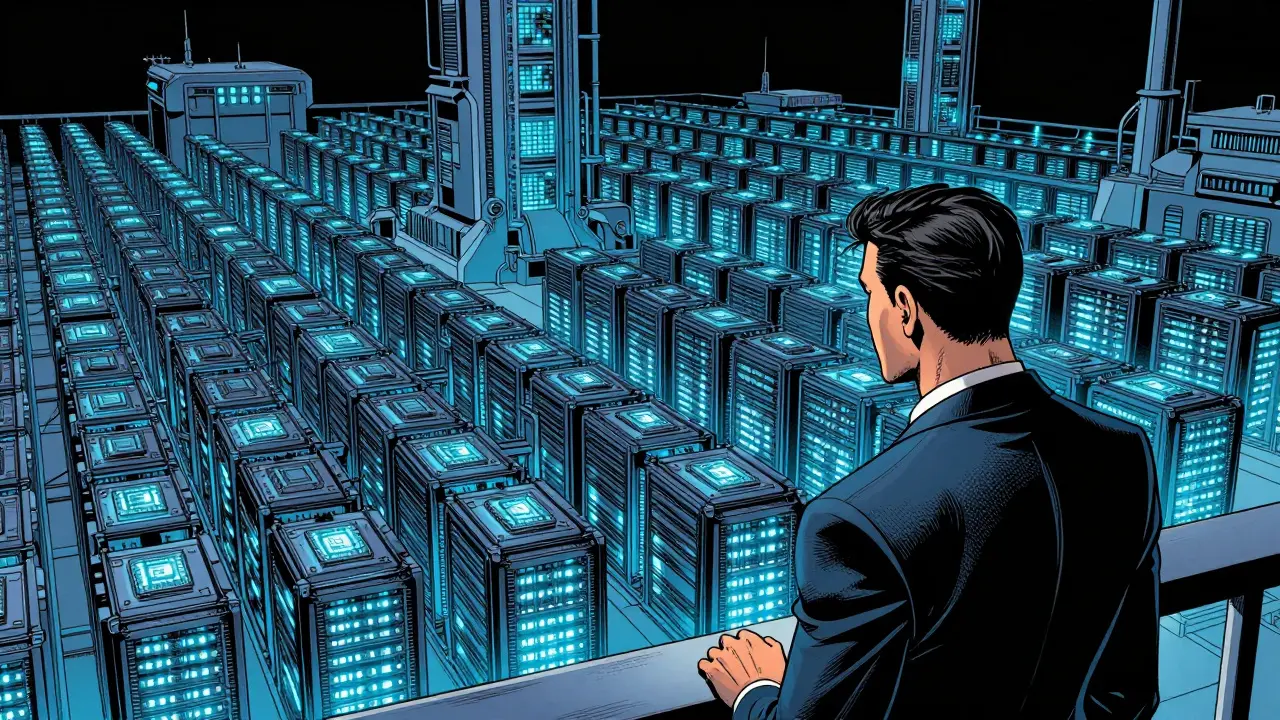
Forget the days of running a few graphics cards in a bedroom and waking up to a fortune. The game has changed. Today, cryptocurrency mining is the process of using computational power to secure a blockchain network and earn digital rewards. It has shifted from a hobbyist's experiment into a high-stakes, institutionalized digital utility sector. If you're wondering whether you can still make money mining, the answer is yes-but the barrier to entry is now a mountain of capital and a direct line to cheap electricity.
The Institutional Shift: From Garages to Data Centers
The landscape of 2026 is dominated by professional firms. Following the 2024 Bitcoin halving, which slashed block rewards to 3.125 BTC, the competition reached a fever pitch. We've seen a massive migration of hash power toward entities that can afford the scale. These aren't just "miners" anymore; they are infrastructure providers. Companies like Marathon Digital and Riot Platforms treat mining as a financial operation, optimizing every milliwatt of power to stay solvent.
Why does this matter for the average person? Because the "difficulty adjustment"-the mechanism that keeps blocks coming at a steady pace-has climbed to all-time highs. When institutional players bring in thousands of next-gen machines, the network gets harder to mine. For the individual, this means solo mining is essentially a lottery ticket. Most now rely on mining pools to smooth out their earnings, combining their power with others to share the rewards.
Hardware Realities: ASIC vs. GPU
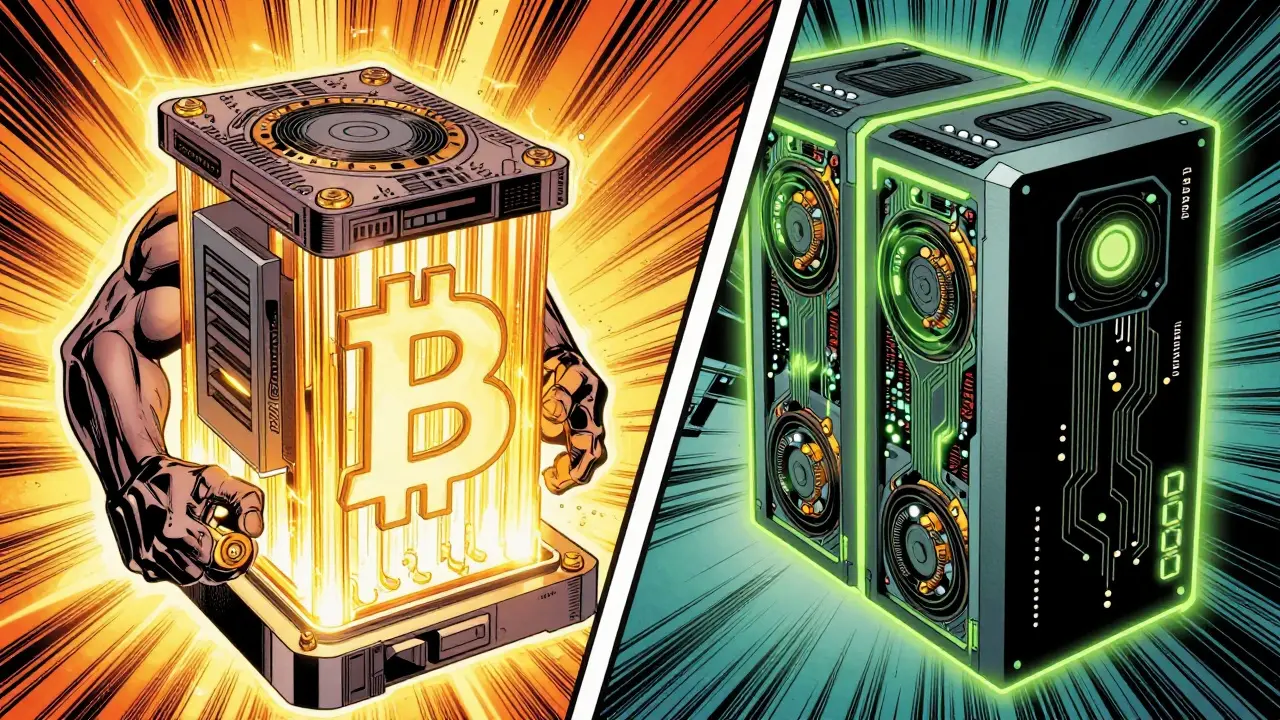
Choosing your gear is no longer a simple choice between a few brands; it's a decision about which specific algorithm you're targeting. For those chasing the big coins, ASIC (Application-Specific Integrated Circuit) hardware is the only way to play. These machines are built for one purpose and one purpose only: solving a specific hash function. For Bitcoin, you need an ASIC that can handle the load and an electricity bill that doesn't bankrupt you. Most successful operations target power costs below $0.06 per kWh to keep the lights on.
On the flip side, there's still a niche for the GPU crowd, though it's tighter than ever. The AI boom has pushed the price of NVIDIA and AMD cards through the roof, making the initial investment steep. However, ASIC-resistant coins are the playground for these miners. Algorithms like RandomX (used by Monero) are designed to favor CPUs and GPUs, preventing the "industrialization" of the network and keeping it more decentralized.
| Hardware Type | Primary Algorithm | Targeted Assets | Entry Cost | Energy Need |
|---|---|---|---|---|
| High-End ASIC | SHA-256 / Scrypt | Bitcoin, Litecoin | $10,000 - $100,000+ | Very High (<$0.06/kWh) |
| GPU Rigs | KAWPOW / Etchash | Ravencoin, ETC | $5,000 - $25,000 | Moderate (<$0.08/kWh) |
| CPU / Hybrid | RandomX | Monero (XMR) | $1,000 - $5,000 | Low to Moderate |
The Energy War and the Green Transition
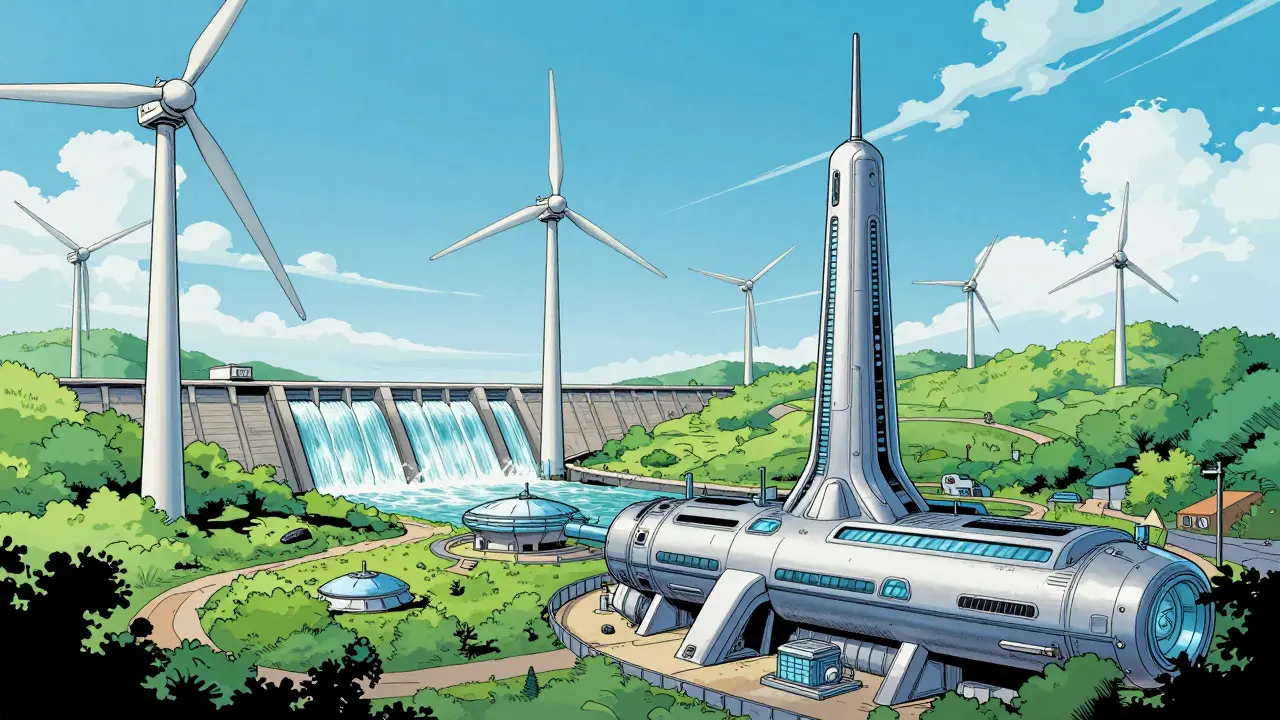
If you want to know where the most profitable mining farms are located, don't look at the stock market-look at the power grid. The future of mining is inextricably linked to Renewable Energy. We're seeing a huge shift toward regions like Paraguay and El Salvador, where hydroelectric power is abundant and cheap. In the US, states like Texas and Wyoming have become hotspots because they offer a mix of wind energy and favorable regulations.
It's not just about cost; it's about survival. Institutional investors now demand ESG (Environmental, Social, and Governance) compliance. If a mining company can't prove it's carbon-neutral or using stranded energy (energy that would otherwise go to waste), it can't get the funding it needs to grow. This has turned miners into energy consultants who help stabilize power grids by consuming excess electricity during off-peak hours.
Alternative Pathways: Cloud Mining and Hybrid Models
Not everyone wants to deal with the noise and heat of a server room. This has led to the rise of cloud mining. Essentially, you rent hashrate from a provider. While some users report high daily returns, the experienced crowd is still wary. The risk is that many cloud platforms have historically been unstable or overpriced. If you go this route, you're betting on the provider's honesty and efficiency rather than your own hardware.
A more interesting trend is merged mining. For example, Litecoin and Dogecoin are often mined together. Because they use the same algorithm, a miner can secure both networks simultaneously without needing extra power. This effectively doubles the productivity of the hardware, making it a much more viable strategy for smaller-to-medium operations.
Practical Steps for Starting a Mining Operation
If you're still determined to jump in, you need a plan. This isn't something you set up in a weekend. Expect a learning curve of 3 to 6 months just to understand the nuances of voltage tuning and thermal management. Here is the realistic workflow:
- Energy Audit: Calculate your cost per kWh. If you're paying more than $0.10 per kWh, you're likely mining at a loss unless the coin price skyrockets.
- Hardware Procurement: Decide between ASICs for stability or GPUs for versatility. Be prepared for 2-4 week lead times for industrial equipment.
- Infrastructure Setup: You can't just plug these into a wall. You'll need dedicated circuits, industrial cooling (fans or immersion cooling), and a stable internet connection.
- Software Configuration: Install mining software and join a reputable pool to ensure a steady stream of small rewards rather than waiting years for a single block.
- Tax and Legal Prep: Depending on your country, every coin you mine is a taxable event. Track your electricity costs as business expenses to offset your gains.
Common Pitfalls to Avoid
The most common mistake is "chasing the pump." Miners see a coin rising in price and buy hardware specifically for it, only to find that the network difficulty has spiked by the time the gear arrives. By the time you've set up your rig, the profit margin has vanished. Always calculate your break-even point based on the lowest expected price of the coin, not the peak.
Another trap is ignoring heat. A single ASIC can heat a room to unbearable temperatures in minutes. Without professional-grade ventilation or liquid cooling, your hardware will "thermal throttle," meaning it slows down to prevent melting, which kills your profitability. Investing in cooling is just as important as investing in the chips themselves.
Is Bitcoin mining still profitable for individuals in 2026?
For most individuals, solo Bitcoin mining is no longer profitable due to the immense hash rate and the 2024 halving. To make a profit, individuals usually need access to electricity costs below $0.06 per kWh and must participate in mining pools to stabilize their income.
What is the difference between ASIC and GPU mining?
ASICs are specialized machines designed for one specific algorithm (like SHA-256 for Bitcoin), offering massive efficiency but zero versatility. GPUs (graphics cards) are general-purpose processors that can mine various ASIC-resistant coins, making them more flexible but less powerful for major networks.
How does merged mining work?
Merged mining allows a miner to mine two different cryptocurrencies that use the same algorithm simultaneously. A great example is mining Litecoin and Dogecoin together, which maximizes the hardware's output without requiring extra electricity.
Are there any coins that can be mined with a regular computer?
Yes, coins that use ASIC-resistant algorithms like Monero (RandomX) can be mined using a standard CPU. While the profits are lower than industrial mining, it is the most accessible entry point for beginners.
What is the risk of cloud mining?
The primary risks are scams and poor transparency. Many cloud mining platforms promise unrealistic returns but fail to actually maintain the hardware they claim to own. It's often safer to own your hardware or buy the coin directly.
What to do next?
If you're a tech enthusiast with a powerful PC, start by exploring Monero or Ravencoin to understand how mining software works. It's a low-risk way to get a feel for the process. If you have significant capital and access to cheap energy, your next step should be a professional energy audit and a consultation with a hardware supplier like Bitmain or MicroBT to determine the best ASIC fleet for your budget.
Greg Reynolds
April 23, 2026 AT 20:38The notion that ASIC-resistant coins actually maintain decentralization is a quaint fantasy. All they do is shift the centralization from specialized hardware to the entities that control the most efficient general-purpose compute clusters. It's just the same game with a different set of rules.
Gloris Young
April 25, 2026 AT 12:16Totally get where this is coming from. It's definitely a tougher climb for the little guy now.
Robert Mosolygo
April 26, 2026 AT 13:17Of course the article mentions institutional players like Marathon and Riot. Follow the money. These firms are essentially puppets for the central banks to stabilize the volatility before they flip the switch on a CBDC. The 'difficulty adjustment' is just a convenient cover for the gradual scrubbing of independent miners from the ecosystem. We are witnessing the managed demolition of the original ethos of Bitcoin to ensure total state control over digital assets.
Benjamin Forg
April 28, 2026 AT 00:57typical corporate propaganda you think these data centers are just optimizing power but they are literally nodes for the new world order tracking every single hash to map the global flow of value before the big crash comes for us all
Kathleen Bergin
April 29, 2026 AT 02:27Actually, GPUs are just too slow for Bitcoin. That's why you use ASICs. It's not that complicated.
Yvette P
April 30, 2026 AT 11:56Oh, honey, let's talk about the 'entry cost' like we're actually in 2026. The sheer audacity to suggest a $10k investment is a 'barrier' while ignoring the systemic latency of the SHA-256 hashing efficiency in residential zones is just precious. Maybe if we use a few more buzzwords like 'hashrate elasticity' or 'thermal throttling thresholds' we can pretend this isn't just a giant game of musical chairs where the music stopped for anyone not owning a power plant in Texas. It's truly adorable that people still think a mining pool is a 'community' effort rather than a centralized brokerage for computational scraps. I'm just vibrating with excitement at the prospect of more people buying overpriced H100s for 'mining' while the AI bubble finally pops and leaves them with very expensive space heaters.
Alex Wan
April 30, 2026 AT 18:32I am simply devastated by the laaaack of accessibility for the new generation!! It is a travesty of the highest order that our youth cannot simply plug in a GPU and thrive!! We must collaborate to find new ways to mentor these brave souls in the face of such oppressive instutitional power!! This is a cry for help for the decentralization movement!! Please, let us find a way to make this inclusive once again for all!!
Hannah Rubia
May 2, 2026 AT 07:37It would be beneficial to consider the long-term environmental implications of such high energy requirements, as the shift toward institutional data centers often involves complex carbon credit offsets that may not be fully transparent.
Gary Lingrel
May 3, 2026 AT 20:58Imagine thinking electricity costs are the only problem here lol 🙄 it's basically a scam at this point
Eric Raines
May 4, 2026 AT 23:06I've already explained this in three other threads, but you're all missing the point. The real issue isn't the hardware, it's the lack of understanding about how the halving actually impacts the long-tail of the distribution curve. It's honestly exhausting having to repeat the basics for people who think they can 'pivot' to Monero and suddenly be rich.
Mike Krasner
May 5, 2026 AT 09:26why do we even care about mining anymore just buy the coin and stop pretending your space heater makes you a capitalist
Jagdish Sutar
May 7, 2026 AT 01:14It's a great time to learn about the underlying tech even if the profit margins are slim for individuals. I always tell my students that understanding the network is more valuable than the coins themselves.
Sarah Fisher
May 7, 2026 AT 20:17There is a certain poetic irony in the fact that a technology designed to liberate us from central authorities has become the ultimate centralized industry. We've replaced the bankers with the data center owners, yet the hunger for the 'digital gold' remains a constant in the human psyche.
Candace Sherrard
May 9, 2026 AT 19:30I find it fascinating how we view 'profitability' as the only metric of success in this space, when the actual act of securing the network provides a utility that transcends monetary gain, though admittedly the sheer scale of industrialization makes one wonder if the original dream of the peer-to-peer electronic cash system has been entirely subsumed by the logic of capital accumulation and energy arbitrage.
Jennifer Taylor
May 11, 2026 AT 01:20The big companies are just stealing the power from the poor. It's all a lie to keep us from seeing that the coins are controlled by a few people at the top who decide the price.
Mary Tawfall
May 12, 2026 AT 08:41Still a lot of room for innovation though! Maybe new ways to use waste heat will make home mining viable again.
Tara Aman
May 13, 2026 AT 22:44Omg yes! Imagine using the heat to warm up a greenhouse! That would be so amazing and sustainable!
debashish sahu
May 15, 2026 AT 18:50The perspective from different regions varies greatly, as electricity costs in some parts of Asia are still quite competitive for small-scale operations.
Alex Hunter
May 16, 2026 AT 22:50For those just starting out, don't let the high barrier to entry discourage you from learning. Start with low-power options or look into cloud mining with caution, and always prioritize education over quick returns.