
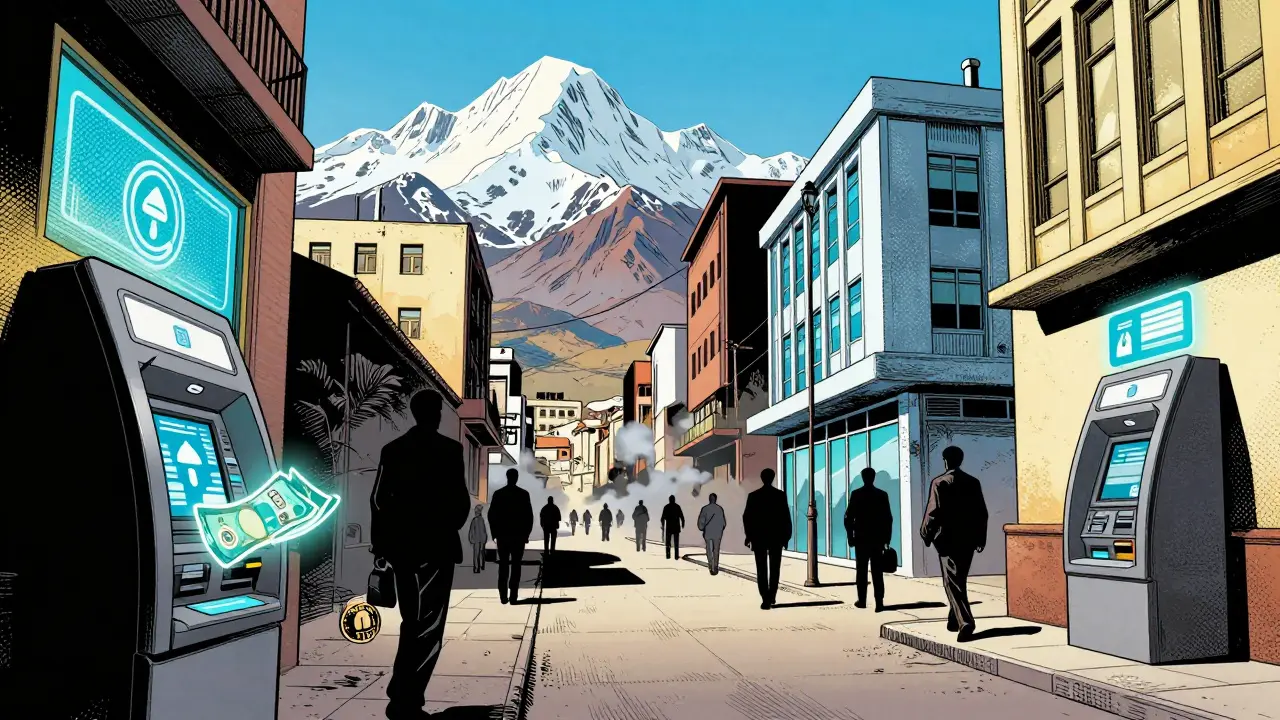
For over a decade, anyone asking about cryptocurrency digital assets including Bitcoin and stablecoins in Bolivia would get a definitive answer: it is completely forbidden. But walking around La Paz today in March 2026 tells a different story. ATMs dispensing stablecoins, local businesses accepting digital payments, and regulated exchanges operating under government licenses have replaced the black market gray zones of the past. If you read old articles claiming a total ban, you are reading outdated news. The complete prohibition ended officially in June 2024.
This massive policy reversal didn't happen overnight, but understanding the timeline is essential for anyone navigating the financial landscape here. You need to know exactly when the rules changed, who is enforcing them, and how to participate legally without running afoul of the authorities. The situation has evolved from a strict blackout period to a structured regulatory environment, creating new opportunities but also new responsibilities for users.
History of the Crypto Ban (2014-2024)
To understand where we are now, we have to look at why things were so tight before. On May 6, 2014, the Central Bank of Bolivia BCB the central monetary authority of Bolivia made a bold move. They issued a resolution explicitly prohibiting the issuance, circulation, and use of cryptocurrencies within the country. Their reasoning was rooted in protecting the national currency, the Boliviano, and shielding citizens from what was then seen as unregulated speculation and fraud risks.
This stance remained incredibly firm for nearly ten years. In December 2020, they reinforced this position with Resolution N° 144/2020, ensuring that despite global trends, Bolivia remained an outlier. During this period, trying to use crypto locally felt like walking a tightrope. While people couldn't officially trade on licensed platforms, peer-to-peer transfers still happened off-grid, often relying on foreign services or cash swaps in risky environments.
The prohibition meant that no local company could offer crypto-related services. Exchanges were blocked, wallets had no local legal standing, and financial institutions were barred from processing transactions involving digital assets. It created a paradox where citizens wanted access to modern finance, especially during times of dollar scarcity or inflation pressure, but the law forbade them from using the tools that could help.
The Great Reversal: Resolution No. 82/2024
Everything shifted dramatically on June 26, 2024. This was the day the era of prohibition officially died. The government enacted Resolution No. 82/2024 officially lifted the crypto ban in Bolivia, removing the blanket ban on virtual assets. This wasn't just a tweak; it was a fundamental policy change acknowledging that prohibition drives markets underground rather than making them disappear.
The decision came after months of internal review and analysis of international best practices. Officials recognized that neighboring countries were integrating digital assets while Bolivia risked becoming economically isolated. By allowing virtual assets, the government opened the door for Virtual Asset Service Providers VASPs providing custody, exchange, and transfer services (VASPs) to operate legally. This move signaled that the state preferred oversight over silence.
You can see the immediate effects of this resolution in how the banking sector reacted. Instead of freezing accounts upon detecting digital asset movements, banks began working with compliance teams to facilitate legitimate transactions. However, it is important to note that this initial resolution removed the ban but did not provide a full rulebook immediately. That framework arrived in the following year, bringing clarity to what was essentially a "wild west" period right after legalization.
The 2025 Regulatory Framework
Lifting the ban was step one; building a system was step two. By April 16, 2025, the Central Bank of Bolivia rolled out Resolution no. 019/2025. This document laid the groundwork for recognizing virtual assets and establishing standards for fintech development. It formally acknowledged that crypto tools could coexist with traditional banking if certain transparency requirements were met.
The most significant legislative milestone followed shortly after. In May 2025, the government passed Supreme Decree No. 5384 comprehensive legal framework for Bolivia's cryptocurrency sector. This decree established a complete legal framework for the entire sector. It introduced licensing obligations for service providers, meaning companies offering crypto services now have to register with the Central Bank. This protects you, the user, by ensuring that any platform you deposit money into is vetted and audited.
The regulations specifically addressed several key areas:
- Licensing: Any business facilitating crypto trades, custody, or exchanges must obtain a specific license from the BCB.
- Aml/KYC: Strict Anti-Money Laundering (AML) and Know Your Customer (KYC) protocols are mandatory to prevent illicit flows.
- Currency Stability: Encouraging the use of USD-pegged stablecoins for cross-border payments to mitigate local inflation volatility.
- Taxation: Clarifying income tax reporting for gains derived from digital asset trading.
This structured approach contrasts sharply with the previous decade of uncertainty. Now, when you open an account with a local crypto provider, you are entering a relationship that is governed by contract and law, not just terms of service.
Market Adoption and Real-World Impact
One might wonder if the laws match the reality on the ground. The numbers suggest an overwhelming positive reception. According to official Central Bank figures, virtual asset transactions reached $294 million in the first half of 2025 alone. This volume represents a massive jump from pre-legalization levels, indicating pent-up demand finally being met through official channels.
A prime example of this growth is the user base expansion of local platforms. Carlos Neira's crypto wallet platform, Meru, saw its user count skyrocket by 6,600% among Bolivian residents after the ban lifted. These aren't just speculative traders; many users are using these tools for remittances and daily savings. Reports from Bloomberg highlighted this surge, noting how the community embraced the technology once the fear of arrest vanished.
Practically speaking, how does this affect your daily life? You can now send money abroad using USDT Tether stablecoin pegged to the US Dollar or similar stablecoins with higher speed and lower fees than traditional SWIFT transfers. Small merchants are increasingly displaying QR codes for crypto payments alongside credit card terminals. The ecosystem is moving toward a dual-finance model where traditional and digital money operate side-by-side.
| Feature | Pre-June 2024 (Prohibited) | Post-March 2026 (Regulated) |
|---|---|---|
| Legal Status | Strictly Illegal | Fully Legal & Regulated |
| Banking Support | No Integration | Direct Fiat Ramps Allowed |
| User Risk | High (Scams, Arrests) | Moderate (Consumer Protections Exist) |
| BTC Adoption | Underground P2P Only | Licensed Exchanges Available |
| Primary Use Case | Hiding Assets | Remittances & Savings |
Regional Context and Cooperation
Bolivia's journey did not happen in isolation. Looking at the region helps put the local changes in perspective. While El Salvador neighbor country that adopted Bitcoin as legal tender took a top-down approach making Bitcoin legal tender, Bolivia chose a more measured path. They avoided declaring crypto as official currency but instead integrated it into the existing financial fabric.
There is even formal cooperation between the two nations. A Memorandum of Understanding signed recently allows Bolivia to leverage El Salvador's experience in digital asset oversight. The National Commission for Digital Assets (CNAD) in El Salvador shares intelligence tools and training with Bolivian regulators. This nation-to-nation knowledge transfer accelerates the learning curve for Bolivian officials managing complex blockchain networks.
In contrast, other regional neighbors moved in opposite directions. For instance, Algeria criminalized all digital asset operations recently. Seeing such divergent paths highlights how specific economic conditions drive policy. In Bolivia, the primary driver was the need to improve liquidity for citizens facing currency volatility, whereas others prioritized controlling capital flight. Understanding these nuances explains why Bolivia's regulations are pragmatic rather than ideological.

Compliance Checklist for Users
If you are looking to participate in this market today, you must follow the rules to stay protected. With Supreme Decree No. 5384 in place, the government has set clear boundaries for safety. Follow this checklist to ensure your activities remain compliant and secure:
- Verify Provider Licenses: Only use platforms that display their Central Bank registration number. Check the BCB website for valid VASPs.
- Complete Identity Verification: Never attempt to bypass KYC checks. Anonymous wallets are restricted on regulated exchanges.
- Report Income: Declare any profits from trading to the tax authority if they exceed the annual thresholds defined by the Ministry of Economy.
- Avoid Unregistered Tokens: Stick to major assets like Bitcoin or regulated stablecoins. Unlisted tokens carry high security risks outside investor protection schemes.
- Secure Your Assets: Utilize hardware wallets or reputable custodial solutions that adhere to the new security mandates.
These steps might sound tedious, but they are the price of legitimacy. The days of operating entirely off the grid are gone for serious investors. By staying within the framework, you gain access to banking bridges and legal recourse in case of platform failure.
Future Outlook and Remaining Challenges
As we move further into 2026, the focus shifts from legality to sophistication. Experts predict continued refinement of the rules, particularly regarding smart contracts and decentralized finance (DeFi). The current infrastructure handles centralized tokens well, but regulating code-based money remains a challenge globally.
Community feedback suggests that while enthusiasm is high, some concerns linger about consumer protection speeds. As the market expands, regulators are under pressure to respond faster to scams that adapt to new tech. However, the establishment of joint task forces with international bodies helps close gaps quickly.
The broader economic implication is clear: digital assets are now a permanent fixture in the Bolivian economy. Whether it is remittances from expats or local savings hedges against inflation, the utility drives the policy. For users, this means the worst-case scenario of a re-ban is highly unlikely, given the current depth of integration.
Is cryptocurrency still illegal in Bolivia?
No, it is not. The complete prohibition was officially lifted by Resolution No. 82/2024 on June 26, 2024. Since then, buying, selling, and holding crypto assets has been legal, though strictly regulated under Supreme Decree No. 5384.
Do I need a license to trade Bitcoin personally?
Individual users do not need a license to trade for personal investment purposes. However, service providers acting as intermediaries (exchanges, wallets) must obtain a license from the Central Bank of Bolivia to operate legally.
Can I use stablecoins for cross-border payments?
Yes, the Central Bank utilizes USD-pegged stablecoins for remittances and cross-border trades. Using stablecoins for stability in a volatile currency environment is encouraged under the new framework.
Are there taxes on crypto profits in Bolivia?
Taxation depends on whether the activity is considered income or investment. Recent decreurs require declaration of profits exceeding certain thresholds, but specific rates vary by individual status and transaction type. Consult a local accountant.
What happened to the 2020 ban?
Resolution N° 144/2020, which reaffirmed the ban, was superseded by Resolution No. 82/2024. The older regulations are no longer in effect, and the legal framework has moved to the post-2024 regulatory model.
Leah Lara
March 30, 2026 AT 18:10seems cool i guess but why write so much about it
Addy Stearns
March 31, 2026 AT 14:28The concept of monetary sovereignty shifts significantly when digital ledgers become accepted infrastructure
We must consider how trust is rebuilt after a decade of prohibition
People lived in fear of legal repercussions for basic financial choices
That psychological burden affects economic participation in profound ways
Now the government acknowledges the inevitability of technological adoption
This transition from suppression to regulation marks a cultural pivot
Financial privacy becomes a matter of compliance rather than evasion
Citizens gain recourse through established legal frameworks
However, history shows that regulations often evolve faster than enforcement
We see similar patterns in other emerging markets adopting fintech solutions
The interplay between tradition and innovation remains the core challenge
Stability depends on consistent application of these new decrees
If rules change too frequently, investor confidence may wane
Patient observation of the next twelve months will provide clarity
Ultimately, the resilience of the local currency hinges on public trust
Lisa Walton
April 1, 2026 AT 18:58oh sure because government oversight is always safe and reliable lol
Wade Berlin
April 2, 2026 AT 01:25classic move wait until taxes come and swallow everything you earn
Cara Boyer
April 3, 2026 AT 16:39It s obivous the feds want contol now :)
You think its about safety no way
Their goal is to track every cent u spend
They claim it for stability but realy for power :)
Joy Crawford
April 4, 2026 AT 18:56so happy we dont need to hide anymore :)
finally we can use our money properly
the old days were super scary
i feel so much relief now :)
Shubham Maurya
April 6, 2026 AT 03:13u r ignoring the risks 😬💸
banks will still steal ur identity info
stablecoins crash anytime they want 😱
don t be so naive bro 💀👋
Raymond K
April 7, 2026 AT 16:46what an amasing stride forward fr the masses!
evryone gets to participate in the future now
its gonna be soo much fun building wealth
hope u all stay safe and smrt though!
we shud celebrate this huge win for us all!
Markus Church
April 8, 2026 AT 10:05The regulatory framework demonstrates a commitment to financial integrity
Such measures typically require extensive background verification processes
One must understand that compliance entails significant administrative burdens
These protocols are designed to mitigate systemic risk exposure
Transparency remains the cornerstone of sustainable market development
International cooperation aids in harmonizing these standards effectively
The potential for fraud reduction is quite substantial indeed
Stakeholders should monitor implementation fidelity closely
Adherence to guidelines ensures long term viability of services
Governance structures must remain adaptable to technological shifts
Diligent observation of early outcomes will inform future policy adjustments
Safety mechanisms appear robust but require continuous testing
Samson Abraham
April 8, 2026 AT 22:48very good read
Beverly Menezes
April 10, 2026 AT 10:32this helps everyone feel safe
good thing they fixed the laws
Michael Nadeau
April 12, 2026 AT 09:40money is trust made digital now
Tiffany Selchow
April 14, 2026 AT 09:02only people who failed at banking do this stuff
real money stays in the bank where it belongs
stop chasing shiny objects and get normal jobs
Jay Starr
April 15, 2026 AT 16:52imagine living in that fear for ten years
it feels like a movie plot but real life here
the atmosphere in La Paz must be totally different now
i hope no one gets hurt in the transition period
Colin Finch
April 16, 2026 AT 02:51the digital tapestry weaving into the economy creates vibrant new possibilities
local merchants flourish while global connections strengthen ties
financial literacy spreads like wildfire through communities eager for progress
innovation blooms where restriction used to stifle ambition completely
cultural acceptance grows as fear dissipates into cautious optimism over time