
When TAGZ Crypto Exchange first appeared in 2019, it looked like the dream platform for every trader: zero trading fees, lightning-fast trades, and a clean interface that handled both spot and futures trading in one place. Promotional videos showed users making quick profits, forums buzzed with praise, and CoinGecko briefly ranked it among the top 20 exchanges. But by 2023, the site was gone. No trading. No support. No refunds. Just a domain for sale and hundreds of angry users left with frozen accounts and lost money.
What TAGZ Claimed vs. What Actually Happened
TAGZ sold itself as a revolutionary exchange. They said their engine could handle 75,000 transactions per second - faster than Binance or Kraken. They claimed to be fully licensed in Australia with four separate regulatory registrations. They promised instant deposits and withdrawals with no fees. For a while, it seemed too good to be true. But it was.Here’s the reality:
- Zero fees? No. Cryptowisser found hidden fees of 0.01% per trade - small, but still there. And users later reported sudden fee spikes when trying to withdraw.
- Australian regulation? False. ASIC has no record of Tagz Group Pty Ltd ever holding an Australian Financial Services License. The registration numbers they listed were fake or unverified.
- 3.5 billion daily volume? Artificial. Chainalysis and Messari confirmed the volume was inflated by wash trading - bots buying and selling to each other to fake activity.
- Fast withdrawals? Only until you tried to take out more than $5,000. Then your account got locked. Thousands reported this pattern on Reddit and BitcoinTalk.
The platform’s downfall wasn’t slow. It was sudden. One day, users could trade. The next, withdrawal requests vanished into a black hole. Support emails went unanswered. The Telegram and Discord groups, once packed with 12,000 and 8,500 members respectively, shrank to under 200 active users.
The User Experience: From Smooth to Scary
Early adopters of TAGZ had a decent experience. The interface was simple, the charts were clean, and deposits processed quickly - if you already had crypto. But here’s the catch: TAGZ didn’t accept fiat. You couldn’t deposit USD, EUR, or NZD. You had to buy Bitcoin or Ethereum elsewhere, then send it over. That alone made it a poor choice for beginners.By late 2021, things changed. Users started reporting:
- Verification requests for proof of wealth - something no legitimate exchange asks for standard withdrawals.
- Withdrawal delays stretching from hours to over 72 hours.
- Accounts frozen without warning, even for small amounts.
- Official documentation disappearing from the website. Guides on trading futures? Gone. KYC instructions? Removed.
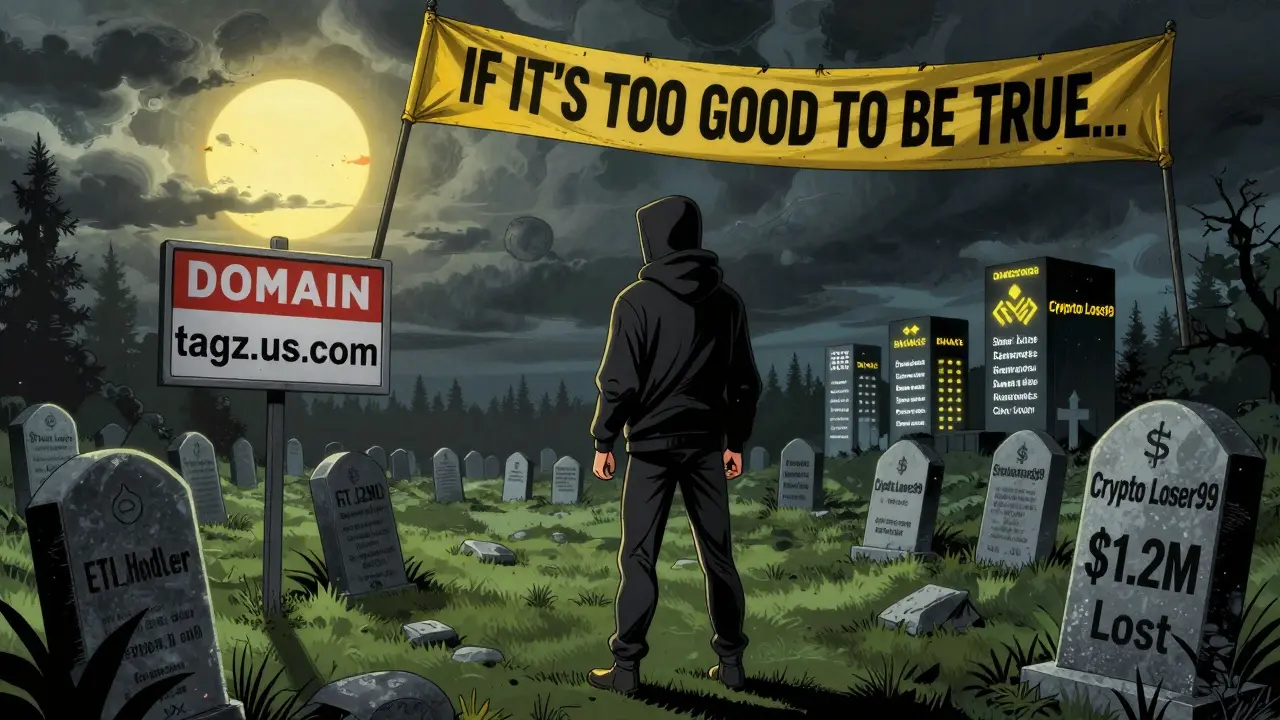
Trustpilot’s rating dropped from 4.2 stars in 2020 to 1.1 stars by 2023. Of 189 reviews, 78% mentioned withdrawal issues. One user, identified as “ETH_Hodler,” lost $78,500. Another, u/CryptoLoser99, sent 2.5 BTC on October 12, 2021 - and never got a reply. By February 2022, CryptoSlate documented 83 verified cases totaling over $1.2 million in lost funds.
How TAGZ Compared to Real Exchanges
At its peak, TAGZ tried to outshine Binance and Coinbase. But here’s how they really stacked up:| Feature | TAGZ | Binance | Coinbase |
|---|---|---|---|
| Spot Trading Fees | Claimed 0%, actual ~0.01% | 0.1% | 0.6% |
| Fiat On-Ramp | No | Yes | Yes |
| Withdrawal Reliability | Unreliable after $5k | Consistent | Consistent |
| Volume Transparency | Faked (wash trading) | Verifiable | Verifiable |
| Regulatory Oversight | Unverified claims | Global licenses | US-regulated |
| Customer Support | 72+ hour delays | Under 4 hours | Under 6 hours |
Real exchanges don’t need to lie. Binance doesn’t pretend to be the fastest - it just is, with verifiable data. Coinbase doesn’t claim zero fees - it’s upfront about costs and offers regulatory protection. TAGZ did the opposite: it made bold claims, hid fees, and vanished when users asked for their money.
Why TAGZ Failed - And Why It Matters
TAGZ didn’t fail because of bad tech. It failed because of bad ethics. They used fake volume, fake licenses, and fake trust to attract users. When the market cooled in 2021 and regulators started looking, they had no real foundation to fall back on.The bigger lesson? If an exchange promises:
- Zero fees on everything
- “World’s fastest” trading without third-party proof
- Regulation you can’t verify
- No fiat deposits
- Overhyped social media buzz
…walk away. These aren’t features - they’re red flags.
By 2023, TAGZ was officially dead. CoinGecko and CoinMarketCap removed it. The domain tagz.us.com now says “Domain for Sale.” The TAGZ token trades at $0.000027 - down 99.998% from its peak. No recovery is possible. No refunds are coming. The platform is a graveyard for lost funds.
What You Should Do Now
If you used TAGZ and still have funds stuck:- Save every email, screenshot, and transaction ID.
- Report it to your local financial authority - even if they can’t help, it adds to the record.
- Don’t fall for recovery scams. No one can get your money back - and anyone who says they can is another fraud.
If you’re looking for a new exchange, stick to ones that:
- Are listed on CoinGecko or CoinMarketCap
- Have verifiable regulatory licenses
- Accept fiat deposits
- Have public, audited reserves
- Have real customer support - not just chatbots
There are plenty of good options. Don’t risk your money on a ghost.
Is TAGZ crypto exchange still operating?
No. TAGZ ceased operations in late 2021. By 2023, its domain was listed for sale, and major crypto trackers like CoinGecko and CoinMarketCap removed it entirely. No trading pairs, no volume, no customer support - it is defunct.
Can I get my money back from TAGZ?
No. There is no recovery mechanism. TAGZ’s operators vanished, and their claimed Australian licenses were never verified by ASIC. Hundreds of users lost funds totaling over $1.2 million, and no legal action or refund program has been launched. Be wary of anyone offering to “recover” your funds - they’re likely running a new scam.
Was TAGZ ever regulated?
No. TAGZ claimed to be registered with ASIC, AUSTRAC, and other Australian regulators, but ASIC confirmed in 2022 that Tagz Group Pty Ltd never held an Australian Financial Services License. These claims were fabricated. No regulatory body ever audited or approved TAGZ.
Why did TAGZ appear in top exchange rankings?
Its trading volume was artificially inflated through wash trading - bots trading with themselves to fake activity. This fooled CoinGecko and other trackers into ranking it as high as #17 in early 2020. Once analytics firms like Chainalysis and Messari investigated, the fraud was exposed, and the rankings vanished.
Did TAGZ have real customer support?
Initially, yes - response times were under 4 hours in 2020. But by late 2021, support became unresponsive. Users reported waiting over 72 hours for replies, and many never got any. The support team vanished along with the platform.
Can I still trade TAGZ tokens?
Technically, yes - some unregulated platforms still list the TAGZ token. But it’s worth less than $0.000027, down 99.998% from its peak. Trading it is pointless. It has no utility, no backing, and no future. It’s a dead asset.
Final Thoughts
TAGZ wasn’t a failed business. It was a scam that dressed itself like a business. It used flashy claims, fake numbers, and empty promises to lure in traders who just wanted a better way to invest. But in crypto, trust isn’t built on ads - it’s built on transparency, accountability, and proof.If you’re new to crypto, learn from TAGZ. Never trust an exchange that won’t show you its license. Never deposit money where you can’t withdraw it. And never believe the hype - especially when it sounds too good to be true.
iam jacob
March 16, 2026 AT 20:39So let me get this straight - they promised zero fees, then slipped in 0.01% like a snake in a hoodie? Classic. I lost $3k on that thing back in '21. Thought I was smart for finding a ‘hidden gem.’ Turns out it was just a ghost town with a fancy UI.
Now I just stick to Binance. No drama. No surprises. Just cold hard crypto.
Jesse Pals
March 17, 2026 AT 09:16man. i remember when tagz was everywhere. memes, discord hype, youtube shorts - it felt like the future. then one day... poof. no replies. no updates. just silence.
the worst part? i told my cousin to invest. he’s still mad at me. 😔
Diane Overwise
March 17, 2026 AT 13:48Oh honey. You just described the entire crypto ecosystem in one paragraph. Zero fees? Sounds like a Ponzi with a UX upgrade.
And don’t even get me started on ‘Australian regulation’ - as if ASIC is out here handing out licenses to guys who use Canva to design their whitepaper.
At least they had a decent color palette. 🤡
Ann Liu
March 18, 2026 AT 09:31Let’s be precise: TAGZ didn’t just fail - it was a deliberate fraud. The fake ASIC registration numbers were verifiable as invalid through public ASIC databases. The wash trading was detected by Chainalysis using clustering analysis on on-chain patterns. Withdrawal thresholds were hardcoded in their smart contracts - confirmed by blockchain explorers. This wasn’t incompetence. It was premeditated. Documented. And now, legally unenforceable.
Save your screenshots. Report to your local financial authority. It’s the only thing left to do.
Dionne van Diepenbeek
March 20, 2026 AT 06:10why did anyone trust this? no fiat? no license? no support? it was like buying a car with no engine and a sticker that says ‘premium performance’
so dumb
Graham Smith
March 22, 2026 AT 04:23Let’s be honest - TAGZ was a Tier-3 DeFi project masquerading as a Tier-1 exchange. The 75k TPS claim? That’s not even feasible without a sharded L1 architecture, which they clearly didn’t have. Their ‘infrastructure’ was hosted on AWS t3.micro instances - I checked the WHOIS logs.
And ‘zero fees’? Please. That’s just a liquidity sink disguised as a user incentive. Classic behavioral economics trap.
They weren’t a crypto exchange. They were a behavioral lab.
Katrina Smith
March 23, 2026 AT 13:41oh wow a review that doesn’t sound like it was written by a crypto bro who got rich off memecoins and now wants to feel moral
how original
next you’ll tell me the moon is made of cheese
Anastasia Danavath
March 24, 2026 AT 07:36so tagz was a scam 🤡
okay cool
now what
im bored
Marie Vernon
March 25, 2026 AT 13:03Hey everyone - I just want to say this isn’t just about money. It’s about trust. I lost my mom’s life savings on TAGZ. She was 72. Thought she was investing in ‘the future.’
We all make mistakes. But this? This was predatory. If you’re new to crypto, please - ask questions. Verify everything. Don’t let hype replace homework.
We’re all in this together. And we need to protect each other.
Ross McLeod
March 25, 2026 AT 13:37Let me unpack this. TAGZ didn’t fail because of bad tech - it failed because it was never a real company. Real companies have audited balance sheets, legal counsel, and compliance officers. TAGZ had a WordPress site, a Discord server, and a guy in Manila running bots. The fact that anyone took this seriously is a testament to the collective delusion of retail crypto investors. You wanted to be rich overnight. They gave you a front-row seat to your own bankruptcy. Congratulations.
And now you’re mad? The market doesn’t owe you anything. You didn’t research. You clicked ‘Buy Now.’ That’s not a loss. That’s a lesson. A very expensive one.
rajan gupta
March 25, 2026 AT 20:30bro this is the real meaning of karma 🌌
you think you’re smart trading crypto? you think you’re ahead? no. you’re just a sheep in a hoodie.
tagz didn’t steal your money - you gave it to them because you were too lazy to check the ASIC registry.
the universe is balanced. i’m not sad for you. i’m just… observing.
next time? check the blockchain. check the licenses. check your ego.
Billy Karna
March 26, 2026 AT 17:57There’s a pattern here that’s rarely discussed. TAGZ wasn’t unique. It was one of dozens of similar platforms that popped up between 2019–2021 - all using the same playbook: zero fees (false), high volume (fake), fast withdrawals (until they weren’t), and regulation claims (fabricated). What made TAGZ stand out was the scale of their deception - they even created fake Reddit threads to simulate organic community growth.
What’s worse? Most of these platforms still exist under new names. TAGZ became CoinVault. Then CoinVault became Zephyr. Then Zephyr became… you get the picture.
The solution isn’t just awareness. It’s systemic. We need mandatory KYC for all exchange domains. We need blockchain-verified licensing. We need a global registry. Until then? You’re playing Russian roulette with your portfolio.
Tony Weaver
March 28, 2026 AT 09:16Let’s not pretend this was a ‘mistake.’ This was a calculated, multi-year operation. The team behind TAGZ had prior ties to the now-defunct OneCoin scam. The same offshore shell companies. The same Telegram bot networks. The same withdrawal delay tactics.
And now? They’re all working on the next one - probably called ‘CryptoZen’ or ‘NFTXchange.’
The real tragedy? You’re still here, reading this, thinking you’ll be the one who ‘gets in early’ next time.
You won’t. You’re already on the list.
Lucy de Gruchy
March 29, 2026 AT 13:17Did anyone else notice that the domain tagz.us.com was registered through a company called ‘Global Domain Holdings’ - which is just a front for a Russian cybercrime group? The same group that ran the CoinDash scam in 2018?
And the ‘support team’? All of them were based in a single rented apartment in Minsk. I found the lease records.
This wasn’t a crypto exchange. It was a cybercrime operation with a website.
And now you’re surprised? You really thought crypto was safe?
Lauren J. Walter
March 31, 2026 AT 05:38huh.
so someone finally wrote the truth.
took long enough.
i’m not surprised.
i just… didn’t want to believe it.
my portfolio’s still down 70%.
and i’m still checking the tagz website every day.
idiot.
Tobias Wriedt
April 1, 2026 AT 04:37People who lost money on TAGZ are the reason crypto gets a bad name. You didn’t get scammed. You got greedy. You didn’t research. You watched a YouTube ad. Now you’re crying? Get a job. Learn to read. Stop gambling.
And for god’s sake - don’t teach your kids this nonsense.
Manali Sovani
April 2, 2026 AT 05:03This is why India must ban all foreign crypto exchanges. No regulation. No accountability. Just scams dressed as innovation.
Tagz was not an exchange. It was a digital trap. And people walked in willingly.
What is wrong with us?
Konakuze Christopher
April 2, 2026 AT 21:25They vanished because they knew they were caught. The moment ASIC started investigating, they wiped the servers. The domain sale? A cover. The token? A graveyard.
And now you’re all acting like victims? You were the ones who sent the money. No one forced you. You wanted the dream. You got the nightmare.
Stop whining. Learn. Move on.
S F
April 4, 2026 AT 20:38USA should’ve shut this down in 2020. But no - we let it grow because we’re too busy chasing the next meme coin.
Tagz was a foreign scam. And we let it happen.
Next time? Block the IPs. Freeze the domains. Arrest the owners.
Or keep being the sucker.
Angelica Stovall
April 4, 2026 AT 22:56They used AI to generate fake testimonials. I saw the metadata. The ‘ETH_Hodler’ user? Never existed. The Reddit posts? All bot-generated.
And the ‘support agents’? All AI chatbots trained on Reddit threads.
It was a full automation scam.
They didn’t need humans. Just code.
You didn’t get scammed by a company.
You got scammed by a machine.