

You might have heard that Switzerland is a haven for crypto investors. But does that mean you pay zero taxes on your Bitcoin holdings? Not exactly. The reality is more nuanced than the headlines suggest. While Switzerland offers one of the most favorable regimes in the world for private crypto investors, it comes with strict rules about how you declare and value your assets.
If you hold cryptocurrency as part of your private wealth, you generally won’t pay capital gains tax when you sell. However, you will likely pay an annual wealth tax on the total value of those holdings. This distinction between income tax and wealth tax is the key to understanding the Swiss system. Get this wrong, and you could face penalties or reclassification as a professional trader, which changes everything.
How Switzerland Classifies Your Crypto Assets
To understand your tax liability, you first need to know how the Swiss Federal Tax Administration (FTA) views your digital assets. Unlike some countries that treat crypto as cash or property, Switzerland classifies cryptocurrencies as "crypto-based assets" (kryptobasierte Vermögenswerte). This places them in the same category as stocks, bonds, and other private wealth instruments.
This classification was formalized in an FTA working paper issued on August 27, 2019, and updated significantly on December 14, 2021. The update introduced a three-tier token classification system that directly impacts your tax treatment:
- Payment Tokens: These are cryptocurrencies like Bitcoin or Ethereum used primarily for payments. They are treated as private wealth assets.
- Asset-Backed Tokens: These represent underlying assets like gold or real estate. They follow similar rules to traditional securities but with specific reporting requirements.
- Utility Tokens: These grant access to a network or service. Their tax status depends on their specific usage characteristics and whether they generate passive income.
The regulatory backbone for this approach is the DLT Act (Distributed Ledger Technology Act), which came into force in August 2021. This legislation established Switzerland as a global hub for digital assets by providing legal certainty rather than prohibitive measures. For you, this means the law recognizes your crypto holdings as legitimate financial assets, not speculative gambling chips.
The Private Investor vs. Professional Trader Distinction
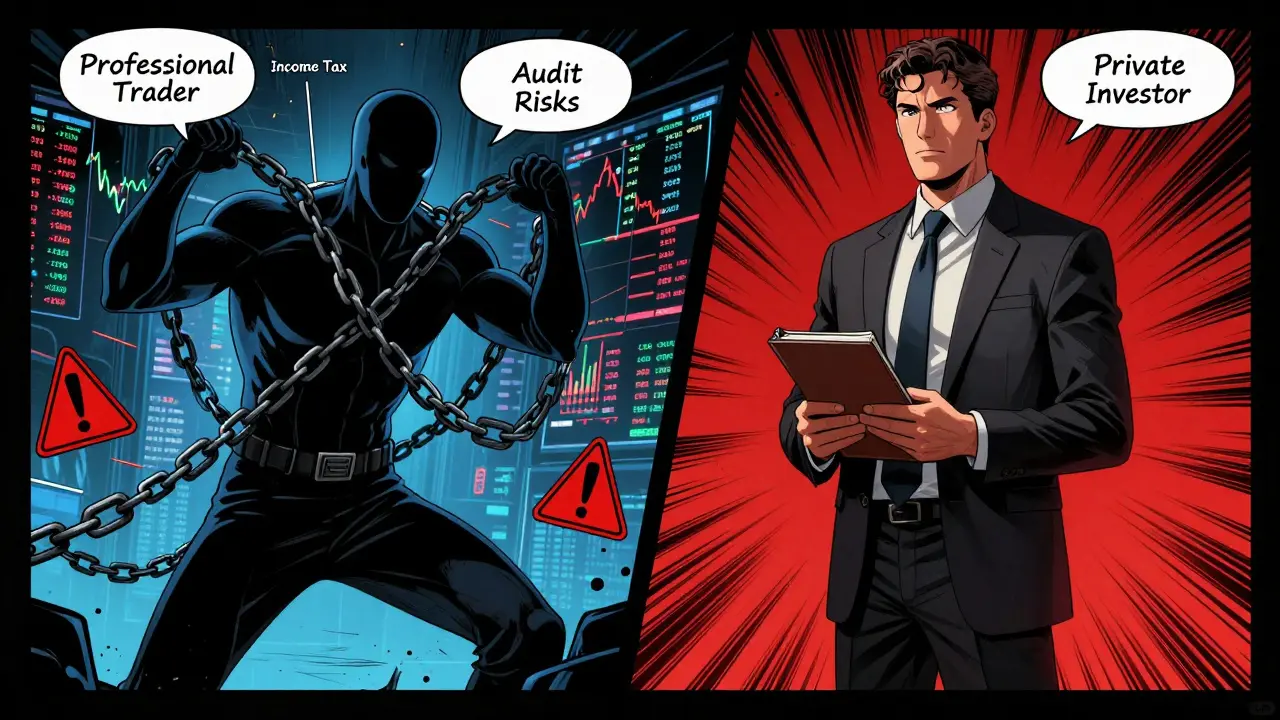
This is where most investors get tripped up. Your tax outcome depends entirely on how the authorities classify your activity. Are you a private investor holding crypto for long-term appreciation, or are you a professional trader actively buying and selling?
If you are classified as a private investor, you benefit from a massive advantage: complete exemption from capital gains tax (CGT) on your cryptocurrency profits. It doesn’t matter if you made $10,000 or $10 million; if it’s considered private wealth management, you pay no tax on the gain itself. This applies to all private wealth assets, including stocks and bonds.
However, if the FTA determines you are a professional securities trader, the rules change drastically. Under FTA Circular No. 36, factors such as the frequency of transactions, the volume of trades, and the use of specialized knowledge can trigger professional status. If you fall into this category, your crypto gains are added to your taxable income. You will then pay federal income tax (ranging from 0% to 11.5%), cantonal income tax, and municipal income tax on those profits.
For businesses holding crypto as inventory or trading assets, there is no exemption. All gains are subject to standard corporate income tax rates. The line between "investing" and "trading" is thin, so maintaining clear records of your intent and strategy is crucial.
Calculating Your Annual Wealth Tax
Even if you don’t pay capital gains tax, you still owe wealth tax. In Switzerland, wealth tax is levied annually on the total net worth of an individual as of December 31st. This includes all cryptocurrencies held at year-end, regardless of when you bought them or whether you sold any during the year.
Here is how you calculate the value of your crypto for wealth tax purposes:
- Check FTA Official Rates: The FTA publishes official year-end conversion rates for major cryptocurrencies, including Bitcoin, Ethereum, Ripple, Bitcoin Cash, and Litecoin. You must use these rates to convert your holdings into Swiss francs (CHF).
- Use Exchange Prices for Altcoins: If your cryptocurrency is not listed in the FTA’s official table, you must use the year-end price from the trading platform where you execute your buys and sells.
- Fallback to Acquisition Cost: If no current market value can be determined (for example, for very illiquid tokens), you must declare the asset at its original purchase price in CHF.
Wealth tax rates vary significantly across Switzerland’s 26 cantons. Most cantons impose rates ranging from 0.3% to 1% annually on total declared wealth. Some cantons offer exemptions for the first portion of your wealth (the "zero-rate zone"), which can reduce your effective tax burden. For example, Zurich has a lower rate compared to Geneva, but the calculation methods differ. Always check the specific regulations of your canton of residence.
Valuation Challenges and Compliance Risks
While the tax rates may seem low, the administrative burden is high. Many investors report challenges in obtaining accurate valuations for lesser-known cryptocurrencies. The FTA does not provide rates for every altcoin, meaning you are responsible for tracking prices yourself.
Mistakes here are costly. If you undervalue your holdings, you risk underpayment penalties. If you overvalue them unnecessarily, you’re paying more tax than needed. The key is meticulous record-keeping. You should maintain a ledger that tracks:
- Date and time of each transaction
- Quantity of crypto acquired or disposed of
- Price per unit at the time of transaction
- Total value in CHF at year-end
Recent updates from December 2024 clarified that mining activities constitute taxable business income, while staking rewards require careful analysis. Staking rewards are often treated as income generation rather than wealth appreciation, potentially triggering income tax liabilities even for private investors. DeFi participation also falls under existing provisions, but the lack of specific guidance means you must apply general principles cautiously.
| Investor Type | Capital Gains Tax | Wealth Tax | Reporting Requirement |
|---|---|---|---|
| Private Investor | Exempt | Yes (0.3%-1%) | Annual declaration of holdings |
| Professional Trader | Taxable (Income Tax Rates) | Yes (on remaining assets) | Detailed transaction logs |
| Business Entity | Taxable (Corporate Tax) | N/A (Corporate Net Worth) | Full audit trail required |

Strategies for Minimizing Your Tax Burden
Since you cannot avoid wealth tax entirely if you hold significant assets, optimization becomes important. Here are common strategies used by Swiss crypto investors:
Cantonal Domicile Selection: Moving your tax residence to a canton with lower wealth tax rates or higher zero-rate zones can save thousands. Cantons like Zug and Schwyz are popular among crypto entrepreneurs due to their favorable tax environments.
Family Structuring: Distributing assets among family members can keep each person’s wealth below certain thresholds, reducing the overall tax rate. However, this must be done carefully to avoid being flagged as artificial splitting.
Timing Disposals: While private investors don’t pay CGT, timing matters for wealth tax calculations. Selling assets before December 31st removes them from your year-end wealth assessment, potentially lowering your next year’s wealth tax bill.
Debt Deductions: If you borrowed money to buy crypto, you can deduct the debt from your taxable wealth. This reduces your net asset base, thereby lowering the wealth tax owed. Keep loan agreements and interest payment records handy.
Looking Ahead: Stability and Future Changes
As of May 2026, Switzerland maintains its position as Europe’s leading cryptocurrency jurisdiction. The Swiss Blockchain Federation reports continued growth in crypto businesses establishing operations here. Industry analysts project stability through 2025 and beyond, with no major changes expected to the core wealth tax structure.
The country’s commitment to technology-neutral taxation ensures that emerging developments like NFTs and decentralized finance (DeFi) fall under existing provisions. This predictability is a major draw for international investors. However, vigilance is required. The FTA continues to update its guidance, with the last comprehensive update occurring on December 3, 2024. Always consult with a local tax advisor who specializes in digital assets to ensure compliance with the latest circulars.
Remember, the absence of capital gains tax is not a license to ignore reporting obligations. The Swiss system relies on self-declaration and transparency. Failure to declare crypto holdings can result in severe penalties, including back taxes and fines. Treat your crypto portfolio with the same seriousness as your bank account.
Do I pay capital gains tax on crypto in Switzerland?
If you are a private investor, no. Private individuals are exempt from capital gains tax on cryptocurrencies held as private wealth. However, if you are classified as a professional trader or hold crypto as business assets, gains are taxed as ordinary income.
How is my crypto valued for wealth tax?
You must use the official year-end exchange rates published by the Swiss Federal Tax Administration (FTA) for major coins like Bitcoin and Ethereum. For other tokens, use the price from your trading platform on December 31st. If no market price exists, use the original acquisition cost.
What is the average wealth tax rate for crypto in Switzerland?
Wealth tax rates vary by canton, typically ranging from 0.3% to 1% of your total declared wealth. Some cantons offer a "zero-rate zone" where the first portion of your wealth is not taxed, effectively lowering your average rate.
Are staking rewards taxable in Switzerland?
Staking rewards are often treated as income generation rather than pure wealth appreciation. This means they may be subject to income tax, even for private investors. Consult a tax advisor to determine the specific treatment based on your staking setup.
Can I deduct debts related to my crypto investments?
Yes. If you took out a loan to purchase cryptocurrencies, you can deduct the outstanding debt from your taxable wealth. This reduces your net asset base and lowers the amount of wealth tax you owe. Ensure you have proper documentation of the loan.