
Gas Fee Comparison Calculator
Calculate how much gas you'd pay with traditional wallets versus smart contract wallets with account abstraction (EIP-4337).
Traditional wallets require ETH to pay for transactions. Smart contract wallets can cover gas fees through Paymasters, so you can send tokens without needing ETH first.
Traditional Wallet
Requires ETHGas fee for this transaction
0.0000 ETH
Total cost: 0.0000 ETH
Smart Contract Wallet
Paymaster SupportedGas fee covered by Paymaster
$0.00 ETH
Total cost: $0.00 ETH
No ETH needed to send tokens - use your existing tokens to cover gas fees
Key Difference
With traditional wallets, you need ETH to pay gas fees. This creates a major barrier for new users since 68% of crypto users abandon transactions because they don't have ETH for gas. Smart contract wallets with account abstraction let you send transactions without needing ETH first - the Paymaster covers the gas fee, so you can use your existing tokens to send value.
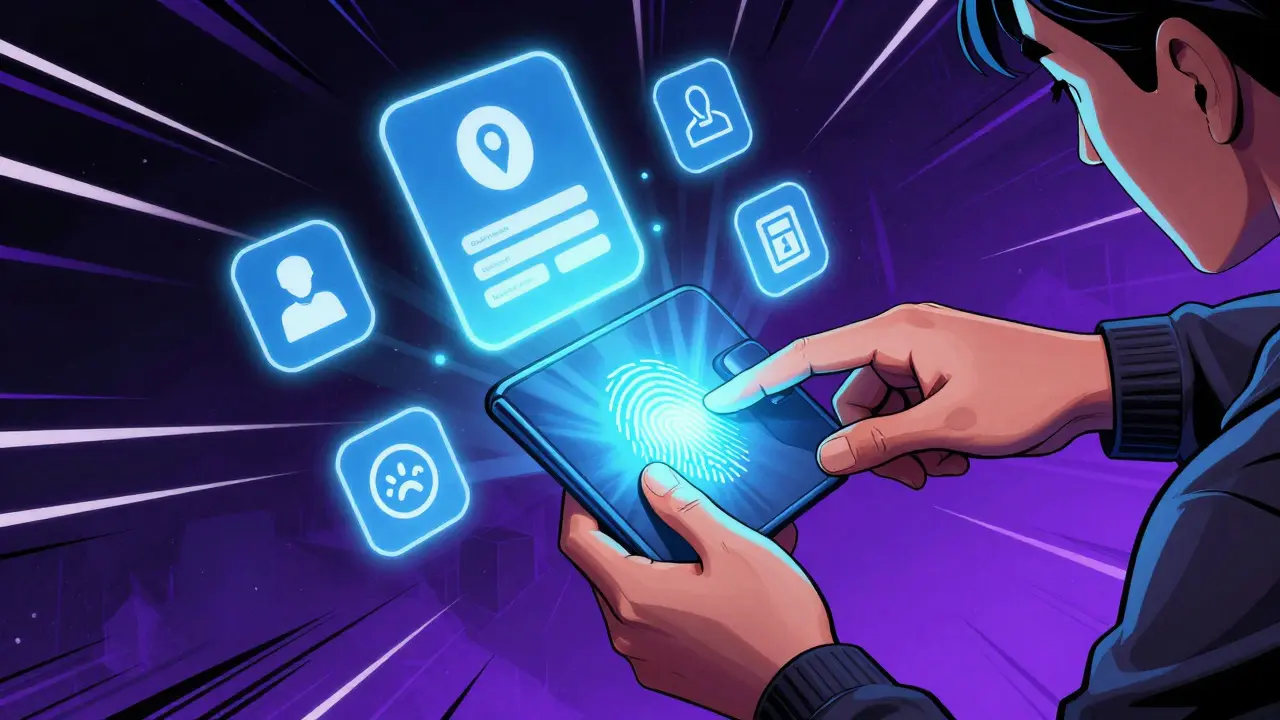
Imagine losing access to your crypto wallet because you forgot your seed phrase - no recovery, no second chance. That’s the reality for millions of users stuck with traditional wallets. Now picture a wallet that lets you log in with your fingerprint, lets a friend help you recover access, and doesn’t require you to buy ETH just to send a token. That’s not science fiction. It’s smart contract wallets with account abstraction, and it’s already changing how people use crypto.
What Exactly Is Account Abstraction?
Account abstraction isn’t just another buzzword. It’s a fundamental shift in how blockchain accounts work. Traditional wallets - called externally owned accounts (EOAs) - are controlled by a single private key. If you lose that key, your money is gone forever. There’s no password reset, no customer support, no backup plan. These wallets can only do one thing: send transactions when the key signs them. Smart contract wallets change all that. Instead of a key, they run code. That code decides what’s allowed. Want to require two people to approve a withdrawal? Done. Want to pay gas fees in USDC instead of ETH? Easy. Want to recover your wallet using your email or a trusted friend? That’s built in. This isn’t a tweak. It’s a complete rewrite of how users interact with blockchains. The standard that made this possible is EIP-4337. Proposed in 2021 and live on Ethereum since March 2023, it didn’t require changing Ethereum’s core code. Instead, it added a new layer on top - a smarter way to send transactions without breaking anything else. That’s why it spread so fast.How Smart Contract Wallets Work (Without the Jargon)
Think of a smart contract wallet like a programmable vault. It doesn’t just sit there waiting for a key. It has rules. Here’s how it actually works in practice:- You open your wallet app and tap ‘Login with Face ID’ - no seed phrase needed.
- You want to swap your DAI for USDC. You don’t need ETH for gas. The app covers it automatically.
- You send the transaction. It doesn’t go straight to the blockchain. Instead, it’s packaged into a ‘UserOperation’ - a special format that includes your signature, what you’re doing, and how you want to pay for it.
- A ‘Bundler’ collects dozens of these UserOperations, bundles them together, and sends them to the EntryPoint contract - the universal hub for all smart wallet transactions.
- The EntryPoint checks: Is the signature valid? Is the wallet funded? Does the Paymaster agree to cover the fee?
- If everything checks out, the transaction runs. You get your USDC. No ETH spent. No seed phrase typed.
- UserOperations: The transaction request, packaged with rules.
- Bundlers: Like mini-miners that group transactions for efficiency.
- EntryPoint Contract: The central rulebook that validates every request.
- Paymasters: The game-changer. They pay your gas fees - either the app, a sponsor, or even a friend.
Why This Matters More Than You Think
Most people think crypto wallets are just about security. They’re not. They’re about access. And right now, access is broken. Coinbase found that 68% of new users abandon crypto transactions because they don’t have ETH to pay gas. That’s not a bug. That’s a design failure. Smart contract wallets fix that. Paymasters mean you can start using crypto with just a token you already own. No need to buy ETH first. No need to wait for an exchange to process your buy order. Security is better too. Traditional wallets are like a single lock on your front door. If someone steals your key, they own your house. Smart contract wallets are like a smart lock that can be set to require two keys, or only unlock during business hours, or send you an alert if someone tries to break in. You can set up social recovery - letting three trusted contacts help you regain access if you lose your phone. No seed phrase memorization. No paper backups. Just your phone and your friends. And then there’s the user experience. Argent Wallet, one of the most popular smart contract wallets, has a 4.3/5 rating on Trustpilot. Why? Users love biometric login. They love gasless swaps. They love not having to manage ETH for fees. One user wrote: ‘I finally feel like I can use crypto like an app, not a bank vault.’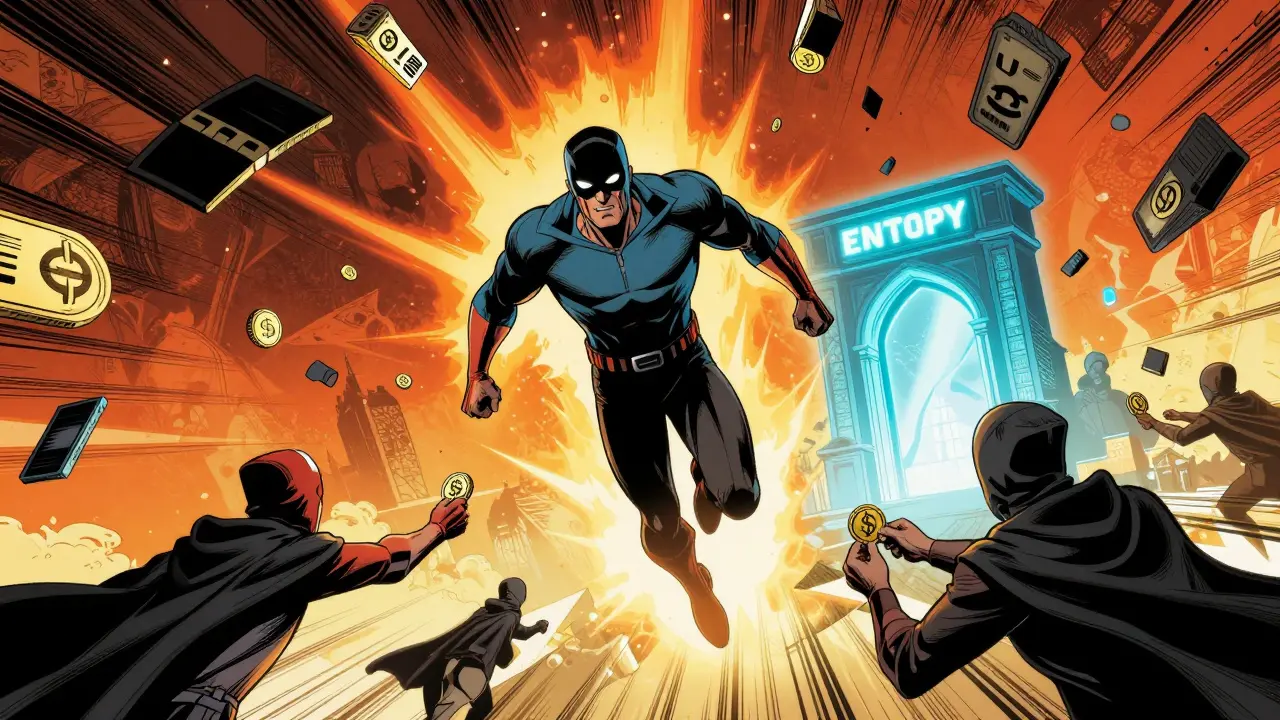
Where It Falls Short - And Why
Nothing’s perfect. Smart contract wallets have real downsides. First, speed. Because transactions go through a bundler and then the EntryPoint, they take 15-30 seconds to confirm. Traditional EOAs? Under 5 seconds. If you’re trading during a volatile market, that delay matters. Second, complexity. Developers have to learn a whole new way to build apps. Integrating with bundlers, handling Paymasters, debugging transaction reverts - it’s not easy. OpenZeppelin’s audit of five major smart wallets found 12 critical vulnerabilities. Most were bugs in specific implementations, not flaws in EIP-4337. But that’s still scary. One mistake in the code, and your funds could be drained. Third, centralization risk. Right now, the top three bundlers handle 78% of all transactions. If one goes down or gets hacked, thousands of wallets could be stuck. Ethereum researchers are working on EIP-7045 to fix this - a system that rewards decentralized bundlers - but it’s not live yet. And then there’s the mental shift. You can’t just think ‘private key = control’ anymore. You have to think ‘code = control.’ That’s a big leap for users who’ve been told for years that private keys are sacred. If you give someone else control over your wallet’s code - even just to cover gas - you’re trusting more than just a key. That’s new territory.Who’s Using It - And Why
Adoption is exploding. Between March and September 2023, over 1.2 million new Ethereum wallets were smart contract wallets. That’s 8.7% of all new wallets in just six months. Gaming and social apps are leading the charge. Why? Because they need to onboard non-crypto users. Imagine playing a game where you earn NFTs, and you can claim them without buying ETH. Or a social app where you tip friends in tokens, and they get them instantly - no wallet setup required. That’s possible now. Enterprise adoption is rising too. Six of the top 10 enterprise blockchain solutions now use smart contract wallets for employee payments and access control. Why? Because companies can set rules: ‘Only approve transfers under $500,’ ‘Require manager approval for large payouts,’ ‘Pay gas in company tokens.’ That’s impossible with EOAs. The total value locked in these wallets hit $2.14 billion by October 2023 - up 380% in one quarter. That’s not hype. That’s real money moving.
What’s Next? The Road Ahead
The next big leap is bundling as a service. Alchemy and Infura launched dedicated networks for smart wallets in September 2023. Result? Confirmation times dropped from 30 seconds to 8 seconds. That’s a game-changer for everyday use. EIP-7002, proposed in August 2023, could eliminate bundlers entirely by letting UserOperations be processed directly by Ethereum’s consensus layer. That means faster, simpler, and more secure transactions. Wallets are getting smarter too. Argent’s ‘Session Keys’ let you authorize a dApp to spend a set amount for a set time - like giving a friend temporary access to your car. Safe (formerly Gnosis Safe) now scans transactions and warns you if something looks fishy - like a request to send all your funds to a new address. Cross-chain support is coming. The CCIP team announced in November 2023 that smart contract wallets will soon work seamlessly across Ethereum, Polygon, Solana, and more. Imagine logging into your wallet once, and using it everywhere - no bridge, no swaps, no headaches. Gartner predicts that by 2026, 60% of new crypto users will interact only with smart contract wallets. That’s up from 15% in 2023. The shift isn’t coming. It’s already here.Should You Switch?
If you’re a beginner: yes. If you’ve ever lost access to a wallet, or been scared of seed phrases, or frustrated by gas fees - smart contract wallets are your best option. Try Argent, Safe, or Coinbase Wallet (which now supports EIP-4337). Log in with your face. Send a token without ETH. Recover your wallet with a friend. It’s not magic. It’s just better design. If you’re a developer: start learning. The learning curve is moderate - 2-3 weeks for experienced Ethereum devs. Use Thirdweb or Particle Network’s tools. They handle most of the complexity. Focus on Paymaster integration and social recovery. That’s where the value is. If you’re skeptical: stay informed. The risks are real - centralization, code bugs, complexity. But the alternatives are worse. EOAs are a dead end for mass adoption. Account abstraction isn’t perfect. But it’s the only path forward that keeps self-custody alive while making crypto actually usable.Frequently Asked Questions
Are smart contract wallets safer than traditional wallets?
Yes, if used correctly. Traditional wallets rely on one private key - lose it, lose everything. Smart contract wallets can require multi-signature approvals, time delays, social recovery, and transaction limits. That makes them harder to hack. But they’re only as secure as their code. A poorly built smart wallet can be exploited. Always use well-audited wallets like Argent or Safe.
Do I still need a seed phrase with a smart contract wallet?
Not necessarily. Many smart wallets let you log in with biometrics or social recovery. But most still generate a seed phrase as a backup - just in case. You don’t need to memorize it or write it down. You can store it encrypted in your cloud or share it with a trusted contact. The key difference: you’re not forced to rely on it as your only recovery method.
Can I use a smart contract wallet on any blockchain?
Mostly on Ethereum and EVM-compatible chains like Polygon and Arbitrum. Solana has its own version of account abstraction built into the protocol. Other chains are catching up. Cross-chain support is emerging through standards like CCIP, so in the near future, you’ll be able to use the same wallet across multiple networks without switching.
Are gasless transactions really free?
Not always. The gas is paid by a Paymaster - which could be the dApp, a sponsor, or even you (if you fund it with a token). So it’s free to you, but someone still pays. That’s the trade-off. It’s like a restaurant offering ‘free’ coffee - the cost is baked into the price of your meal. In crypto, the dApp covers gas to get you in the door. Once you’re hooked, they’ll find ways to monetize you.
What happens if the bundler goes down?
Your transaction gets stuck - temporarily. Bundlers are like delivery drivers. If one van breaks down, another can pick up the package. There are dozens of public bundlers, and most wallets automatically switch to a backup if the first one fails. But if the majority go down at once - like during a major network attack - delays could last hours. That’s why Ethereum is pushing for decentralized bundler incentives (EIP-7045) to prevent this.
Kathy Wood
December 11, 2025 AT 20:20Rakesh Bhamu
December 13, 2025 AT 16:44Hari Sarasan
December 14, 2025 AT 20:34Stanley Machuki
December 16, 2025 AT 15:31Lynne Kuper
December 16, 2025 AT 16:12John Sebastian
December 18, 2025 AT 00:47Candace Murangi
December 19, 2025 AT 13:43Albert Chau
December 21, 2025 AT 11:53Tiffany M
December 21, 2025 AT 12:40Eunice Chook
December 22, 2025 AT 19:04Lois Glavin
December 23, 2025 AT 03:33Abhishek Bansal
December 25, 2025 AT 00:31Bridget Suhr
December 26, 2025 AT 02:13Scot Sorenson
December 27, 2025 AT 18:36Ike McMahon
December 28, 2025 AT 06:02JoAnne Geigner
December 29, 2025 AT 19:00Anselmo Buffet
December 30, 2025 AT 22:03PRECIOUS EGWABOR
December 31, 2025 AT 21:42Ian Norton
January 1, 2026 AT 08:20Sue Gallaher
January 2, 2026 AT 03:00