
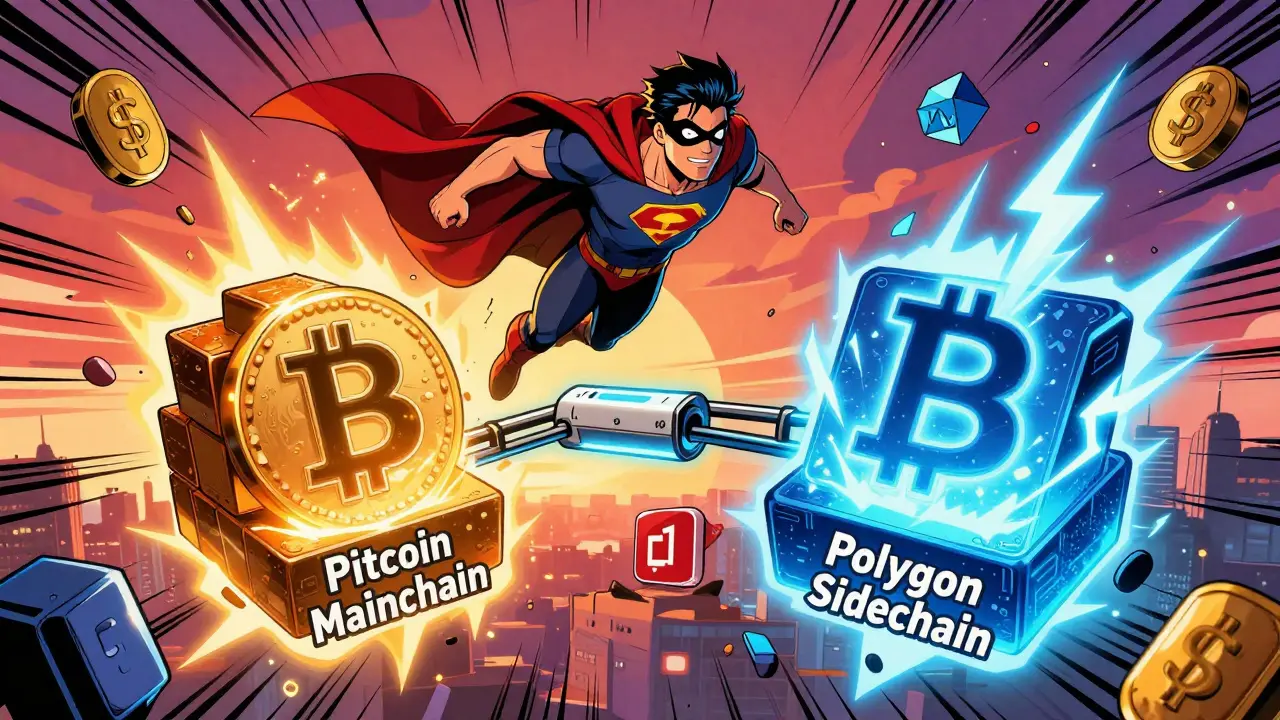
Sidechains aren’t just a technical footnote in blockchain history-they’re a working solution that’s already handling millions of transactions every day. If you’ve ever bought an NFT, used a crypto rewards program, or sent Bitcoin faster than usual, you’ve probably interacted with a sidechain without even knowing it. Unlike Layer-2 solutions that try to squeeze more out of Ethereum or Bitcoin, sidechains are their own blockchains. They run parallel, connected by a two-way peg, and they’re built to do things the mainchain can’t-fast, cheap, and customized.
What Exactly Is a Sidechain?
A sidechain is a separate blockchain that links to a main blockchain-like Bitcoin or Ethereum-through a two-way peg. This peg lets you move assets back and forth between chains securely. Think of it like a ferry between two islands: you can take your Bitcoin to a sidechain, do something there, then bring it back. The key difference? Sidechains don’t rely on the mainchain’s consensus rules. They have their own validators, their own block times, and their own fee structures.
The idea was laid out in a 2014 paper by Bitcoin pioneers like Adam Back and Pieter Wuille. But it wasn’t until Liquid Network launched in 2017 as Bitcoin’s first real sidechain that the concept proved it could work at scale. Today, sidechains like Polygon PoS and Rootstock aren’t just experiments-they’re infrastructure.
Why Do Sidechains Exist?
Mainblockchains like Bitcoin and Ethereum were never meant to handle thousands of transactions per second. Bitcoin processes about 7 TPS. Ethereum manages 15-30 TPS under normal conditions. That’s fine for settlements or high-value transfers. But for apps that need speed-like online games, digital collectibles, or real-time payments-it’s too slow.
Sidechains solve this by offloading the workload. Polygon PoS, for example, handles over 7,000 transactions per second. That’s 250 times faster than Ethereum’s base layer. And transaction fees? On Polygon, you’re looking at $0.0001 per transaction. On Ethereum during peak hours, you might pay $5 or more. That’s not just an improvement-it’s a game-changer for user adoption.
Top Use Cases for Sidechains
- High-Volume NFT Trading - Platforms like Immutable X (a sidechain built for gaming) process 9,000 TPS. That’s why big NFT marketplaces and games like Axie Infinity moved there. Ethereum’s base layer simply couldn’t keep up with the volume.
- Enterprise Supply Chains - Companies like Walmart and Maersk use sidechains to track goods in real time. Sidechains let them build private ledgers with custom rules, while still anchoring critical data to Bitcoin or Ethereum for security.
- Bitcoin Smart Contracts - Bitcoin doesn’t support smart contracts natively. Rootstock (RSK) changes that. It’s a Bitcoin sidechain with an Ethereum-compatible virtual machine. Over 150 dApps now run on RSK, enabling DeFi, lending, and tokenized assets on Bitcoin.
- Privacy-Focused Payments - Liquid Network, operated by Blockstream, lets exchanges and institutions transfer Bitcoin privately and instantly. It’s used by major players like Bitfinex and Kraken. Transactions settle in under two minutes, with full confidentiality.
- Community Rewards and Loyalty - Reddit’s Community Points system (now on Arbitrum, but originally inspired by sidechain models) gave users crypto rewards for posting. It scaled to 1.2 million wallets because sidechain architecture made low-cost, high-frequency transactions possible.
How Do Sidechains Stay Secure?
Security is the biggest trade-off. Sidechains don’t inherit the full security of Bitcoin or Ethereum. Instead, they rely on their own validator sets. Liquid Network uses 15 trusted functionaries. Polygon PoS uses a PoS system with thousands of stakers. But here’s the catch: if those validators get hacked or collude, the sidechain can be compromised.
The Ronin Network hack in March 2022 is the starkest example. Axie Infinity’s sidechain lost $625 million because attackers gained control of 5 out of 9 validator keys. That’s a 55% threshold breach. On Ethereum’s mainnet, that kind of attack would be impossible.
Chainalysis found that sidechains typically offer only 65-70% of the security of their parent chain. Layer-2 solutions like zk-Rollups, by contrast, inherit 100% of Ethereum’s security. So sidechains aren’t for storing life savings. They’re for high-throughput, lower-risk applications.
Sidechains vs. Layer-2 Solutions
It’s easy to confuse sidechains with Layer-2s like Optimistic Rollups or zk-Rollups. But they’re fundamentally different.
| Feature | Sidechains | Layer-2 Solutions (e.g., zk-Rollups) |
|---|---|---|
| Security Model | Independent validators | Inherits 100% mainchain security |
| Consensus Flexibility | Can use any consensus (PoS, PoA, PoW, federated) | Locked to mainchain’s consensus |
| Transaction Speed | 2-5 seconds finality (Polygon) | 10-30 seconds (zk-Rollups) |
| Fee Cost | $0.0001-$0.01 | $0.01-$0.10 |
| Use Case Fit | High throughput, custom logic | High security, general-purpose |
Sidechains win when you need speed, low cost, and custom rules. Layer-2s win when you need maximum security and compatibility. That’s why Polygon, once a pure sidechain, is now shifting toward zk-Rollups. They’re trying to have it both ways.
Real-World Adoption and Growth
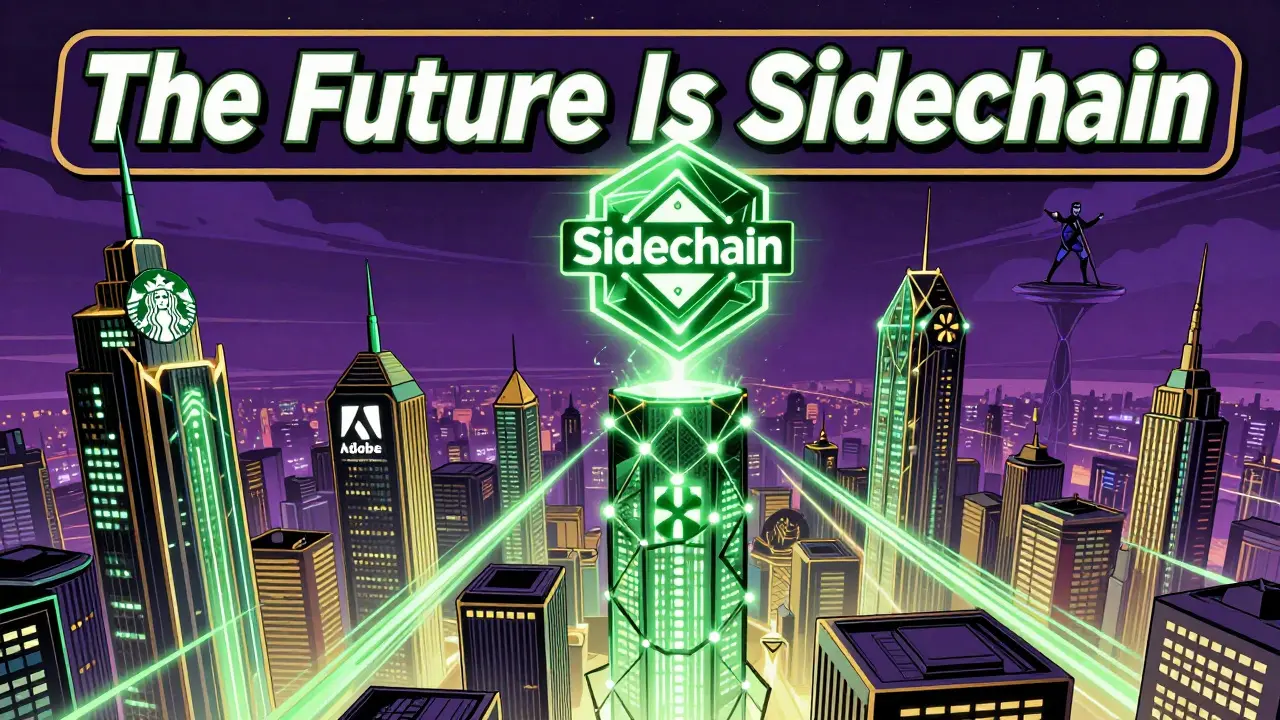
Sidechains aren’t niche anymore. In 2023, they handled 38% of all non-mainnet blockchain activity-second only to Layer-2s. The market for sidechain services hit $4.2 billion. Over 70 Fortune 500 companies are testing or using them.
Starbucks uses Polygon to power its Odyssey loyalty program. Adobe uses it for Content Credentials to verify digital files. These aren’t crypto enthusiasts-they’re global brands that needed scalability without rebuilding their systems.
Developer adoption is growing too. Polygon has over 6,700 dApps built on it. That’s more than most Layer-1 chains. But it’s not easy. Developers report a 3-week learning curve to understand Polygon’s staking, validator roles, and bridging mechanics. Documentation quality varies wildly. Polygon scores 4.3/5 on GitHub. Lesser-known sidechains? As low as 2.8/5.
The Future of Sidechains
Sidechains are evolving. The trend isn’t toward pure sidechains anymore-it’s toward hybrid models. Cosmos’ IBC protocol lets 32 sidechains share security, reducing the risk of individual chain hacks. Ethereum’s Shanghai upgrade improved cross-chain communication, cutting bridging costs by 40%.
But challenges remain. Validator incentives are hard to sustain. A 2023 Blockchain Council survey found 68% of sidechain projects struggled to keep validators active without heavy token rewards. And regulation is messy. The EU’s MiCA law treats sidechains as separate financial entities. The U.S. SEC has sued sidechain operators for unregistered securities.
Experts are split. Vitalik Buterin says sidechains can’t match Layer-2 security. Gavin Andresen calls them the most practical way to bring smart contracts to Bitcoin. Emin Gün Sirer warns they fragment the ecosystem.
Here’s what’s clear: sidechains aren’t going away. Gartner predicts 60% of enterprise blockchain deployments will use sidechain architectures by 2027. Stanford researchers give them a 78% chance of lasting through 2030. Their flexibility, speed, and customization make them indispensable for specific workloads-even if they’re not the universal solution.
When Should You Use a Sidechain?
Ask yourself:
- Do I need to process 1,000+ transactions per second?
- Do I need custom rules (e.g., private transactions, unique tokenomics)?
- Can I accept lower security than Ethereum or Bitcoin?
- Am I building for users who care more about speed and cost than absolute safety?
If you answered yes to most of these, a sidechain makes sense. If you’re storing large sums of crypto, or building something that can’t afford to be hacked, stick to Layer-2 or the mainchain.
Are sidechains safer than Layer-2 solutions?
No, sidechains are generally less secure than Layer-2 solutions. Layer-2s like zk-Rollups inherit 100% of the parent blockchain’s security-meaning if Ethereum is hacked, so is the Layer-2. Sidechains have their own validators, and if those are compromised (like in the Ronin Network hack), assets can be stolen. Sidechains offer speed and flexibility, but not maximum security.
Can I send Bitcoin to a sidechain?
Yes, through a two-way peg. Bitcoin can be locked on the mainchain, and an equivalent amount is issued on the sidechain-like Liquid Network. When you want to move Bitcoin back, the sidechain coins are burned, and the original Bitcoin is unlocked. This process is cryptographically verified and typically takes 6 confirmations for security.
Why do sidechains have different consensus mechanisms?
Sidechains are designed for specific use cases. Bitcoin’s PoW is slow and energy-heavy, so Liquid Network uses a federated model with 15 trusted nodes for faster, private transactions. Polygon uses PoS to allow thousands of validators to secure the chain cheaply. This flexibility lets sidechains optimize for speed, cost, or privacy-something mainchains can’t easily do.
Do sidechains work with Ethereum?
Yes. Many sidechains are built to be compatible with Ethereum’s EVM (Ethereum Virtual Machine). Polygon PoS, Rootstock, and Gnosis Chain all let developers deploy Ethereum smart contracts with minor changes. This makes them popular for scaling Ethereum-based apps without leaving the ecosystem.
Are sidechains regulated differently than mainchains?
Yes. In the EU, MiCA treats sidechains as separate financial entities that require individual licensing. In the U.S., the SEC has taken action against sidechains it considers unregistered securities offerings, like LBRY’s. This means sidechains aren’t just technical tools-they’re legal entities with compliance obligations.
Sidechains are one of the most practical tools in blockchain today. They don’t replace the mainchain-they complement it. For every high-security transaction on Ethereum, there’s a thousand fast, cheap ones happening on a sidechain. That’s not a flaw. That’s the system working as designed.
Sharon Tuck
March 8, 2026 AT 15:45Love how sidechains make crypto feel accessible again. I used to dread gas fees on Ethereum, but now I just mint my NFTs on Polygon and move on with my day. It’s like upgrading from a bicycle to a scooter.
Christina Young
March 9, 2026 AT 00:23Sidechains are just a Band-Aid on a broken system. If you need speed, fix the base layer-not bolt on another fragile chain.
Steven Lefebvre
March 9, 2026 AT 14:13Wait, so if I send BTC to Liquid, and then use it on RSK, am I technically using two sidechains in sequence? That’s wild. Anyone tried that?
Leah Dallaire
March 9, 2026 AT 14:36They say sidechains are secure… but what if the validators are secretly controlled by the Fed? Or worse-Big Tech? We’re not building freedom, we’re building gated communities with blockchain branding.
James Burke
March 10, 2026 AT 01:40Sidechains are the reason I started using crypto. I run a small online store, and before Polygon, I couldn’t afford to accept crypto payments. Now I do, and my customers love it. It’s not perfect, but it works.
Bill Pommier
March 10, 2026 AT 17:55The Ronin hack was not an accident. It was a systemic failure of governance, and yet the community still praises Polygon like it’s a miracle. This isn’t innovation-it’s reckless optimism dressed up as progress.
Olivia Parsons
March 12, 2026 AT 14:25Sidechains aren’t just for NFTs. I work in logistics, and we use a private sidechain to track pharmaceutical shipments. It’s faster than our old SAP system, and we anchor critical hashes to Bitcoin. Simple. Effective.
Nick Greening
March 12, 2026 AT 14:58Layer-2s are superior. Full stop. Sidechains are just Ethereum’s ugly cousins who show up to the party with stolen credit cards and no shoes. They look flashy until someone checks the balance.
Issack Vaid
March 12, 2026 AT 23:27Let’s be honest: sidechains are capitalism’s answer to scalability. You want speed? You get fragmentation. You want cost? You get centralization. You want security? You get nothing. It’s the American Dream of blockchain: fast, cheap, and doomed.
Shawn Warren
March 13, 2026 AT 02:55Sidechains are the future of enterprise adoption. Period. No more waiting for Ethereum to fix its problems. We’re building now. With real tools. Real speed. Real results. Stop overthinking it.
Austin King
March 14, 2026 AT 16:15My buddy lost money on a sidechain hack last year. He’s still mad. But he also says it taught him to never trust a chain with fewer than 100 validators. Hard lesson. Worth it.
Bryanna Barnett
March 16, 2026 AT 13:29sidechains arent even real blockchains theyre more like… well… kinda… side things? like, not the main thing? idk. but i like em. low fees. good vibes.
Josh Moorcroft-Jones
March 17, 2026 AT 10:29Let’s not pretend sidechains are revolutionary. They’re a workaround. A hack. A band-aid on a bullet wound. The fact that we need them at all means the original architecture failed. Bitcoin and Ethereum were designed for decentralization, not throughput. So now we’ve got 17 different sidechains, each with their own validator set, each with their own attack surface, each with their own regulatory gray zone. And we call this progress? We call this innovation? We call this the future? No. This is chaos with a whitepaper.
Rachel Rowland
March 17, 2026 AT 21:16If you’re new to this, don’t be scared off by the haters. Sidechains opened the door for regular people to use crypto without going broke. I started with $5 on Polygon. Now I’m helping my mom use it for gift cards. That’s impact.
Bonnie Jenkins-Hodges
March 18, 2026 AT 21:07USA built the internet. USA built blockchain. Why are we letting Canada and Europe run sidechains? If you want real innovation, stick with Bitcoin. No sidechains. No gimmicks. Just freedom. 🇺🇸
Melissa Ritz
March 19, 2026 AT 11:53I read all this. I still don’t get why sidechains exist. Why not just improve Ethereum? Why not fix Bitcoin? Why build another chain? It feels like someone just said ‘let’s make 10 more of these’ and walked away.
Cerissa Kimball
March 21, 2026 AT 08:00Sidechains require meticulous auditing. The validation mechanisms vary wildly. Liquid Network’s federated model is elegant but centralized. Polygon’s PoS is scalable but vulnerable to whale collusion. The documentation is often outdated. Developers must assume nothing is secure until proven otherwise. This is not plug-and-play. This is enterprise-grade risk management.
Jennifer Pilot
March 22, 2026 AT 00:49It is, of course, profoundly naive to believe that sidechains represent "progress"-as if decentralization could be achieved through arbitrary consensus mechanisms, each with their own governance quagmire. The very notion of a "two-way peg" is a cryptographic illusion, predicated on trust in entities that are, by definition, not trustless. One need only recall the Ronin incident-or, indeed, the countless private sidechains quietly collapsing under the weight of their own validator collusion-to recognize that what we are witnessing is not innovation, but the institutionalization of fragility. The elegance of Bitcoin’s design-its simplicity, its immutability-is being replaced by a Rube Goldberg machine of bridges, validators, and regulatory loopholes. This is not evolution. This is entropy dressed in whitepaper.
Sherry Kirkham
March 22, 2026 AT 20:10You’re all missing the point. Sidechains aren’t about speed or cost. They’re about sovereignty. They let communities build their own rules-privacy, tokenomics, governance-without begging Ethereum for permission. The Ronin hack? That’s a governance failure, not a sidechain failure. The real problem is we still treat blockchains like utilities instead of ecosystems. Stop comparing them to Layer-2s. They’re not competitors. They’re different species.