

Despite having one of the fastest-growing crypto markets in the Middle East, Saudi Arabia has made it nearly impossible for its citizens to use banks for cryptocurrency transactions. The rules aren’t about banning crypto itself-they’re about cutting off the financial pipeline. If you want to buy Bitcoin, trade Ethereum, or run a crypto business in Saudi Arabia, you can’t use your local bank account. Not directly. Not easily. And definitely not legally through official channels.
How the Ban Works
The Saudi Central Bank, known as SAMA, has been clear since 2018: banks are forbidden from handling any crypto-related transactions. This includes deposits, withdrawals, wire transfers, or even opening accounts for crypto exchanges. The ban isn’t a suggestion-it’s a hard rule enforced by regulators. If a bank in Riyadh, Jeddah, or Dammam processes a payment to Binance, Kraken, or any other crypto platform, it risks fines, sanctions, or losing its license. This isn’t just about keeping money safe. It’s about control. The government doesn’t want digital currencies interfering with the Saudi Riyal’s dominance or bypassing its financial oversight. Unlike the UAE or Bahrain, which built licensing systems for crypto firms, Saudi Arabia chose to wall off its banking system entirely. That means no direct link between your bank and your crypto wallet.But People Are Still Buying Crypto
Here’s the twist: crypto adoption in Saudi Arabia is exploding. In 2024, the market hit $23.1 billion in value. Over 4 million Saudis-about 11.4% of the population-own digital assets. Transaction volumes jumped 153% between July 2023 and June 2024, crossing $31 billion. That’s not small-time trading. That’s institutional-level activity happening outside the banking system. How? People are using workarounds. Peer-to-peer (P2P) platforms like Paxful and LocalBitcoins are popular. Traders use international bank accounts, crypto-friendly payment processors, or even cash deposits through third-party agents. Some businesses rely on offshore entities to move money. Others use stablecoins like USDT to bridge between fiat and crypto without touching a Saudi bank. The result? A thriving underground crypto economy. It’s not illegal to own Bitcoin in Saudi Arabia. It’s illegal to use your bank to buy it. That gray zone is where most activity lives.What About Businesses?
For crypto startups, the ban is a nightmare. No bank account means no payroll. No way to pay suppliers. No way to receive revenue from clients without jumping through hoops. Many Saudi-based crypto firms operate out of Dubai or Singapore just to access banking services. Others set up shell companies abroad and route funds through complex layers of intermediaries. Tax compliance is another headache. The government taxes crypto as an asset. Businesses pay 20% corporate income tax, 15% capital gains tax, and 2.5% zakat. But if you can’t deposit profits into a local bank, how do you prove you paid taxes? How do you file returns? Many rely on foreign accountants and international financial reporting systems-adding cost and complexity.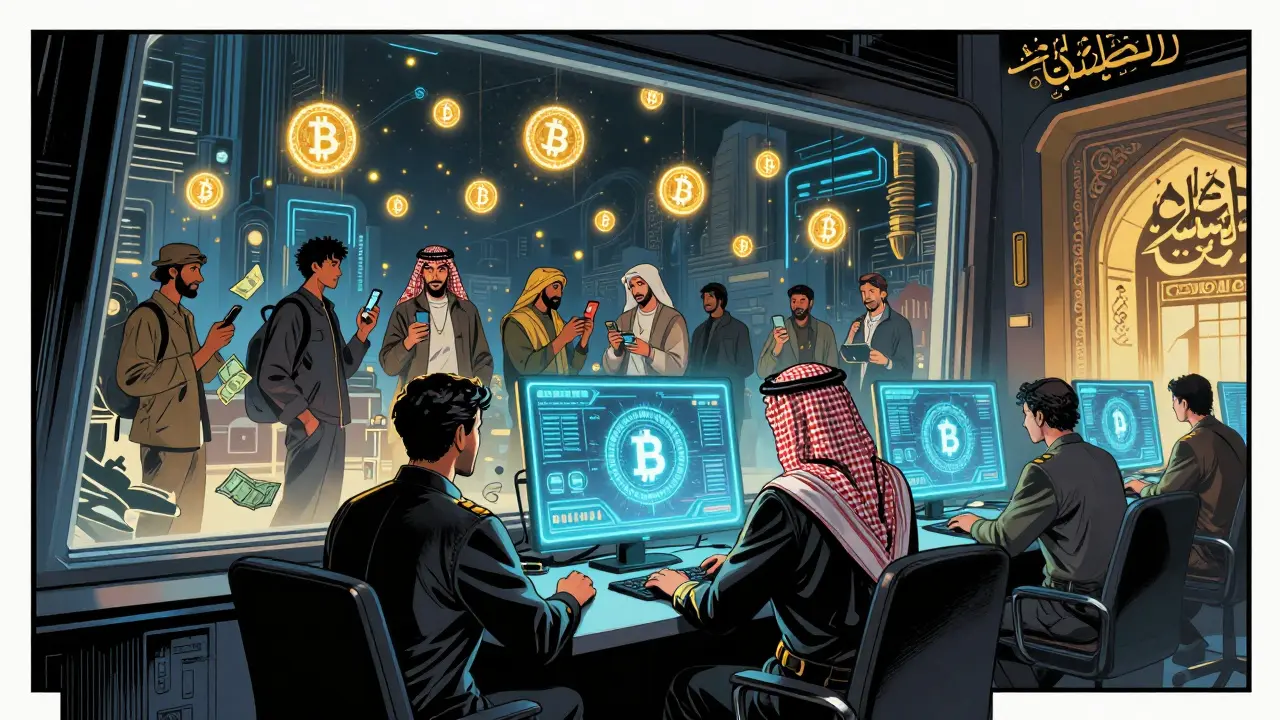
The Blockchain Paradox
Here’s where it gets confusing. While banks can’t touch crypto, the Saudi government is deeply invested in blockchain technology. In 2024, Saudi Arabia joined the mBridge project-a pilot with China, Thailand, Hong Kong, and the UAE-to test a central bank digital currency (CBDC). SAMA is actively developing its own digital riyal, testing it for cross-border payments and financial efficiency. This isn’t a contradiction. It’s a strategy. The government wants digital money-but only if it controls it. A state-backed CBDC can be tracked, taxed, and regulated. Bitcoin? Not so much. That’s why the ban exists: to keep decentralized crypto out while bringing government-controlled digital currency in.Religious Approval, Financial Blockade
In 2023, a top Saudi religious authority issued a fatwa stating that Bitcoin and other cryptocurrencies are permissible under Sharia law. The reasoning? They function as a medium of exchange, not gambling or speculation. This was a big deal. It removed one major cultural barrier to adoption. But religion doesn’t override banking law. So now you have a society where many Muslims believe crypto is halal, yet the banks won’t touch it. That tension is growing. Young Saudis-63% of the population are under 30-are more tech-savvy and open to innovation than previous generations. They’re using crypto anyway. The gap between religious acceptance and financial restriction is widening.
Taylor Mills
January 24, 2026 AT 20:23Arielle Hernandez
January 25, 2026 AT 23:31David Zinger
January 27, 2026 AT 03:02Nathan Drake
January 28, 2026 AT 06:09Nadia Silva
January 28, 2026 AT 09:05Mike Stay
January 29, 2026 AT 21:26steven sun
January 31, 2026 AT 20:07Ryan Depew
February 2, 2026 AT 09:31Heather Crane
February 2, 2026 AT 22:23Barbara Rousseau-Osborn
February 4, 2026 AT 04:03Chidimma Catherine
February 5, 2026 AT 10:39Melissa Contreras López
February 5, 2026 AT 23:55Catherine Hays
February 6, 2026 AT 14:55Shamari Harrison
February 6, 2026 AT 22:26carol johnson
February 8, 2026 AT 10:53Clark Dilworth
February 8, 2026 AT 16:16Darrell Cole
February 9, 2026 AT 17:15Matthew Kelly
February 10, 2026 AT 17:05Sara Delgado Rivero
February 12, 2026 AT 13:58David Zinger
February 13, 2026 AT 17:49