
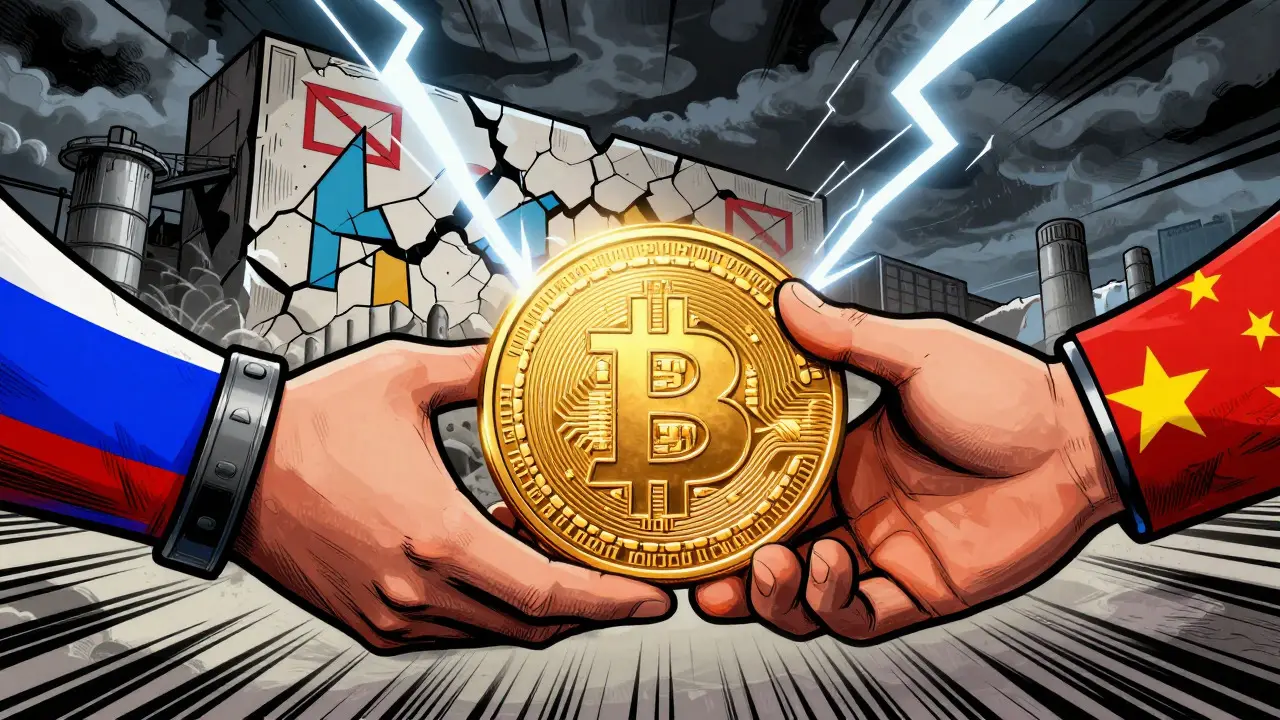
For years, sending money from Moscow to Shanghai felt like a logistical nightmare. Banks were slow, fees were high, and Western sanctions made the path even more treacherous. Then, in September 2024, everything shifted. Russia officially opened the door for Bitcoin is a decentralized digital currency that enables peer-to-peer transactions without intermediaries, specifically for cross-border trade between companies. This wasn't a full embrace of crypto for everyday life; it was a strategic pivot. The government wanted a way to keep international trade flowing when traditional banking channels were blocked. Now, under the new regulatory framework, Russian businesses can use digital assets to settle deals with foreign partners, but only if they play by very specific rules.
The core of this change lies in Federal Law No 221-FZ is a pilot program authorizing legal entities to use cryptocurrencies for cross-border settlements. It acts as a temporary three-year trial period. Think of it as a controlled experiment where the state watches closely. If it works, permanent laws will follow. If it fails or causes chaos, the window closes. This law allows companies, not individuals, to move value across borders using approved cryptocurrencies. It’s a narrow lane, but it’s wide enough for major energy exports and industrial imports to pass through.
Who Can Actually Use Crypto?
You might be wondering if you can finally buy coffee with Bitcoin in St. Petersburg. The short answer is no. Domestic usage remains strictly prohibited. You cannot pay your landlord or your local grocery store with ETH or BTC. The restriction applies to anyone living inside Russia who wants to use crypto for internal commerce. However, the picture changes completely for international business. Only legal entities participating in the pilot program can conduct these cross-border transactions. This means small startups or individual traders are largely locked out unless they partner with established firms already in the system.
There is also a tiered access model for investments. Regular citizens face high barriers. To invest in crypto-based products, you generally need to qualify as a "highly qualified" investor. This requires holding securities and deposits worth over 100 million rubles or earning an annual income exceeding 50 million rubles. In May 2025, the Bank of Russia allowed these elite investors to purchase Bitcoin futures. Within the first month, they bought $16 million worth of contracts. While this sounds impressive, it represents a tiny fraction of the market. Most Russians still hold their assets on foreign platforms because domestic options are so limited. Estimates suggest Russians hold over $25 billion in digital assets, yet most of that activity happens outside the official radar.
How the Pilot Program Works in Practice
Running a cross-border crypto payment isn't as simple as clicking "send." The process involves strict compliance protocols. Transactions must go through certified digital asset platform operators. These platforms act as the bridge between the sender and receiver, ensuring that every step is recorded. You need to disclose the origin of funds and maintain a full transaction history. Transparency is the name of the game here. The government wants to prevent money laundering while allowing legitimate trade to proceed.
The technical side relies on coordination with the Bank of Russia is the central bank of the Russian Federation responsible for monetary policy and financial stability. They oversee the entire operation. Approved cryptocurrencies include Bitcoin (BTC), Ethereum (ETH), and stablecoins like Tether (USDT). Stablecoins are particularly popular for trade because they reduce volatility risk. When a Russian oil company invoices a buyer in India, they might quote the price in dollars but settle in USDT. This bypasses the SWIFT network entirely, which has been heavily restricted due to sanctions.
| Feature | Domestic Usage | Cross-Border Trade |
|---|---|---|
| Legal Status | Prohibited for retail payments | Authorized under Pilot Law 221-FZ |
| Eligible Users | N/A (Banned) | Legal entities in pilot programs |
| Required Infrastructure | N/A | Certified platform operators |
| Primary Goal | Control inflation/maintain fiat dominance | Bypass sanctions/facilitate trade |
| Investor Access | Limited to highly qualified investors | Open to participating corporations |

The Role of the Digital Ruble
While Bitcoin gets the headlines, the Digital Ruble is a central bank digital currency (CBDC) issued by the Bank of Russia for domestic settlement. is quietly becoming the backbone of the domestic economy. Launched as a pilot in August 2023, it started with just 12 banks. By mid-2024, it had processed over 100,000 transactions across 2,500 wallets in more than 150 cities. The plan is aggressive. Starting September 1, 2026, large enterprises will be required to accept the Digital Ruble. By 2028, all merchants should be onboarded. This creates a two-track system: the Digital Ruble handles internal efficiency and state oversight, while Bitcoin and other cryptos handle external trade resilience.
This separation is deliberate. The government fears that letting Bitcoin roam free domestically would undermine the ruble's stability. But they recognize that trying to block global trade flows is economically suicidal. So, they created a firewall. Inside the border, you use the state-backed digital currency. Outside the border, you use whatever digital asset keeps the goods moving. It’s a pragmatic approach born out of necessity.
Sanctions Evasion and Economic Resilience
Let’s be honest: the primary driver here is geopolitical. Since 2022, Western sanctions have frozen Russian assets and cut many banks off from the global financial system. Traditional wire transfers became risky, slow, and sometimes impossible. Cryptocurrency offered a workaround. By early 2025, Russian energy firms were already using crypto to invoice oil and gas exports to China and India. The A7 Group, partially owned by a sanctioned bank, used Tether for international transactions. This isn't just about convenience; it's about survival. If the SWIFT system goes down again, the crypto pipeline stays open.
The scale is growing fast. Official statistics show that Russia's crypto-facilitated trade reached 1 trillion rubles in 2025. That’s a massive jump from zero just a few years ago. Energy companies lead the charge because their trades are large, infrequent, and involve counterparties willing to deal in non-dollar currencies. As the pilot program matures, we expect more sectors to join. Agriculture, manufacturing, and tech hardware could all benefit from faster, cheaper settlement methods that don't rely on correspondent banking relationships in London or New York.

Challenges and Compliance Hurdles
It’s not all smooth sailing. The compliance burden is heavy. Companies must implement robust Anti-Money Laundering (AML) measures. The Bank of Russia has issued detailed recommendations for identifying suspicious peer-to-peer transactions. Know Your Customer (KYC) requirements are strict, though enforcement is tricky because many exchanges operate outside Russia’s legal jurisdiction. Tax authorities and financial regulators now share data more frequently to track crypto activities. For a mid-sized trading firm, setting up the necessary infrastructure can cost hundreds of thousands of dollars. It’s a barrier that keeps smaller players out, effectively consolidating power among larger, better-capitalized firms.
There is also political tension. The Bank of Russia remains skeptical. In March 2025, they recommended criminal liability for using crypto outside the experimental regime. They want to protect the ruble at all costs. On the other hand, Deputy Finance Ministry head Ivan Chebeskov advocates for a broader national strategy. He sees digital assets as a tool for long-term economic development, not just a sanctions workaround. This internal debate shapes the pace of implementation. Expect cautious expansion. The government will widen the net slowly, monitoring each step for risks before granting more freedom.
What Comes Next?
The next few years will define whether this pilot succeeds or fizzles out. The Central Bank is finalizing a list of base assets for derivative financial instruments. A draft regulatory act is expected in 2026. Investment funds may soon be allowed to buy cryptocurrency derivatives, though access will remain restricted to those highly qualified investors. The Ministry of Finance is considering easing the criteria for investor status, which could bring in more institutional money. If the pilot proves effective, we might see a permanent legal framework by 2027. If not, the window closes, and Russia returns to its previous stance of prohibition.
For now, the message is clear. Russia is betting on digital assets to secure its economic sovereignty. It’s a high-stakes gamble. If it works, Russian companies gain a resilient channel for global trade. If it fails, they lose time and capital. Either way, the era of total crypto ban in Russia is over. The question isn't whether crypto will be part of the Russian economy, but how much control the state will maintain over it.
Can regular people in Russia use Bitcoin for daily purchases?
No. Domestic usage of cryptocurrency for retail payments remains strictly prohibited. Only legal entities participating in specific pilot programs can use crypto for cross-border settlements. Individuals must wait for potential future rule changes or use foreign platforms for investment purposes.
Which cryptocurrencies are approved for cross-border trade in Russia?
The current framework primarily supports Bitcoin (BTC), Ethereum (ETH), and stablecoins like Tether (USDT). The exact list is managed by the Bank of Russia and certified platform operators, focusing on assets with high liquidity and low volatility for trade settlement.
How does the Digital Ruble differ from Bitcoin in Russia?
The Digital Ruble is a central bank digital currency (CBDC) designed for domestic use and state oversight. Bitcoin is a decentralized asset used for cross-border trade under the pilot program. The Digital Ruble aims to replace cash internally, while Bitcoin helps bypass international banking restrictions.
What are the penalties for using crypto illegally in Russia?
Using crypto for domestic payments outside the pilot regime can lead to fines and potential criminal liability, as recommended by the Bank of Russia in 2025. Enforcement focuses on large-scale transactions and attempts to bypass AML/KYC requirements.
When will permanent crypto laws be introduced in Russia?
Permanent rules are planned after the three-year pilot period concludes, likely around 2027. The timeline depends on the success of the current experiments and the evolving geopolitical landscape. Drafts for derivative markets are expected in 2026.