
Imagine logging into your favorite crypto trading platform to find it completely empty. No charts, no order books, and worst of all, no access to your funds. For anyone who ever used RightBTC, a centralized cryptocurrency exchange that operated from 2014 until its collapse, this nightmare scenario isn't hypothetical-it’s history.
If you are reading this review in 2026, the short answer is simple: RightBTC is dead. But if you are holding onto old login credentials or wondering why your portfolio looks different than it did five years ago, you need to understand exactly what happened. This isn't just a story about one failed company; it is a critical lesson on how to spot trouble before it sinks your savings.
The Rise and Fall of RightBTC
Back in 2014, the crypto world was a wild west. Security standards were loose, regulations were nonexistent, and new exchanges popped up daily. RightBTC launched during this chaotic early era. At its peak, it claimed to be a "regular in the top 25 crypto exchanges by volume." That sounds impressive, right? In the mid-2010s, being in the top 25 meant you had some traction.
The platform positioned itself as user-friendly. It boasted a clean design, 24/7 customer support, and a straightforward fee structure. Unlike modern giants that use complex tiered fees based on whether you are a market maker or taker, RightBTC charged a flat 0.2% on all trades. For beginners buying Bitcoin or Litecoin, this simplicity was appealing. You knew exactly what you would pay without doing math.
However, simplicity often hides fragility. While major competitors like Binance and Coinbase were investing heavily in security infrastructure, regulatory compliance, and liquidity depth, RightBTC remained a mid-tier player. It didn't publish regular proof-of-reserves audits. It didn't have a massive war chest for legal battles. And when the market turned against it, it didn't survive.
Current Status: Officially Defunct
Let's get straight to the point. As of 2026, RightBTC is classified as "defunct" by every major tracking authority. CryptoWisser, which maintains an "Exchange Graveyard," explicitly lists RightBTC as closed down. Their methodology checks for website accessibility, trading activity, and user engagement-all of which are zero for RightBTC.
ICORankings describes the platform as "empty." There are no active markets. There is no reserve transparency. If you try to visit their website today, you will likely encounter a dead link, a parked domain, or a generic error page. CoinMarketCap, which requires minimum daily volumes and operational transparency for listing, has long since removed RightBTC from its active exchange list.
| Feature | RightBTC (Historical) | Modern Top-Tier Exchange (e.g., Coinbase/Kraken) |
|---|---|---|
| Status | Defunct / Closed | Active / Regulated |
| Fees | Flat 0.2% | Tiered (often lower for makers) |
| Proof of Reserves | None documented | Regular third-party audits |
| Security | Basic (by 2014 standards) | Cold storage, multi-sig, insurance |
| Liquidity | Low / Non-existent | High (billions in daily volume) |
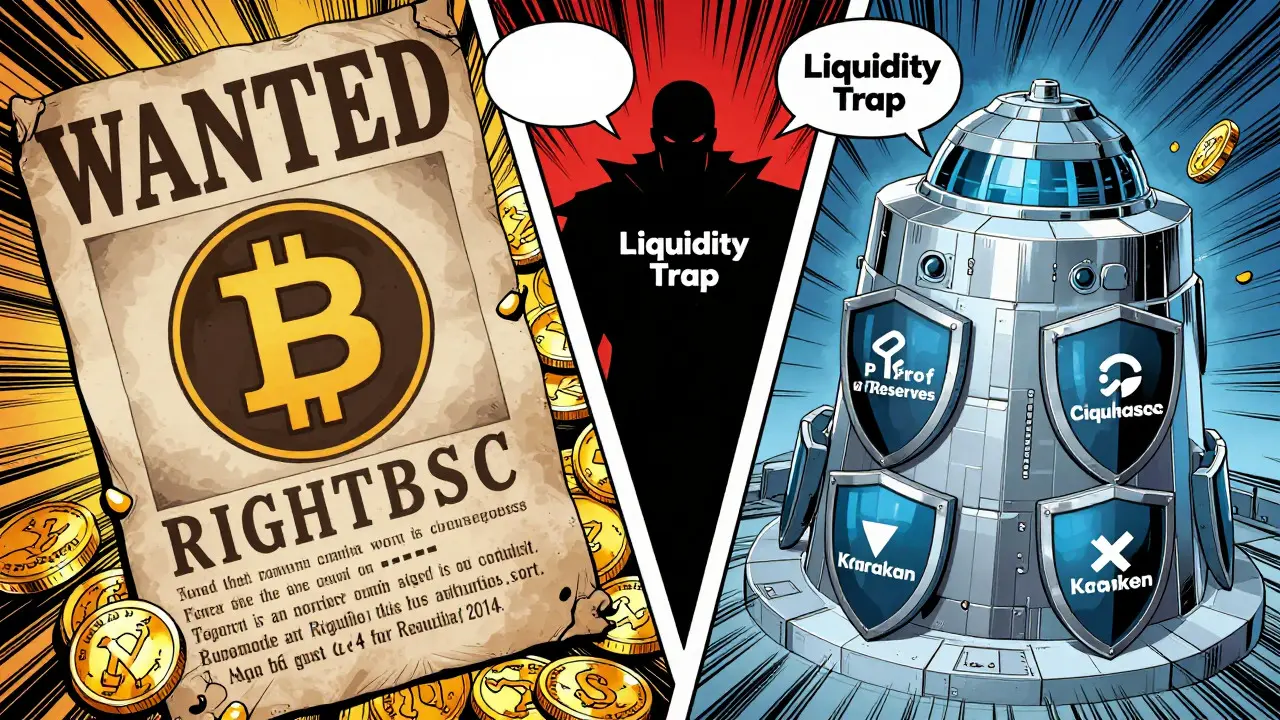
Why Did RightBTC Fail?
You might wonder, "Did they get hacked?" Surprisingly, there is no public record of a massive security breach specific to RightBTC. Most exchange failures aren't caused by hackers breaking in; they are caused by bad business models running out of money.
Here is the reality of running a mid-sized crypto exchange. You need deep pockets to maintain liquidity. When traders want to sell, someone else needs to buy. If your exchange doesn't have enough users, the "spread" (the difference between buy and sell prices) gets wide, and traders leave. Once traders leave, volume drops. Once volume drops, revenue vanishes. It’s a death spiral.
Data from Chainalysis shows that approximately 68% of exchanges operating in 2018 had ceased operations by 2023. RightBTC fits this pattern perfectly. It grew during bull markets when everyone was buying, but it lacked the capital reserves to survive bear markets. Without significant investments in compliance-like the $150 million annually spent by Coinbase in 2023-regulatory pressure eventually squeezes smaller players out of existence.
Another critical factor was the lack of transparency. After the FTX collapse in 2022, the industry demanded proof-of-reserves. Users wanted to know their coins actually existed. RightBTC never provided this level of auditability. In a post-FTX world, opacity is fatal.
What Happens to Your Funds?
This is the question keeping people up at night. If you left money on RightBTC, what are your chances of getting it back?
The hard truth is that recovery is extremely rare. A study by the Cambridge Centre for Alternative Finance found that 83% of failed exchanges provide no mechanism for user fund recovery. When an exchange goes "dark," the private keys to the wallets holding user assets often disappear with the management team.
Unlike traditional banks, which have government-backed insurance (like FDIC in the US), crypto exchanges are largely self-insured or uninsured. If the company dissolves, there is rarely a legal entity left to sue. Some users have reported finding abandoned forums or dead social media channels where complaints went unanswered for months before silence fell completely.
If you still have credentials, do not deposit more money. Do not pay anyone claiming they can "recover" your funds via private channels-these are almost always scams targeting victims of defunct platforms.

Lessons for Traders in 2026
RightBTC serves as a cautionary tale. The crypto market has matured, but risks remain. Here is how to avoid ending up in the "Exchange Graveyard":
- Demand Proof of Reserves: Only use exchanges that publish regular, verifiable proof-of-reserves reports. This ensures they actually hold the assets they claim to.
- Check Regulatory Compliance: Look for licenses in major jurisdictions (US, EU, UK). Regulated exchanges face stricter oversight and are less likely to vanish overnight.
- Monitor Liquidity: Avoid exchanges with low trading volume. Low volume means you might not be able to sell your assets quickly, or you’ll suffer huge losses due to slippage.
- Use Cold Storage: The golden rule of crypto is "not your keys, not your coins." For long-term holdings, move your assets off the exchange entirely into a hardware wallet.
- Watch for Red Flags: Sudden changes in terms of service, delayed withdrawals, or a lack of recent communication from the team are early warning signs.
Alternatives to RightBTC
Since RightBTC is gone, where should you trade? In 2026, the market is dominated by a few highly regulated, liquid platforms. These exchanges have survived multiple market cycles and invest heavily in security and compliance.
Coinbase remains the go-to for US-based users seeking maximum regulatory safety. They are publicly traded, which adds a layer of financial transparency. Kraken is another strong contender, known for its robust security track record and dedicated regulatory affairs team. For global users, Binance offers the deepest liquidity and widest range of assets, though it faces ongoing regulatory scrutiny in various regions.
When choosing an alternative, look beyond the fee structure. A slightly higher fee on a secure, transparent platform is cheaper than losing everything on a "cheap" but unstable one.
Is RightBTC safe to use in 2026?
No. RightBTC is officially defunct. Multiple authoritative sources, including CryptoWisser and ICORankings, classify it as closed. There are no active markets, and the website is inaccessible. Depositing funds is impossible, and existing funds are likely unrecoverable.
Can I recover my funds from RightBTC?
Recovery is highly unlikely. Studies show that 83% of failed crypto exchanges offer no mechanism for fund recovery. Without a legal entity or accessible private keys, users rarely get their assets back. Be wary of scammers promising recovery services for a fee.
Why did RightBTC close down?
RightBTC likely failed due to insufficient capital reserves and lack of liquidity, rather than a specific hack. Like many mid-tier exchanges, it could not sustain operations during market downturns or meet increasing regulatory costs. The absence of proof-of-reserves also eroded user trust over time.
What was RightBTC's fee structure?
When operational, RightBTC charged a flat trading fee of 0.2% for all transactions, regardless of whether the user was a maker or taker. This was simpler than tiered structures but potentially more expensive for high-volume traders compared to modern competitors.
How can I tell if a crypto exchange is failing?
Watch for declining trading volume, delays in withdrawals, lack of communication from the team, and absence of regular proof-of-reserves audits. If an exchange stops updating its website or social media channels, it is a major red flag indicating potential closure.
Heather Austin
July 23, 2026 AT 14:26honestly this is just the cycle repeating itself every few years. people forget about FTX and Mt Gox for a bit then get burned again by some mid-tier exchange that looked shiny but had no substance. rightbtc was always sketchy with their lack of audits. i told my cousin to move his coins to cold storage back in 2019 and he laughed at me now hes crying over lost btc. lesson learned too late for most.
Jessie Smith
July 24, 2026 AT 13:12the narrative here is painfully simplistic. you assume failure is merely a result of poor liquidity or regulatory pressure which is bourgeois thinking. the true collapse stems from the inherent instability of fiat-backed valuation models imposed on decentralized assets. rightbtc did not fail because they lacked money; they failed because the system demands conformity to archaic banking standards that crypto was meant to dismantle. it is a tragedy of ideology not finance.
Ran Tao
July 25, 2026 AT 03:32omg can we stop acting like these exchanges are victims?? 😡 they took our money and ran! typical corporate greed! i remember when rightbtc said they were 'top 25' lol they were probably buying fake volume on darknet forums 🤡 everyone knows how this works. the elites want us to trust centralized platforms so they can rug pull us whenever they feel like it. stay woke out there!! 🔥💸
Brad Semp
July 26, 2026 AT 05:49One must consider the statistical probability of survival for any entity operating without rigorous oversight. The data presented suggests a correlation between opacity and insolvency, yet causation is rarely linear in complex financial systems. RightBTC’s demise serves as a case study in the necessity of institutional accountability rather than mere technological innovation.
Lisa Chong
July 28, 2026 AT 04:26THEY LIED TO US ALL ALONG!!! it was never about security it was about tracking our transactions for the globalist agenda. rightbtc closed down because they knew too much about where the real money was going. do you think by accident they vanished? NOPE. the government shut them down to silence the truth. check the dates against the fed meetings. its all connected. wake up sheeple before they take your last satoshi.
Josephine Finlayson
July 28, 2026 AT 22:07It is truly unfortunate that so many individuals have suffered financial losses due to the closure of RightBTC. While the article provides a comprehensive overview of the events, it is important to approach such situations with empathy and understanding. Many users were simply trying to navigate a complex financial landscape and made decisions based on the information available to them at the time. Let us hope that future regulations will provide greater protection for retail investors.
Korn Arrieta
July 29, 2026 AT 10:34stop whining about lost funds and look at your own incompetence. if you left money on an unregulated exchange in 2024 you deserved to lose it. the market does not care about your feelings. it cares about liquidity and security. rightbtc was a zombie company walking around for years waiting for someone to notice it was dead. the fact that people still ask about it in 2026 shows a fundamental lack of financial literacy among the general populace.
Kristy Morrow
July 29, 2026 AT 17:42everyone says use cold storage but who really does? convenience kills more dreams than hackers ever could. rightbtc offered simplicity and people chose ease over safety. now they cry. irony is delicious. next time theyll buy another scam coin promising 100x returns and forget this pain entirely. human memory is short and greed is long.
Tracy Marshall
July 30, 2026 AT 00:05i have been saying this for years that centralized exchanges are just fronts for the deep state to control wealth. rightbtc didnt just close they were silenced. look at the pattern of closures after major political events. it is not coincidence. they want us to trust banks again because banks report to the powers that be. keep your coins offline and never trust a website that asks for your email address. :/
Ruth Williams
July 30, 2026 AT 02:36The average investor lacks the discernment required to evaluate risk properly. They see a logo and assume legitimacy. This review highlights the critical importance of due diligence, a practice largely abandoned by the masses in favor of speculative gambling. One should demand transparency not as a courtesy but as a prerequisite for participation in any financial instrument.
Sophie Nakasako
July 31, 2026 AT 10:30what a fascinating read! i love how history repeats itself. it makes me wonder if we are learning anything at all or just running in circles. maybe the answer lies in decentralization after all. instead of trusting companies we should trust code. smart contracts dont lie and they dont run away with your money. what do you all think about moving everything to dapps?
Tuan Nguyen
July 31, 2026 AT 19:28The inefficiency of the current model is glaring. Mid-tier exchanges operate in a vacuum of accountability until the bubble bursts. It is not surprising that RightBTC failed; it is surprising that it lasted as long as it did given the predatory nature of the broader ecosystem. Users are complicit in their own exploitation by ignoring basic economic principles.
Hazel Fruitman
July 31, 2026 AT 23:10its sad but true. people need to take responsibility. if you cant afford to lose it dont put it there. simple as that. rightbtc was risky and anyone with half a brain knew it. now we have these fancy regulated places but even those can fail. nothing is safe. just accept it and move on.
Jackie D
August 1, 2026 AT 01:59hey guys! just wanted to add that i found some old threads from 2018 where users were already complaining about slow withdrawals. red flags everywhere! why did nobody listen? we gotta learn from this. also has anyone tried using lightning network for smaller transactions? feels safer than keeping stuff on exchanges. let me know your thoughts!