
You want to trade Bitcoin in Doha? You can’t. Not legally. Since February 2018, the Qatar Central Bank has strictly prohibited financial institutions from touching cryptocurrencies. If you are a retail trader looking for a local exchange to buy Ethereum or Solana, you will hit a wall. The rules are clear, and they have been consistent for years.
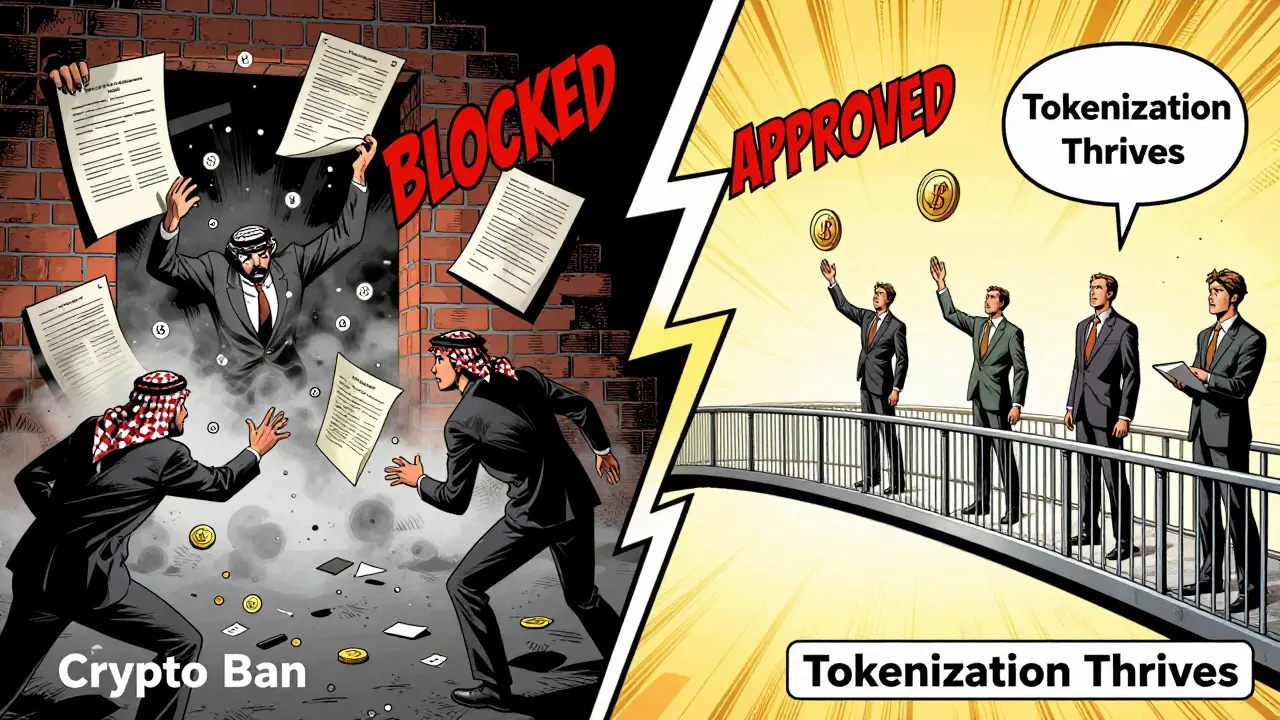
But here is the twist that catches most people off guard: while Qatar bans speculative crypto, it is aggressively building one of the world’s most advanced frameworks for tokenizing real-world assets. As of late 2024, the country has opened its doors to blockchain technology, but only if it serves traditional finance, real estate, or Islamic banking. It is not a rejection of innovation; it is a strict filter.
The History of the Ban: From 2018 to Today
To understand where things stand today, we have to look at how the prohibition started. In February 2018, the Qatar Central Bank (QCB) issued Circular No. (6) of 2018. This document explicitly told all banks and financial institutions in Qatar to stay away from cryptocurrencies. The goal was simple: protect investors from volatility and prevent money laundering through unregulated channels.
This stance hardened significantly on December 26, 2019. The Qatar Financial Centre Regulatory Authority (QFCRA) released a comprehensive alert banning virtual asset services within the Qatar Financial Centre (QFC). This wasn't just a warning. It prohibited exchanging virtual assets for fiat currency, transferring them, safekeeping them, or offering any financial services related to their issuance. For nearly five years, this created a complete blackout on crypto activities within the regulated financial sector.
If you tried to operate a crypto exchange in the QFC during this period, you were breaking the law. The authorities drew a hard line between "virtual assets" meant for speculation and legitimate financial instruments. This distinction became crucial when the regulatory landscape began to shift in 2024.
The 2024 Shift: QFC Digital Assets Regulations
Something changed on September 1, 2024. The QFC Authority and QFCRA jointly announced the enactment of the QFC Digital Assets Regulations 2024. This did not lift the ban on Bitcoin or Ethereum. Instead, it created a controlled legal framework for something else entirely: the tokenization of real-world assets.
Under these new regulations, the QFCRA defined "Excluded Tokens." These are virtual assets that do not represent a right in any property other than the token itself, or those that act as a substitute for currency. This category explicitly includes:
- Cryptocurrencies (like Bitcoin, Litecoin, etc.)
- Stablecoins (tokens pegged to fiat currencies)
- Central Bank Digital Currencies (CBDCs)
These remain banned. However, the regulations permit "Included Tokens," which are digital representations of tangible assets. Think commercial real estate, bonds, commodities, or Islamic finance products like sukuk. The government wants the efficiency of blockchain without the risk of speculative bubbles.
Yousef Al-Jaida, CEO of the Qatar Financial Centre, emphasized that this ban does not hinder innovation. Instead, it redirects it toward stable applications. The framework provides legal recognition for smart contracts, making them enforceable in Qatari courts. This is a massive technical leap for the country’s digital infrastructure.
How Qatar Compares to Its GCC Neighbors
Qatar’s approach is unique in the Gulf Cooperation Council (GCC). To see why, let's look at how other major players handle crypto.
| Country | Regulatory Stance | Key Authority | Crypto Trading Allowed? |
|---|---|---|---|
| Qatar | Ban on crypto; allows asset tokenization | QFCRA / QCB | No (Retail & Institutional) |
| UAE | Fully regulated ecosystem | VARA (Dubai), SCA (Abu Dhabi) | Yes (With licenses) |
| Kuwait | Comprehensive ban | Central Bank / Capital Markets Authority | No (Strict prohibition) |
| Bahrain | Licensed exchanges allowed | Central Bank of Bahrain | Yes (Licensed entities only) |
| Saudi Arabia | Framework exists, no active licensing yet | Capital Market Authority (CMA) | Restricted / Pending |
The United Arab Emirates has gone all-in, with Dubai’s Virtual Assets Regulatory Authority (VARA) capturing about 68% of the GCC’s crypto trading volume. Kuwait remains as strict as Qatar, if not stricter, maintaining an absolute ban on payments, investments, and mining. Qatar sits in a middle ground that leans conservative: it rejects the casino-like nature of crypto trading but embraces the plumbing of blockchain for serious finance.

Who Benefits? Real Estate and Islamic Finance
So, if you can’t buy Dogecoin, what are companies doing? They are tokenizing high-value assets. The QFC framework enables the tokenization of illiquid assets through special purpose vehicles (SPVs). This means a single commercial building or a large bond issuance can be split into digital tokens that are easier to trade.
A prime example happened in the first quarter of 2025. Barwa Real Estate Company successfully tokenized a QAR 150 million commercial property. Before tokenization, settling such a transaction took about 30 days. With the digital token system, settlement time dropped to just 48 hours. That is the kind of efficiency the regulators are chasing.
Islamic finance is another huge beneficiary. Sharia-compliant digital assets make up 58% of tokenization initiatives under the new framework. Products like sukuk (Islamic bonds) fit perfectly into this model because they are backed by physical assets, aligning with the QFCRA’s requirement that tokens must represent underlying property rights.
The Reality for Retail Investors
For the average person in Doha, the situation is frustrating. According to a February 2025 survey by Qatar University, 68% of citizens aged 18-35 support limited legalization of cryptocurrency. Yet, retail adoption remains low at about 0.8% of the population, compared to 14% in the UAE.
Why the gap? Because accessing crypto requires work. Users turn to offshore exchanges, which come with higher fees and stricter Know Your Customer (KYC) hurdles. On Reddit’s r/CryptoQatar forum, users frequently complain about paying an extra 2.5% per transaction due to these barriers. There is no local, regulated gateway for buying Bitcoin.
Financial firms face challenges too. A survey by OneEquity found that 78% of Qatari financial services firms reported increased compliance costs-averaging 15% higher than regional competitors. They have to spend significant resources verifying that none of their transactions involve prohibited cryptocurrencies. Setting up a compliant tokenization business also isn't cheap or quick. Expect 6-8 months for implementation and setup costs around QAR 850,000 ($233,500 USD).
Expert Opinions: Innovation vs. Stability
Is Qatar’s strategy working? Experts are divided. Dr. Ibrahim Al-Hashimi, Professor of Finance at Qatar University, argues that the framework shows a sophisticated understanding of the difference between speculative crypto and utility-focused tokenization. He believes it aligns with Qatar’s conservative financial tradition while positioning the country for blockchain-enabled efficiency gains.
On the other side, blockchain consultant Ahmed Mansoor criticizes the exclusion of stablecoins. He argues that by banning them, Qatar misses out on liquidity and price discovery mechanisms that could benefit its tokenized asset markets. Without stablecoins, moving value in and out of the tokenized ecosystem can be clunky.
The Financial Stability Board’s MENA Group acknowledged Qatar’s "cautious but progressive steps" in January 2025 discussions. They noted that while the approach prioritizes stability, the exclusion of stablecoins creates fragmentation between traditional markets and emerging digital ones.
What Comes Next? Future Outlook
Looking ahead, the core prohibition on cryptocurrencies is expected to remain through 2030. Governor Sheikh Bandar bin Mohammed Al Thani of the Qatar Central Bank stated clearly in January 2025 that investor protection and financial system stability take precedence over short-term market participation.
However, the tokenization side is expanding. The QFC’s 2025-2027 roadmap identifies new targets for tokenization, including carbon credits, intellectual property rights, and art collections. By March 2025, 47 international asset managers had formally inquired about establishing operations in the QFC, suggesting strong institutional interest despite the crypto ban.
Qatar is betting that being the safest place for institutional digital assets will outweigh the popularity of being a hub for retail crypto traders. Whether this bet pays off depends on whether global finance continues to move toward tokenized real-world assets faster than it moves toward decentralized currencies.
Can I legally buy Bitcoin in Qatar?
No. The Qatar Central Bank and the QFCRA prohibit financial institutions from engaging in cryptocurrency trading. While individuals are not criminally prosecuted for holding crypto, there are no licensed local exchanges to buy or sell Bitcoin, Ethereum, or other cryptocurrencies. You must use offshore platforms, which may carry higher fees and compliance risks.
What is the difference between the crypto ban and asset tokenization?
The ban applies to "Excluded Tokens," which include cryptocurrencies, stablecoins, and CBDCs that do not represent underlying physical assets. Asset tokenization refers to creating digital tokens that represent ownership in real-world assets like real estate, bonds, or commodities. The latter is permitted and regulated under the QFC Digital Assets Regulations 2024.
Are stablecoins legal in Qatar?
No. Stablecoins are classified as "Excluded Tokens" under the QFC Digital Assets Regulations 2024 because they act as a substitute for currency. They are subject to the same prohibition as other cryptocurrencies.
How does Qatar's crypto policy compare to the UAE?
The UAE has a fully regulated environment for cryptocurrency trading, with dedicated authorities like VARA in Dubai. Qatar maintains a strict ban on crypto trading but allows for the tokenization of real-world assets. The UAE focuses on both retail and institutional crypto markets, while Qatar focuses exclusively on institutional-grade asset tokenization.
When might Qatar legalize cryptocurrency trading?
Current projections suggest the prohibition on cryptocurrencies will remain in place through 2030. The Qatar Central Bank prioritizes financial stability and investor protection. While the regulatory framework for tokenized assets is expanding, there are no immediate plans to lift the ban on speculative cryptocurrencies.
What types of assets can be tokenized in Qatar?
Permitted assets include commercial real estate, Islamic finance products (such as sukuk), bonds, commodities, and potentially carbon credits, intellectual property, and art collections in the future. These assets must have clear underlying property rights and be managed through regulated special purpose vehicles (SPVs).