

For years, the crypto community has been locked in a heated debate about whether Proof of Stake is truly secure. Skeptics argue that it lacks the "physical" security of mining hardware, while proponents claim it’s the only sustainable path forward for blockchain technology. The truth? It’s neither perfect nor broken. It’s just different.
When Ethereum completed "The Merge" in September 2022, shifting from energy-intensive Proof of Work to Proof of Stake, it didn’t just cut energy use by 99.95%. It fundamentally changed how we define security in a decentralized network. Instead of trusting electricity and silicon, we now trust economic incentives and cryptographic penalties. But does that actually make your assets safer?
The Myth of "Weak" Security
The most persistent myth is that Proof of Stake is easier to attack than Proof of Work. You’ve likely heard the argument: "In Proof of Work, you need physical machines. In Proof of Stake, you just buy tokens." On the surface, this sounds like a valid concern. If I can buy 51% of the coins, can’t I take over the network?
Let’s look at the numbers. To launch a 51% attack on Bitcoin today, you’d need specialized ASIC miners worth hundreds of millions of dollars, plus massive electricity bills running into the tens of millions annually. For Ethereum, the math is different but equally prohibitive. As of late 2023, controlling 51% of the staked ETH would require purchasing approximately $294 million worth of tokens. That’s a staggering amount of capital to risk.
But here’s the kicker: in Proof of Stake, if you try to attack the network, you don’t just lose your money-you get slashed. Slashing is the protocol’s way of saying, "Nice try." Validators who act maliciously-like trying to sign two different blocks at the same height-have their stake confiscated. In Ethereum’s case, minor infractions cost 0.5 ETH, while severe violations wipe out the entire 32 ETH deposit. This creates a security model where attacking the network is economically irrational. Why spend $300 million to steal $50 million when you’ll likely lose everything anyway?
| Feature | Proof of Work (PoW) | Proof of Stake (PoS) |
|---|---|---|
| Attack Cost | Hardware + Electricity (Ongoing) | Token Purchase (Upfront Capital) |
| Deterrent Mechanism | Market Devaluation (Indirect) | Slashing / Confiscation (Direct) |
| Energy Usage | High (~78 TWh/year for BTC) | Negligible (~0.01 TWh/year for ETH) |
| Finality Speed | Probabilistic (Hours) | Deterministic (Seconds with BFT) |
The Centralization Fear: Is It Real?
Another common criticism is that Proof of Stake leads to centralization. The logic goes: those with more money get more power, creating a plutocracy. While it’s true that large entities like Coinbase Cloud or Lido Finance hold significant stakes, the reality is more nuanced.
In Proof of Work, centralization happens through industrial-scale mining farms controlled by a few companies in specific geographic regions (often China or Kazakhstan). In Proof of Stake, anyone with the minimum requirement (32 ETH for Ethereum) can run a validator node on consumer-grade hardware-a laptop or a small server with 16GB RAM and a 4-core CPU. This lowers the barrier to entry significantly.
However, there is a risk. If too many people delegate their tokens to a few large staking pools, those pools gain disproportionate influence. As of December 2023, Lido controlled about 30% of all staked ETH. This concentration is concerning because if one pool acts maliciously, it could theoretically impact the network’s stability. To mitigate this, protocols are developing "distributing staking" solutions and regulatory frameworks like the EU’s MiCA legislation, which treats validators as distinct entities to prevent monopoly behavior.
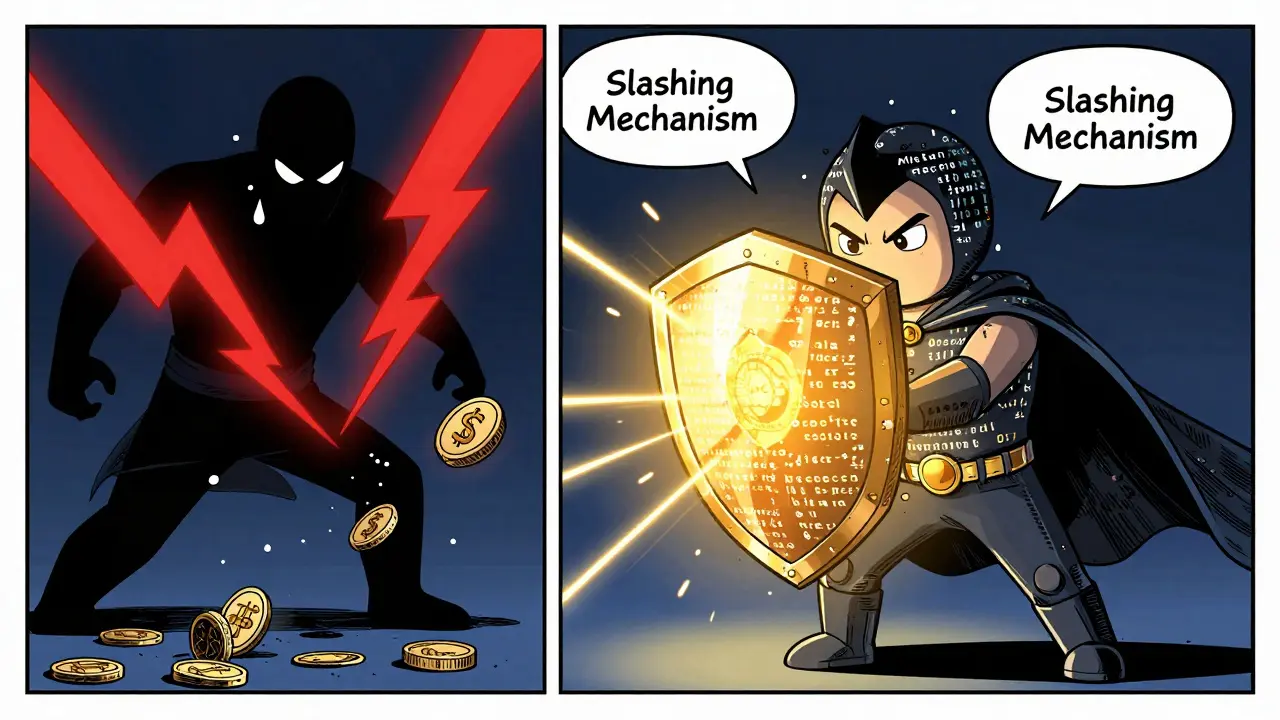
Understanding Slashing: The Network’s Immune System
If you’re considering becoming a validator, you need to understand slashing. It’s not just a penalty; it’s the core security feature of Proof of Stake. Think of it as the network’s immune system. When a validator misbehaves, the protocol detects it and removes the threat.
Ethereum’s consensus layer has three main slashing conditions:
- Double-signing: Signing two different blocks at the same block height. This is the most common error and results in a partial slash.
- Surround Vote: Voting for a block that is both older and newer than another vote you cast. This indicates confusion or malicious intent.
- Surround Attest: Similar to surround voting but related to attestations (proofs that you saw a block).
Most slashing incidents aren’t caused by hackers. They’re caused by human error. According to data from r/ethstaker, nearly 30% of user-reported issues involve accidental slashing due to client configuration mistakes. Running multiple clients on the same machine without proper isolation can lead to these errors. Professional providers like Coinbase Cloud maintain 99.98% uptime precisely because they automate these checks and isolate nodes rigorously.
The "Nothing-at-Stake" Problem Solved
Early critics pointed to a theoretical flaw called "nothing-at-stake." The idea was that since validators don’t expend energy, they could support multiple conflicting chains simultaneously, causing chaos. Why wouldn’t they hedge their bets?
This problem was solved through economic finality. In modern Proof of Stake systems like Ethereum’s Casper FFG, validators are required to commit to a single chain. If they support conflicting histories, they are slashed. The cost of hedging outweighs the potential reward. Furthermore, Byzantine Fault Tolerance (BFT) mechanisms ensure that once a block is finalized, it cannot be reversed unless more than one-third of validators collude-a scenario that is economically unfeasible.
Long-Range Attacks: The Ghost in the Machine
There is one vulnerability that doesn’t exist in Proof of Work: the long-range attack. In theory, an attacker could create a fake history from the genesis block, tricking new nodes into syncing to a fraudulent chain. Since old transactions are cheap to simulate, why shouldn’t this happen?
The solution isn’t purely cryptographic; it’s social. Nodes always start syncing from a trusted checkpoint-a recent block verified by reputable sources. Additionally, "inactivity leaks" reduce the balance of validators who go offline for extended periods, making it harder for an attacker to maintain a fake history without losing value. While this remains a theoretical risk, no major Proof of Stake network has ever suffered a successful long-range attack.

Practical Steps for Secure Staking
If you want to participate in Proof of Stake security, follow these best practices:
- Use Consumer Hardware: You don’t need a supercomputer. A standard desktop with 16GB RAM and a reliable SSD is sufficient for Ethereum validators.
- Isolate Your Keys: Never store your withdrawal credentials on the same machine as your validator client. Use a hardware wallet or air-gapped device.
- Monitor Uptime: Downtime doesn’t slash you immediately, but it reduces your rewards. Use monitoring tools like Prometheus and Grafana to track performance.
- Avoid Single Points of Failure: Don’t rely on a single internet provider or power source. Consider redundant connections.
- Stay Updated: Client software updates frequently to patch vulnerabilities. Follow official channels like the Ethereum Foundation for release notes.
The Future of Proof of Stake Security
Proof of Stake is evolving. Upgrades like Ethereum’s "Dencun" and future "Verkle Tree" implementations aim to reduce hardware requirements by 90%, allowing even more users to run nodes. Restaking protocols like EigenLayer introduce new layers of security by allowing staked assets to secure multiple networks simultaneously, though this also introduces complex interdependencies.
As of 2026, Proof of Stake secures over 68% of new Layer 1 launches. It’s no longer an experiment; it’s the industry standard. The myths of weakness and centralization have largely been debunked by real-world performance. The reality is a system that is energy-efficient, economically robust, and increasingly decentralized.
Is Proof of Stake safer than Proof of Work?
Yes, in terms of economic security. Proof of Stake makes attacks financially irrational due to slashing penalties, whereas Proof of Work relies on the high cost of hardware and electricity. However, Proof of Work offers stronger resistance to certain types of long-range historical attacks.
What happens if I get slashed?
If you violate consensus rules, such as double-signing blocks, a portion or all of your staked ETH will be confiscated. Minor errors may result in a small fine (e.g., 0.5 ETH), while severe violations can wipe out your entire 32 ETH deposit.
Do I need expensive hardware to run a validator?
No. Unlike Proof of Work mining, Proof of Stake validators can run on consumer-grade hardware. A computer with a 4-core CPU, 16GB RAM, and a 512GB SSD is sufficient for most networks, including Ethereum.
Can a 51% attack happen on Proof of Stake?
It is theoretically possible but economically impractical. An attacker would need to purchase over 50% of the staked tokens, costing hundreds of millions of dollars. Upon attempting an attack, their stake would be slashed, resulting in a total loss far exceeding any potential gain.
What is the "nothing-at-stake" problem?
This was a theoretical issue where validators could support multiple chains simultaneously without cost. Modern Proof of Stake systems solve this through slashing mechanisms that penalize validators for supporting conflicting histories, ensuring economic finality.