
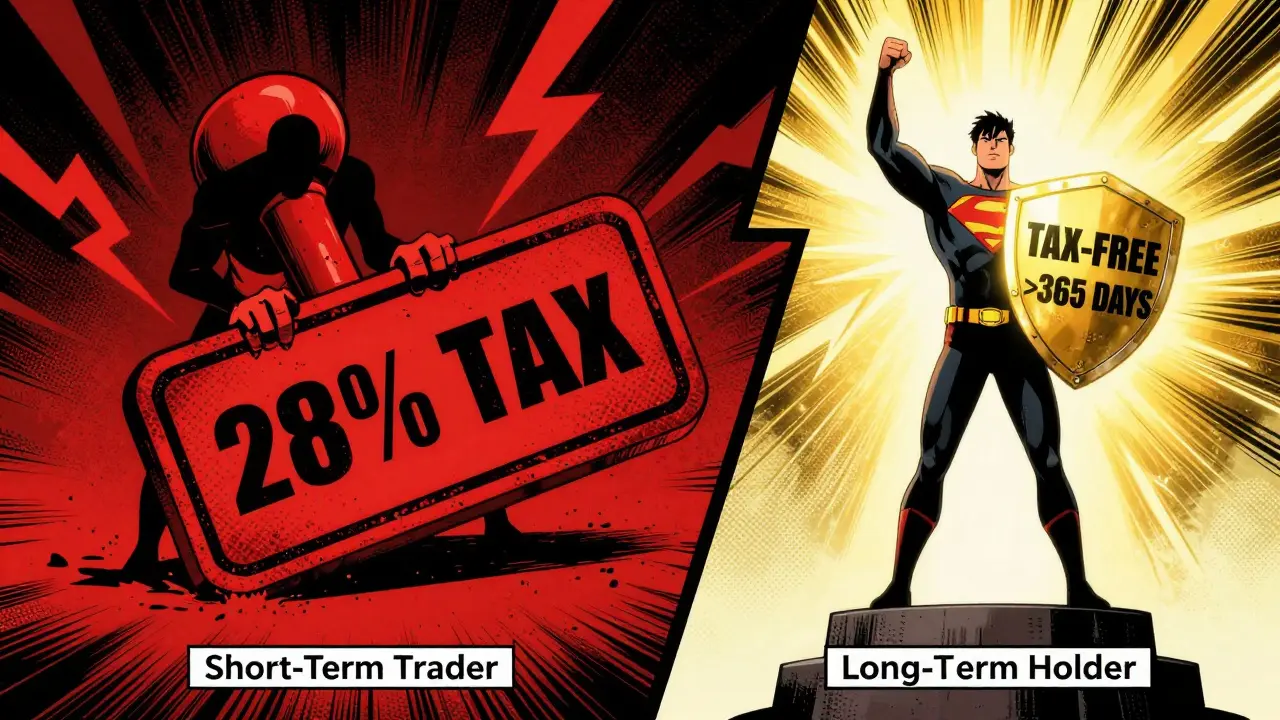
Remember when Portugal was the undisputed king of crypto tax havens? For a few years, holding Bitcoin or Ethereum there meant paying zero tax on your gains. It felt like a golden era for digital asset investors. But that era ended in 2023. Today, if you sell your crypto after holding it for less than a year, you face a flat 28% tax on those profits. If you hold longer, you still pay nothing.
This shift wasn’t random. Portugal aligned its laws with European Union standards while trying to keep its appeal for long-term investors and digital nomads. The rules are specific, strict, and require careful planning. Whether you are an active trader, a passive staker, or someone who just bought Bitcoin five years ago, understanding these distinctions is critical to keeping more of your money.
The Core Rule: The 365-Day Threshold
The entire system hinges on one number: 365 days. This is the dividing line between a taxable event and a tax-free windfall. Under Portuguese law, any cryptocurrency held for less than 12 months is considered a short-term speculative gain. When you dispose of these assets-whether by selling them for euros, trading them for another crypto, or spending them-you trigger a tax liability.
Short-Term Capital Gains are defined as profits from assets held under 365 days, taxed at a flat rate of 28%. This applies to all major cryptocurrencies, including Bitcoin, Ethereum, and stablecoins. The clock starts ticking the moment you acquire the asset. If you buy Bitcoin on January 1st, you must wait until January 2nd of the following year to sell it tax-free. Selling on January 1st means you owe 28% on the profit.
Conversely, if you hold the asset for more than 365 days, the gain is exempt from personal income tax. This creates a powerful incentive for "HODLing" (holding on for dear life). It forces traders to rethink their strategies. Day trading and swing trading become significantly more expensive due to the 28% hit on every quick flip. Long-term investing remains attractive because the government effectively rewards patience with a 100% tax exemption on the profit portion.
Flat Rate vs. Progressive Income Tax: Which Do You Choose?
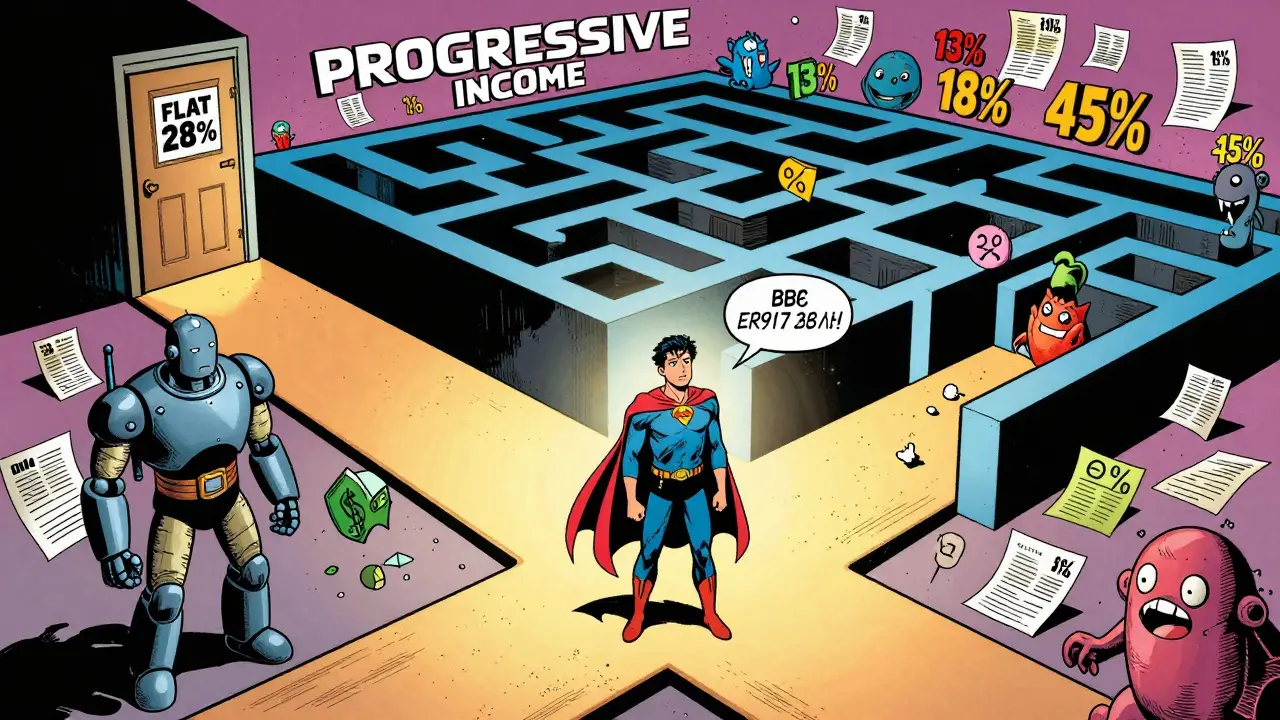
Here is where it gets tricky. The 28% rate is not mandatory for everyone. It is an option. Portuguese taxpayers can choose how they want their short-term crypto gains taxed. You have two paths:
- The Flat Rate Option: You pay exactly 28% on the net gain. This is simple, predictable, and often cheaper for moderate earners.
- The Aggregation Option: You add your crypto gains to your other annual income (salary, rent, etc.) and pay tax based on Portugal’s progressive income tax brackets.
Why would you ever choose the second option? Because if your total income falls into lower tax brackets, the effective rate might be less than 28%. Let’s look at the 2024-2026 tax brackets to see how this works.
| Annual Income Range (EUR) | Marginal Tax Rate | Better Than 28%? |
|---|---|---|
| Up to €7,703 | 13.25% | Yes |
| €7,703 - €11,623 | 18% | Yes |
| €11,623 - €16,472 | 23% | Yes |
| €16,472 - €21,321 | 26% | Yes |
| €21,321 - €27,146 | 32.75% | No |
| €27,146 - €39,791 | 37% | No |
| €39,791 - €51,997 | 43.5% | No |
| €51,997 - €81,199 | 45% | No |
| Above €81,199 | 48% | No |
If your salary is €15,000 and you make €5,000 in crypto gains, aggregating them pushes you into the 26% bracket. That is cheaper than the 28% flat rate. However, if your salary is €50,000, adding crypto gains pushes you into the 45% bracket. In that case, sticking to the 28% flat rate saves you significant money. High-income earners almost always prefer the flat rate. Low-to-mid income earners should run the numbers both ways before filing.
Staking, Lending, and DeFi Rewards
It is not just about buying low and selling high. The tax net casts wide over passive income streams. Many people earn yield through staking Ethereum, providing liquidity on Uniswap, or lending USDT on platforms like Aave. These rewards are treated as passive income.
Under current rules, staking and lending rewards are subject to the same 28% flat tax rate. They are not automatically aggregated with your salary unless you choose to do so. This means if you earn €1,000 in staking rewards, you owe €280 in tax, regardless of your job income. This simplifies reporting for many users but removes the ability to offset these gains against losses in other parts of your portfolio unless you are classified as a professional trader.
Decentralized Finance (DeFi) activities are increasingly scrutinized. While the core principle remains the 28% rate for short-term disposals, the complexity arises when tokens are received via airdrops or forks. Generally, receiving an airdrop is not a taxable event itself. However, the moment you sell or swap that airdropped token, the 365-day clock starts. If you sell it immediately, you pay 28% on the fair market value at the time of receipt. If you hold it for a year, it becomes tax-free.
Professional Traders: A Different Beast
If you trade frequently, use complex algorithms, or treat crypto trading as your primary source of income, you might be classified as a professional trader. This distinction changes everything. Professional trading profits are not taxed as capital gains. They are taxed as business income.
Business income falls under the progressive tax system, ranging from 14.5% to 53% depending on your total revenue and social security contributions. This sounds worse than 28%, but there is a catch: professionals can deduct expenses. If you spend money on data feeds, specialized software, home office costs, or even travel related to your trading business, you can deduct these from your gross income. Casual investors cannot deduct expenses; they only pay tax on the net profit.
Determining professional status is subjective. The tax authority looks at frequency, volume, sophistication of strategy, and whether it replaces your regular employment. If you trade daily and live off the profits, expect to file as a business. If you buy occasionally and work a regular job, you remain a casual investor.
Filing Your Taxes: The Portal das Finanças
You cannot ignore these gains. Portugal requires detailed reporting through the Portal das Finanças. You will need to submit several forms during the annual tax season (typically April to June).
- Modelo 3: The main income tax return form.
- Anexo G: This is crucial for crypto. It reports capital gains. You must list every transaction, separating assets held under 365 days from those held longer. The system calculates the 28% tax on the short-term gains.
- Anexo E: Used for passive income like staking rewards. You declare the gross amount, and the 28% withholding is applied.
- Anexo B: Reserved for professional traders declaring business income.
Record-keeping is non-negotiable. You need proof of purchase dates, sale dates, amounts, and the price in Euros at the time of each transaction. Using crypto tax software like CoinLedger or Koinly is highly recommended. These tools connect to your exchanges, calculate the holding periods, and generate reports compatible with Portuguese forms. Without accurate records, calculating the exact 365-day threshold for dollar-cost averaging purchases becomes a nightmare.

The End of the NHR Program for New Applicants
If you were considering moving to Portugal for tax benefits, the landscape has shifted dramatically. The Non-Habitual Residence (NHR) program was a golden ticket for many expats. It offered a flat 20% tax rate on certain foreign-sourced incomes, including some crypto gains, for ten years. Some interpretations even allowed for full exemptions on foreign crypto gains under NHR.
However, the NHR program closed to new applicants in January 2024. If you established residency before this date, you retain your benefits. If you move to Portugal now, in 2026, you fall under the standard tax rules. This means the 28% short-term tax applies to you immediately, and you lose the potential 20% flat rate advantage. Existing NHR holders still benefit, but the door is shut for newcomers. This change has made Portugal slightly less attractive for new digital nomads seeking aggressive tax optimization, though the long-term exemption still keeps it competitive compared to neighbors.
How Portugal Compares to Europe
Is 28% bad? In the context of Europe, it is actually quite reasonable. Let’s compare Portugal to other major jurisdictions.
| Country | Short-Term Tax Rate | Long-Term Exemption? | Notes |
|---|---|---|---|
| Portugal | 28% (Flat) or Progressive | Yes (>365 days) | Clear distinction between speculation and investment. |
| Germany | Up to 45% (Income Tax) | Yes (>1 year) | Taxed as income, not capital gains. Complex private use clause. |
| France | 30% (Flat Tax + Social Charges) | No | Applies to all gains regardless of holding period. |
| Spain | 19% - 28% (Savings Income) | No | Integrated into savings income tax bracket. |
| UK | 10% - 20% (CGT) or up to 45% (Income) | No specific crypto exemption | Depends on whether HMRC views you as a trader or investor. |
France taxes everything at 30% plus social charges, making it one of the most expensive places for crypto investors. Germany can hit you with up to 45% if gains are deemed business-like. Portugal’s 28% flat rate, combined with the complete exemption for long-term holdings, remains one of the most favorable structures in the EU. It balances fairness for the treasury with incentives for patient capital.
Practical Tips for Minimizing Tax Liability
You cannot avoid the tax if you trade short-term, but you can optimize your position. Here are actionable steps:
- Track Your Dates Meticulously: Use a spreadsheet or software to log every acquisition date. Set reminders 364 days after purchase to know when assets become tax-free.
- Calculate Both Scenarios: Before filing, calculate your tax using the 28% flat rate and then again by aggregating gains with your salary. Choose the lower option.
- Harvest Losses: If you have short-term losses, you can offset them against short-term gains. This reduces your taxable base. Ensure you document these losses clearly in Anexo G.
- Consider the Holding Period: If you are on the fence about selling, ask yourself: Is the potential gain worth the 28% tax? Often, waiting a few extra weeks to cross the 365-day threshold saves thousands.
- Consult a Local Advisor: Crypto tax laws evolve. A qualified accountant in Portugal can help navigate the nuances of professional trader status and ensure your filings are compliant.
Is crypto tax-free in Portugal in 2026?
Only if you hold the cryptocurrency for more than 365 days. Gains from assets held for less than a year are taxed at a flat rate of 28% or added to your progressive income tax.
Do I have to pay tax on staking rewards?
Yes. Staking and lending rewards are considered passive income and are subject to the 28% flat tax rate in Portugal. You report these on Anexo E.
Can new residents use the NHR program for crypto tax breaks?
No. The NHR program closed to new applicants in January 2024. New residents in 2026 must follow the standard tax rules, including the 28% short-term crypto tax.
What is the difference between Anexo G and Anexo E?
Anexo G is used for reporting capital gains from buying and selling cryptocurrencies. Anexo E is used for reporting passive income such as staking rewards, mining yields, and lending interest.
When does the 365-day clock start?
The clock starts on the day you acquire the cryptocurrency. If you buy on January 1st, you must hold until January 2nd of the next year to qualify for the tax exemption.
Terry Hyland
June 17, 2026 AT 07:37the system is rigged against the little guy. they want you to hold so they can control the market. it is all a big lie.
Monica Pathammavong
June 18, 2026 AT 22:48wait, did u read the part about staking? i think u missed the nuance there. its not just holding, its about passive income streams too. people are so dumb if they dont check Anexo E requirements lol
Tim Lefebvre
June 20, 2026 AT 16:30hey man, i actually use koinly for this stuff and it saves me so much headache. the portal das financas interface is super clunky so having a pre-made report helps a ton. just make sure u connect all your wallets before filing though or u might miss some txns
Manish Prajapat
June 21, 2026 AT 05:42The philosophical implication of a 365-day threshold suggests that time itself is the ultimate validator of value in digital assets. It forces a meditation on patience versus greed, which is a core tenet of many eastern philosophies. The tax structure thus becomes a tool for moral alignment, encouraging long-term stewardship rather than short-term exploitation. This aligns with the idea that wealth should be earned through sustained effort and belief, not fleeting speculation. It is interesting how legal frameworks can subtly shape ethical behavior in financial markets.
John Doe
June 22, 2026 AT 19:13I feel like everyone is panicking over nothing but I get why it feels heavy. The shift from zero tax to 28% is a massive emotional hit for those who planned their lives around the old rules. It’s heartbreaking to see people lose out because they didn’t know the clock started on acquisition day. We need more compassion in these discussions because taxes are stressful enough without the fear of missing a deadline by one day.
Danna Charris
June 23, 2026 AT 00:36Only amateurs worry about the flat rate. True investors understand progressive brackets. If you cannot calculate your marginal rate, you do not belong in crypto.
Fede Faith
June 24, 2026 AT 18:38Let's keep it chill here. The key takeaway is simply tracking your dates. Use a spreadsheet if you have to. Don't stress the professional trader label unless you are really doing it full time. Most of us are just casual holders trying to grow wealth slowly. Stay consistent and don't let the bureaucracy scare you off. You got this.
Josh Dodson
June 25, 2026 AT 13:35yo guys, dont forget to harvest losses! if u sold some shitcoins at a loss earlier this year, u can offset those gains. its a legit way to lower ur tax bill. just make sure u document everything properly so the auditors dont come knocking later. stay positive!
Suman Patil
June 27, 2026 AT 00:12Bro, the DeFi space is moving fast and Portugal is trying to catch up. But look at the synergy between staking rewards and the 28% flat tax. It creates a predictable environment for yield farmers. We need to embrace this clarity instead of complaining. Let's collaborate on better record-keeping tools for the community. The future is decentralized but the taxes are centralized, so we adapt. 🚀
Kumaran sowkarpet
June 28, 2026 AT 01:48Hello friends! In India we have different rules but this Portuguese model is very clean. The 365 day rule is simple to follow. I suggest using software like CoinLedger as mentioned. It makes life easy. Hope everyone files correctly and keeps smiling :) The sun shines brighter when taxes are sorted.
Mauricio Contreras Loredo
June 28, 2026 AT 10:03Oh great, another country deciding my wallet belongs to them. 'Patience' is just a fancy word for 'locked up capital'. Sure, wait a year and pay nothing, but inflation eats your gains anyway. Classic government move. At least they admit it's a speculative gain now. Maybe next year they'll tax breathing air in Lisbon.
sreeja boora
June 29, 2026 AT 11:19The regulatory framework must be respected. It ensures stability for the nation. Citizens should comply with the law without question. The distinction between short-term and long-term holdings is clear and logical. Professional traders must adhere to business income regulations. This order benefits society as a whole.
Grace Newman
June 30, 2026 AT 04:17One must consider the deeper implications of such fiscal policies. Is the state merely collecting revenue, or is it orchestrating a broader surveillance apparatus under the guise of taxation? The requirement to report every transaction via Portal das Finanças suggests a level of scrutiny that exceeds mere financial compliance. One wonders what other data points are being correlated with these crypto movements. The individual is increasingly transparent to the collective, while the mechanisms of power remain obscured.
Annemarie Fitzgerald
July 2, 2026 AT 03:22i mean, its kinda poetic no? the government wants u to hold. its like they are forcing u to be a stoic philosopher. but then they take 28% if u cant wait. its tragic really. also typo alert: Anexo G is hard to spell. why does it have to be so complicated? just ask me directly.
Abby Sivertsen
July 3, 2026 AT 12:25Look, I’ve lived in three countries and dealt with their tax systems. Portugal’s approach is actually pretty straightforward compared to the nightmare in the US. Just track your dates. Seriously. Set a calendar reminder. It’s not rocket science. Stop making excuses and do the work. Your future self will thank you when you’re not getting an audit letter.
Benjamin Eisen
July 4, 2026 AT 19:40hey thanks for the detailed guide. i was confused about the aggregation option vs flat rate. now i see if my salary is low, aggregating might save me money. i should probably run both numbers before filing. appreciate the help everyone. lets keep supporting each other in this journey