
Imagine trading thousands of tokens without ever handing over your private keys to a company or waiting days for an account approval. That is the core appeal of a decentralized exchange. While the market is flooded with options, PancakeSwap v2 is a leading decentralized exchange (DEX) that uses an automated market maker (AMM) model to let users swap tokens directly via liquidity pools. Originally the king of the BNB Chain, it has expanded into a multi-chain powerhouse, and its presence on opBNB makes it a go-to for anyone tired of paying high gas fees.
The Lowdown on PancakeSwap and opBNB
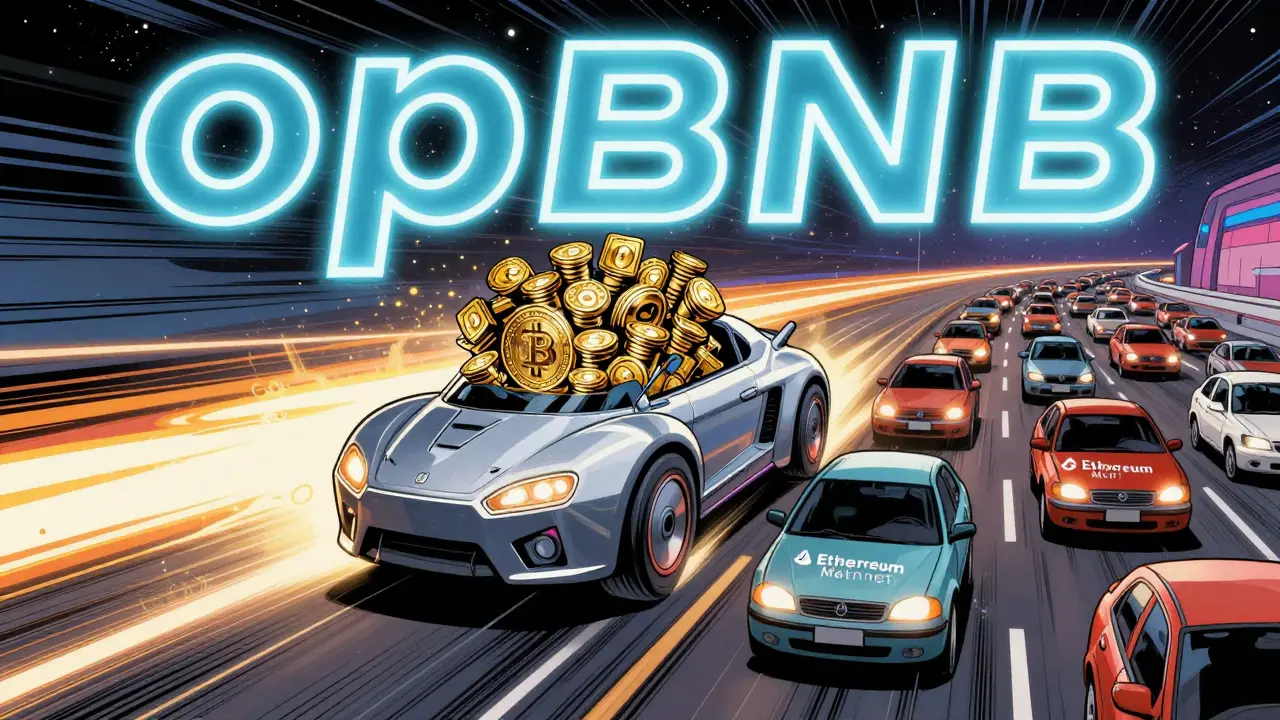
To get why this specific combination matters, you have to understand the tech. Most people know PancakeSwap as the "Uniswap of BNB Chain," but the shift to opBNB is a game changer. opBNB is a Layer 2 scaling solution designed to bring ultra-low transaction costs and high throughput to the ecosystem. When you use PancakeSwap v2 on this network, you aren't just getting a fast trade; you're getting fees that are practically negligible compared to the Ethereum mainnet.
The platform doesn't rely on a traditional order book where a buyer and seller must match. Instead, it uses Liquidity Pools is crowdsourced collections of tokens locked in a smart contract that facilitate instant trading. This means you can swap your assets 24/7 without needing a counterparty to be online at that exact second.
Key Features That Actually Matter
If you're just looking to swap a few tokens, the basic interface is a breeze. But if you're trying to make your money work for you, there are a few deeper tools you should know about. First, the yield farming options. You can provide liquidity to a pool and earn a share of the trading fees plus additional rewards. It's a way to turn passive assets into an income stream, though it comes with the risk of impermanent loss-where the price of your deposited tokens changes relative to each other, potentially leaving you with less value than if you had just held the tokens.
Then there are the Limit Orders is a feature that allows traders to set a specific price target for a trade to execute automatically. In a typical AMM, you get the current market price. Limit orders give you a bit more control, letting you buy the dip or sell at a peak without staring at a chart for ten hours a day. Just keep in mind that these aren't supported for tokens that have built-in transfer taxes.
For the big players, TWAP (Time-Weighted Average Price) is a lifesaver. If you try to dump a massive amount of a low-liquidity token at once, you'll tank the price. TWAP breaks that one giant trade into smaller pieces over a set period, smoothing out the market impact and getting you a fairer average price.
| Feature | PancakeSwap v2 (opBNB) | Typical CEX (e.g., Binance/Coinbase) |
|---|---|---|
| Account Setup | No registration (Wallet only) | Full KYC and email registration |
| Asset Control | You hold private keys | Exchange holds keys |
| Trading Fee | 0.25% standard | Varies (often lower for high volume) |
| Privacy | High (Anonymous) | Low (Monitored) |
| Speed | Instant (On-chain) | Instant (Off-chain) |
The Reality of Trading Fees and Speed
Let's talk numbers. The trading fee on PancakeSwap is flat at 0.25% for both makers and takers. While some centralized giants might offer lower fees for high-volume traders, the lack of account fees and the speed of the opBNB network balance the scales. On opBNB, the "gas" cost-the fee paid to the network to process the transaction-is tiny. You can move assets and execute swaps for a fraction of what you'd pay on Ethereum, making it viable for small-cap trading and micro-investing.
The speed is equally impressive. Because it uses full node validation rather than simplified payment verification, your trades are confirmed quickly and securely. You aren't waiting for a congested network to clear; you're moving at the speed of a Layer 2 solution.
The Risks You Can't Ignore
It isn't all sunshine and cheap swaps. The biggest hurdle for most is Impermanent Loss is a temporary loss of funds experienced by liquidity providers due to volatility in a trading pair. If the price of one token in your pool rockets up while the other stays flat, the AMM rebalances your holdings, and you might find that selling your LP tokens gives you less than if you'd just kept the coins in your wallet. It's a calculated risk that requires a deep understanding of the assets you're pairing.
Then there's the regulatory void. PancakeSwap operates without a central authority or government oversight. While this is great for privacy and censorship resistance, it means there is no "customer support" number to call if you send tokens to the wrong address or lose your seed phrase. You are your own bank. If you make a mistake, there is no undo button.
Getting Started: From Wallet to Swap
You don't need a degree in computer science to start. The process is straightforward:
- Get a Wallet: Download a compatible wallet like MetaMask or Trust Wallet.
- Add opBNB Network: Ensure your wallet is configured to use the opBNB network so you can interact with the Layer 2 contracts.
- Fund Your Account: Move some BNB into your wallet to cover those tiny gas fees.
- Connect to PancakeSwap: Go to the official site, hit "Connect Wallet," and approve the connection.
- Swap: Select the tokens you have and the ones you want, check the slippage tolerance, and confirm the trade.
For those moving beyond basic swaps, the platform provides a learning center. I highly recommend checking it out before diving into Staking Pools or Initial Farm Offerings (IFO), as these involve more complex mechanisms and higher risks of volatility.
Final Verdict: Who Is This For?
PancakeSwap v2 on opBNB is a powerhouse for the "do-it-yourself" trader. It's perfect for people who value their privacy and want to avoid the bureaucratic nightmare of KYC (Know Your Customer) checks. If you're looking for an ecosystem where you can swap, stake, and farm all in one place without paying $50 in gas fees for a $100 trade, this is it.
However, if you're a complete beginner who is terrified of managing your own private keys, a centralized exchange might still be your safer bet. The freedom of a DEX comes with the responsibility of total asset management. But for everyone else, the combination of multi-chain support and the efficiency of opBNB makes this one of the most competitive tools in the DeFi space today.
What is the difference between PancakeSwap v1 and v2?
V2 is significantly more efficient. It reduces slippage (the difference between the expected price of a trade and the price at which the trade is executed) and is designed to prevent the capital loss issues that were more common in the original v1 implementation.
Are there any fees to use PancakeSwap on opBNB?
Yes, there is a standard trading fee of 0.25% per swap. Additionally, you pay a very small network gas fee to the opBNB blockchain, which is much cheaper than fees on the Ethereum mainnet.
Is my money safe in liquidity pools?
Your funds are held in smart contracts. While PancakeSwap undergoes frequent security audits, DeFi always carries risks. The main risk for liquidity providers is impermanent loss, where price swings can reduce the value of your position compared to simply holding the tokens.
Can I trade any cryptocurrency on PancakeSwap?
You can trade over 150 tokens across 3,000+ pairs, but they must be supported on the blockchain network you are currently using (like BNB Chain or opBNB). You cannot trade a token that only exists on Solana while connected to the BNB network.
What happens if I lose my wallet seed phrase?
Because PancakeSwap is decentralized, they do not have access to your accounts. If you lose your seed phrase, you lose access to your funds forever. There is no "password reset" button in DeFi.