
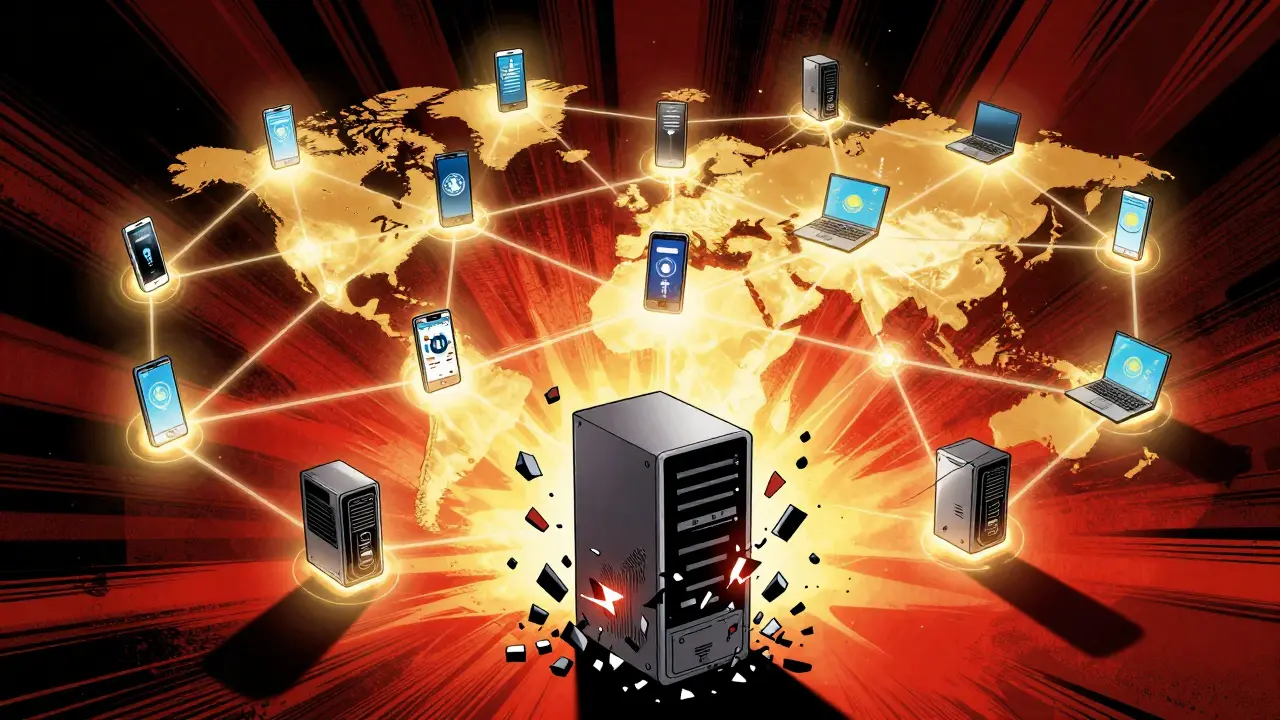
Think about how you usually access the internet. You open your browser, type in a website, and boom - data flows from a central server to your device. That’s the client-server model, and it’s been the backbone of the web for decades. But blockchain doesn’t work like that. Instead, it uses something called peer-to-peer (P2P) networking - and that choice isn’t random. It’s the reason blockchain can exist without banks, governments, or tech giants controlling it.
How Client-Server Architecture Works
In a client-server setup, there’s a clear hierarchy. One side is the server - a powerful machine that stores data, runs apps, and responds to requests. The other side is the client - your phone, laptop, or tablet - that asks for stuff but doesn’t give anything back. Think of it like a restaurant: you (the client) order food, and the kitchen (the server) prepares it. You don’t cook for other diners.
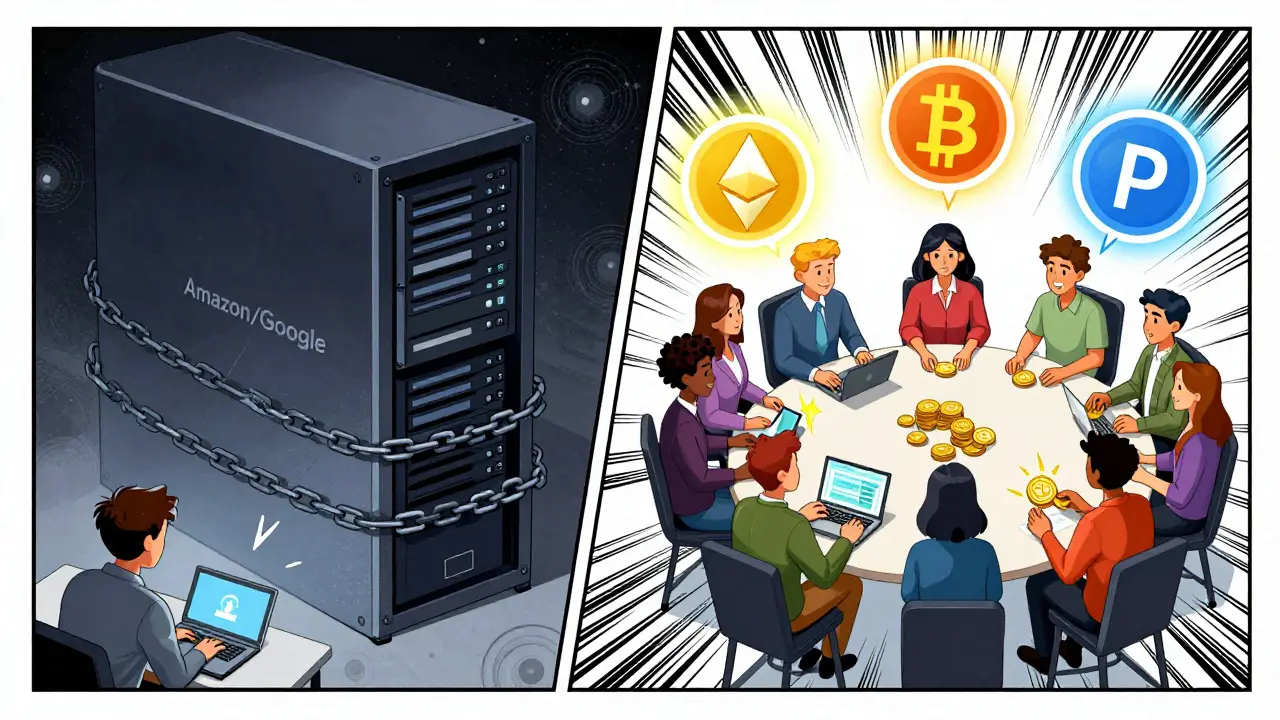
This model is simple and reliable. Companies like Amazon, Google, and Facebook rely on it because it’s easy to manage, scale, and secure. But it has one huge flaw: it’s centralized. If the server goes down, the whole system crashes. If the company decides to censor something - like removing a post or freezing an account - they can. And if hackers break into that server? All the data is at risk.
How Peer-to-Peer Architecture Works
Now imagine a different kind of network. No servers. No bosses. Just a bunch of computers - your phone, a laptop in Berlin, a miner in Kazakhstan - all connected directly to each other. Each one can ask for data, and each one can also give data. That’s P2P.
In a pure P2P network, every node is equal. There’s no single point of control. If one node disappears, the others keep going. If one node tries to cheat, the rest of the network ignores it. This isn’t just a technical detail - it’s a philosophical shift. P2P means no one owns the network. No company controls it. No government can shut it down.
Why Blockchain Chooses P2P Over Client-Server
Blockchain isn’t just another app. It’s designed to be trustless, censorship-resistant, and always available. That’s impossible with client-server architecture. Here’s why P2P is the only option:
- No single point of failure: In Bitcoin’s network, over 10,000 nodes spread across the globe hold a copy of the entire blockchain. Take down one? The rest keep running. Take down ten? Still fine. Even if half the nodes vanish, the network survives.
- Decentralized data storage: Every transaction ever made on Bitcoin or Ethereum is stored on every full node. No central database. No corporate server. No single entity can delete or alter history.
- Cost distribution: Running a server costs money - hardware, electricity, IT staff. In P2P, those costs are shared. Miners, validators, and everyday users all contribute resources. That’s why anyone can join Bitcoin without paying a dime to a company.
- Censorship resistance: If a government tries to block a transaction, there’s no central authority to pressure. Nodes don’t care who you are. They only care if the math checks out.
Compare that to a traditional bank system. If you try to send money and the bank says “no,” you’re stuck. With Bitcoin, if your transaction follows the rules, it goes through - no permission needed.
Why Client-Server Fails for Blockchain
You might think: “Why not just use a bunch of servers instead of P2P? That’s still decentralized, right?” Wrong. Even if you use 100 servers, you still have 100 points of control. Someone owns those servers. Someone can turn them off. Someone can be hacked or pressured.
Blockchain’s whole point is to remove trust in institutions. Client-server architecture puts trust right back in - in the server operators. That defeats the entire purpose.
Also, scaling a client-server blockchain would be a nightmare. Imagine Ethereum needing a server farm to handle every DeFi trade, NFT sale, and smart contract. The cost? Hundreds of millions per year. The energy? Unthinkable. P2P spreads the load. Thousands of small machines do what one giant server could never handle efficiently.
How P2P in Blockchain Is Different from BitTorrent or Skype
Not all P2P networks are the same. BitTorrent lets you download movies. Skype lets you call people. But blockchain? It has to agree on one truth.
BitTorrent doesn’t care if your file is real or fake. You get what you download. But blockchain can’t have two versions of history. If one node says “Alice sent Bob $10,” and another says “No, she didn’t,” the network must resolve it. That’s where consensus mechanisms come in - Proof of Work, Proof of Stake, and others.
These aren’t just technical tricks. They’re economic incentives. Miners get paid in Bitcoin for validating blocks. Validators lock up ETH to earn rewards. Cheating costs more than it’s worth. That’s how P2P stays secure without a central authority.
The Hidden Costs of P2P
It’s not all perfect. P2P networks are slower to start. New nodes take hours to sync with the full blockchain. Bandwidth usage is high. It’s harder to fix bugs because there’s no central team pushing updates.
But these aren’t flaws - they’re trade-offs. The trade-off for censorship resistance is complexity. The trade-off for decentralization is slower updates. And most users? They don’t run full nodes. They use wallets that connect to trusted nodes. The network still stays decentralized because anyone can run a node. The option exists. That’s enough.
Real-World Proof: Bitcoin and Ethereum
Bitcoin has processed over $10 billion in daily transactions. Ethereum hosts thousands of decentralized apps, from lending platforms to prediction markets. Neither relies on a single company. Neither needs a CEO to approve a transaction.
How? Because every time someone sends ETH, every node in the network checks the math. Every block is verified by dozens of independent machines. No central server. No middleman. Just code, cryptography, and consensus.
These networks don’t just work - they’ve survived for over a decade. They’ve withstood hackers, government threats, market crashes, and media hype. And they’ve done it all because they’re built on P2P.
What’s Next? Scaling Without Losing Decentralization
Blockchain P2P networks still face challenges. Bitcoin can only handle 7 transactions per second. Ethereum used to be slow too. But developers aren’t abandoning P2P. They’re improving it.
Layer-2 solutions like the Lightning Network for Bitcoin let users transact off-chain, then settle on the main blockchain. Sharding splits Ethereum into smaller, parallel chains. Both keep the core P2P structure intact while boosting speed.
Even AI and IoT devices are being added to P2P blockchain networks. Imagine a smart fridge in Wellington that pays for its own milk using a blockchain - all without a bank. That future relies on P2P. Not servers. Not cloud platforms. Just peers.
Final Thought: It’s Not About Tech - It’s About Power
Choosing P2P over client-server isn’t a technical decision. It’s a political one. It’s about who controls the system. Client-server gives power to corporations and governments. P2P gives power back to users.
Blockchain doesn’t use P2P because it’s trendy. It uses it because it’s the only way to build a system that can’t be controlled. And that’s why, no matter how fast the internet gets or how smart the AI becomes, P2P will stay at the heart of blockchain.
Is P2P faster than client-server?
It depends. For small networks, client-server is faster because data flows directly from one place. But for large, global systems like blockchain, P2P wins. It spreads the load across thousands of nodes, so no single machine gets overloaded. Bitcoin and Ethereum handle millions of transactions daily because they don’t rely on one server - they use the whole network.
Can blockchain work without P2P?
Technically, yes - you could build a blockchain that runs on a few centralized servers. But it wouldn’t be blockchain anymore. It would just be a database with extra steps. The whole point of blockchain is decentralization. Without P2P, you lose censorship resistance, trustlessness, and resilience. You get something that’s easier to control - and that defeats the purpose.
Why don’t all apps use P2P if it’s so secure?
Because P2P is harder to build, slower to start, and harder to update. Most apps don’t need decentralization. A banking app, a social media platform, or a streaming service doesn’t need to be uncensorable. They need speed, control, and reliability - things client-server delivers better. P2P is only worth the complexity when you need to remove trust from the system - like in money, voting, or identity systems.
Do I need to run a node to use blockchain?
No. Most users interact with blockchain through wallets or apps that connect to nodes run by others. But the network stays decentralized because anyone can run a node. You don’t have to - but the fact that you could is what keeps the system honest. It’s like democracy: you don’t have to vote, but the option exists.
What’s the biggest risk of P2P blockchain networks?
The biggest risk isn’t hacking - it’s centralization creep. If only a few big mining pools or validator groups control most of the network, the system starts behaving like a client-server model. That’s why Ethereum moved to Proof of Stake and why Bitcoin’s mining distribution is monitored closely. True decentralization requires active participation from many independent users - not just a handful of corporations.
Ruby Ababio-Fernandez
February 17, 2026 AT 02:06Jeremy Fisher
February 18, 2026 AT 14:41Angela Henderson
February 19, 2026 AT 12:01Paul David Rillorta
February 20, 2026 AT 21:46andy donnachie
February 21, 2026 AT 17:53Lauren Brookes
February 22, 2026 AT 09:53Chris Thomas
February 24, 2026 AT 02:26James Breithaupt
February 25, 2026 AT 11:00Alex Williams
February 27, 2026 AT 09:45Sarah Shergold
February 28, 2026 AT 21:40Andrew Edmark
March 2, 2026 AT 14:30Dominica Anderson
March 3, 2026 AT 19:16sruthi magesh
March 3, 2026 AT 21:52Lisa Parker
March 5, 2026 AT 19:06Nova Meristiana
March 6, 2026 AT 01:52Aileen Rothstein
March 7, 2026 AT 18:25JJ White
March 9, 2026 AT 15:08Nicole Stewart
March 11, 2026 AT 13:00Alan Enfield
March 12, 2026 AT 07:49Kyle Tully
March 13, 2026 AT 02:20Rajib Hossaim
March 14, 2026 AT 02:57AJITH AERO
March 14, 2026 AT 16:31Geet Kulkarni
March 15, 2026 AT 01:38Jennifer Riddalls
March 15, 2026 AT 03:17Ruby Ababio-Fernandez
March 15, 2026 AT 14:06