
For over two decades, Syrian citizens looking to buy Bitcoin or send money via cryptocurrency faced a brick wall. U.S. sanctions made it illegal for American platforms to serve them, and the penalties for breaking these rules were severe. But if you are reading this in mid-2026, that wall has largely come down. The landscape shifted dramatically in 2025, turning what was once a high-risk gray area into a regulated, albeit complex, opportunity.
The core change isn't just political; it's legal. On June 30, 2025, Executive Order 14312 revoked six foundational orders that had blocked Syrian financial activities since 2004. By August 2025, the Office of Foreign Assets Control (OFAC) completely removed the Syrian Sanctions Regulations from federal code. For a Syrian user, this means you can now legally interact with U.S.-based exchanges like Coinbase or Kraken, provided you aren't on a specific blacklist. This guide breaks down exactly what is allowed, what remains banned, and how to stay compliant in this new era.
The End of Blanket Prohibitions
To understand why today’s situation is different, you have to look at where we started. Before July 1, 2025, the Syrian Sanctions Regulations (SySR) were a comprehensive set of U.S. economic sanctions that prohibited most financial transactions between U.S. persons and Syrian entities acted as a total ban. If you were a Syrian citizen trying to deposit funds into a U.S. wallet provider, you were breaking federal law. The risks weren't theoretical. Penalties included asset freezing, criminal prosecution, and civil fines up to $20 million.
This blanket approach forced many Syrians into underground channels or offshore workarounds that offered zero consumer protection. The removal of the SySR by OFAC on August 26, 2025, dismantled this barrier. It didn't just tweak the rules; it deleted them. This regulatory amendment meant that the default status for a Syrian person engaging in crypto transactions with U.S. services changed from "illegal" to "permitted," unless specifically restricted by other programs.
Why does this matter for crypto? Because cryptocurrency relies on global interoperability. When major U.S. players were barred from serving Syrian users, liquidity dried up, fees skyrocketed on alternative platforms, and security risks increased. With the SySR gone, Syrian users can access the same tier-1 exchanges and DeFi protocols as anyone else, assuming they pass identity checks.
How General License 25 Opens the Door
If the removal of the SySR took away the lock, General License 25 is an OFAC authorization issued on May 28, 2025, that provides blanket permission for transactions previously prohibited by Syrian sanctions opened the door. Issued earlier in the transition period, this license remains one of the most critical tools for Syrian crypto users today.
General License 25 provides blanket authorization for transactions that would otherwise be prohibited by remaining sanctions frameworks, such as those targeting global terrorism or foreign terrorist organizations. In practical terms, this means that even if a broader anti-terrorism rule technically covers a transaction, GL 25 overrides it for standard Syrian civilian activity.
Here is how this works in a real-world scenario:
- Before 2025: A Syrian user tries to verify their identity on a U.S. exchange. The exchange’s compliance team sees the country flag and blocks the account immediately to avoid violating broad anti-terrorism statutes linked to Syria.
- After GL 25: The same user applies. The exchange still runs checks, but GL 25 gives them the legal cover to approve the account if the user is not individually sanctioned. The license effectively creates a safe harbor for everyday financial conduct.
This license is not a free pass for everyone, though. It applies to the general population. It does not protect individuals who are themselves designated as terrorists or criminals. But for the average person wanting to save in Bitcoin or pay for goods using stablecoins, GL 25 is the legal shield that makes these transactions viable.

The New Reality: PAARSS and Targeted Sanctions
Sanctions relief doesn’t mean no sanctions. It means *smarter* sanctions. On September 24, 2025, OFAC rebranded the remaining program from the Syrian Sanctions Regulations to the Promoting Accountability for Assad and Regional Stabilization Sanctions Regulations (PAARSS) the current U.S. sanctions framework targeting specific individuals and entities associated with the Assad regime and human rights abuses. This name change signals a shift from punishing the nation to punishing specific bad actors.
Under PAARSS, OFAC maintains sanctions on over 100 individuals and entities affiliated with the Bashar al-Assad regime. Restrictions also remain on human rights abusers, Captagon traffickers, ISIS affiliates, and those linked to Iran’s proxy networks. For a crypto user, this introduces a new challenge: screening.
You might think, "I’m just buying Ethereum, why do I care about regime affiliates?" You care because your exchange cares. Platforms must implement sophisticated screening mechanisms to ensure they aren’t inadvertently servicing a sanctioned individual. If your digital wallet address is ever linked-directly or indirectly-to a person on the SDN List (Specially Designated Nationals), your assets could be frozen instantly.
The good news is that OFAC delisted 518 individuals and entities from the SDN List during this transition. This mass unblocking cleared the path for hundreds of people who were previously trapped by association. However, the list is dynamic. New names are added, and old ones are sometimes reinstated if violations occur. Staying off the radar requires clean transaction histories and avoiding mixing services that obscure the origin of funds, as these raise red flags for compliance teams.
| Feature | Pre-July 2025 (Old SySR) | Post-August 2025 (PAARSS + GL 25) |
|---|---|---|
| Access to U.S. Exchanges | Prohibited for all Syrian residents | Permitted for non-sanctioned individuals |
| Legal Basis | Blanket national emergency | Targeted accountability (PAARSS) |
| Key Authorization | None | General License 25 |
| Risk Profile | High (Criminal penalties) | Medium (Compliance screening required) |
| Delisted Entities | 518+ removed from SDN List | Remaining ~100+ targeted entities |
Hardware and Infrastructure: The BIS Role
Crypto isn’t just software; it’s hardware. Mining rigs, cold storage devices, and blockchain infrastructure nodes require physical components. Previously, exporting this technology to Syria was heavily restricted. That changed with the Bureau of Industry and Security (BIS).
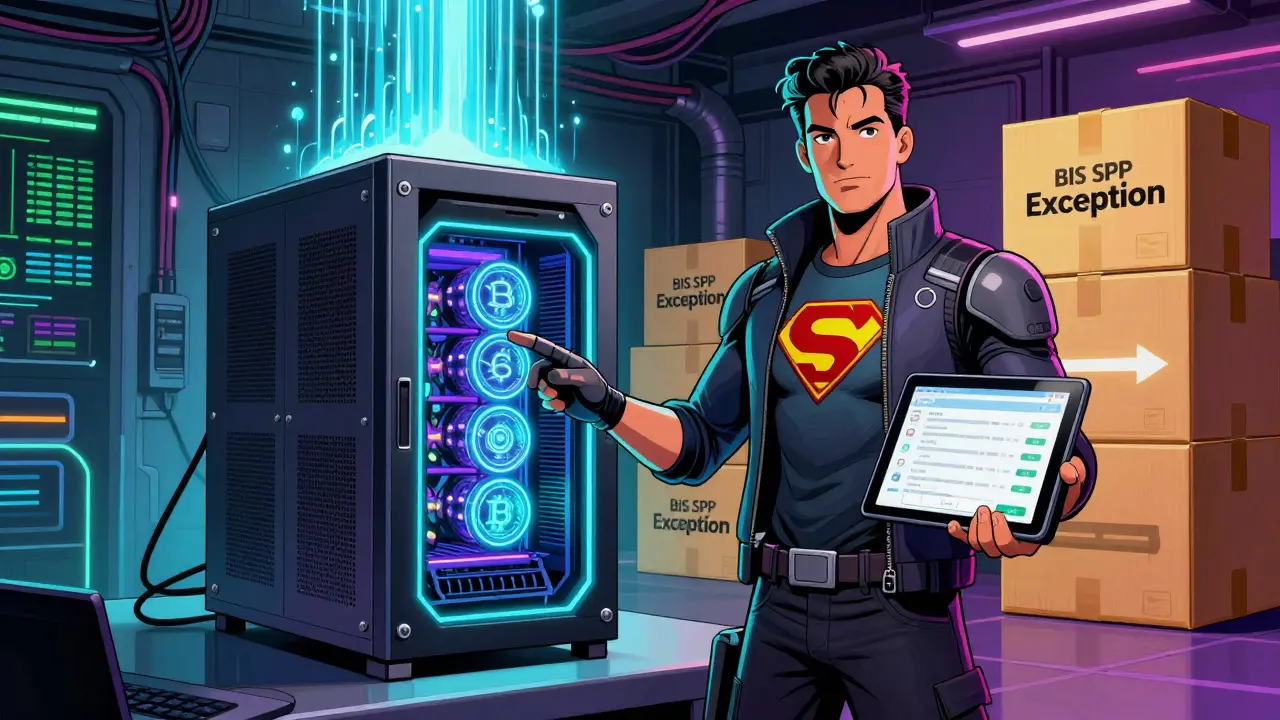
On August 28, 2025, BIS created the License Exception Syria Peace and Prosperity (SPP) an export control exemption allowing the transfer of EAR99 items, including crypto mining equipment, to Syria without a specific license. Effective September 2, 2025, this exception authorizes the export of all EAR99 items to Syria. EAR99 covers low-tech dual-use items, which includes much of the consumer-grade hardware used for cryptocurrency mining and storage.
What does this mean for you? If you want to start mining Litecoin or run a local node to support the network, you can now order equipment from international suppliers without jumping through hoops for export licenses. This facilitates the growth of a domestic crypto ecosystem in Syria. It lowers costs for hardware and increases availability, making it easier for local entrepreneurs to build tech businesses around digital assets.
However, keep in mind that high-end specialized chips or military-grade encryption tools may still fall under stricter controls. Always check the specific Export Control Classification Number (ECCN) of any hardware you import to ensure it qualifies under the SPP exception.
Navigating Compliance as a User
With the barriers lowered, responsibility shifts partly to the user. Financial institutions and Virtual Asset Service Providers (VASPs) are following FinCEN guidance issued in June 2025, which encourages a risk-based approach. This means exchanges will ask more questions, not fewer.
Expect rigorous Know Your Customer (KYC) procedures. When you sign up for a platform, you’ll need to provide clear identification, proof of address, and potentially source-of-funds documentation. The goal for these companies is to distinguish between legitimate Syrian civilians and the targeted entities under PAARSS. Over-compliance is a real risk; some smaller platforms might still hesitate to serve Syrian users due to fear of making mistakes. Stick to major, reputable exchanges that have updated their compliance manuals to reflect GL 25 and PAARSS.
Avoid using peer-to-peer (P2P) markets that lack oversight. While P2P trading offers privacy, it also lacks the legal protections of licensed platforms. If you accidentally trade with a sanctioned individual on an unregulated P2P site, you have no recourse. Licensed exchanges perform the screening for you, reducing your personal liability.
Looking Ahead: Future Regulatory Developments
The current framework is stable, but it’s not static. OFAC has indicated plans to supplement the PAARSS regulations with more detailed interpretive guidance. We might see additional general licenses or specific definitions that clarify edge cases in cryptocurrency usage. For example, rules regarding decentralized finance (DeFi) protocols that operate without central intermediaries could evolve as regulators figure out how to apply targeted sanctions to anonymous smart contracts.
Additionally, the Department of State’s 180-day waiver of restrictions under the Caesar Syria Civil Protection Act reduces compliance risks for infrastructure investment. This suggests a longer-term trend toward normalization. As Syria stabilizes, expect more mainstream financial integration, including potential partnerships between local fintech startups and global crypto firms.
For now, the window is open. The days of total isolation are over. By understanding the roles of General License 25, PAARSS, and the SPP export exception, Syrian crypto users can participate in the global digital economy safely and legally. Stay informed, keep your records clean, and choose compliant platforms to navigate this new chapter successfully.
Can Syrian citizens use Coinbase or Binance now?
Yes, generally speaking. Since the removal of the Syrian Sanctions Regulations in August 2025, Syrian residents who are not on the SDN List can legally use U.S.-based exchanges like Coinbase. International platforms like Binance also serve Syrian users, provided they complete KYC verification. Always check the specific platform's current supported countries list, as policies can vary.
What is General License 25 and why do I need it?
General License 25 is an OFAC authorization that allows transactions previously blocked by broader sanctions laws. You don't need to apply for it; it applies automatically to eligible transactions. It protects both you and the exchange you use by providing legal cover for standard financial activities, ensuring that routine crypto trades aren't flagged as violations of anti-terrorism statutes.
Are there any Syrians who are still banned from using crypto?
Yes. Under the PAARSS framework, individuals and entities affiliated with the Assad regime, human rights abusers, Captagon traffickers, and terrorist groups remain sanctioned. If you or your business partners are on the SDN List, you cannot legally use U.S. financial services or crypto platforms. Checking the SDN List regularly is crucial for compliance.
Can I import crypto mining equipment to Syria?
Yes, thanks to the BIS License Exception Syria Peace and Prosperity (SPP). This exception, effective September 2025, allows the export of EAR99 items, which include most consumer-grade mining hardware and blockchain infrastructure components, without requiring a special license. Ensure your equipment falls under EAR99 classification to avoid customs delays.
What happens if I accidentally transact with a sanctioned entity?
If you inadvertently engage in a transaction with a sanctioned party, you should report it to OFAC within 10 business days. Prompt self-disclosure can mitigate penalties. To prevent this, use reputable exchanges that perform automated screening against the SDN List. Avoid unregulated P2P markets where you cannot verify the counterparty's status.
Abby Sivertsen
June 14, 2026 AT 21:27finally some actual progress instead of the usual bureaucratic runaround that keeps people stuck in poverty
Kenneth Riley
June 16, 2026 AT 18:35you guys are completely missing the point here this is just a trap to get more data on syrians for future sanctions they want you to think its free but its all monitored now every transaction is tracked and stored forever so enjoy your little bitcoin while it lasts before they freeze everything again because the government never actually lets go of control they just change the method of oppression
and dont forget how many people got screwed by the old rules so why would anyone trust this new system its just another way to keep the poor down while the rich play with their crypto toys
Benjamin Eisen
June 18, 2026 AT 02:37i think this is really good news for everyone involved hope it helps the local economy grow properly without all the fear of getting arrested or losing savings overnight
maybe we can see more tech startups popping up there soon which would be awesome for innovation in the region
ravi mahla
June 19, 2026 AT 06:56haha look at you americans trying to fix everything with paperwork lol but seriously if this works then maybe other countries will follow suit and stop using sanctions as a weapon against regular people who did nothing wrong
crypto was always meant to be borderless so this is just catching up to reality finally
Mark Brunschwiler
June 21, 2026 AT 06:26i feel like the real story here is how much power these agencies have over our daily lives it is scary to think that one signature can change whether you can buy coffee or not based on where you were born
but hey at least now we have general license 25 to save us from ourselves isn't that something i guess we should be grateful for small mercies even if they come wrapped in red tape
Sonya O'Brien
June 22, 2026 AT 02:30i've been following the situation closely and it's fascinating to see how the legal framework has shifted from blanket prohibitions to targeted accountability, which I believe is a much more nuanced approach that allows for economic participation while still holding specific bad actors responsible for their actions, and I think this could serve as a model for other sanctioned regions where the goal is to punish regimes rather than the general population who suffer the most under these restrictions
it's important to note that the removal of the SySR doesn't mean anarchy, but rather a structured environment where compliance is key, and I encourage anyone looking to engage to read the fine print carefully because the difference between permitted and prohibited activities can be quite subtle depending on your specific circumstances and the nature of the transactions you intend to make
Filbert Reeves
June 23, 2026 AT 22:29typical government move lift the ban just enough to let in the surveillance tools then tighten the screws later when everyone is hooked on the digital leash
they say its for peace and prosperity but its really about controlling the flow of money so they can track every cent you spend and decide if you are worthy of keeping it next year so don't get too excited about this freedom because it comes with a price tag of total transparency to washington
and who do you think benefits from this chaos the big banks who get to charge fees for processing these new compliant transactions or the regular joe trying to send money home to his family
Nick Rice
June 25, 2026 AT 04:58this is a significant step forward for financial inclusion and I urge everyone to take advantage of the opportunities presented by the new regulations while being diligent about compliance requirements
we need to build bridges not walls and this policy change shows that diplomacy can work when combined with clear legal frameworks that protect both national security interests and individual rights
Amit Thakur
June 26, 2026 AT 02:25the technical implications of GL 25 are massive for DeFi protocols operating in gray zones previously users had to rely on mixers or offshore entities to avoid triggering alerts but now with blanket authorization for civilian activity the friction cost drops significantly allowing for better liquidity pools and deeper markets
however the KYC burden remains high so expect centralized exchanges to dominate initially until decentralized identity solutions mature enough to satisfy OFAC screening requirements without compromising user privacy entirely
Eric Scheinberg
June 27, 2026 AT 23:02it is imperative that individuals understand the distinction between PAARSS and the previous regulatory regime as the former targets specific entities rather than imposing a comprehensive embargo
therefore one must ensure that their counterparty is not listed on the SDN list before initiating any transfer to avoid inadvertent violations which could result in severe penalties including asset forfeiture
pankaj chawla
June 28, 2026 AT 19:07great update thanks for sharing this information it seems like a positive development for cross-border trade and personal finance management in the region
i hope this leads to more stability and growth for businesses that were previously shut out of global markets
Jessica Lane
June 30, 2026 AT 17:09i am curious about the long-term impact on remittances sent by the diaspora back home will this reduce the fees charged by informal networks like hawala systems which have been prevalent due to the lack of formal banking options
if so this could have a profound effect on household incomes and overall economic resilience in affected areas
Charles Pawlikowski
July 1, 2026 AT 01:09about time they stopped punishing innocent people for the crimes of their leaders :D
let them trade and build their own future without washington breathing down their necks every second of the day
Andrea Burd
July 2, 2026 AT 02:49surely this is just another excuse for american corporations to exploit cheap labor and resources under the guise of humanitarian aid
don't believe the hype its all about profit margins and market expansion disguised as moral superiority
Akeem Whittaker
July 3, 2026 AT 05:16we need to focus on education and ensuring that users understand how to navigate these new rules safely
compliance is not optional it is essential for maintaining access to the global financial system so please take the time to learn about KYC procedures and SDN lists before engaging in any transactions
Manish Prajapat
July 4, 2026 AT 07:04the philosophical shift from collective punishment to individual accountability reflects a maturation of international law and ethics
it acknowledges that sovereignty does not equate to impunity for human rights abuses nor does it justify the suffering of the general populace
this balanced approach offers hope for reconciliation and reconstruction through economic integration rather than isolation
John Doe
July 5, 2026 AT 14:10i can't help but feel a sense of relief reading this after years of uncertainty and fear surrounding financial transactions
it feels like a weight has been lifted off the shoulders of millions who simply wanted to participate in the modern economy without breaking federal laws
here's to a new chapter defined by opportunity rather than restriction
Mekz Wheoki
July 5, 2026 AT 19:34oh wonderful another american solution to a problem they created in the first place
enjoy your regulated freedom while it lasts i bet it won't be long before they find a new reason to slap sanctions back on because someone looked at a map the wrong way
Skm Shubham
July 7, 2026 AT 07:52the analysis provided here is superficial at best it ignores the geopolitical ramifications and the likelihood that iran will use this opening to increase its influence through proxy networks within syria
sanctions relief is often a precursor to greater instability not peace so watch closely because the calm before the storm is usually the loudest
Rob Aronson
July 8, 2026 AT 21:26from a risk management perspective the introduction of GL 25 provides a clear safe harbor for VASPs which reduces their liability exposure significantly 🛡️
however they must still implement robust AML/KYC protocols to screen against the SDN list effectively so technology providers offering automated screening solutions will see increased demand in this sector 📈
Kwon Bill
July 8, 2026 AT 21:54the cultural exchange facilitated by open financial channels cannot be overstated as it allows for greater understanding and cooperation between nations
crypto serves as a neutral medium that transcends traditional political boundaries fostering a sense of global community among users regardless of their geographic location 🌍
Danna Charris
July 8, 2026 AT 23:45please remember that compliance is mandatory not optional so do your homework before transacting
Fede Faith
July 10, 2026 AT 10:30i'm glad to see this positive change and i hope it encourages more investment in local infrastructure and technology sectors
feel free to reach out if you need guidance on setting up compliant wallets or choosing reputable exchanges i'm happy to help where i can
Josh Dodson
July 11, 2026 AT 04:24thats great news man hope it works out for everyone involved no more hiding money under the mattress lol
just make sure u read the rules cause its easy to slip up
Suman Patil
July 12, 2026 AT 01:35this is a win-win situation for both sides as it promotes economic growth and stability while adhering to international standards
let's collaborate and share knowledge to maximize the benefits of this new regulatory framework for all stakeholders involved 🚀