
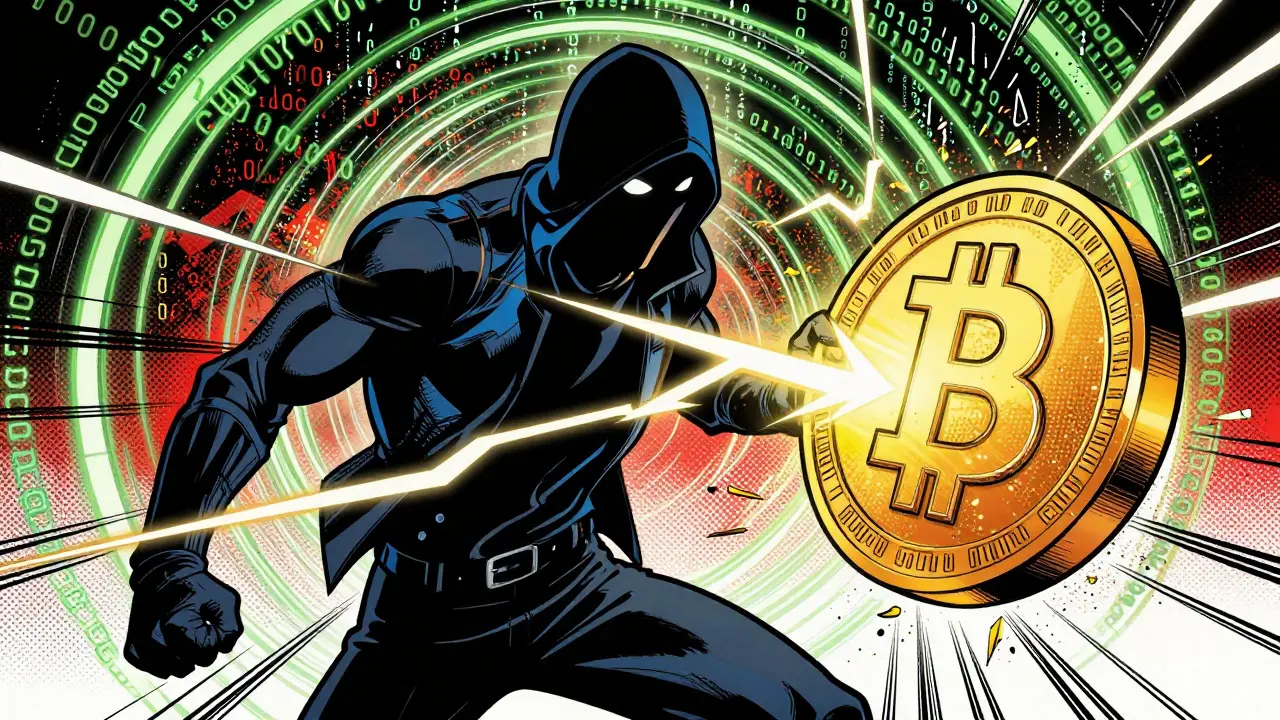
Imagine losing your life savings to a thief who doesn't use a mask or a getaway car, but instead uses a string of alphanumeric characters on a public ledger. That is the reality facing millions of cryptocurrency holders today due to North Korean crypto sanctions, which target a state-sponsored effort to steal digital assets and fund nuclear weapons programs. As of late 2025, the Democratic People's Republic of Korea (DPRK) has stolen over $2 billion in a single year, marking a historic high that dwarfs previous records. But how do you protect yourself? The answer lies in understanding not just the money, but the specific sanctioned wallet addresses that act as the regime's financial fingerprints.
The Scale of the Problem: Why 2025 Was Different
For years, North Korean hacking was seen as sporadic. In 2025, it became an industrial-scale operation. According to data from Elliptic, a leading blockchain analytics firm, DPRK-linked groups stole approximately $2.03 billion in cryptocurrency between January and October 2025 alone. To put that in perspective, this amount is nearly triple the total stolen in 2024 ($712 million) and almost double the previous record set in 2022 when the Ronin Network was breached.
The primary driver behind this surge was the massive breach of the Bybit exchange in February 2025, where hackers drained roughly $1.46 billion. Other notable targets included LND.fi, WOO X, and Seedify. These weren't random crimes; they were coordinated strikes designed to maximize yield with minimal risk of immediate attribution. The funds didn't disappear into thin air. They flowed through complex networks to eventually support Pyongyang's missile and nuclear development budgets.
Who Is Behind the Theft? Identifying Key Actors
To track the money, you first need to know who is moving it. The U.S. Department of the Treasury's Office of Foreign Assets Control (OFAC) has been aggressive in labeling these actors. In July 2025, OFAC designated several entities and individuals, including Vitaliy Sergeyevich Andreyev and Kim Ung Sun, for their roles in fraudulent IT worker schemes. These individuals often serve as the bridge between the hacker groups and the global financial system.
Companies like Shenyang Geumpungri Network Technology Co., Ltd and Korea Sinjin Trading Corporation have also been hit with sanctions. Their role is less about hacking and more about laundering-taking stolen crypto and converting it into usable foreign currency or goods. Understanding these corporate shells is crucial because they often hold the wallet keys that trigger compliance alerts.
| Year | Primary Target | Estimated Loss | Key Actor/Group |
|---|---|---|---|
| 2022 | Ronin Network | $625 Million | Lazarus Group |
| 2024 | Various DeFi Protocols | $712 Million | Multiple DPRK Teams |
| 2025 | Bybit Exchange | $1.46 Billion | DPRK State-Linked Hackers |
How Sanctioned Wallet Addresses Work
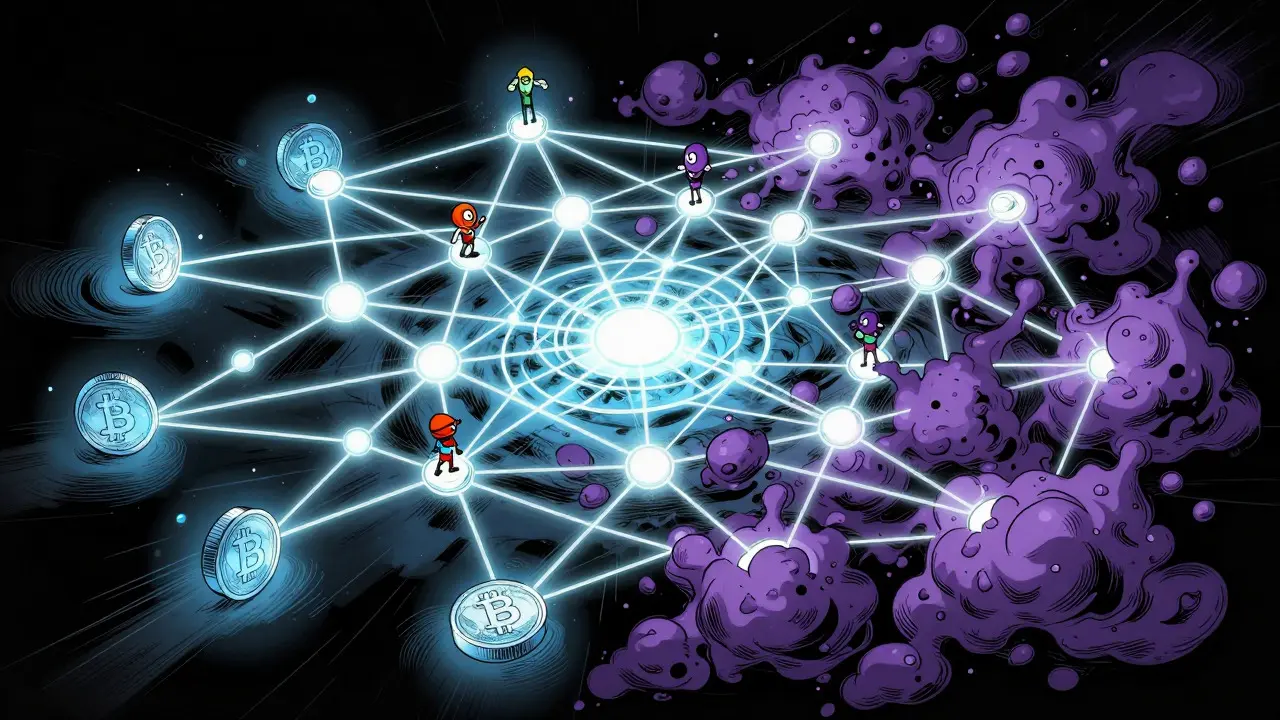
A sanctioned wallet address is simply a public cryptographic key that has been flagged by a government body like OFAC or the UN Security Council. If you send Bitcoin or Ethereum to one of these addresses, you technically violate international law. But finding them isn't as simple as looking up a phone number. North Korean actors use sophisticated laundering techniques to hide their tracks.
Here is how the process typically unfolds:
- Initial Theft: Hackers drain an exchange or protocol.
- Mixing: Funds are sent through mixing services to break the link between the victim and the recipient.
- Cross-Chain Swaps: Assets are moved across different blockchains (e.g., from Ethereum to Solana) using bridges, further obscuring the trail.
- Privacy Coins: Conversion into Monero or Zcash, which offer greater transactional privacy.
- Fiat Conversion: Finally, the crypto is swapped for US Dollars or Euros via offshore exchanges.
Blockchain analytics firms like Elliptic and Chainalysis use pattern recognition to identify clusters of wallets that behave similarly. Even if the final wallet is clean, the intermediate steps often leave traces that point back to known DPRK infrastructure.
The Role of Blockchain Analytics in Enforcement
Without technology, tracking these funds would be impossible. Firms specializing in blockchain forensics now provide real-time screening tools to banks and exchanges. These tools flag transactions involving high-risk addresses before they settle. For example, if a user tries to deposit coins from a wallet that has previously interacted with a known Lazarus Group address, the transaction might be frozen pending review.
However, the cat-and-mouse game continues. In 2025, the sophistication of laundering increased significantly. The Multilateral Sanctions Monitoring Team (MSMT), a coalition of 11 nations including the U.S., Japan, and South Korea, released a report highlighting that North Korea's cyber program now rivals that of China and Russia. This means simple keyword searches for "North Korea" won't catch everything. You need deep-chain analysis that looks at transaction velocity, gas fees, and peer-to-peer connections.

Practical Steps for Protecting Your Assets
If you hold significant amounts of cryptocurrency, you are a potential target. Here is how to minimize your risk:
- Use Reputable Exchanges: Stick to major platforms that implement robust KYC (Know Your Customer) and AML (Anti-Money Laundering) checks. Smaller, unregulated exchanges are prime targets for hacks and poor security.
- Monitor Your Wallets: Use free or paid blockchain explorers to check if any of your receiving addresses have ever interacted with high-risk clusters. Tools like Arkham Intelligence or Nansen can help visualize these connections.
- Avoid Privacy Coins for Large Transfers: While Monero offers privacy, it is heavily scrutinized by regulators. Moving large sums into privacy coins can raise red flags for compliance teams.
- Stay Updated on Designations: OFAC updates its list frequently. Subscribe to alerts from the Treasury Department or use compliance APIs that automatically update your internal blacklists.
International Cooperation and Future Outlook
The fight against DPRK crypto theft is no longer a solo U.S. effort. The MSMT represents a shift toward multilateral enforcement. By sharing intelligence among 11 countries, the group aims to close loopholes that hackers exploit by moving funds through jurisdictions with weaker regulations. The U.S. Department of State has even offered rewards of up to $15 million for information leading to the disruption of these revenue streams, signaling just how critical this issue is to national security.
Looking ahead, experts predict that North Korea will increasingly target decentralized finance (DeFi) protocols and cross-chain bridges. These areas lack centralized points of failure, making them attractive for stealthy operations. However, as blockchain analytics improve, the cost of laundering rises. The long-term viability of these thefts depends on whether the DPRK can adapt faster than the global compliance infrastructure. For now, the balance of power seems to be shifting toward the defenders, but vigilance remains essential.
What happens if I accidentally send crypto to a sanctioned wallet?
You may face civil penalties under U.S. law if you are a U.S. person or entity. The funds are often frozen by intermediaries. It is advisable to consult legal counsel immediately and notify the relevant regulatory body. Most cases involve small accidental transfers, but large amounts attract scrutiny.
Which blockchain analytics tools are best for tracking DPRK activity?
Elliptic, Chainalysis, and TRM Labs are industry leaders. For individual users, Arkham Intelligence and Nansen provide good visualization tools. Institutional investors should look for enterprise-grade solutions that integrate directly with their custodial wallets.
Are all North Korean hackers part of the Lazarus Group?
No. Lazarus Group is the most famous, but there are other state-linked teams such as Blue Monkey, Thallium, and Fox One. Each has distinct operational signatures, but all operate under the umbrella of DPRK state interests.
How much has North Korea stolen in total since 2018?
As of late 2025, the cumulative known value exceeds $6 billion. This includes major heists like the Harmony Bridge attack and the Bybit breach. The actual figure is likely higher due to unreported incidents.
Do sanctions apply to stablecoins like USDT?
Yes. Stablecoins are fully subject to sanctions if held in a sanctioned wallet. Tether (USDT) is particularly popular among DPRK actors due to its low volatility and wide acceptance, making it a key focus for analysts.
Alexander Scheel
August 19, 2026 AT 02:56It is truly a testament to the moral decay of our digital age that a totalitarian regime can siphon off billions in public view, yet we are expected to simply 'monitor our wallets' like responsible citizens. One wonders if the architects of this open-ledger utopia foresaw that their creation would become the primary vehicle for state-sponsored theft and nuclear proliferation. The irony is not lost on those who observe with clear eyes.
Evelyn Kula
August 19, 2026 AT 14:28Oh, please. You think this is about North Korea? No, no, no. This is the globalist elite testing the waters before they implement full CBDC control. They want you scared so you'll hand over your private keys willingly. I've been saying it for years: the blockchain was never meant to be free, it was always a trap set by the deep state. Wake up! 🚩
manish jha
August 21, 2026 AT 01:06The narrative presented here is somewhat superficial. While the scale of the Bybit breach is undeniable, one must consider the systemic failures in DeFi security protocols that allowed such an exodus. It is not merely a matter of external hacking; it is a reflection of internal complacency among developers who prioritize speed over robustness. The true lesson lies in architectural integrity, not just wallet monitoring.
Ashley Snyder
August 21, 2026 AT 19:10I actually found this really helpful thanks! I had no idea that sending crypto to a sanctioned wallet could technically violate international law even if you didn't know better. Glad I checked my receiving addresses on Arkham Intelligence last week. Fingers crossed nothing pops up!
Sarah Hafner
August 22, 2026 AT 09:19Just wanted to add a little context for anyone new to this space. : )
If you are using smaller exchanges, double-check their KYC procedures. Many of these DPRK groups target platforms with weaker AML checks because it's easier to move funds out without triggering alerts. It’s a bit like checking the locks on your front door before going to sleep – simple but essential. Stay safe out there! 😊
Gary Straiton
August 22, 2026 AT 19:13CATASTROPHE! Absolute disaster! Who let them in?! We need to burn the bridges! Literally! The infrastructure is failing us! If we don’t act now, we’ll all be holding worthless tokens while Pyongyang builds another missile! It’s a national emergency! ACT NOW! 🔥🔥🔥
Daniel Brown
August 24, 2026 AT 00:07You might want to clarify the distinction between OFAC sanctions and UN Security Council resolutions, as they carry different legal weights for non-US entities. Furthermore, the term 'sanctioned wallet' is often misused in retail circles; technically, it is the *entity* behind the key that is sanctioned, though the address serves as the enforcement vector. Precision matters when discussing compliance liabilities.
Kate Staab
August 25, 2026 AT 11:30Boring. Just another list of things to worry about. Why do we keep making crypto so complicated? If it were easy, everyone would use it, right? But no, we have to track wallets and fear spies. Typical. 💤
Kelsey Anne
August 26, 2026 AT 12:01Wrong. Sanctions apply to the asset, not just the entity. If you hold USDT in a flagged wallet, it’s frozen. Period. Stop overthinking the legal nuances and just check your holdings. Simple.
Patrick Pat
August 27, 2026 AT 19:35So, the US offers $15m for info, but the hackers stole $2b in a year. Seems like the ROI on surveillance is pretty low, eh? Maybe we should just let the market sort itself out. Or maybe the 'defenders' are just too slow. Funny how that works. 🙄
Dina Lazarova
August 28, 2026 AT 08:15One must appreciate the elegance of the multilateral approach, albeit its bureaucratic sluggishness. The MSMT report highlights a sophisticated adversary, which necessitates a response equally refined. To suggest otherwise is to underestimate the complexity of modern financial warfare. It requires a certain... intellectual rigor to grasp the full scope of this geopolitical chess game.
alex fordy
August 29, 2026 AT 02:09This is a really important topic, folks. 🧠💡
I think we often forget that crypto isn't just a speculative asset; it's becoming a strategic resource for nations. When a country uses it to fund weapons programs, it changes the whole dynamic. It makes me wonder if decentralization is actually protecting us or just creating new vulnerabilities. What do you all think about the long-term viability of privacy coins in this climate? 🤔✨
Nia Franklin
August 30, 2026 AT 20:40Omg, did you guys see the part about the IT worker schemes?? Like, literally disguised as tech recruiters!! So sneaky!!! 😱 Also, the stablecoin thing is wild, I didn't realize Tether was such a big target for them. It’s kinda terrifying but also fascinating how much money moves through these invisible pipes!! 🌐💸 #CryptoLife #StaySafe
Stephanie Millar
September 1, 2026 AT 05:28From a British perspective, we often feel left out of the US-centric enforcement actions, but the MSMT inclusion is a positive step. However, the reliance on American legal frameworks for global crypto regulation remains a point of contention. It is imperative that jurisdictions like the UK develop independent screening capabilities to avoid being caught in the crossfire of extraterritorial jurisdiction. ⚖️🇬🇧
Nikki keller
September 1, 2026 AT 13:35I think the balance of power shifting toward defenders is a hopeful sign, but we shouldn't get complacent. The cat-and-mouse game will continue, and adaptability is key. It’s interesting to see how international cooperation is evolving in this space. Do you think we’ll see more real-time data sharing between countries in the next few years?
miranda gamboa
September 1, 2026 AT 17:26Let’s break down the technical side here! The mention of 'transaction velocity' and 'gas fee analysis' is crucial. High-velocity transfers with abnormal gas patterns are classic indicators of automated laundering bots. If you’re running a node, make sure your indexing software is optimized for these heuristics. Proactive defense beats reactive cleanup every single time! 🚀⚙️
Zothana Pachuau
September 3, 2026 AT 04:25Nice article, but let's be real. How many of us actually check our wallets daily? Most people just HODL and hope for the best. The system is designed to overwhelm the average user. It's a bit like telling a fish to watch out for sharks. 😂 But good points on the exchange security.
Shawn Schaerer
September 3, 2026 AT 21:07We must recognize that the threat vector is expanding beyond mere theft into active disruption. The targeting of DeFi protocols suggests a strategy to undermine confidence in decentralized finance itself. This is not just a criminal enterprise; it is a form of asymmetric economic warfare. We must respond with equal strategic precision and unwavering resolve.
Hicham Mounir
September 4, 2026 AT 00:22Hey everyone, just dropping in to say this is super relevant. I work in fintech compliance and we’ve seen a huge spike in false positives lately because of all the new sanctioned addresses. It’s tough balancing security with user experience. Hope this helps some of you understand why your deposits sometimes take longer to clear! 🙌
Ami Elizabeth
September 5, 2026 AT 16:05honestly i dont get why everyone is so stressed. just use a cold wallet and dont touch it. if u lose it u lose it. if north korea steals it well at least ur not broke. chill vibes only 🛌
Walker Perry
September 5, 2026 AT 22:37THEY ARE WATCHING YOU! Every transaction is logged! The US government wants to track every satoshi you own! North Korea is just the excuse to pass more laws! Wake up sheeple! The matrix is closing in! 👁️👁️👁️
Susan Kiley
September 6, 2026 AT 09:03Finally, someone talks sense! 🎉 This is exactly what we needed. The details on the laundering process are gold. I’m printing this out and taping it to my monitor. Let’s stay vigilant, ladies and gentlemen! 💅✨