
Imagine you run a small online shop in Berlin. You want to accept Bitcoin or stablecoins from customers without handing your private keys to an exchange. Sounds simple, right? Well, since the European Union rolled out MiCA, the landscape has shifted. The Markets in Crypto-Assets Regulation (Regulation (EU) 2023/1114) is now fully active, and the clock is ticking toward July 1, 2026.
If you are thinking about accepting crypto in the EU, you need to know where you stand. Do you need a license? Is your wallet safe? Can you still use decentralized tools? This guide cuts through the legal jargon to explain exactly how non-custodial acceptance works under MiCA, what triggers a license requirement, and how merchants can stay compliant while keeping control of their funds.
The Core Rule: Are You a Service Provider?
To understand if you need to worry about MiCA, you first have to answer one question: Are you providing a service to clients, or are you just acting as a merchant?
MiCA defines its scope around Crypto-Asset Service Providers (CASPs). These are firms that offer specific services like custody, trading platforms, exchanges, or transfer services on behalf of clients. If you fall into this bucket, you need authorization from a national competent authority (NCA) in the EU.
However, if you are a business owner simply accepting payment for goods or services, you are likely not a CASP. According to legal analysis from firms like Narvi and Grant Thornton, merchants who accept crypto directly do not automatically become regulated entities. As long as you don't hold other people's assets or move money on their behalf, you are operating outside the CASP perimeter. You are acting as a principal, not an intermediary.
Custody vs. Non-Custody: The Critical Line
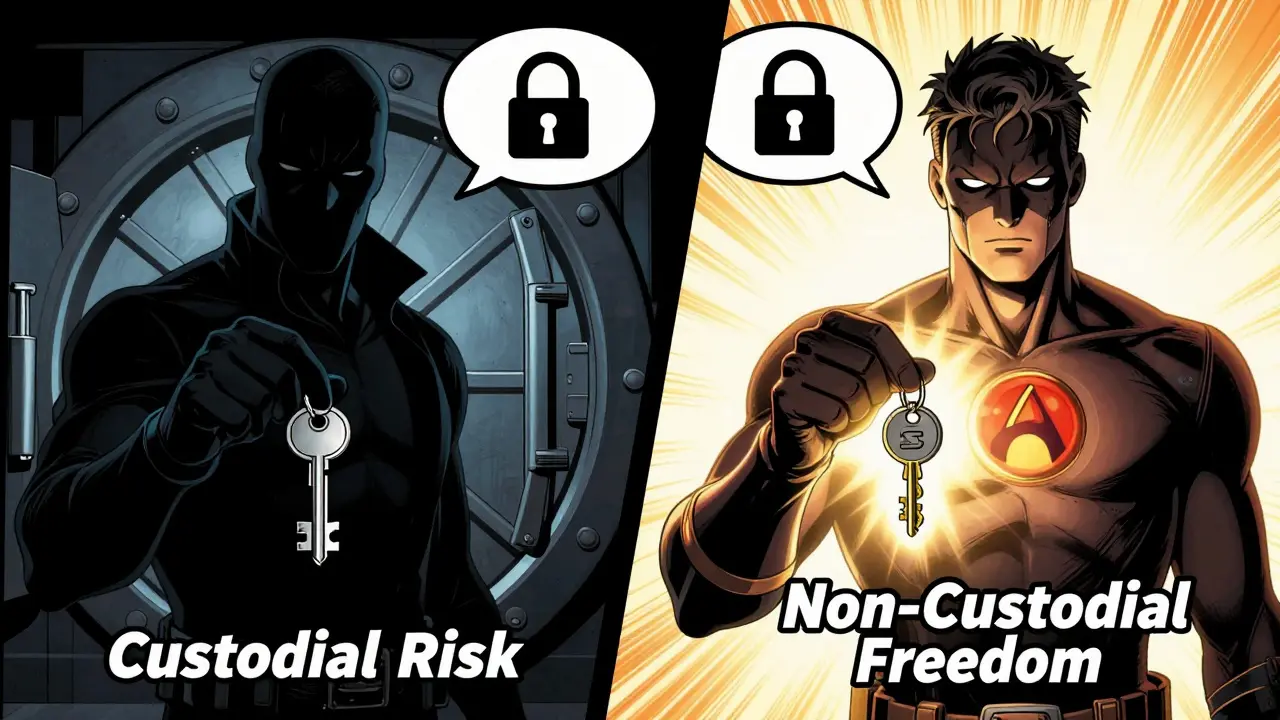
The biggest distinction under MiCA is whether you provide "custody and administration" of crypto-assets. This is one of the ten regulated services. Custody means a third party holds or controls your private keys and can unilaterally execute transactions for you.
In a non-custodial setup, you keep your private keys. You might use a hardware wallet like a Ledger or Trezor, or a self-hosted software wallet. Because no one else controls your funds, you aren't providing a custody service. Therefore, you aren't triggering that specific MiCA obligation.
This is why many solo founders and indie hackers prefer non-custodial gateways. For example, systems like TxNod allow merchants to connect extended public keys (xpubs) from their own hardware wallets. The gateway derives addresses for invoices, but the funds settle directly to the merchant's wallet. Since the platform never touches the private keys or holds the balance, it avoids the heavy CASP licensing requirements associated with custodial services.
The Stablecoin Factor
Most daily crypto payments in the EU involve stablecoins rather than volatile assets like Bitcoin. MiCA treats these differently based on their type:
- E-Money Tokens (EMTs): Pegged to a single official currency like the Euro. Examples include EURC.
- Asset-Referenced Tokens (ARTs): Pegged to a basket of assets. USDC is often categorized here depending on its reserve structure.
Since June 30, 2024, issuers of significant EMTs and ARTs must comply with strict capital, governance, and white paper requirements. If you are a merchant, this matters because you should only accept stablecoins that are compliant with MiCA. Using an unregulated stablecoin could expose your customers-and potentially you-to regulatory risk. Always check if the stablecoin issuer has obtained the necessary authorization in the EU.
Infrastructure and Third-Party Risks
Even if you aren't a CASP, the infrastructure you use might be. Many merchants rely on payment processors, on-ramps, or off-ramps to convert crypto to fiat. These intermediaries are CASPs and must be licensed under MiCA.
Here is the catch: After July 1, 2026, any firm providing in-scope crypto services to EU clients without MiCA authorization will be in breach of EU law. If you use an unauthorized provider to handle conversions or transfers, you face operational and legal risks. Your partner needs a passportable license from an EU NCA to operate legally across all 27 member states.
For non-custodial setups, this means carefully vetting your tech stack. If you use a tool that merely transmits data but doesn't hold keys, you're generally safe. But if that tool starts routing orders or holding funds on your behalf, it crosses the line into regulated territory.
Decentralized Finance (DeFi) and NFTs
What about fully decentralized protocols? Currently, MiCA 1.0 largely excludes DeFi lending, borrowing, and staking (except for certain ART/EMT staking). It also mostly ignores unique NFTs. The regulation targets identifiable legal entities that act as intermediaries.
If you use a smart contract that executes automatically without a central administrator, it falls outside MiCA's current reach. However, regulators are watching closely. Discussions about a potential "MiCA 2.0" suggest that the perimeter might expand in the future. For now, purely peer-to-peer interactions via decentralized apps remain a gray area but are not explicitly banned.
Cross-Border and Third-Country Rules
MiCA does not have a special "light-touch" regime for companies based outside the EU. If a non-EU firm actively promotes or advertises services to EU clients, it must obtain full MiCA authorization. There is no simple registration process.
There is an exception called "reverse solicitation," where an EU client approaches a foreign provider entirely on their own initiative. But this cannot be used as a systematic strategy to access the EU market. If you are a merchant using a non-EU payment processor, ensure they are either authorized in the EU or that your relationship strictly qualifies as reverse solicitation-which is risky to rely on for business continuity.
| Feature | Custodial Model | Non-Custodial Model |
|---|---|---|
| Private Key Control | Held by third-party provider | Held by merchant/user |
| CASP License Required? | Yes (for the provider) | No (for the merchant) |
| Counterparty Risk | High (exchange failure, freeze) | Low (self-sovereign) |
| Regulatory Scrutiny | Heavy (AML, KYC, Capital) | Minimal (unless acting as intermediary) |
| Settlement Finality | Dependent on provider policy | On-chain finality |
Practical Steps for Merchants
If you want to accept crypto in the EU while staying compliant and secure, follow these steps:
- Use Self-Custody Wallets: Keep your private keys offline. Use hardware wallets like Ledger or Trezor. Never share your seed phrase with any service.
- Vet Your Infrastructure: Ensure any payment gateway or converter you use is MiCA-compliant or operates strictly as a non-custodial interface. Tools like TxNod derive addresses locally from your xpubs, ensuring the server never sees your keys.
- Choose Compliant Stablecoins: Stick to EMTs and ARTs that have obtained EU authorization. Avoid obscure tokens with unclear reserve backing.
- Document Reverse Solicitation (If Applicable): If you work with non-EU providers, document that you initiated the contact to avoid accidental regulatory breaches.
- Monitor Regulatory Updates: Keep an eye on discussions around MiCA 2.0, especially regarding DeFi and NFTs.
Conclusion
MiCA brings clarity to the EU crypto market, but it also raises the bar for compliance. For merchants, the good news is that non-custodial acceptance remains largely out of scope for direct licensing. By keeping control of your keys and choosing compliant partners, you can accept crypto safely and legally. The key is understanding the difference between being a user and being a service provider. Stay informed, keep your keys private, and build your business on solid ground.
Do I need a MiCA license to accept crypto payments as a merchant?
Generally, no. MiCA regulates Crypto-Asset Service Providers (CASPs) who offer services like custody, exchange, or transfer on behalf of clients. If you are a merchant accepting payment for your own goods or services and you do not hold or manage other people's crypto assets, you are not considered a CASP and do not need a license.
What is the difference between custodial and non-custodial crypto acceptance?
In a custodial model, a third party (like an exchange) holds your private keys and manages your assets. This triggers strict regulatory requirements under MiCA. In a non-custodial model, you retain full control of your private keys using your own wallet. Since no intermediary controls the funds, the merchant does not provide a regulated custody service.
Which stablecoins are allowed under MiCA?
MiCA regulates Asset-Referenced Tokens (ARTs) and E-Money Tokens (EMTs). To be compliant, the stablecoin issuer must be authorized in the EU. Popular compliant options include EURC (an EMT) and USDC (often treated as an ART). Merchants should verify the status of any stablecoin they accept to ensure it meets MiCA standards.
When does the transitional period for existing crypto businesses end?
The transitional period for existing crypto businesses ends on July 1, 2026. After this date, any firm providing in-scope crypto-asset services to EU clients without MiCA authorization must wind down those services. It is crucial for businesses to secure their licenses before this deadline.
Does MiCA cover Decentralized Finance (DeFi)?
Currently, MiCA 1.0 largely excludes fully decentralized services like DeFi lending, borrowing, and most NFT activities. The regulation focuses on identifiable legal entities acting as intermediaries. However, regulators may expand the scope in future iterations (potentially MiCA 2.0), so users should stay updated on legislative changes.