
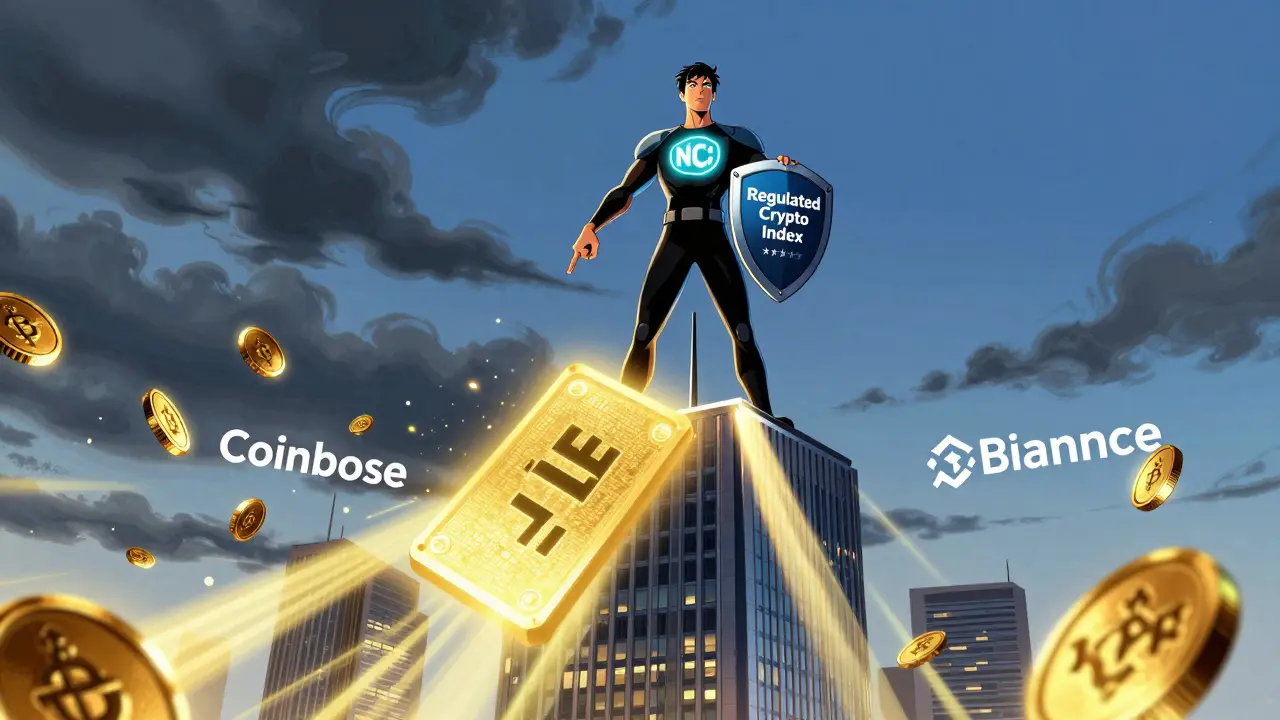
Many people assume Nasdaq is a cryptocurrency exchange like Coinbase or Binance. They’re wrong. Nasdaq doesn’t let you buy Bitcoin with a credit card, trade altcoins, or withdraw crypto to your wallet. If you’re looking for a place to trade digital assets like a regular user, Nasdaq isn’t it. But if you’re an investor, financial advisor, or institution trying to get crypto exposure without stepping into the wild west of crypto exchanges, Nasdaq has something powerful - and it’s changing how traditional finance thinks about digital assets.
What Nasdaq Actually Offers in Crypto
Nasdaq doesn’t run a crypto exchange. Instead, it runs indexes. The two main ones are the Nasdaq Crypto Index (NCI) and the Nasdaq Crypto US Index (NCIUS). These aren’t trading platforms. They’re benchmarks. Think of them like the S&P 500, but for cryptocurrencies.
The NCI tracks the performance of the largest digital assets by market cap, but with strict rules. To be included, a coin must be listed on regulated European exchanges like SIX Swiss Exchange or Xetra. As of December 2025, the index was dominated by Bitcoin at 74.47%, Ethereum at 14.30%, XRP at 6.27%, Solana at 3.39%, and smaller shares for Cardano, Chainlink, and Stellar. That’s not random. It’s designed to reflect the most liquid, regulated, and institutionally acceptable assets.
The NCIUS is even more specific. It only includes assets that are either traded on U.S.-regulated platforms or used as the underlying asset for derivatives on regulated futures markets. This isn’t about popularity. It’s about compliance.
The Real Product: The Hashdex Nasdaq Crypto Index ETF
The only way most people interact with Nasdaq’s crypto data is through the Hashdex Nasdaq Crypto Index ETF. This is an exchange-traded fund that tracks the NCI. You don’t buy crypto. You buy shares of the ETF through your brokerage - Fidelity, Schwab, Vanguard - the same way you buy Apple or Tesla stock.
As of December 2025, this ETF had $660 million in assets under management. That’s tiny compared to Bitcoin spot ETFs like BlackRock’s IBIT, which hit over $20 billion. But it’s not about size. It’s about access. For financial advisors managing retirement accounts or institutional portfolios, this ETF is a bridge. No need to set up a Coinbase account. No need to worry about private keys or exchange hacks. Just click "buy" in your existing platform.
The catch? The expense ratio is 0.95%. That’s more than double the 0.25% fee on Bitcoin-only ETFs. Some investors complain it’s too expensive. But for institutions, the cost of compliance, custody, and legal risk is far higher than that fee. The ETF isn’t cheap - it’s a safety net.
Nasdaq’s Bigger Move: Tokenized Securities
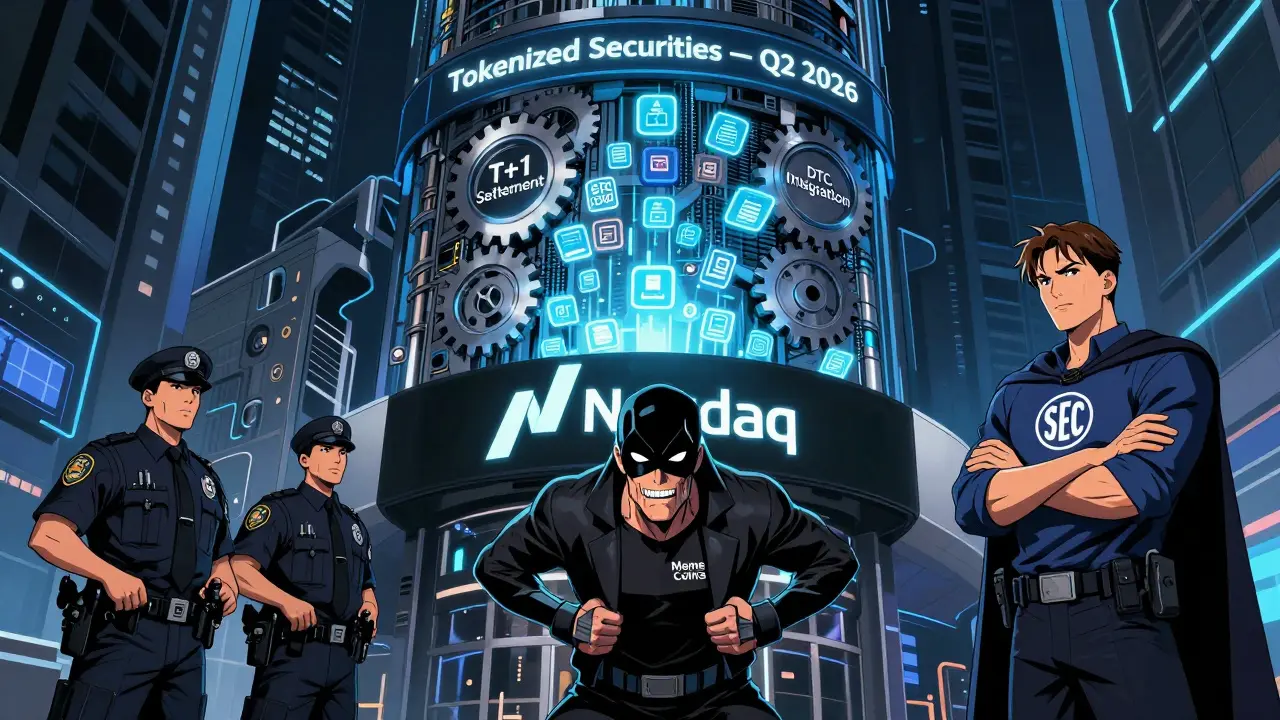
In September 2025, Nasdaq filed a rule change with the SEC to allow trading of tokenized securities on its existing platform. This isn’t about Bitcoin. This is about turning real-world assets - stocks, bonds, real estate - into digital tokens that can be traded on blockchain infrastructure while still following SEC rules.
Here’s how it works: Instead of buying a share of Apple through a paper certificate or a digital ledger in a bank’s system, you’d buy a token that represents that share. The token lives on a blockchain, but the entire trade is still regulated, settled in T+1, and cleared through DTC (Depository Trust & Clearing Corporation). Nasdaq isn’t trying to replace Wall Street. It’s trying to upgrade it.
SEC Commissioner Hester Peirce publicly backed this move in July 2025, saying market participants must still follow federal securities laws - even when using blockchain. That’s key. Nasdaq isn’t pushing for crypto exemptions. It’s pushing for crypto integration.

Nasdaq vs. Coinbase: Two Different Worlds
Compare Nasdaq to Coinbase. In Q4 2025, Coinbase processed $1.2 trillion in trading volume. It had $13.4 billion in revenue. It offers spot trading, leverage, staking, NFTs, and a wallet. It’s a full-service crypto exchange.
Nasdaq? It processed zero spot trades. It doesn’t have a wallet. It doesn’t offer leverage. It doesn’t list new tokens based on hype. It lists regulated assets and provides data. Its "volume" is measured in index licensing fees and ETF assets, not trading activity.
One serves retail traders. The other serves pension funds.
That’s why Nasdaq’s approach is so smart. While other exchanges fight regulators, Nasdaq works with them. While others chase viral meme coins, Nasdaq sticks to Bitcoin and Ethereum. While others build apps for Gen Z, Nasdaq builds infrastructure for 65-year-old retirees.
Who Uses Nasdaq’s Crypto Products?
You won’t find retail traders on Nasdaq’s crypto pages. The users are:
- Financial advisors managing portfolios for high-net-worth clients
- Institutional investors in pension funds, endowments, and insurance companies
- Brokerage platforms integrating crypto into traditional accounts
- Asset managers looking for regulated exposure without custody risk
On forums like Seeking Alpha, one advisor wrote: "I can now recommend crypto exposure to clients who refused to touch a crypto exchange. This is the first time I’ve felt comfortable adding digital assets to conservative portfolios."
On Reddit, a user named "InstitutionalTrader88" said: "The 0.95% fee hurts, but I don’t have to explain to compliance why I’m holding ETH on Coinbase. That’s worth it."
Limitations and Criticisms
Nasdaq’s model has clear limits:
- No direct crypto trading - you can’t buy Solana or Dogecoin directly
- High fees compared to spot Bitcoin ETFs
- Excludes newer, smaller tokens - no AI coins, no DeFi protocols, no Layer 2s
- Only accessible through institutional channels or ETFs - no retail trading interface
CryptoCompare gave Nasdaq’s indices a 4.3/5 rating for "regulatory rigor," but noted: "Limited coverage of emerging tokens." Trustpilot users called Nasdaq’s data "excellent but hard to understand" for newcomers.
And then there’s the big question: What if the SEC changes its mind? If a new law gives the CFTC full control over spot crypto markets (as the proposed Boozman-Booker bill might), Nasdaq’s entire model could be upended. It’s built on the assumption that crypto assets with market caps over $1 billion will always be treated as securities - not commodities.
The Future: What’s Next for Nasdaq in Crypto?
Nasdaq’s roadmap is quiet but bold:
- Tokenized securities trading is expected to launch in Q2 2026
- Staking derivatives may be added to the NCI after IRS guidance in November 2025
- Partnerships with DTC to build blockchain-based settlement systems
- Potential expansion to include tokenized bonds and real estate funds
J.P. Morgan rated Nasdaq’s strategy an 8.5/10 for "high viability," while Messari called it "crypto-adjacent." Both agree: Nasdaq isn’t trying to be the next Binance. It’s trying to be the bridge between two worlds.
By 2028, TRM Labs predicts regulated tokenized securities could make up 15-20% of traditional securities volume. That’s not crypto. That’s finance - upgraded.
Final Verdict: Who Should Care?
If you’re a retail trader looking to buy crypto, skip Nasdaq. Go to Coinbase, Kraken, or Bybit.
If you’re an investor who wants exposure to crypto through your 401(k), IRA, or brokerage account - without touching a crypto wallet - then Nasdaq’s index products are one of the most important tools in your toolbox.
Nasdaq didn’t enter crypto to compete. It entered to connect. And in a world where regulators are tightening rules and institutions are nervous, that’s not just smart. It’s necessary.