
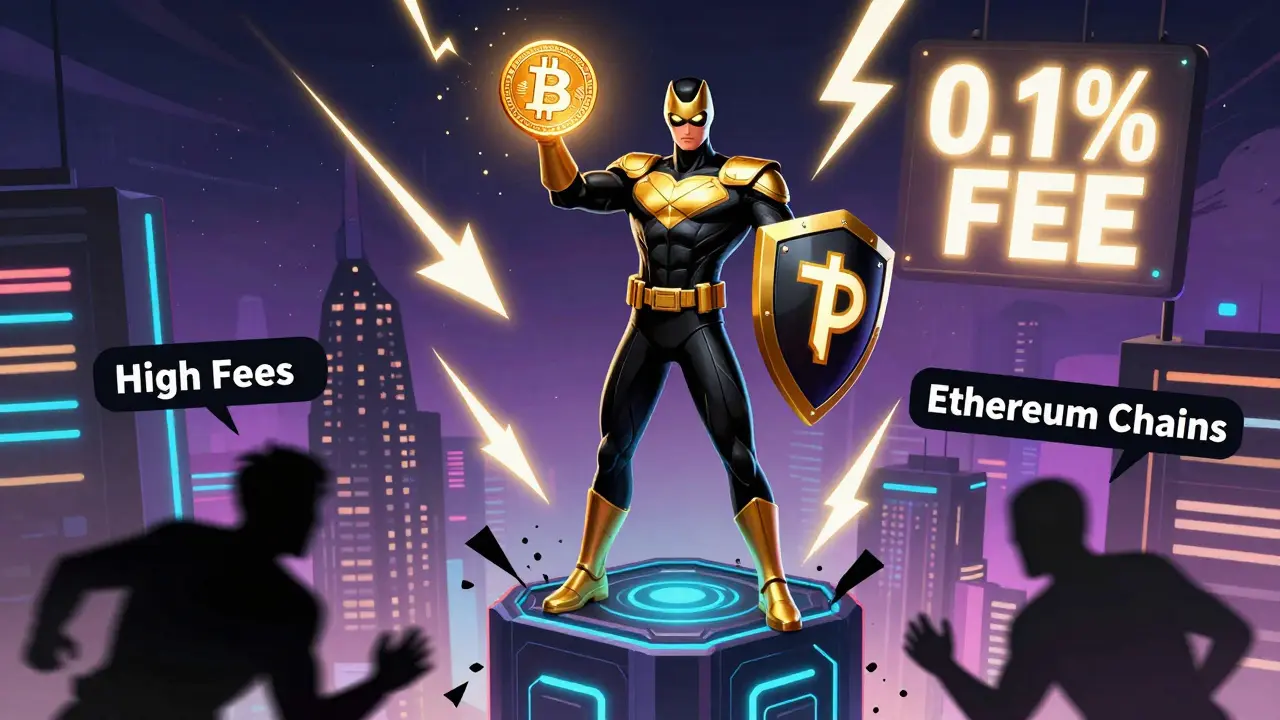
When you want to trade Bitcoin without switching to Ethereum wallets or paying high fees, Libre Crypto Exchange sounds like a dream. It promises near-instant trades, 0.1% fees, and no need for MetaMask. But is it really that simple? Or are there hidden traps lurking beneath the surface?
What Exactly Is Libre?
Libre isn’t another centralized exchange like Binance or Coinbase. It’s a decentralized, Bitcoin-native Layer-2 solution built to fix Bitcoin’s biggest problem: slow and expensive transactions. Launched in March 2023, it lets you swap BTC for USDT directly on its own chain - no bridging, no wrapping, no Ethereum involved. That’s the whole point. If you’re a Bitcoin maximalist who hates having to move your BTC onto other blockchains just to trade, Libre was made for you.It runs on a custom consensus system that changes validators every 10 to 30 seconds. This isn’t proof-of-work like Bitcoin. It’s faster, more dynamic, and designed for speed. Transactions settle in just 2 seconds. Compare that to Bitcoin’s 10-minute average, or even Ethereum’s 12-15 seconds. Libre’s throughput hits 3,500 transactions per second. That’s more than Visa’s average. For a Bitcoin-focused project, that’s insane.
But here’s the catch: Libre doesn’t support altcoins. Not even ETH. Not even LTC. Right now, the only pair available is BTC/USDT. That’s it. If you want to trade SOL, ADA, or DOGE, you’ll need to go elsewhere. Libre isn’t trying to be everything. It’s laser-focused on making Bitcoin trading smooth, cheap, and fast.
The Fee Advantage: 0.1% Is Hard to Beat
Most DEXs charge between 0.3% and 0.5%. Thorchain? 0.5%. Sideshift.ai? Up to 0.7%. Even centralized exchanges like Kraken charge 0.1% only if you’re a top-tier trader. Libre? Flat 0.1% - no volume tiers, no hidden fees. That’s why users love it. On Reddit, people are calling it “the first DeFi exchange that respects Bitcoin.”That low fee isn’t just a marketing trick. It’s baked into the protocol. Every trade, whether it’s $10 or $10,000, costs exactly 0.1%. No surprises. No surprise gas fees. No fluctuating costs based on network congestion. That kind of predictability is rare in crypto.
But here’s what nobody talks about: you still need LIBRE tokens to vote on governance. You don’t need them to trade. But if you want to influence upgrades, fee changes, or future token additions, you have to stake LIBRE. And staking requires you to lock up your tokens for up to a year. The rewards? Up to 12.7% APY. Sounds great - until you realize you can’t access those tokens during the lock period. If the price crashes, you’re stuck.
Privacy Features: Anonymous, But Not Verified
Libre claims to use ring signatures and stealth addresses - the same privacy tech used by Monero. That means your transaction history is hidden. Your inputs and outputs are obfuscated. No one can trace where your BTC came from or where it went. That’s powerful. Especially if you live in a country with strict crypto monitoring.But here’s the problem: no one has seen the audit. Libre says its smart contracts were audited by Certik. Coinbase even lists it as “audited.” But the audit report? Not public. Not downloadable. Not even a summary. Meanwhile, security site eatcm.net called it out in August 2025: “No public smart contract audits.”
This isn’t just a technical detail. It’s a trust issue. You’re handing over your Bitcoin to a system that doesn’t show its work. If there’s a bug, you won’t know until it’s too late. Security researcher Alex Thorn wrote in October 2025: “Libre’s lack of transparent audit history creates significant counterparty risk.” That’s not a small concern. It’s the kind of thing that can wipe out life savings overnight.

Performance Under Pressure: Speed vs. Reality
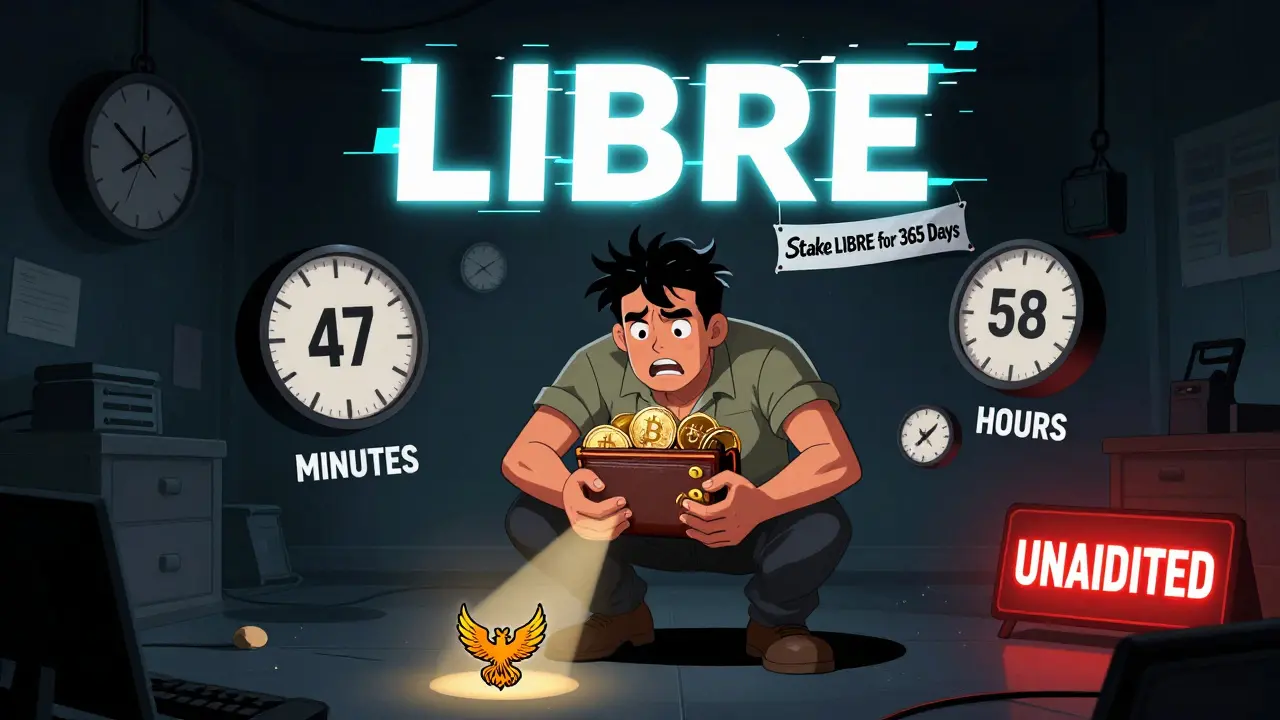
Libre’s 2-second finality sounds amazing. And in tests, it works. But real-world usage tells a different story. Users on Trustpilot report withdrawal delays averaging 47 minutes. One person waited 2 hours to get $12,000 in USDT out during a market spike on October 28, 2025. That’s not a bug - that’s a bottleneck.Why? Because Libre relies on decentralized p.network bridges to move pegged BTC in and out. These bridges aren’t automated. They’re manually verified by node operators. During high volume, the queue builds up. And there’s no priority system. No rush fee. No customer support escalations. You’re just… waiting.
Customer support? Average response time is 58 hours. That’s more than two full days. If you’re stuck with funds and need help, you’re on your own. The Telegram group has over 12,000 members - but it’s full of people asking the same questions: “Why is my withdrawal stuck?” “Where’s my LIBRE token?” “How do I unstake?”
Who Is This For? And Who Should Avoid It?
Libre is perfect for one kind of user: someone who owns Bitcoin, wants to trade it for USDT, hates Ethereum, and doesn’t care about altcoins or advanced trading tools. If you’re the type who says, “I just want to swap BTC for stablecoin without paying 0.5%,” then Libre is one of the best options out there.But if you’re looking for:
- Limit orders, stop-losses, or margin trading
- More than BTC/USDT pairs
- Fast withdrawals during market volatility
- Transparent security audits
- Mobile app or desktop GUI
Then you should walk away. There are better tools for those needs. Sideshift.ai supports more pairs. Bitstamp has better support. Even Bitcoin-native Lightning Network wallets like Phoenix offer instant swaps with better UIs.
The Bigger Picture: Is Libre Here to Stay?
Libre’s TVL (total value locked) is around $180 million. That’s tiny compared to Ethereum-based DeFi giants like Uniswap or Curve. But it’s growing. Bitcoin DeFi as a whole has exploded from $1.2 billion in early 2024 to over $8.7 billion by late 2025. Libre is riding that wave.Its roadmap includes adding USDC and DAI support by Q2 2026. That’s huge. It also plans to integrate with FedNow for direct fiat on-ramps - meaning you could deposit USD directly into Libre without a bank intermediary. That’s the kind of innovation that could change how Bitcoin is used.
But here’s the cliff: Delphi Digital says Libre has a 65% chance of surviving past 2027. Standard Chartered says 30%. Why the split? Because regulators are watching. The SEC’s October 2025 framework for non-EVM DeFi protocols doesn’t know what to do with Libre. It’s not a security. It’s not a money transmitter. It’s something new. And that uncertainty could kill it.
The biggest risk? The audit. If a major exploit happens - and no one knows if the code is safe - users will flee. And once trust is gone, it doesn’t come back.
Final Verdict: A Niche Tool With Big Trade-Offs
Libre Crypto Exchange isn’t for everyone. It’s not a full-service exchange. It’s not a wallet. It’s not even a great place to store assets long-term. But if you’re a Bitcoin user who wants to trade BTC for USDT quickly, cheaply, and without touching Ethereum - it’s one of the few real options.Use it for small, frequent swaps. Don’t park large sums there. Don’t expect fast support. Don’t assume your privacy is flawless. And never, ever trust it with your life savings until someone releases that audit.
It’s not the future of crypto. But for a narrow slice of users, it’s the best solution we have right now.
Can I trade altcoins on Libre Crypto Exchange?
No. As of November 2025, Libre only supports trading between Bitcoin (BTC) and Tether (USDT). There are no other trading pairs available, and no plans to add altcoins like ETH, SOL, or ADA in the near term. It’s designed specifically for Bitcoin-native users who want to avoid Ethereum-based systems.
Is Libre Crypto Exchange safe to use?
It depends on your risk tolerance. Libre uses privacy tech like ring signatures and stealth addresses, which are technically strong. But its smart contracts have never been publicly audited, despite claims from Coinbase and its own documentation. Security experts warn this creates serious counterparty risk. If a bug exists, you won’t know until funds are lost. Use only small amounts you can afford to lose.
Do I need a LIBRE token to trade on Libre?
No, you don’t need LIBRE tokens to trade BTC for USDT. The 0.1% fee is paid in the trading pair itself (e.g., BTC or USDT). However, if you want to vote on governance proposals - like adding new stablecoins or changing fees - you must stake LIBRE tokens. Staking locks your tokens for 30 to 365 days.
How fast are withdrawals on Libre?
Withdrawals are supposed to be instant, but in practice, they often take 30 to 120 minutes, especially during market spikes. This is because Libre uses decentralized p.network bridges that require manual verification. During high volume, the queue backs up. There’s no priority system or customer support escalation for large withdrawals.
What happens if Libre shuts down?
If Libre’s infrastructure fails or the team disappears, your funds are not automatically recoverable. Unlike centralized exchanges, there’s no customer service to contact. Your assets are locked on the blockchain, but accessing them requires technical knowledge of Bitcoin’s native protocols and the p.network bridge. Most users would lose access unless they’ve backed up their private keys and know how to interact with the chain manually.
Is Libre better than the Lightning Network for trading?
Libre and Lightning serve different purposes. Lightning is for fast, cheap Bitcoin payments - like buying coffee or tipping. Libre is for trading BTC and USDT on a DeFi-style automated market maker. Lightning doesn’t have order books or liquidity pools. Libre does. But Lightning is more mature, widely supported, and has no audit risks. Choose Lightning for payments. Choose Libre only if you want to trade BTC/USDT with low fees and no EVM wallet.
Kaz Selbie
February 10, 2026 AT 22:38Robbi Hess
February 11, 2026 AT 06:49Ace Crystal
February 12, 2026 AT 17:12krista muzer
February 13, 2026 AT 16:44monique mannino
February 14, 2026 AT 22:23Sakshi Arora
February 15, 2026 AT 20:28Peggi shabaaz
February 15, 2026 AT 21:08Grace Mugambi
February 16, 2026 AT 03:01Benjamin Andrew
February 17, 2026 AT 14:28SAKTHIVEL A
February 17, 2026 AT 18:37Keturah Hudson
February 19, 2026 AT 00:39Crystal McCoun
February 20, 2026 AT 09:22Elijah Young
February 22, 2026 AT 00:52John Doyle
February 22, 2026 AT 16:02kelvin joseph-kanyin
February 24, 2026 AT 15:47Beth Trittschuh
February 25, 2026 AT 03:23Brittany Meadows
February 25, 2026 AT 23:47Desiree Foo
February 26, 2026 AT 19:22Michelle Cochran
February 28, 2026 AT 04:23Christopher Wardle
February 28, 2026 AT 04:57