
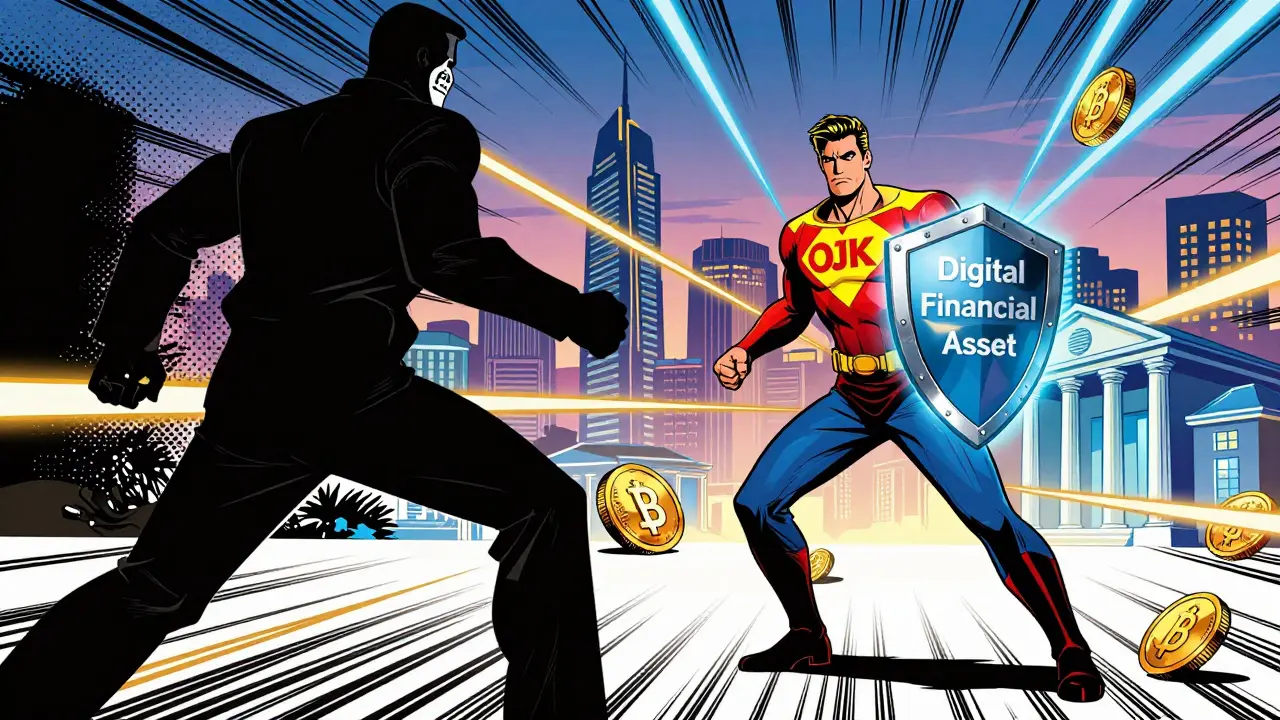
For years, if you traded cryptocurrency in Indonesia, you were navigating a gray area that felt more like a wild west commodity market than a regulated financial sector. You knew it was legal to trade, but illegal to spend. You knew the rules changed often. But as of mid-2026, the landscape has shifted dramatically. The days of treating Bitcoin and Ethereum merely as speculative commodities under loose oversight are over.
In January 2025, Indonesia executed a massive regulatory pivot. Oversight moved from the Commodity Futures Trading Regulatory Agency (BAPPEBTI) to the Financial Services Authority (OJK). This wasn't just a change of address; it was a fundamental reclassification of what crypto is. It is now officially a "digital financial asset." If you are an investor, a business owner, or simply someone holding crypto in your Indonesian wallet, this shift affects how you pay taxes, how exchanges operate, and how protected your money actually is.
The Great Shift: Why BAPPEBTI Lost Control
To understand where we are in 2026, you have to look at where we started. For nearly a decade, Indonesia treated crypto like gold or soybeans-a commodity. BAPPEBTI supervised the trading platforms, maintaining a whitelist of approved assets. By early 2025, that list had ballooned to over 850 tokens. While this allowed for variety, it lacked the rigorous consumer protections found in traditional banking or securities markets.
The turning point came with Law No. 4 of 2023, known as the PPSK Law. Enacted in January 2023, this law laid the groundwork for strengthening the entire financial sector. It explicitly authorized the transfer of crypto oversight to the OJK. The transition became effective on January 10, 2025. Why did the government make this move? Because treating crypto as a mere commodity left gaps in anti-money laundering (AML) enforcement and systemic risk management. The OJK brings the same level of scrutiny to crypto that it applies to banks and stock brokers.
This means the era of low-barrier entry for crypto exchanges is dead. Under BAPPEBTI, requirements were manageable for small startups. Under OJK, the stakes are significantly higher. The goal is no longer just to allow trading; it is to integrate digital assets into the formal financial system while preventing fraud and protecting retail investors.
New Rules for Exchanges: High Capital, Strict Compliance
If you run a crypto exchange in Indonesia, or if you are an investor wondering why some smaller platforms disappeared, the answer lies in the new capital requirements. OJK Regulation No. 27 of 2024, issued in December 2024, set the operational standards for this new era.
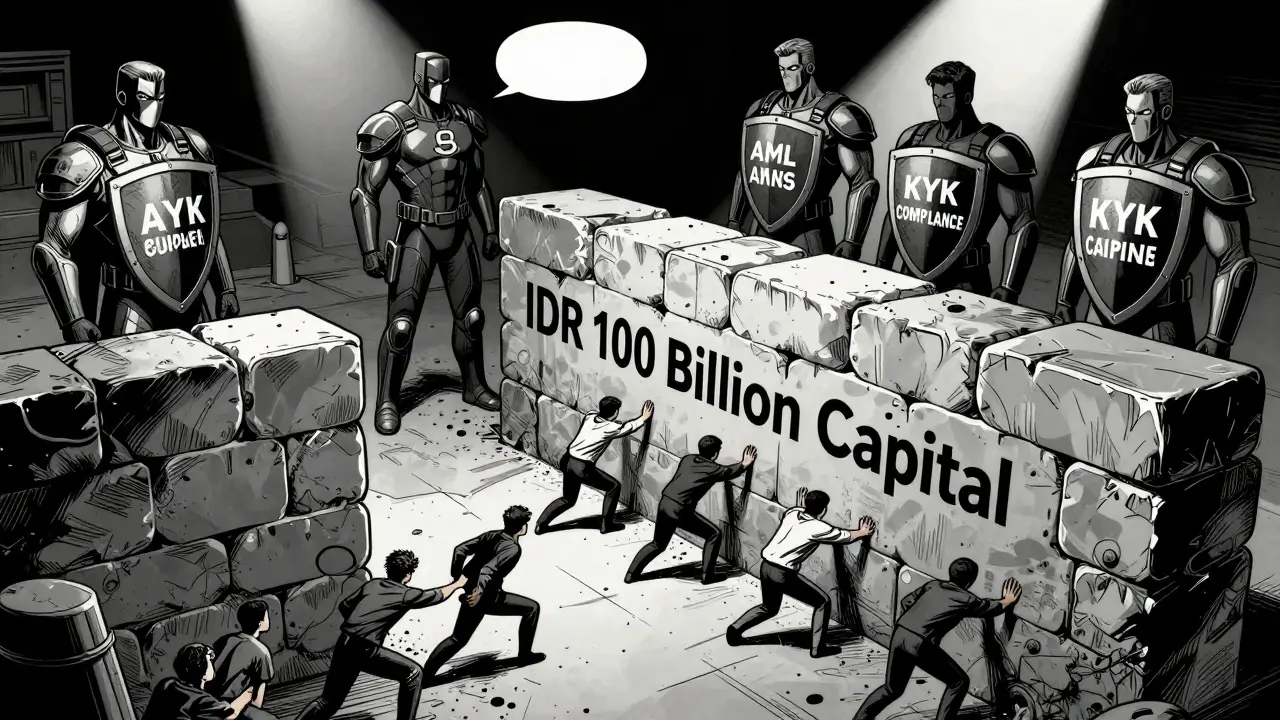
Here is the hard reality for businesses: To operate as a Crypto Asset Trader, you must maintain a minimum paid-up capital of IDR 100 billion (approximately USD $6 million). Furthermore, you must sustain a minimum equity of IDR 50 billion. The OJK can demand even more capital depending on your systemic impact. This effectively wipes out many small, local exchanges that cannot raise such funds. They either merge, partner with larger entities, or shut down.
But capital is only half the battle. The compliance burden has skyrocketed. Exchanges must:
- Obtain proper licensing directly from the OJK.
- Implement robust Anti-Money Laundering (AML) and Know-Your-Customer (KYC) protocols, as mandated by SEOJK No. 20 of 2024.
- Submit both periodic and incidental reports to the authority.
- Ensure all customer data is protected under strict privacy laws.
- Report any suspicious transactions immediately to the Financial Transaction Reports and Analysis Center (PPATK).
The deadline for existing businesses to meet these obligations was July 2025. Those who failed to comply faced severe consequences, including license revocation and potential criminal charges. For investors, this is a double-edged sword. On one hand, fewer options mean less competition and potentially higher fees. On the other hand, the platforms that remain are financially stable, heavily monitored, and far less likely to vanish with your funds.
Taxation Overhaul: Goodbye VAT, Hello Income Tax
Perhaps the most tangible change for individual traders happened in the summer of 2025. For years, crypto transactions were taxed under the framework established by Minister of Finance Regulation No. 68/2022 (PMK 68). This treated crypto as an intangible commodity. Every time you bought or sold crypto, you paid Value Added Tax (VAT) on the delivery of the asset, plus a final income tax on sales. It was complex, often double-taxing the same value, and administratively heavy.
That ended on August 1, 2025, with the enactment of Minister of Finance Regulation No. 50 of 2025 (PMK 50). This regulation fundamentally revoked the old VAT treatment. Now, the transfer of crypto assets is no longer subject to VAT. Instead, the focus shifts entirely to income tax.
Why does this matter? When you sell Bitcoin for a profit, you don't pay VAT on the transaction itself. Instead, the profit is treated as taxable income. This aligns crypto taxation with how stocks and other financial instruments are taxed globally. It simplifies the process for exchanges, which no longer need to collect and remit VAT on every trade. For you, the trader, it means clearer reporting. You declare your gains, and you pay income tax on those gains. The previous confusion around whether VAT applied to peer-to-peer transfers or specific token types has been largely eliminated.
Alongside PMK 50, regulations PMK 53 and PMK 54 were introduced to provide comprehensive tax treatment and amend previous conflicting articles. The result is a cleaner, more predictable tax environment that encourages legitimate investment rather than hiding trades in opaque channels.
The Payment Ban Remains: Crypto Is Not Money
Despite all these changes, one rule remains stubbornly unchanged: You cannot use cryptocurrency as a payment method in Indonesia.
This prohibition, originally set by Bank Indonesia, stands firm. Even though the OJK now regulates crypto as a financial asset, it is not recognized as legal tender. You cannot buy coffee, pay rent, or settle invoices using Bitcoin or USDT. Doing so violates central bank regulations.
This creates a unique duality in the Indonesian market. Crypto is a highly regulated investment vehicle, but it is strictly forbidden as a medium of exchange. This distinction is crucial for businesses. If you are a merchant accepting crypto payments, you are operating illegally. If you are an investor, you must treat your holdings as speculative assets, not as a digital wallet for daily spending.
Industry advocates continue to push for the legalization of stablecoins for payment purposes, arguing that they could enhance financial inclusion and reduce transaction costs. However, as of mid-2026, the government has not budged. The focus remains on integration into the capital markets, not the payment systems.
| Feature | Pre-2025 (BAPPEBTI Era) | Post-2025 (OJK Era) |
|---|---|---|
| Regulatory Body | BAPPEBTI (Commodity Agency) | OJK (Financial Services Authority) |
| Asset Classification | Commodity / Intangible Good | Digital Financial Asset |
| Minimum Capital for Exchanges | IDR 5 Billion (approx.) | IDR 100 Billion Paid-Up Capital |
| VAT Treatment | Subject to VAT on delivery | No VAT; Income Tax on profits only |
| Payment Legality | Illegal | Illegal |
| Whitelist Size | 850+ assets (loose approval) | Strictly reviewed; delisting of non-compliant assets |

What This Means for Investors in 2026
If you are looking to invest in crypto in Indonesia today, the environment is safer but more exclusive. The high capital requirements have consolidated the market. Major players like Tokocrypto, Indodax, and Pintu have adapted, securing their licenses and meeting the stringent OJK standards. Smaller, niche exchanges have largely exited or merged.
For you, this means:
- Enhanced Security: Your funds are held by institutions with significant capital reserves and strict AML protocols. The risk of exchange insolvency due to mismanagement is lower.
- Cleaner Tax Filing: With the removal of VAT, your tax calculations are simpler. Focus on tracking your cost basis and capital gains. Use the data provided by your OJK-licensed exchange to file your annual income tax return accurately.
- Limited Asset Choice: The OJK has tightened the whitelist. Not every meme coin or obscure token available globally will be tradable in Indonesia. Exchanges must revalidate assets, and many lower-quality tokens have been delisted to ensure market integrity.
- No Off-Ramp to Fiat for Payments: You can still withdraw crypto to your bank account via licensed exchanges, but you cannot use crypto directly to pay merchants. Ensure you understand the withdrawal limits and fees associated with converting crypto back to Rupiah.
The regulatory synergy between the OJK, Bank Indonesia, and PPATK creates a robust net against fraud. Real-time monitoring of transactions allows authorities to detect suspicious patterns quickly. If you encounter a platform promising high returns with low security checks, it is likely operating outside the law. Stick to OJK-licensed operators.
Future Outlook: Stablecoins and Global Integration
As we move through 2026, the immediate shock of the regulatory transition has settled. The market is adapting. However, questions remain. Will the ban on crypto payments ever lift? Industry stakeholders are increasingly vocal about the utility of stablecoins for cross-border trade and remittances. The government is aware of this pressure, but caution prevails. Any future relaxation of payment rules will likely start with a pilot program for institutional stablecoin usage, not retail adoption.
Another key development is the entry of foreign investors. With a clear legal framework under the OJK, international funds are more willing to enter the Indonesian market. This could bring deeper liquidity and more sophisticated trading products, such as derivatives and structured notes, in the coming years. The OJK’s ability to balance innovation with stability will determine Indonesia’s position in Southeast Asia’s crypto race. Currently, the country is emerging as a leader in regulatory clarity, offering a model that prioritizes investor protection over unrestricted experimentation.
For now, the message is clear: Crypto in Indonesia is serious business. It is no longer a side hustle for tech enthusiasts; it is a regulated financial asset class. Treat it with the respect, diligence, and compliance it demands.
Is it still legal to trade cryptocurrency in Indonesia?
Yes, trading cryptocurrency is legal in Indonesia. Since January 2025, it has been regulated as a "digital financial asset" by the OJK (Financial Services Authority). You must use OJK-licensed exchanges to trade legally.
Can I use Bitcoin to pay for goods in Indonesia?
No. Using cryptocurrency as a payment method is strictly prohibited by Bank Indonesia. Crypto is only legal for investment and trading purposes, not as a medium of exchange for daily transactions.
Do I have to pay VAT on my crypto trades?
No. As of August 1, 2025, under PMK 50, crypto transactions are no longer subject to Value Added Tax (VAT). Instead, you are required to pay income tax on any profits generated from selling crypto assets.
Which agency regulates crypto in Indonesia now?
The OJK (Otoritas Jasa Keuangan) is the primary regulator for digital financial assets since January 10, 2025. Previously, oversight was handled by BAPPEBTI under the commodity framework.
What are the capital requirements for starting a crypto exchange in Indonesia?
Under OJK Regulation No. 27 of 2024, a Crypto Asset Trader must have a minimum paid-up capital of IDR 100 billion and maintain a minimum equity of IDR 50 billion. These high barriers ensure financial stability and consumer protection.
Terry Hyland
June 18, 2026 AT 10:00They are trying to control everything now. The government wants to watch every single transaction you make. It is not about safety it is about power and tracking your money. You should be worried about this.
Monica Pathammavong
June 19, 2026 AT 06:42actually the whole point of moving to OJK is because BAPPEBTI was too loose with regulations and allowed scams to happen so easily. people think they know better but they dont understand financial systems at all. its basic economics that you need strict oversight for digital assets otherwise bad actors will exploit the gaps in AML protocols
Tim Lefebvre
June 21, 2026 AT 00:02i can see why some people are skeptical but honestly having clearer rules helps legit traders a lot. no more confusing vat issues on every trade makes filing taxes way easier. plus knowing your exchange has 100 billion rupiah in capital means they wont just vanish with your funds like some small platforms did before
Kenneth Riley
June 22, 2026 AT 07:35this is absolute madness how do you expect innovation to thrive under such heavy bureaucratic boot? the ojk is strangling the industry with red tape and high capital requirements that only big corps can afford. we are seeing a monopoly forming right before our eyes and nobody seems to care about the little guy getting crushed by fees and restrictions
ravi mahla
June 22, 2026 AT 15:52oh please stop crying about freedom already. regulation is what keeps the market from being a total scam fest. if you want wild west trading go somewhere else. indonesia is finally maturing and treating crypto like real finance which is good for everyone who actually wants to invest without losing their shirt to fraudsters
Mark Brunschwiler
June 24, 2026 AT 05:45the human condition is always seeking order in chaos but does this order come at the cost of soul? i feel a deep emptiness when i look at these new rules. it feels like they are trying to sanitize the very essence of decentralization. we are becoming cogs in a machine designed by men in suits who do not understand the spirit of bitcoin
Sonya O'Brien
June 26, 2026 AT 02:40i really appreciate how detailed this article is because it breaks down the complex shift from commodity to financial asset in a way that makes sense for everyday investors. it is interesting to note that while the regulatory body changed the fundamental prohibition on using crypto for payments remains unchanged which creates a unique dual status for digital assets in the country where they are strictly for investment purposes only
Filbert Reeves
June 26, 2026 AT 21:09you guys are all missing the bigger picture here. this is part of a global surveillance network designed to track every movement of wealth. the ojk is just a puppet for international banks who want to kill off decentralized currencies. they say it is for protection but it is really about control and ensuring that fiat currency stays dominant while they slowly squeeze out any alternative that threatens their power structure
Nick Rice
June 27, 2026 AT 19:59look i get the skepticism but let us be real here. the old system was a mess with over 850 tokens listed without proper scrutiny. now with the ojk stepping in we have actual standards. yes it is stricter but that is how you build trust in a financial system. if you cannot handle compliance then maybe crypto investing is not for you
Amit Thakur
June 28, 2026 AT 11:47from an institutional perspective the alignment with global standards is crucial for attracting foreign direct investment into the digital asset space. the removal of vat on transactions reduces friction significantly and allows for better liquidity management. however stakeholders must ensure robust kycaml frameworks are implemented to mitigate regulatory risk and maintain operational continuity in this evolving landscape
Eric Scheinberg
June 28, 2026 AT 16:23the transition marks a significant milestone in the maturation of the indonesian financial sector. by reclassifying cryptocurrencies as digital financial assets the government has provided a clear legal framework that enhances investor protection and market stability. this approach aligns with international best practices and fosters a more secure environment for both retail and institutional participants
pankaj chawla
June 30, 2026 AT 13:30i agree that the higher capital requirements might hurt smaller exchanges but in the long run it will create a more stable market. we saw too many failures before due to lack of funds. now only serious players remain which is good for security. the tax changes also simplify things for traders who were confused about vat earlier
Jessica Lane
July 1, 2026 AT 05:20it is fascinating to observe how the regulatory landscape continues to evolve rapidly in response to technological advancements and market demands. the decision to exclude cryptocurrency from payment systems while allowing it as an investment vehicle reflects a cautious yet progressive stance by policymakers. this balance aims to protect consumers from volatility risks associated with daily transactions while encouraging innovation in the financial sector
Charles Pawlikowski
July 2, 2026 AT 17:21typical government overreach :( they always find a way to tax and control everything. first they ban payments now they want to monitor all trades. it is disgusting how they treat citizens like criminals. we deserve true financial freedom not this regulated cage they are building around us :/
Andrea Burd
July 2, 2026 AT 19:36boring read. another day another regulation. whoever wrote this clearly loves bureaucracy. most people just want to trade without reading a novel about capital requirements. skip the fluff and tell me if my coins are safe or not. typical elitist nonsense pretending to care about ordinary investors