

Imagine trying to buy a coffee or pay for an international service in Indonesia, only to be told that your cryptocurrency wallet is useless at the register. It sounds like a scene from a sci-fi movie, but it is the daily reality for millions of users in Southeast Asia's largest economy. The confusion stems from a regulatory split that leaves many traders scratching their heads: you can legally buy and sell Bitcoin, but you cannot use it to buy anything.
This article breaks down exactly why Indonesia has banned crypto payments while simultaneously tightening its grip on trading regulations. We will look at the specific laws involved, the recent shift in oversight from commodity regulators to financial authorities, and what this means for your money if you are trading or doing business in the region.
The Core Conflict: Asset vs. Money
To understand the ban, you first need to understand the distinction the government makes between "money" and "assets." In Indonesia, the Rupiah (IDR) is the sole legal tender. This status is protected by the Currency Law, which gives the central bank, Bank Indonesia, the power to enforce monetary stability.
Bank Indonesia views cryptocurrencies like Bitcoin and Ethereum as volatile assets that threaten the stability of the Rupiah. If people start using Bitcoin to pay salaries or buy groceries, the demand for Rupiah drops, potentially causing inflation or currency devaluation. Therefore, since 2016, under Bank Indonesia Regulation Number 18/40/PBI/2016 and subsequent updates, no payment system operator-from banks to e-wallets-can process transactions involving virtual currency.
However, the government realized that banning ownership entirely was impossible and counterproductive. So, they created a compromise. While Bank Indonesia says "you can't spend it," another agency says "you can trade it." This dual-track system is the source of most confusion.
Who Watches the Watchers? The Shift to OJK
For years, cryptocurrency in Indonesia was treated as a commodity, similar to gold or silver. This meant it fell under the jurisdiction of Bappebti (the Commodity Futures Trading Regulatory Agency). But commodities don't usually involve complex financial derivatives or high-frequency trading risks in the same way securities do.
In January 2025, a massive shift occurred. Oversight transferred to OJK (Otoritas Jasa Keuangan), the Financial Services Authority. This change, mandated by OJK Regulation No. 27 of 2024, reclassified crypto assets as "digital financial assets." This is a crucial semantic and legal change. It moves crypto closer to stocks and bonds rather than raw materials.
Why does this matter to you? Because OJK has stricter requirements for capital, security, and anti-money laundering (AML) protocols than Bappebti did. For exchanges, this meant a scramble to comply with new rules before the July 2025 deadline.
| Feature | Bappebti (Pre-2025) | OJK (Post-January 2025) |
|---|---|---|
| Asset Classification | Commodity | Digital Financial Asset |
| Primary Focus | Market integrity for commodities | Financial stability and investor protection |
| Capital Requirement (Exchanges) | Lower thresholds | IDR 50 billion (~USD 3.2 million) |
| Regulatory Fees (2025) | Standard fees applied | Suspended for 2025 calendar year |
| Payment Status | Prohibited | Prohibited (enforced by Bank Indonesia) |

The Cost of Compliance: Capital and Security
Under the new OJK framework, playing nice with the law isn't cheap. The regulator set minimum capital requirements to ensure that exchanges don't vanish overnight with user funds. You need IDR 50 billion (approximately USD 3.2 million) just to operate as a digital asset exchange. Custodians need IDR 25 billion, and token issuers need IDR 10 billion.
These aren't just numbers on a page; they are barriers to entry. Smaller, less secure platforms have been forced to shut down or merge. For the big players like Indodax and Tokocrypto, this consolidation is actually good news. It reduces competition from shady operators and increases trust in the remaining licensed entities.
Security standards have also jumped significantly. Platforms must now implement distributed ledger technology with 99.5% uptime and meet ISO/IEC 27001:2022 security standards. They also need real-time transaction monitoring systems that connect directly to OJK's Digital Financial Innovation Monitoring System (SIM IAKD). This integration uses ISO 20022 financial messaging standards, which is the same protocol used by traditional banks globally.
Taxation Changes: A Relief for Traders
If the regulatory hurdles seem steep, there is some good news regarding taxes. Historically, crypto transactions in Indonesia were hit with a 1% Value Added Tax (VAT). This was widely criticized because VAT is typically a consumption tax, not a capital gains tax. It penalized traders every time they swapped one coin for another, even if they didn't make a profit.
Effective August 1, 2025, Minister of Finance Regulation No. 50 of 2025 (PMK 50) changed the game. The 1% VAT was eliminated. Instead, a flat 0.21% final income tax rate applies to transaction values. This reclassifies crypto more accurately as a financial instrument, aligning it with how stocks are taxed.
Additionally, OJK announced a complete suspension of regulatory fees for licensed providers for the entire year of 2025. This waiver covers exchanges, custodians, and clearing houses. For operators who previously paid up to IDR 500 million annually, this is a massive cost saving that should theoretically lower trading fees for end-users.
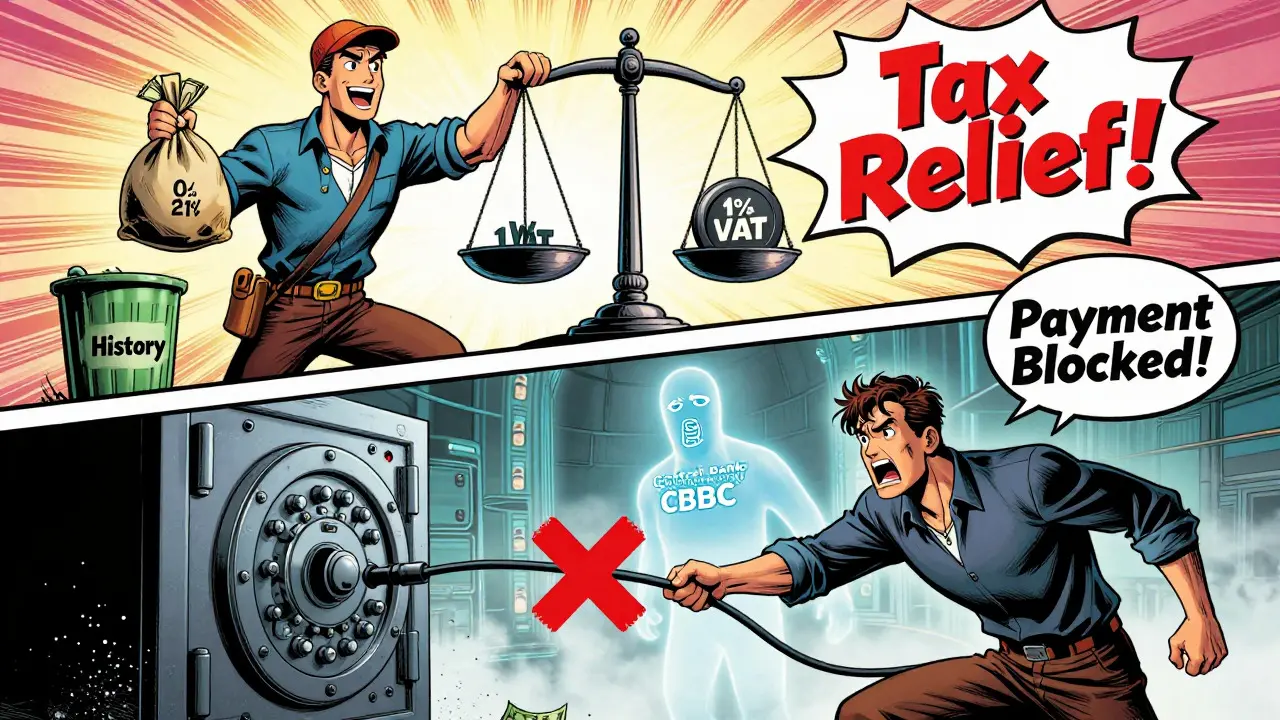
Real-World Impact: Why Merchants Hate the Ban
While traders might appreciate the tax cut, businesses are frustrated. The payment ban creates a "regulatory schizophrenia" where companies can hold crypto assets on their balance sheets but cannot accept them from customers without jumping through hoops.
Consider the case of a Jakarta-based electronics exporter. An international buyer wants to pay in USDT (Tether) to avoid slow SWIFT transfers. Under current rules, the merchant cannot receive this payment directly into a corporate bank account linked to a crypto wallet. They have to use informal peer-to-peer channels or third-party converters, which adds risk and cost.
Data from the Indonesian Blockchain Association (ABI) shows that 68% of surveyed merchants still accept crypto payments through informal channels despite the ban. This creates a gray market. According to Professor Budi Suharjo from Universitas Gadjah Mada, these informal arrangements increase consumer protection risks because there is no recourse if the intermediary disappears.
Furthermore, Indonesia falls behind neighbors like Singapore and Thailand. In Singapore, licensed payment service providers can facilitate crypto payments. In Indonesia, businesses face 37% higher transaction costs for international settlements compared to countries allowing crypto payments, according to Alvarez & Marsal's 2025 analysis. This inefficiency hurts competitiveness.
The Future: CBDCs and Potential Loopholes
Is the ban permanent? Not necessarily. The conversation is shifting toward Central Bank Digital Currencies (CBDCs). Bank Indonesia is actively researching a digital Rupiah. The idea is that a state-backed digital currency could offer the speed and low cost of blockchain without the volatility of Bitcoin.
The Indonesian House of Representatives is reviewing Draft Law No. 12/2025 on Digital Rupiah Integration. This law could create a bridge between traditional banking and digital assets. Governor Perry Warjiyo of Bank Indonesia has stated that any relaxation of the payment prohibition would require comprehensive assessment of monetary policy transmission mechanisms. This bureaucratic language essentially means "we are looking at it, but don't expect changes tomorrow."
For now, the status quo remains: Trade freely under OJK supervision, pay your 0.21% tax, but keep your crypto out of the checkout line. As long as the Rupiah remains the sole legal tender, Bank Indonesia will continue to guard the gate fiercely.
Can I use Bitcoin to buy goods in Indonesia?
Technically, no. Bank Indonesia prohibits all payment system operators from processing transactions using virtual currency. While some merchants may accept it informally via peer-to-peer transfers, it is not recognized as a valid legal payment instrument, and using it carries regulatory risk.
Who regulates crypto in Indonesia now?
As of January 2025, the OJK (Financial Services Authority) regulates crypto as "digital financial assets." Previously, it was regulated by Bappebti as a commodity. This shift brings stricter financial oversight and higher capital requirements for exchanges.
What is the tax rate for crypto trading in Indonesia?
Since August 1, 2025, the previous 1% VAT has been replaced by a 0.21% final income tax on transaction values. This change aligns crypto taxation more closely with other financial securities.
Why is crypto banned as payment but allowed as an asset?
Bank Indonesia bans crypto payments to protect the Rupiah's status as the sole legal tender and maintain monetary stability. However, the government allows trading to foster innovation and capture economic value, provided it is strictly regulated by the OJK.
Are there any exemptions to the payment ban?
Currently, there are no formal exemptions for commercial payments. However, peer-to-peer transfers between individuals are technically possible but fall into a gray area. Future regulations may introduce bridges via Central Bank Digital Currencies (CBDCs), but this is not yet implemented.