
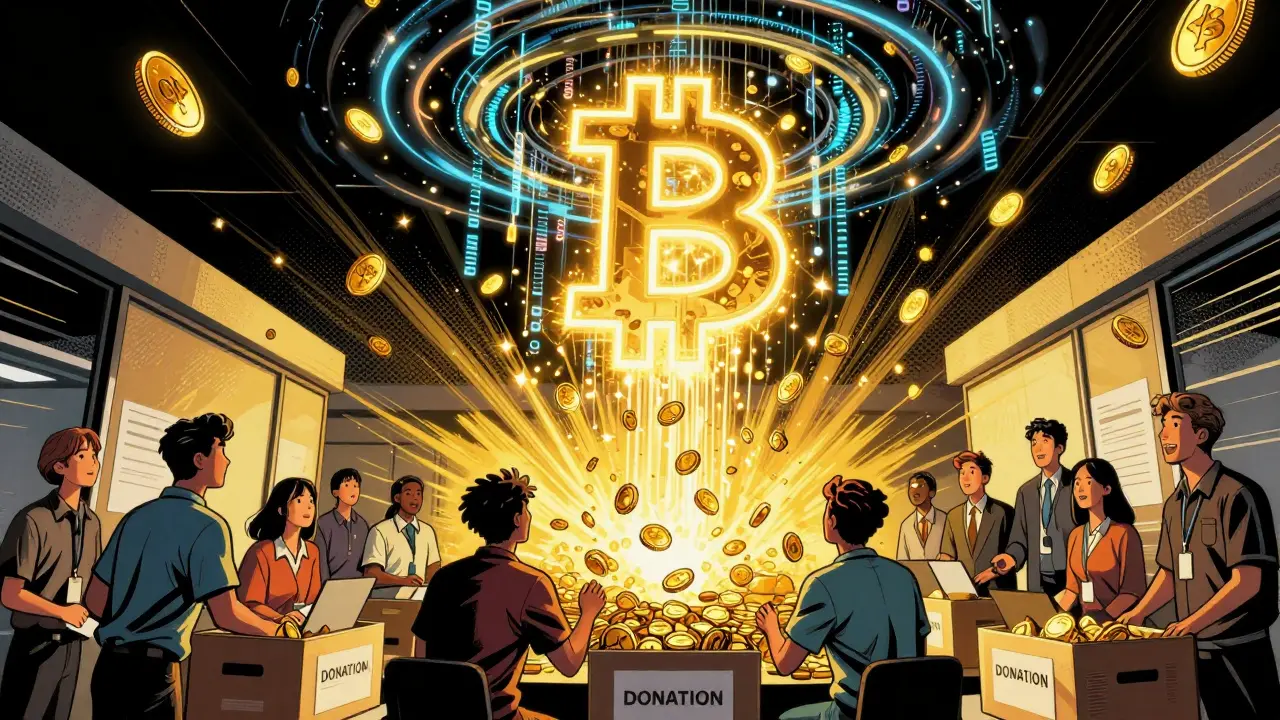
Imagine receiving a single donation that is nearly 150 times larger than your average one-time gift. While that sounds like a dream for most fundraising teams, it is becoming a reality for organizations that embrace Cryptocurrency Donations is the process where digital assets like Bitcoin or Ethereum are transferred directly to charitable organizations as tax-efficient contributions. In 2024 alone, over $1 billion in digital assets flowed into the nonprofit sector. If you are still relying solely on credit cards and checks, you are missing out on a donor class that is not only wealthier on average but significantly more generous.
Quick Guide to Crypto Giving
- Average Gift Size: Approximately $10,978 in 2024, dwarfing the typical $74 one-time donation.
- Donor Benefit: Donors avoid capital gains taxes and get a full market value deduction.
- Nonprofit Benefit: Lower processing fees (0.5-1.5%) compared to credit cards (2.5-3.5%).
- Main Risk: Extreme price volatility requires immediate conversion to cash.
Why Your Nonprofit Needs a Crypto Strategy Now
The shift toward digital assets isn't just a trend for tech enthusiasts; it is a strategic move to capture the "Great Wealth Transfer." With trillions of dollars moving from baby boomers to millennials-a generation where 35% already own crypto-your organization needs to speak the language of the next generation of philanthropists. Currently, about 70% of the Forbes Top 100 Charities already accept these assets. If you aren't on that list, you're effectively telling a growing segment of wealthy donors that their preferred assets aren't welcome.
The real magic happens in the tax code. Because the IRS is the United States government agency responsible for tax collection and tax law enforcement classifies cryptocurrency as property (Notice 2014-21), donors who give appreciated assets held for over a year can avoid paying 15-20% in capital gains taxes. This means a donor can give more to your cause while paying less to the government. From their perspective, it's a win-win; from your perspective, it's a massive increase in the effective value of the gift.
How to Actually Accept Crypto: The Infrastructure
You don't need to be a blockchain developer to start taking donations. Most nonprofits use a third-party processor to handle the technical heavy lifting. These platforms provide a donor-facing portal and automatically handle the conversion of volatile coins into stable US dollars.
Depending on your size and needs, you'll likely choose one of these three primary paths:
| Processor | Best For | Key Feature | Est. Market Share |
|---|---|---|---|
| The Giving Block | Enterprise & Large Nonprofits | Full-service philanthropy suite | ~65% |
| Coinbase Commerce | Quick Setup/Mid-size | Integration with Coinbase ecosystem | ~22% |
| BitPay | Global Payments | Wide variety of supported coins | Remaining % |
If you choose a turnkey solution, setup usually takes 4 to 8 weeks. You'll need to establish a secure wallet protocol and, most importantly, decide on your conversion policy. To avoid the horror story of a $50,000 donation dropping 40% in value overnight, most successful nonprofits convert 50-70% of received assets to fiat currency immediately.

Navigating the Accounting and Legal Maze
This is where many small nonprofits stumble. You cannot simply record a crypto gift as a standard cash donation. The Financial Accounting Standards Board (FASB) issued ASU 2023-08, which changes how these assets sit on your balance sheet. Essentially, crypto must be classified at fair value, and any unrealized gains or losses must be reported in your statement of activities.
This means your finance team needs to dedicate roughly 10-15 hours a month to crypto management. If you don't have an in-house expert, you might need a consultant. Be warned: some small organizations have reported spending $150/hour on blockchain consultants just to get their wallet infrastructure right. To avoid this, stick to the reputable processors mentioned above who provide the necessary reporting tools to keep your accountants happy.
Expanding Beyond Simple Transfers: NFTs and Web3
Once you have the basics down, you can move into more creative fundraising. NFTs is Non-Fungible Tokens, unique digital identifiers that can represent ownership of a specific piece of art or a digital collectible on a blockchain are being used by organizations like CARE and water.org to create new types of engagement. Instead of a standard donation, a donor might buy a digital collectible that grants them special access or recognizes their status as a founding member of a project.
While 42% of nonprofits are planning NFT initiatives for 2025, remember that this is higher risk. The volatility of the NFT market is even more extreme than that of Bitcoin. Use these tools for engagement and brand awareness, but rely on direct cryptocurrency transfers for your core financial stability.

Common Pitfalls and How to Avoid Them
The biggest mistake nonprofits make isn't technical-it's educational. Research shows that 55% of crypto investors aren't even sure they can donate their digital assets to charity. If you just put a "Donate Crypto" button on your site without explaining the tax benefits, you're leaving money on the table.
Create a dedicated landing page that explicitly explains:
- That you accept Bitcoin, Ethereum, and other major coins.
- How giving crypto avoids capital gains tax (the "Tax Win").
- The security of your storage (mentioning cold storage or institutional custodians like Fidelity Digital Assets).
Another trap is the "holding' mentality. Some nonprofits hold onto their crypto hoping it will moon. While the University of Pennsylvania saw a $5.2 million gift appreciate 22% before conversion, others have seen their funds evaporate during a market crash. Establish a strict Treasury Policy that mandates immediate or scheduled conversion to protect your mission.
Is it legal for a 501(c)(3) to accept cryptocurrency?
Yes, it is entirely legal. The IRS treats cryptocurrency as property, meaning it can be donated just like stocks or real estate. The key is to ensure you provide the donor with a proper acknowledgement letter that describes the asset given without assigning a dollar value, as the donor is responsible for determining the fair market value for their tax deduction.
What are the biggest security risks?
The primary risks are losing access to private keys (the "password" to your funds) and phishing attacks. To mitigate this, nonprofits should use institutional-grade custodians or reputable payment processors that use "cold storage" (keeping assets offline) rather than managing their own private keys on a laptop.
How do we handle the volatility of Bitcoin or Ethereum?
The gold standard is immediate conversion. Most payment processors can automatically convert the crypto to USD the moment it hits your account. If you prefer to hold some assets, create a written policy that defines what percentage is converted immediately and what is held for long-term growth.
Do donors get the same tax deduction as cash?
Actually, they often get a better deal. For assets held longer than a year, donors can deduct the full fair market value of the crypto and avoid paying the capital gains tax they would have owed if they sold the asset first. This often results in a 30-50% increase in the effective value of their gift.
Which nonprofits are seeing the most success with crypto?
Currently, organizations focused on education (16%), health and medicine (13.4%), and children and youth (9.9%) are receiving the largest shares of crypto donations. This is largely because these causes resonate with the younger, tech-savvy demographic that holds the most digital assets.
Next Steps for Your Organization
If you are a small nonprofit, start by researching Coinbase Commerce for a low-friction entry point. If you are a mid-to-large organization with a dedicated development team, The Giving Block provides the most robust infrastructure for scale. Regardless of the tool, your first priority should be updating your finance team on ASU 2023-08 to ensure your books remain compliant. Once the pipes are laid, shift your focus to donor education-tell your supporters that their digital wealth can change the world.
Robert Smith
April 28, 2026 AT 23:29Huge game changer for charities 🚀💰
Felix Eduardo Velasquez
April 29, 2026 AT 02:43The tax implications here are the real driver. When you view cryptocurrency not as currency but as a volatile asset class, the strategic advantage of donating appreciated property becomes clear. It allows the donor to bypass the capital gains realization event entirely, essentially shifting a tax liability into a charitable contribution. This is a fundamental principle of high-net-worth philanthropy that is simply being applied to a new digital medium. Most people get hung up on the tech, but the math of the tax code is where the actual value lies for both parties.
Lloyd I
April 29, 2026 AT 09:17This is such a great way to get younger donors involved! We should all be looking at how to make giving easier and more modern. Let's get these tools implemented and help more causes grow together!
Emily A
April 30, 2026 AT 08:35It is remarkably naive to ignore the systemic risks associated with third-party processors. While the provided guide suggests these platforms simplify the process, it fails to emphasize the counterparty risk involved. If a processor fails, the nonprofit's funds are effectively hostage to the processor's bankruptcy proceedings. Furthermore, the claim that 70% of Forbes Top 100 charities accept crypto is a correlation, not a causation of success. True fiscal responsibility requires a much more rigorous audit trail than what most of these 'turnkey' solutions offer.
Brendan Thraxton
May 1, 2026 AT 12:23totally agree with the immediate conversion strategy man its the only way to sleep at night without checking charts every five mins
Lex Harley
May 3, 2026 AT 09:52definitely feeling the fomo on this... like if my org doesnt get the infra set up for the great wealth transfer we're basically leaving bags on the table lol. the slippge on some of these altcoins though is real and the volatility is just wild. honestly the gas fees on eth can be a total nightmare for smaller gifts too
Kristi Swartz
May 5, 2026 AT 03:49crypto is just a gamble and nonprofits should not be gambling with money meant for the poor it is morally wrong to use such unstable assets for charity
Alex Mazonowicz
May 7, 2026 AT 01:28I love this approach!!! It's so exciting to see technology helping the world in such a positive way!!! Keep it up Everyone!!!
Arti Jain
May 8, 2026 AT 06:21Typical Western focus on a few platforms. India's digital infrastructure is far more agile. This is basic.
VIVEK SINGH
May 9, 2026 AT 21:00Oh yes, because nothing says "stable philanthropy" like assets that can drop 20% during a lunch break. Truly a masterpiece of financial planning. I'm sure the accountants are just thrilled to spend 15 hours a month tracking phantom gains in a digital void. But please, let us continue to believe that a JPEG of a monkey is the future of humanitarian aid. How profoundly enlightened we have become.
Harvey Alford
May 11, 2026 AT 07:13I tried this and lost money. Why is everyone acting like this is safe?
Abhishek Verma
May 12, 2026 AT 10:55Maybe if you actually read the part about "immediate conversion" you wouldn't have lost your lunch money. But hey, some people love the thrill of a crash!
April D Thompson
May 12, 2026 AT 21:17Imagine the energy! This isn't just about the money, it's about the soul of how we connect with the future. We're literally rewriting the contract of generosity. It's almost poetic that we use a decentralized ledger to fuel centralized compassion. It's a wild ride, and we're all just along for the journey into the digital ether!
Kara Spadone
May 13, 2026 AT 09:28The irony of using a speculative bubble to fund a nonprofit is just... 🙄. We're just dressing up greed as altruism at this point 💅.
Arun Prabhu
May 13, 2026 AT 16:56A quaint little guide for the unimaginative. The prose is as dry as the blockchain itself, and the insights are merely surface-level observations of a trend that has already peaked in any intellectual circle worth noting. Utterly banal.
Jehan ZA
May 13, 2026 AT 21:41I find the transition to digital assets quite intriguing. It would be prudent for organizations to maintain a balance between innovation and fiscal conservatism to ensure long-term sustainability.
Chloe Fletcher
May 14, 2026 AT 23:16Get your teams on this now! 🌟 It's all about the pivot to the new economy. Don't let your org get left behind in the dust! Let's make those big gains for the kids! 💥
Carli Bates
May 16, 2026 AT 10:31wow a button on a website that says donate crypto. such a revolutionary strategy. truly the pinnacle of marketing genius here
Gabrielle Danis
May 18, 2026 AT 07:28The reference to ASU 2023-08 is critical. Many organizations mistakenly treat these as cash equivalents, which leads to significant reporting errors during the annual audit. Ensuring that your fair value measurements are documented according to the new FASB standards is the only way to avoid a qualified opinion from your auditors.
Janis Naglis
May 19, 2026 AT 08:56This is such an amazing opportunity for synergy!!! We can really optimize our donor acquisition funnel by leveraging these high-net-worth crypto-philanthropists!!! The scalability is just off the charts!!! 📈✨
Jimmy vasquez
May 19, 2026 AT 19:11I've helped a few small non-profits set up Coinbase Commerce and it's honestly the fastest way to get started. Just make sure you have your 501c3 paperwork ready for the KYC process or you'll be stuck in verification limbo for weeks.
Wayne Gillis
May 20, 2026 AT 13:13Yo who else is doing the NFT thing? 🎨 I bet we could make a mint if we just drop a limited collection for a good cause! 🚀 Let's gooo!
Lynne Teperman
May 21, 2026 AT 20:09a kaleidoscope of new possibilities for the heart but keep the keys locked away in a deep dark vault
Rachel S
May 22, 2026 AT 05:28Oh my goodness, the risk of losing private keys is absolutely terrifying! 😱 I cannot even imagine the horror of a board meeting where you have to admit a million-dollar gift is gone because someone lost a piece of paper! Please, please use the institutional custodians! 🏛️✨
Veronica Bago
May 23, 2026 AT 16:16Sounds like a good way to modernize things. Pretty chill if you just use the processors and don't overthink it.