
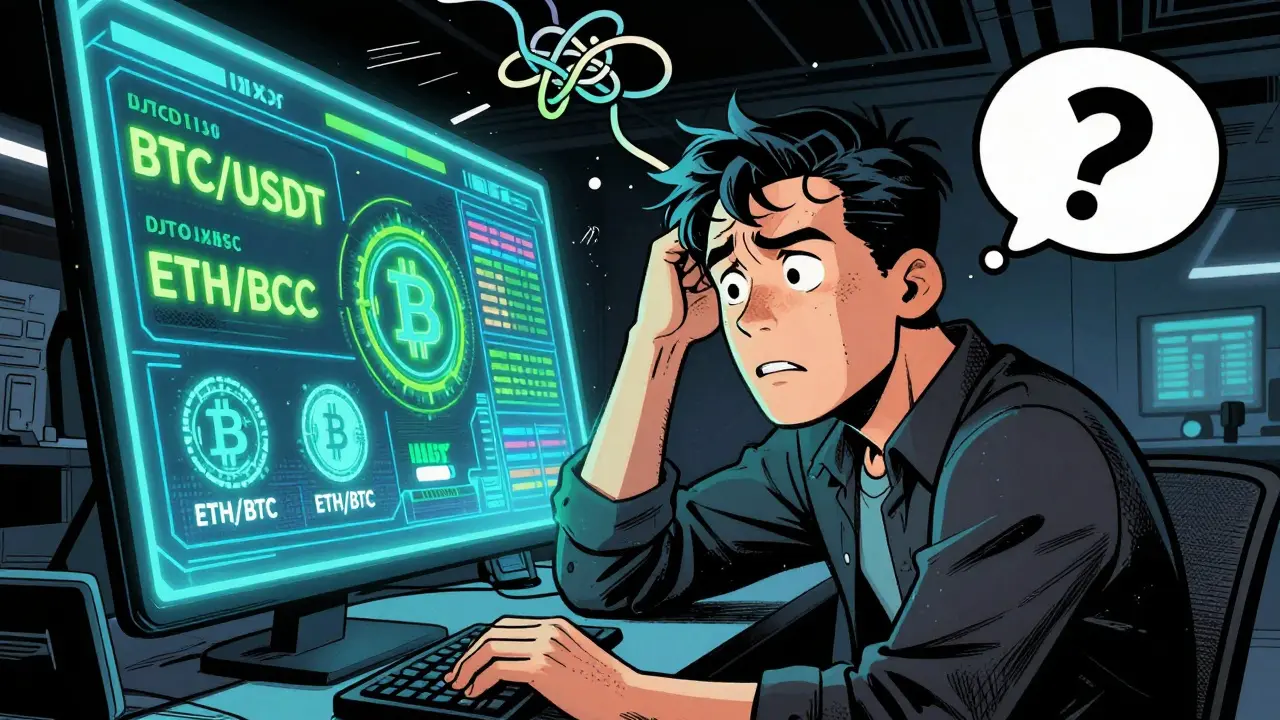
Ever opened a crypto exchange and felt like you were staring at a secret code? You see things like BTC/USDT or ETH/BTC and wonder, "Which one am I actually buying?" If you've ever felt that confusion, you aren't alone. In fact, research shows that nearly 68% of new users struggle to identify which currency they are buying versus selling when they first start. Misreading these symbols isn't just a minor mistake-it can lead to unintended position sizes and immediate financial losses.
The good news is that crypto trading pair notation is a standardized way of expressing the relative value of two different digital assets. Once you understand the logic behind the slash, it's exactly like basic math. You're simply looking at the price of one asset expressed in terms of another.
The Core Logic: Base vs. Quote
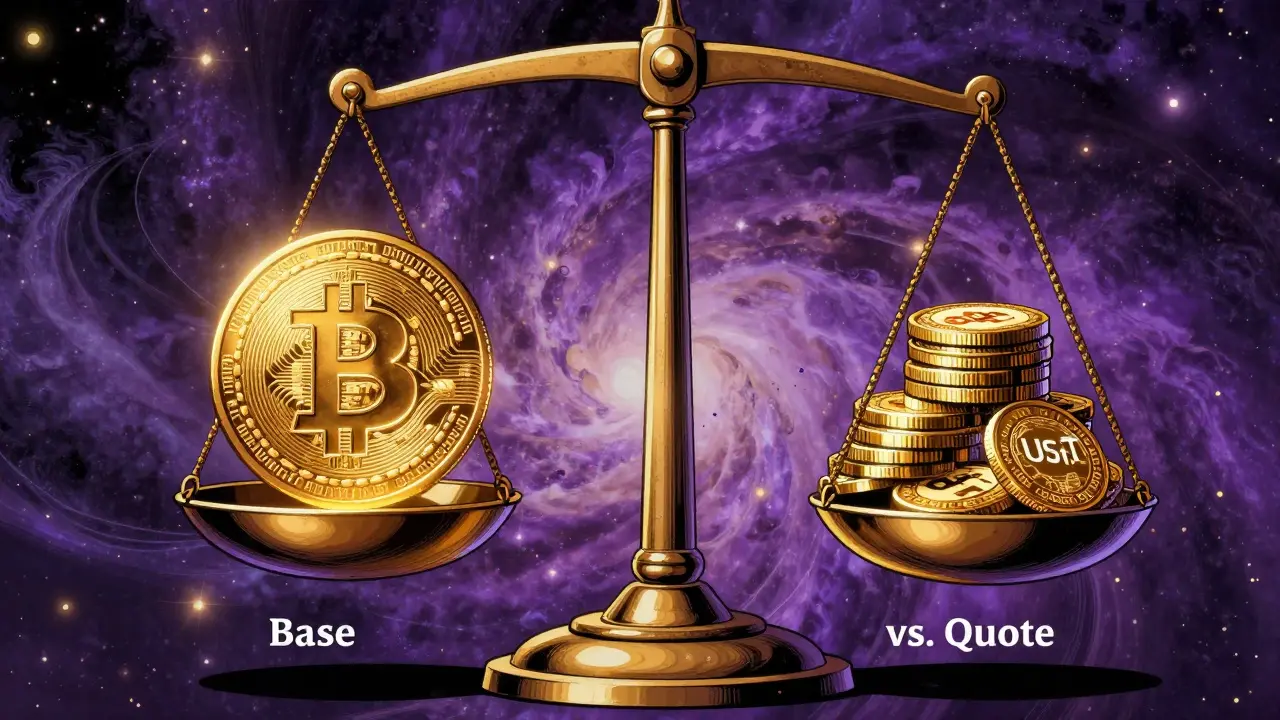
Every trading pair is split into two parts: the base currency and the quote currency. Think of this as a scale where the base currency is the item you're weighing, and the quote currency is the unit of measurement.
- Base Currency: This is the first asset listed. It is the asset you are actually buying or selling.
- Quote Currency: This is the second asset listed. It is the currency used to determine the price of the base asset.
For example, if you see ETH/BTC, Ethereum (ETH) is the base currency and Bitcoin (BTC) is the quote currency. The price you see tells you exactly how much Bitcoin is needed to buy one single Ethereum token. If the price is 0.05, it means 1 ETH = 0.05 BTC.
| Pair | Base Asset (What you buy/sell) | Quote Asset (How it's priced) | Translation |
|---|---|---|---|
| BTC/USDT | Bitcoin | Tether (USDT) | How many USDT for 1 BTC? |
| ETH/USD | Ethereum | US Dollar | How many USD for 1 ETH? |
| SOL/ETH | Solana | Ethereum | How many ETH for 1 SOL? |
| ADA/BTC | Cardano | Bitcoin | How many BTC for 1 ADA? |
Common Types of Trading Pairs
Depending on your goals, you'll encounter different styles of pairings. Most traders start with stablecoin pairs because they feel more like traditional shopping.
Stablecoin Pairs
These pairs use assets like
USDT (Tether) or USDC (USD Coin). Because stablecoins peg their value to the US dollar, these pairs make it easy to track your profit and loss in "real world" money. BTC/USDT is currently the most traded pair globally, accounting for roughly 34.7% of all spot trading volume.
Crypto-to-Crypto Pairs
These are pairs where both assets are volatile, such as ETH/BTC. Traders use these when they don't want to exit the crypto ecosystem into cash. For example, if you believe Ethereum will grow faster than Bitcoin, you might trade your BTC for ETH using an ETH/BTC pair to maximize your holdings of the stronger asset.
Fiat Pairs
These involve a government-issued currency, like BTC/USD or BTC/EUR. These are the most direct way to enter or exit the market using a traditional bank account.
The Practical Application: Buying and Selling
This is where most beginners trip up. The action you take (Buy or Sell) always applies to the base currency.
- When you click "BUY" on BTC/USDT: You are agreeing to give away USDT (the quote) to receive BTC (the base). You are essentially saying, "I want more Bitcoin."
- When you click "SELL" on BTC/USDT: You are giving away your BTC (the base) to receive USDT (the quote). You are essentially saying, "I want to lock in my gains in dollars."
A common mistake reported in exchange support tickets-occurring in about 28% of novice cases-is clicking "Buy" when the user actually intended to "Sell" because they were focused on the quote currency. Always remember: The first asset is the one you are gaining or losing.
Advanced Notations and Market Nuances
As you move beyond basic spot trading, the notation gets a bit more complex. If you venture into
Futures Contracts, you'll see symbols that include maturity dates and product codes. These often follow a format like ProductCode_CurrencyPair_Date, which helps professional traders track contracts that expire on specific days.
In the world of Decentralized Exchanges (DEXs) like Uniswap, you might encounter "Wrapped" assets. For instance, you might see DAI/wETH. The "w" in wETH stands for "Wrapped Ether," a version of Ethereum that allows it to be used in different smart contracts. While the notation remains BASE/QUOTE, the underlying asset behavior can differ from a centralized exchange like Coinbase or Binance.
Moreover, the liquidity of a pair-how easily you can buy or sell without moving the price-varies wildly. High-volume pairs like BTC/USDT have huge liquidity, meaning you can trade millions of dollars with minimal "slippage." However, if you trade a rare pair like LTC/BCH, you might find that there aren't enough buyers or sellers, which can result in a worse price than what you expected.
How to Avoid Costly Mistakes
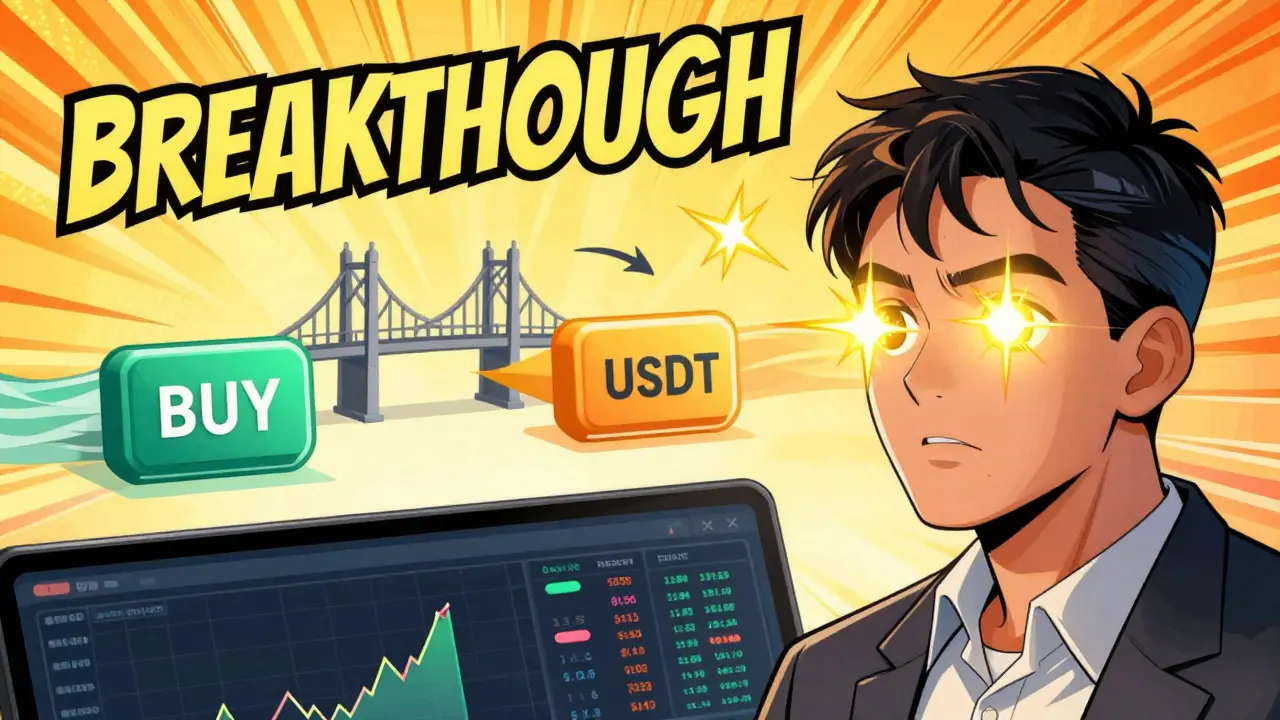
Experienced traders often describe the moment they truly "got" pair notation as a breakthrough. One trader noted that once they viewed the slash as a mathematical "per" (e.g., USDT per BTC), their ability to spot arbitrage opportunities increased significantly. To keep your account safe, follow these rules of thumb:
- Double-check the Base: Before hitting the execute button, ask yourself: "Am I trying to get more of the first coin in this pair?"
- Stick to Major Pairs: If you're starting out, stick to pairs ending in USDT or USDC. They are the most intuitive and have the most liquidity.
- Use a Paper Trading Account: Many exchanges offer demo modes. Practice buying and selling various pairs without risking real capital until the BASE/QUOTE logic becomes second nature.
- Watch for Consistency: Be aware that some exchanges use slightly different tickers. While most use BTC, some legacy systems might use XBT. Always verify the full name of the asset.
What does BTC/USDT actually mean?
It means you are looking at the price of Bitcoin (the base currency) quoted in Tether (the quote currency). If the price is 60,000, it means 1 Bitcoin costs 60,000 USDT.
If I 'Sell' an ETH/BTC pair, what am I receiving?
Since ETH is the base currency and BTC is the quote, selling the pair means you are giving away Ethereum to receive Bitcoin.
Why are stablecoin pairs more popular than fiat pairs?
Stablecoin pairs (like BTC/USDT) allow traders to move in and out of positions instantly without waiting for bank transfers or dealing with the slower processing times of traditional fiat currency.
Can I trade any two cryptocurrencies together?
Technically yes, but only if the exchange has created a "trading pair" for them. If no pair exists (e.g., a very obscure coin paired with another obscure coin), you would have to sell the first coin for a common asset like USDT first, then buy the second coin using that USDT.
What is 'slippage' and how does it relate to pairs?
Slippage is the difference between the expected price of a trade and the price at which the trade is actually executed. This happens more often in low-liquidity pairs where there aren't enough orders to fill your request at the current market price.
Sandeep Bhoir
April 16, 2026 AT 06:54Oh wow, a guide explaining that the first word is the thing you're buying. Truly groundbreaking stuff here. I'm sure the 68% of people who struggle with this are just waiting for a table to save them from the grueling task of reading a label.
Kaitlyn Wu
April 17, 2026 AT 20:01Let's be real, most people get this wrong because exchange UIs are intentionally cluttered to keep you clicking. It is crucial to maintain a boundary between your emotional impulse to trade and the actual execution of the order. Stick to the base currency logic and don't let the flashing lights distract you from the math.
nikki krinkin
April 18, 2026 AT 19:59I remember my first trade and the sheer panic of not knowing if I was selling my Bitcoin for a random altcoin or the other way around. It's a steep learning curve for some.
Kim Smith
April 20, 2026 AT 09:32it's funny how we treat these digital tickers like a secret language when really it's just a reflections of old forex markets from like decades ago and its kinda wild how weve just accepted this weird notation as the universal truth of the internet age even though most of us just want a big button that says buy this thing with my money without having to think about base or quote currencies in some weird mathematical void lol
Tracy Sperandio
April 21, 2026 AT 08:17This is absolutely stellar for the newcomers! Let's crush the confusion and get everyone trading with confidence. The clarity here is a total game-changer for anyone feeling intimidated by the jargon!
Prachi Bhadarge
April 22, 2026 AT 16:36Imagine actually needing a 1,000-word article to understand that A/B means the price of A in terms of B. Truly a peak moment for the education system.
Trudy Morse
April 22, 2026 AT 16:52It's basically just a ratio. Simple logic applied to a complex asset class.
Ankit Sindhu
April 24, 2026 AT 02:13For those just starting, don't feel bad if you're confused. We all started somewhere. Just take it slow and maybe use a notebook to write down your pairs until it clicks!
nathan jones
April 24, 2026 AT 08:11Been using USDT pairs for years. Much easier than dealing with bank wires.
Evan Iacoboni
April 26, 2026 AT 06:24Why is the focus on stablecoins? The real money is in the crypto-to-crypto pairs where you can actually accumulate more BTC while the market moves. Stablecoins are just for people who are afraid of volatility.
Sean Douglas
April 27, 2026 AT 06:38The sheer audacity of the exchanges to maintain such a convoluted system is simply breathtaking! It is a catastrophic failure of user experience design that leads to the absolute devastation of a novice trader's portfolio. My soul weeps for the thousands of souls who have clicked 'Sell' when they meant 'Buy' because of a single forward slash!
Vicky Duffala
April 29, 2026 AT 01:57Love the breakdown! It's all about the mindset shift. Once you see the flow of value, the whole game changes. 🚀
Adam Mann
April 30, 2026 AT 12:45I really think that the best way for people to learn this is just by doing it in a safe environment, and I've always found that when I'm helping people, the most important thing is to remind them that it's okay to make mistakes as long as you aren't using your entire life savings on the first day, so definitely try those paper trading accounts mentioned in the guide because they really take the pressure off and let you focus on the mechanics of the trade without the heart-pounding stress of losing real cash.
Andrew Southgate
May 1, 2026 AT 20:09I've spent years teaching people how to navigate these markets and the one thing I always emphasize is that you should never rush the learning process. Most people want to jump straight into high-leverage futures without even understanding what a base currency is, and that is a recipe for disaster. If you take the time to master the basics-like understanding that the quote currency is simply the yardstick for the base asset-you'll find that the rest of the technical analysis becomes much more intuitive and you'll stop making those silly mistakes that can wipe out a small account in minutes. Just stay patient and keep practicing the basics until they become a reflex.
Keri Pommerenk
May 2, 2026 AT 14:39thanks for the tips. really helps clear things up
Sean Mitchell
May 3, 2026 AT 09:28The formatting of this guide is marginally acceptable, but the concept is dreadfully simplistic. I am utterly appalled that we need a manual for something that should be intuitive to anyone with a basic grasp of arithmetic.
Thomas Jewett
May 3, 2026 AT 21:32This is just another way for the globalist elites to trick us into using their stablecoins and tracking our every move through these exchange pairs while they print money out of thin air and the real american trader gets left behind because they cant read a simple slash on a screen which is probably exactly what the system wants so we stay confused and poor while the big banks laugh at us from their ivory towers and we just keep clicking buttons like sheep
Anna Grealis
May 5, 2026 AT 13:09Tether is a scam anyway... probably just a way for them to launder money for the cabal. Why bother learning pairs if the whole system is rigged from the start?
Kevin Lư
May 6, 2026 AT 17:49Hey, don't be too hard on the beginners. We all messed up our first few trades. Just remember to double check everything before you hit that button and you'll be fine!
Michelle Stanish
May 7, 2026 AT 04:47I don't get why everyone is so excited. It's just numbers.
Karen Mogollon Gutierrez
May 8, 2026 AT 02:04It is an absolute travesty that such fundamental knowledge is relegated to a 'Beginner's Guide' in the current era of financial technology! One must demand a higher standard of intuitive design from these platforms, lest we all perish in a sea of misclicked 'Sell' orders and shattered dreams!