
When you buy an NFT, you’re not just buying a digital image or audio file-you’re buying a piece of code that tracks ownership on a blockchain. But here’s the part most people don’t think about: every time that NFT changes hands after the first sale, the original creator can still earn money. That’s not a bonus. It’s built into the system. This is how NFT creators earn royalties on resales-and why it’s both powerful and broken.
How Royalties Work in Practice
Every time an NFT is sold on a secondary marketplace, a small percentage of the sale price automatically goes to the person who made it. This isn’t a handshake deal. It’s not a promise. It’s code. When a creator mints an NFT, they set a royalty rate-usually between 2% and 10%-in the smart contract. That number gets written into the blockchain. When someone later sells that NFT for 5 ETH, the contract calculates 5% of that (0.25 ETH) and sends it straight to the creator’s wallet. No invoices. No follow-ups. No paperwork. It happens in under 30 seconds.
This system started gaining traction around 2018 with Ethereum’s ERC-721 standard. Early adopters like CryptoPunks and CryptoKitties didn’t have royalties built in, but platforms like SuperRare and Rarible quickly added them. Today, if you’re an artist, musician, or game developer who mints NFTs, you can set up royalties during the minting process using tools like Manifold Studio or Foundation’s dashboard. All you need is a crypto wallet, some gas fees (usually under $5 on Ethereum), and a few minutes to input your terms.
Why Royalties Matter to Creators
Before NFTs, artists had almost no way to profit after their work was sold. A painter might sell a piece for $1,000, but if it later sells for $100,000 at auction, they get nothing. NFT royalties change that. They turn digital art into a long-term income stream. Take artist Pak, who created The Merge. As of 2023, Pak earned over $91 million in royalties from secondary sales of that collection alone. That’s not a fluke. It’s the new model.
For many creators, royalties make up 5-15% of their total income. Some rely on it as their main revenue source. A 2023 survey by NFT Plazas found that creators who set a 7% royalty rate earned, on average, $12,000 annually from resales-even if their original NFTs sold for under $200. It’s passive income that scales. The more your work is traded, the more you earn. And because the blockchain records every transaction, there’s no way to hide or manipulate the payout.
The Problem: Not All Marketplaces Play Fair
Here’s where it falls apart. Royalties aren’t enforced by the blockchain itself. They’re enforced by marketplaces. And not all of them care.
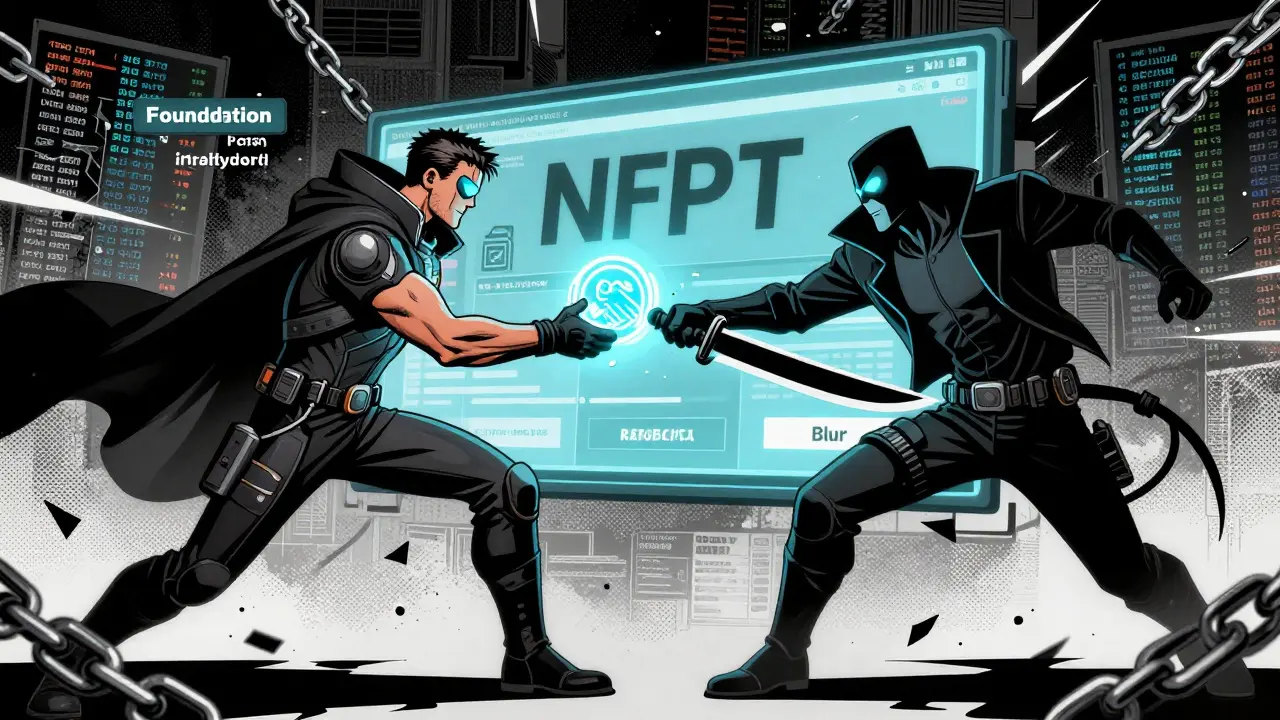
OpenSea used to enforce creator royalties by default. Then in July 2022, they changed their policy. Now, creators must opt in per collection-and even then, the max rate is capped at 10%. Meanwhile, Blur, which exploded in early 2023, eliminated royalties entirely. By Q1 2023, Blur handled 53% of all Ethereum NFT trades. Why? Because traders love it. No royalties mean lower prices. More volume. More profit for buyers.
That created a split. Collections minted on Foundation, SuperRare, or Magic Eden still pay royalties. But if you list the same NFT on Blur, the royalty gets ignored. The buyer pays the seller. The creator gets nothing. A creator named u/ArtByMia lost $3,200 in projected royalties when her collection was moved to Blur. She wasn’t alone. In 2022, 68% of creators reported missing royalty payments due to marketplace non-compliance.
Marketplace Comparison: Who Pays and Who Doesn’t
| Platform | Chain | Enforcement Policy | Max Royalty Rate | Credibility Rating |
|---|---|---|---|---|
| Foundation | Ethereum | Strictly enforced | 10% | 5/5 |
| Magic Eden | Solana | Collection-based opt-in | 10% | 4.2/5 |
| OpenSea | Ethereum | Collection-based opt-in | 10% | 3/5 |
| Blur | Ethereum | No enforcement | 0% | 2.1/5 |
| LooksRare | Ethereum | Optional | 10% | 3.5/5 |
Some platforms are trying to fix this. Magic Eden introduced “royalty enforcement scores” in April 2023, giving creators a visibility score based on how well their royalties are honored across platforms. Others, like Rarible, let creators set different rates per NFT-not just per collection. But without a universal standard, it’s chaos.
The Bigger Issue: Royalties Aren’t Legal
Here’s the uncomfortable truth: even if a smart contract sends money to a creator, it doesn’t mean the creator has legal rights. Rarible’s terms of service say creators grant the platform “royalty-free rights to any content.” That means the platform can use your art, even if you’re earning royalties from sales. Courts don’t recognize blockchain royalties as enforceable contracts. They’re more like community norms-backed by code, not law.
Legal experts at Fordham IPLJ compare NFT royalties to the French droit de suite, a 1920s law that gives artists a cut of resale profits. But in France, the law is backed by courts. In crypto? It’s just a rule written in code. If a marketplace decides to ignore it, there’s no legal recourse. You can’t sue Blur for not paying you. You can only move your collection elsewhere.
What’s Next? The Battle for Standards
There are signs things might change. In May 2023, a new proposal called ERC-6672 was submitted to standardize how royalties are written into NFTs. It’s designed to be readable by any platform, not just Ethereum-based ones. Harvard D3 researchers also proposed a “staking model” where marketplaces would lock up crypto assets to prove they honor royalties-lose your stake if you don’t pay.
Some creators are already adapting. Instead of relying on royalties alone, they’re bundling them with other perks: exclusive Discord access, physical merchandise, or future drops. Nike’s .Swoosh platform, for example, enforces 10% royalties on virtual sneakers-but also ties them to real-world product access. That’s the future: royalties as part of a bigger ecosystem, not the only income stream.
What Creators Should Do Today
If you’re a creator, here’s what you need to do right now:
- Set your royalty rate during minting. Aim for 5-7%. Rates above 10% hurt liquidity. Rates below 3% barely make a difference.
- Mint on platforms that enforce royalties. Foundation and Magic Eden are your safest bets. Avoid Blur and Looksrare if royalties matter to you.
- Use tools like Royalty Registry. Launched in early 2023, it helps track where your NFTs are being sold and whether royalties are being paid.
- Don’t assume your NFTs are protected. If a buyer lists your NFT on a royalty-free marketplace, you’ll lose out. That’s why some creators now include clauses in their collection descriptions: “Royalties honored only on Foundation and Magic Eden.”
- Build community, not just collections. People who feel connected to you are more likely to buy on compliant platforms-even if it costs them a bit more.
The truth is, NFT royalties are still experimental. They’re not guaranteed. They’re not legal. But they’re real. Right now, they’re one of the few ways digital creators can earn from the long-term value of their work. If you’re building something that matters, it’s worth setting up. Just don’t rely on it alone. The market is changing fast. The rules are still being written. And the next big platform might not pay you a cent.
Do NFT royalties work on all blockchains?
No. Ethereum is the most common, but royalty implementation varies. Solana handles royalties through its token metadata system, which is less standardized than Ethereum’s. Some newer chains like Polygon and Flow have their own approaches. If you mint on Solana, your royalties may not be honored on Ethereum marketplaces like OpenSea. Always check what the platform supports before minting.
Can I change my royalty rate after minting?
Generally, no. Once an NFT is minted, the royalty rate is locked into the smart contract. You can’t update it. Some platforms allow creators to mint new versions of their collection with updated terms, but the original NFTs keep their old rates. That’s why setting the right rate the first time matters.
Why do some buyers hate royalties?
Because royalties increase the cost of reselling. If an NFT has a 10% royalty, the seller only gets 90% of the sale price. Buyers on platforms like Blur want to buy low and sell high-without giving a cut to the creator. This creates a trade-off: higher royalties mean less liquidity. Lower royalties mean more trading, but less income for creators.
Are NFT royalties taxable?
Yes. In most countries, including the U.S. and New Zealand, royalty payments received in cryptocurrency are treated as income. You’ll need to report the USD value at the time you received the payment. Keep records of every transaction. Tax software like Koinly or CoinTracker can help track NFT royalty income automatically.
What’s the future of NFT royalties?
It’s uncertain. Some experts predict royalties will stabilize at 5% by 2025, as creators and buyers find a balance. Others warn that without technical enforcement, royalties will fade. The next big shift may come from new standards like ERC-6672 or platforms that combine royalties with real-world utility. For now, the best strategy is to diversify-use royalties as one income stream, not the only one.
Deeksha Sharma
February 9, 2026 AT 05:51David Bain
February 10, 2026 AT 05:33Katie Haywood
February 12, 2026 AT 00:43mahikshith reddy
February 12, 2026 AT 16:51Alex Garnett
February 13, 2026 AT 11:07Freddie Palmer
February 14, 2026 AT 03:48Brendan Conway
February 14, 2026 AT 10:23Ajay Singh
February 14, 2026 AT 12:17Olivette Petersen
February 16, 2026 AT 04:05Matt Smith
February 16, 2026 AT 12:38Oliver James Scarth
February 17, 2026 AT 16:28Ryan Chandler
February 19, 2026 AT 00:15Kieren Hagan
February 20, 2026 AT 08:21Michelle Anderson
February 21, 2026 AT 07:52Josh Flohre
February 23, 2026 AT 02:46perry jody
February 23, 2026 AT 17:18sachin bunny
February 24, 2026 AT 10:37orville matibag
February 26, 2026 AT 09:50Jesse Pasichnyk
February 27, 2026 AT 04:10