
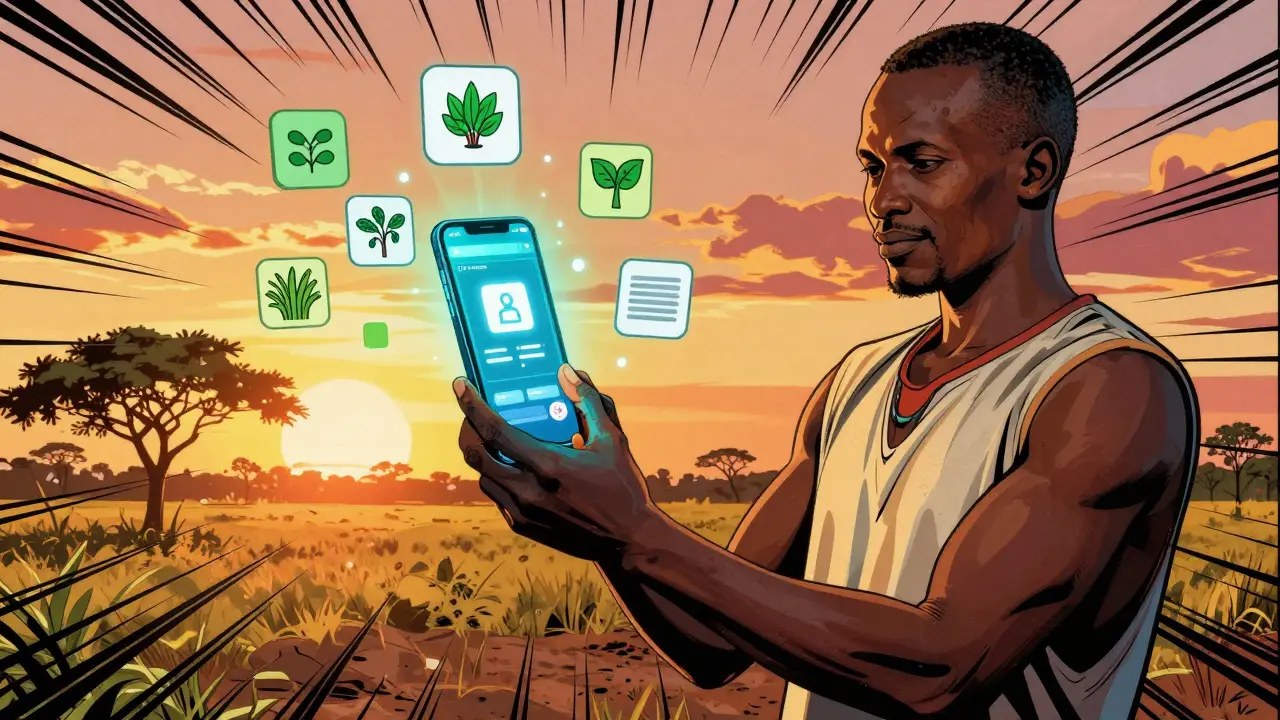
More than 1.7 billion people around the world don’t have a bank account. They live in rural villages, informal settlements, or remote islands. They work in cash economies. They send money through friends or middlemen. They can’t save. They can’t borrow. They can’t invest. And for most of them, traditional banks don’t even try to reach them - too expensive, too risky, too far away.
But blockchain is changing that. Not with fancy labs or billionaire investors. But with simple phones, internet access, and code that works without permission.
What Blockchain Actually Does for the Unbanked
Blockchain isn’t just about Bitcoin or crypto prices. At its core, it’s a public, digital ledger - like a shared notebook that everyone can see but no one can erase. That’s powerful when you don’t have a bank to trust.
Think about it: if you’re a farmer in rural Kenya, you don’t need a branch nearby. You need to get paid for your crops, send money to your kids in the city, and save for seeds next season. Traditional banks ask for ID, proof of income, and a physical address. Most unbanked people don’t have any of those. Blockchain? All you need is a phone and a digital wallet. No paperwork. No approval process. No minimum balance.
That’s the first breakthrough: digital wallets. These aren’t apps from Apple or Google. They’re built on open networks like Ethereum or Solana. Anyone can download one. No bank account required. You hold your own money - not a company, not a government. Just you and your private key.
How Smart Contracts Replace Banks
Banks exist to manage risk, verify identity, and move money. Blockchain does all that - but with code.
Take smart contracts. They’re self-running programs on a blockchain. You set the rules: "If I send $20, then $15 goes to my sister, $5 to my loan, and $1 to my savings." The contract checks if the money arrives. If yes, it splits it automatically. No loan officer. No branch manager. No delays.
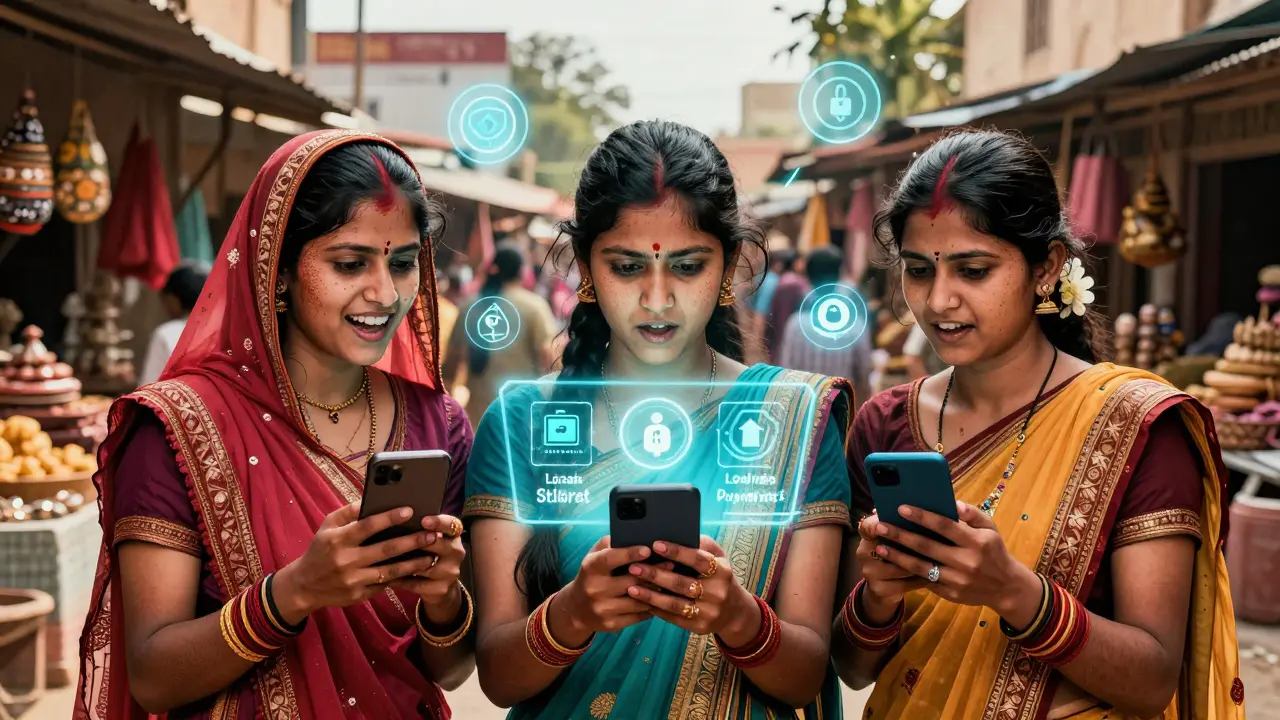
This is already happening. In Nigeria, farmers use smart contracts to sell cocoa directly to buyers overseas. Payments arrive in minutes. No currency exchange fees. No middlemen taking 30% cut. In India, women in self-help groups use similar systems to pool money and give small loans to each other - no bank needed.
The result? Lower costs. Faster payments. More control. And for people who’ve been shut out for decades, that’s not just convenience - it’s dignity.
Tokenization: Owning a Piece of the World
Most people think of blockchain as just for money. But it’s also changing how we own things.
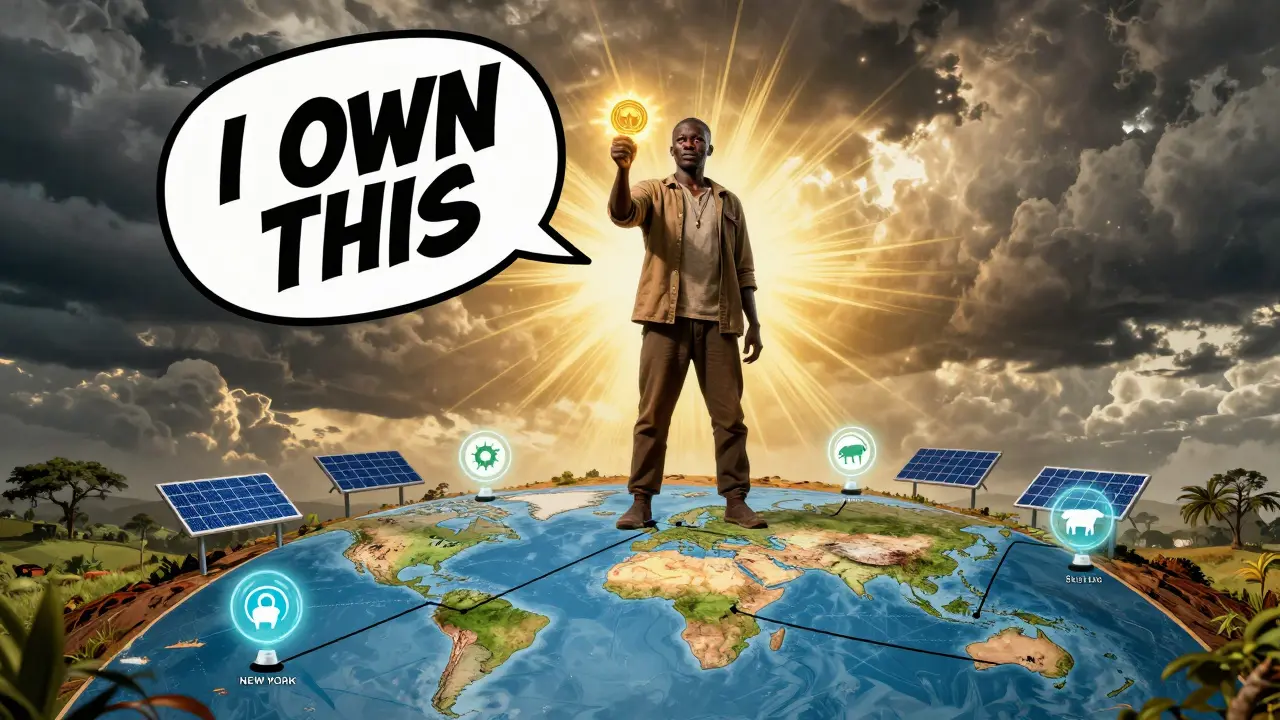
Tokenization turns real assets - land, livestock, even solar panels - into digital tokens. Each token represents a fraction of ownership. You don’t need $50,000 to buy a piece of farmland. With blockchain, you can buy $5 worth. A single token. A tiny slice.
This matters because wealth building isn’t just about earning - it’s about owning. In many developing countries, land titles are lost, corrupted, or controlled by elites. Blockchain makes ownership transparent. You can prove you own your plot. You can rent it out. You can sell part of it. You can use it as collateral for a loan.
Projects in Colombia and Ghana are already testing this. Farmers tokenize their land. Investors from anywhere in the world buy small shares. The farmer gets capital. The investor gets returns. Everyone wins - without a lawyer, notary, or bank.
DeFi: Banking Without Banks
Decentralized Finance - or DeFi - is the most disruptive part of this shift. It’s not a company. It’s not an app. It’s a whole new system built on open code.
With DeFi, you can:
- Borrow money without a credit score
- Save and earn interest without a bank
- Trade currencies without exchanging cash
- Get insurance for crops or health without an agent
How? Through protocols like Aave, Compound, or MakerDAO. You lock your crypto as collateral. The system lends you stablecoins. You pay it back. No interviews. No forms. No waiting weeks.
And it’s not just for techies. Uniswap, once a tool for coders, now has a simple mobile app. People in Indonesia, Mexico, and Bangladesh use it daily. They earn interest on their savings. They send money home. They buy seeds with crypto. They’re not using banks - they’re using code.
Real-World Examples That Work
It’s not theory. It’s happening.
Take M-Pesa in Kenya. It started as a text-message money transfer system. Now it’s a full financial ecosystem. Over 50 million people use it. It’s not blockchain - but it showed the world: if you give people a simple way to move money, they’ll use it. Blockchain is the next step.
Then there’s Humaniq. The company built a blockchain-based ID and wallet system using facial recognition. No government ID needed. Just your face and a phone. Now, people in Cameroon and the Philippines can open a digital bank account, get microloans, and even earn crypto by completing small tasks online.
In the Philippines, over 1.2 million people now use blockchain-based remittance apps to send money home. Costs dropped from 10% to under 2%. That’s $300 saved per year for a worker sending $3,000 home. Multiply that by millions - that’s billions in savings.
Why This Isn’t Just a Tech Fix
Blockchain won’t fix financial inclusion by itself.
Too many people still can’t afford a smartphone. Too many places have no internet. Too many don’t understand how to use a digital wallet. Language barriers. Literacy gaps. Scams. Fraud.
Technology alone doesn’t create inclusion. Education, trust, and design do.
The best blockchain projects aren’t the ones with the fastest code. They’re the ones designed for people who’ve never used a computer. Voice-based interfaces. SMS alerts. Local language support. Community agents who help people set up wallets. These are the real innovations.
And governments? They need to step up. Clear rules. Consumer protection. Tax clarity. No one will adopt blockchain if they fear their money will be seized or frozen.
Challenges Still Standing in the Way
Yes, blockchain is powerful. But it’s not magic.
Scalability is still an issue. Some blockchains can only handle a few transactions per second. That’s fine for sending $10. Not for a country of 100 million people.
Energy use is another concern. Older blockchains like Bitcoin use a lot of power. Newer ones - like Solana or Polygon - use 99% less. That’s critical for places where electricity is scarce or expensive.
Regulation is patchy. Some countries ban crypto. Others welcome it. Without clear rules, people are scared. Investors won’t fund projects. Banks won’t partner.
And then there’s the trust gap. After years of scams and crashes, many people think blockchain = gambling. The real answer? Better design. Better education. Better transparency.
The Bigger Picture: Inclusion as a Human Right
Financial inclusion isn’t about profit. It’s about survival.
When you can save, you avoid loan sharks. When you can borrow, you start a business. When you can send money home, your family eats. When you can invest, your child goes to school.
Blockchain doesn’t solve poverty. But it removes one of its biggest barriers: exclusion from the financial system.
The World Bank says access to a transaction account is the first step toward ending extreme poverty. Blockchain gives that access - without a bank.
And it’s growing fast. PwC estimates blockchain could bring financial services to 1.4 billion people who currently lack them. That’s not a prediction. It’s a possibility. One that’s already being built - in villages, on phones, by people who’ve been told "no" for too long.
What Comes Next?
The next five years will decide if blockchain becomes a tool for the few - or a lifeline for the many.
Developers need to build simpler apps. Governments need to create fair rules. Funders need to support local startups. Communities need to lead the way.
It won’t be easy. But it’s already working. And that’s more than we can say for most financial systems.
Can blockchain really help people without smartphones?
Yes - but not directly. Blockchain apps need internet and a device. However, many projects now use SMS, USSD, or voice-based systems to interact with blockchain services. For example, a farmer can text a code to receive a payment or check their savings balance. The blockchain runs in the background - no app needed. This is already being tested in parts of Africa and South Asia.
Is blockchain safer than traditional banks?
It depends. Blockchain ledgers are nearly impossible to hack or alter - that’s a big advantage. But if you lose your private key, your money is gone forever. Banks have fraud protection and recovery options. Blockchain gives you control - but also full responsibility. For people without access to banks, this trade-off is often worth it.
Do I need to buy Bitcoin to use blockchain for finance?
No. While Bitcoin was the first blockchain, most financial inclusion projects today use other networks like Ethereum, Solana, or Polygon. These support digital wallets, smart contracts, and stablecoins - digital currencies pegged to the US dollar or local currency. You can send, save, or borrow without ever touching Bitcoin.
Can blockchain help with microloans in rural areas?
Absolutely. In places where credit scoring doesn’t exist, blockchain can use alternative data - like mobile usage, crop sales, or repayment history - to assess risk. Projects in Uganda and Bangladesh already offer microloans through smart contracts. Farmers get funds in minutes. Repayments are automatic. No paperwork. No collateral. Just trust built into code.
Why aren’t more governments using blockchain for financial inclusion?
Many are - but slowly. Governments move cautiously. They worry about losing control, managing risks, or facing public backlash. Some countries, like Nigeria and India, are testing central bank digital currencies (CBDCs) built on blockchain. Others are partnering with NGOs and startups to pilot small-scale projects. The key is proving it works at scale - and that’s still happening.
Alan Enfield
February 20, 2026 AT 20:43Blockchain for the unbanked? Sounds like magic until you realize most people in rural Kenya don't have smartphones, let alone crypto wallets. The real innovation isn't the tech-it’s the SMS-based systems like M-Pesa that actually work. Blockchain is just the shiny new toy people are clinging to while ignoring what already works.
Let’s not pretend this is a revolution. It’s a marketing pitch with code.
Jennifer Riddalls
February 21, 2026 AT 10:37i love how this post doesn't sugarcoat it-people don't need fancy apps, they need to be able to send money to their kids without getting scammed. the real win here is giving folks control, not just access. no bank telling you what you can or can't do with your own cash? that's dignity.
also, shoutout to the folks building voice-based interfaces. that's the kind of innovation that actually saves lives. 🙌
kieron reid
February 23, 2026 AT 02:031.7 billion unbanked? That’s just a number. The real question is: how many of them even know what a blockchain is? Or care? Most just want to eat. This whole thing feels like Silicon Valley solving a problem they’ve never seen.
Also, smart contracts? Try explaining that to a farmer in Bihar who’s never used a calculator.
James Breithaupt
February 24, 2026 AT 20:28Let’s be real-DeFi isn’t banking. It’s a high-risk casino with open-source code. Yes, you can borrow without a credit score, but if you lose your seed phrase, you’re screwed. No recourse. No FDIC. No human to call.
And let’s not ignore the fact that most blockchain-based financial tools are built in English, for people who can read. What about the 40% of the global population that’s illiterate? You can’t just paste a QR code on a wall and call it inclusion.
Sarah Shergold
February 25, 2026 AT 10:10Oh wow blockchain is gonna save the poor?? 🤡
next up: NFTs for clean water.
the real story? people in rural india are using *basic* mobile banking, not crypto. this post is just techbro fanfiction.
also, who gave you the right to call this "dignity"? you’ve never met a single person you’re "saving".
Andrew Edmark
February 25, 2026 AT 11:59Just want to say-this is one of the most hopeful things I’ve read all year. I’ve seen firsthand how a simple digital wallet changed a woman’s life in rural Uganda. She started selling her handmade crafts online, saved up for her daughter’s school fees, and even lent money to her neighbor. No bank. No paperwork. Just a phone and some code.
It’s not perfect, but it’s real. And it’s changing lives. 💛
sruthi magesh
February 27, 2026 AT 05:19Blockchain? More like blockchain capitalism. The same elites who built the broken banking system are now selling crypto as salvation. Wake up. This isn’t liberation-it’s rebranding. The real solution? Nationalize financial infrastructure. Not some decentralized fantasy run by Americans in their basements.
Also, why is everyone ignoring that 90% of crypto transactions are still tied to USD? This isn’t independence. It’s new colonialism with smart contracts.
Nova Meristiana
February 27, 2026 AT 17:52"Blockchain gives access without a bank"-sure, if you have a smartphone, stable internet, a basic understanding of private keys, and aren’t afraid of losing everything because you mistyped a 12-word phrase.
Meanwhile, my cousin in Mexico uses *cash* to send money home. It’s slower. It’s less "innovative." But she doesn’t lose her life savings because some app updated.
Maybe we should stop calling this "progress" and start calling it "a new way to get scammed."
Ian Plunkett
March 1, 2026 AT 12:28Let me be the first to say this: blockchain won’t fix poverty. It won’t fix corruption. It won’t fix power outages or illiteracy.
But it will make rich white guys in San Francisco look like heroes while ignoring the fact that 80% of the people "helped" by these systems still can’t afford a data plan.
It’s not inclusion. It’s performance art with a whitepaper.
Avantika Mann
March 3, 2026 AT 01:26I’ve worked with women’s self-help groups in Tamil Nadu, and what they’re doing with blockchain-based microloans? It’s quiet, powerful, and real. One woman told me, "Now I don’t have to beg for a loan. I just tap my phone."
It’s not perfect. Some women lost money because they didn’t understand the interface. But with local volunteers teaching them step by step? They’re learning. And that’s the key-not the tech, but the people behind it.
Let’s not romanticize it. But let’s not dismiss it either.
Nikki Howard
March 3, 2026 AT 01:57The notion that blockchain can replace traditional banking infrastructure is not only naive, it is dangerously misleading. The regulatory frameworks underpinning financial systems exist for a reason: to protect consumers. Blockchain removes those safeguards. The result? Increased vulnerability to fraud, loss, and systemic collapse.
Moreover, the environmental cost of some blockchain protocols remains unaddressed. This is not innovation-it is negligence dressed up as idealism.
Sasha Wynnters
March 4, 2026 AT 15:37Imagine a world where your land, your livestock, your future-none of it belongs to a bureaucrat or a bank. It belongs to you. That’s what tokenization does. It doesn’t just move money. It moves power.
People call it crypto. I call it the first real step toward economic self-determination since the printing press. This isn’t about technology. It’s about rewriting the rules of ownership. And yeah, it’s messy. But so was democracy. So was voting. So was civil rights.
They said it couldn’t be done. Now millions are doing it-with phones, not notaries.
Charrie VanVleet
March 4, 2026 AT 20:19Just saw a video of a grandma in Nigeria using a voice-based blockchain app to check her savings. No typing. No reading. Just talk to your phone and it tells you how much you’ve got.
That’s the real win. Not the blockchain. Not the crypto. The fact that someone who never used a computer can now control her own money.
Keep building like this. 🙏
Scott McCrossan
March 5, 2026 AT 11:07"Blockchain is changing lives"-yeah, right. Meanwhile, in the US, we’re still stuck with banks that charge $35 for a bounced check. This whole post reads like a VC pitch deck with extra steps.
Let’s not pretend this is altruism. It’s a new asset class. And the unbanked? They’re just the next market segment.
Also, tokenizing land? In countries with corrupt land registries? That’s a recipe for disaster. Who audits the blockchain? Who stops a rich guy from buying up all the tokens?
Rajib Hossaim
March 6, 2026 AT 19:01While blockchain offers promising tools, the focus should remain on foundational infrastructure: affordable internet, digital literacy, and local governance. Technology without context is just noise.
In India, we’ve seen mobile money succeed because it was built with local needs-not imported from Silicon Valley. The same principle applies here. Innovation must serve, not dictate.
Beth Erickson
March 8, 2026 AT 05:57blockchain is just a way for rich tech bros to feel good while ignoring the real problem-corruption and lack of political will
why not fix the banks instead of building a whole new system on shaky ground
also why is everyone ignoring that most blockchain projects are funded by american investors who want to profit off poor people
its not liberation its exploitation with better branding
Ruby Ababio-Fernandez
March 8, 2026 AT 06:511.7 billion unbanked? That’s a marketing stat. Most of them don’t want a wallet. They want food, water, and safety.
Blockchain won’t feed a child. It won’t stop a flood. It won’t give someone a job.
Stop pretending tech can fix everything. Some problems need governments, not code.
Jenn Estes
March 8, 2026 AT 14:36Oh, so now we’re going to let people "own" their land via blockchain? That’s cute. Meanwhile, in the US, we have people getting evicted because their property tax bill got lost in the mail.
Maybe we should fix our own system before we start exporting "solutions" to countries that have been colonized for centuries.
Also, who authorized this? Did the farmers in Ghana vote on it? No? Then it’s not inclusion. It’s imposition.
Angela Henderson
March 9, 2026 AT 04:09I’ve been following this for years. The truth is, most people don’t care about blockchain. They care about whether their money arrives. Whether they can pay for medicine. Whether their kids can go to school.
The best projects aren’t the ones with the most hype. They’re the quiet ones-the ones that use SMS, or local agents, or voice prompts. The ones that don’t even mention blockchain to the user.
It’s not about the tech. It’s about the trust. And trust doesn’t come from a whitepaper. It comes from someone showing up, again and again, helping someone else. That’s the real innovation.
Chris Thomas
March 10, 2026 AT 17:15Let’s unpack this. DeFi protocols require collateralization in crypto. That means you need to own crypto to access credit. But most unbanked people don’t own crypto. So how do they get in? The answer: they don’t. The system excludes them before they even start.
Also, stablecoins? Pegged to the USD. So now you’re dependent on American monetary policy. That’s not financial sovereignty. That’s dependency with a blockchain logo.
And let’s not forget: 90% of blockchain adoption is driven by speculation, not utility. This isn’t financial inclusion. It’s financial theater.
Alex Williams
March 11, 2026 AT 19:34People keep talking about "smart contracts" like they’re magic. But here’s the truth: they’re just code. And code breaks. Especially when you’re dealing with low-bandwidth networks, unstable power, or users who’ve never seen a smartphone before.
The real success stories? They’re not about the blockchain. They’re about the community hubs-local women trained to help others set up wallets, explain transactions, and recover lost keys.
That’s the backbone of this movement. Not the tech. The humans. Always the humans.
Dominica Anderson
March 11, 2026 AT 21:39"Dignity"? Please. This is capitalism with a blockchain filter. You’re not helping the poor-you’re creating a new class of crypto-dependent laborers who trade their data for access to their own money.
And let’s not forget: every blockchain project needs users. So they’re not solving poverty. They’re creating a market. And markets don’t care about dignity. They care about growth.
Wake up. This isn’t liberation. It’s monetization.
Lisa Parker
March 12, 2026 AT 09:44i just want to say that after my dad lost his life savings to a crypto scam last year, i don’t trust any of this anymore
he was 72. he thought he was "investing."
now he’s afraid to even use his debit card
so please stop selling this as "empowerment"
it’s just another way to take from people who can’t afford to lose
Alan Enfield
March 13, 2026 AT 22:53Replying to @1910: You’re right about SMS. But let’s not pretend M-Pesa is some altruistic miracle. It’s owned by Safaricom, a telecom giant with a monopoly. They take 10% on transfers. They track every transaction. They sell your data.
Blockchain might be risky-but at least it doesn’t have a CEO.
Avantika Mann
March 15, 2026 AT 14:28Replying to @1909: You’re not wrong. But M-Pesa was built *by* Kenyans, for Kenyans. Blockchain tools are being built *with* communities in Uganda, Bangladesh, and Ghana-not imposed from outside. The difference? Agency.
We’re not just using tech. We’re designing it-with them. Not for them.
Charrie VanVleet
March 16, 2026 AT 02:04Replying to @1904: I’m so sorry about your dad. That’s heartbreaking. But the solution isn’t to stop trying-it’s to build better. Voice-based interfaces. Local language support. Community coaches. We’re already doing it. It’s slow. It’s messy. But it’s real.
Let’s not let one scam make us forget the thousands of people who are finally in control of their money.