
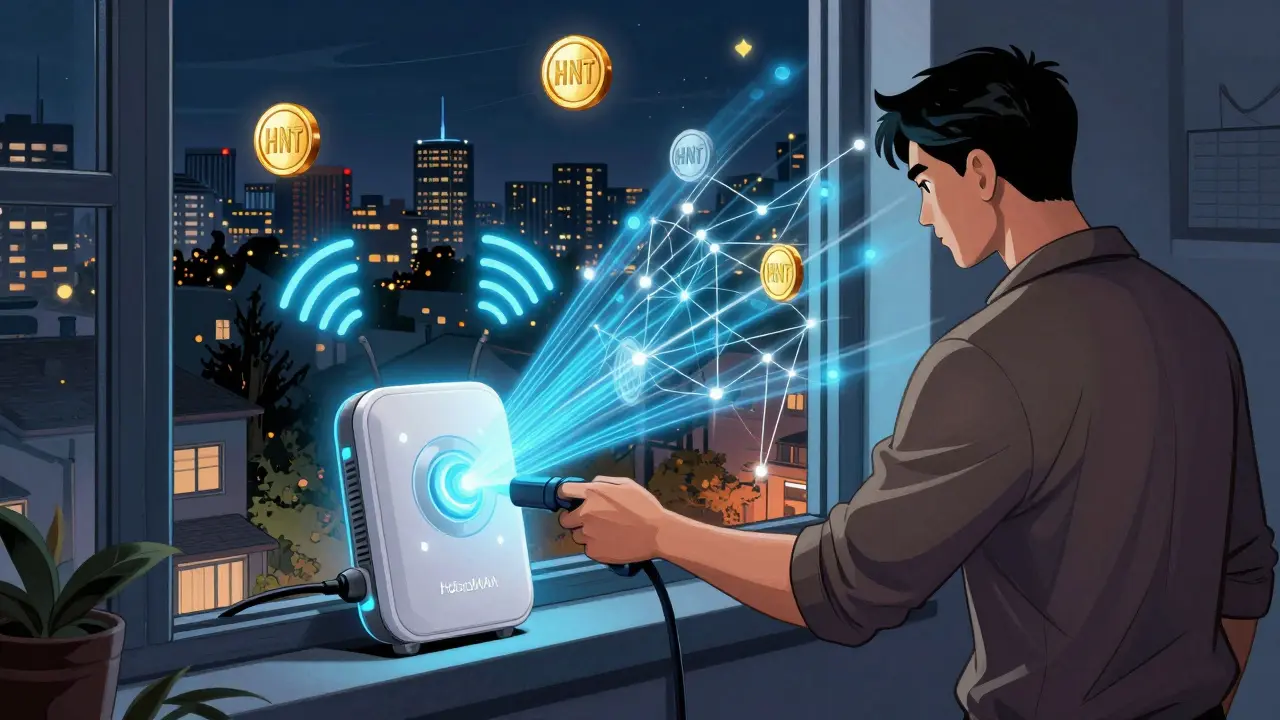
Imagine a wireless network built not by Verizon or AT&T, but by thousands of everyday people with devices in their homes and businesses. That’s the Helium Network - a real, working example of DePIN (Decentralized Physical Infrastructure Network) that’s already connecting over 124,000 mobile users and processing half a petabyte of data every quarter. This isn’t a theory. It’s happening right now, and it’s changing how IoT devices get online.
What Exactly Is DePIN?
DePIN stands for Decentralized Physical Infrastructure Network. It sounds complicated, but the idea is simple: instead of one company building and owning infrastructure - like cell towers, fiber lines, or data centers - regular people contribute hardware and earn rewards for it. Think of it like Uber, but for physical infrastructure. You don’t need to be a telecom giant to help build a network. You just need a hotspot, a power outlet, and a little space.
The Helium Network is the biggest and most proven DePIN project in the world. Launched in 2019, it started with a bold question: What if we let anyone build wireless coverage for IoT devices - and pay them in crypto for it? The answer? Over 400,000 hotspots spread across 80 countries. That’s more coverage than many national cellular networks have in rural areas.
How Does Helium Actually Work?
At its core, Helium uses a technology called LongFi - a mix of LoRaWAN (Long Range Wide Area Network) and blockchain. LoRaWAN lets devices talk over long distances with very little power. A smart water meter, a bike tracker, or a warehouse sensor can send data for miles using just a tiny battery. That’s perfect for IoT.
Here’s the twist: each Helium hotspot is both a wireless receiver and a blockchain node. When your IoT device sends data, the nearest hotspot picks it up, sends it to the internet, and gets rewarded with HNT tokens. But how do you know someone isn’t just pretending to have coverage? That’s where Proof-of-Coverage (PoC) comes in.
PoC is Helium’s secret sauce. Every six hours, hotspots send out encrypted beacons. Nearby hotspots - at least 12 of them - act as witnesses and verify that the signal is real. If the location matches what’s on record and the signal strength checks out, everyone gets paid. The system even checks hardware IDs to stop people from faking 50 hotspots in one apartment. It’s clever, low-power, and designed to be tamper-proof.
Why Solana Made All the Difference
Early on, Helium ran on its own blockchain. It was slow. Transactions cost $0.30. Hotspots were expensive to mint. Then, in 2023, they moved everything to Solana.
The change was massive. Transaction speed jumped from 10 per second to over 1,600. Fees dropped from $0.30 to under $0.01. Hotspots went from costing hundreds of dollars to mint as compressed NFTs for just $0.50-$1.00. That’s a 1,000x cost reduction. Suddenly, turning an old Ubiquiti router into a hotspot became practical. In fact, 60% of mobile hotspots on the network are converted devices - not new hardware.
This wasn’t just a tech upgrade. It unlocked real utility. Now, HNT can be used in Solana DeFi apps. Users can stake it, lend it, or even use it to pay for mobile data. The network stopped being a crypto experiment and became a working infrastructure layer.

Real-World Use Cases You Can See Today
Helium isn’t just for crypto fans. It’s solving real problems:
- Smart agriculture: Farmers in Iowa use Helium to track soil moisture across 50-acre fields without paying for cellular plans.
- Asset tracking: Logistics companies in Germany track shipping containers with Helium-enabled sensors that last years on a single battery.
- Smart cities: Cities in Spain and Portugal use Helium to monitor parking spaces, trash bins, and air quality - all with zero infrastructure cost.
- Helium Mobile: Since July 2023, users can sign up for unlimited mobile data on Helium’s 5G network. Coverage isn’t nationwide yet, but in cities like Portland, Austin, and Denver, it’s working. Users report decent speeds and no data caps - all for $10/month.
These aren’t demos. They’re live deployments. The network processed 576TB of data in Q4 2024 - up 555% from the previous quarter. That’s real demand.
How to Get Involved
You don’t need to be a tech expert to join. Here’s how:
- Buy a compatible hotspot. Options range from $300 to $800. Popular models include the Bobcat 300, SenseCAP, and Nebra.
- Or, convert an existing device. If you have a Ubiquiti or Eero router, you can flash it with Helium firmware. It takes 20 minutes.
- Plug it in near a window. Placement matters. Higher and unobstructed = better coverage.
- Link it to your Solana wallet. The Helium app walks you through it.
- Wait. You’ll start earning HNT within 24-48 hours if your hotspot is verified.
Most people earn between $5-$20/month in HNT, depending on location and network demand. It’s not a get-rich-quick scheme - but it’s passive income with real utility.
Where Helium Stands Against the Competition
Other DePIN projects exist. Filecoin lets you rent out hard drive space. Render lets you rent GPU power. But Helium is different - because people are using it every day.
Traditional telecoms need billions to build a network. Helium built one of the world’s largest LoRaWAN networks with almost no upfront capital. No corporate towers. No government permits. Just people with routers.
Compare that to 5G rollout in the U.S. - estimated to cost $275 billion. Helium’s 5G expansion is happening with $0.01 transactions and community-driven hotspot placement. It’s not just cheaper. It’s faster. And it’s already live.
Challenges and Real Talk
Is Helium perfect? No.
Some users report spotty coverage in rural areas. If no one nearby has a hotspot, your sensor won’t connect. It’s not like cellular - it’s peer-to-peer. You need density.
Setup isn’t always easy. Antenna orientation, local RF laws, and Wi-Fi interference can mess with performance. Reddit threads are full of people asking, “Why am I only getting 3 witnesses?” But the community is active. Discord and forums have detailed guides.
And yes - the token rewards could change. If HNT’s value drops too much, fewer people will run hotspots. But here’s the thing: Q4 2024 showed growth. More data. More users. More mobile sign-ups. Demand is outpacing supply. That’s a good sign.
The Bigger Picture
Helium isn’t just about crypto or wireless. It’s about ownership. It’s about breaking the monopoly of telecom giants and letting communities build their own infrastructure. That’s the power of DePIN.
By 2026, Helium could have over a million hotspots. That’s not a guess - it’s based on current growth. And if it works, other industries will follow: decentralized energy grids, peer-to-peer broadband, even community-owned satellite networks.
This isn’t the future. It’s the present. And you can be part of it - with a device, a window, and a little curiosity.
Can I really earn money with a Helium hotspot?
Yes. Hotspot operators earn HNT tokens for providing wireless coverage. Earnings vary by location, but most users earn between $5 and $20 per month. The more reliable and well-placed your hotspot, the more you earn. Earnings are paid daily and can be claimed directly to your Solana wallet.
Do I need technical skills to set up a Helium hotspot?
No. The Helium app guides you through setup in under 15 minutes. You just plug in the device, connect to Wi-Fi, and link your wallet. If you’re using a converted device like a Ubiquiti router, you’ll need to flash firmware - but step-by-step tutorials are available. Basic knowledge of Wi-Fi and crypto wallets helps, but isn’t required.
Is Helium Mobile a real alternative to Verizon or AT&T?
In select cities, yes. Helium Mobile offers unlimited data for $10/month using its own 5G network, built from community hotspots. Coverage is still expanding, so it’s not nationwide yet. But in places like Portland, Austin, and Denver, users report reliable service with no throttling. It’s not a full replacement for everyone - but it’s a functional, affordable option for many.
What’s the difference between LoRaWAN and Wi-Fi?
LoRaWAN is designed for low-power, long-range IoT devices. It can reach up to 10 miles in open areas and uses tiny amounts of energy - perfect for sensors that last years on one battery. Wi-Fi is fast but short-range (usually under 150 feet) and drains power quickly. Helium uses LoRaWAN for IoT, and 5G for mobile phones - two different tools for different jobs.
Why did Helium switch to Solana?
Helium switched to Solana to fix speed and cost problems. Its old blockchain was slow (10 transactions per second) and expensive ($0.30 per transaction). Solana handles over 1,600 transactions per second and costs about $0.01. This made it possible to mint hotspots for under $1, claim rewards daily, and connect to DeFi apps - all while keeping the network running smoothly.
Is Helium legal in my country?
In most countries, yes. Helium operates on unlicensed radio bands (like 915 MHz in the U.S. or 868 MHz in Europe), which are legal for low-power devices. You don’t need a telecom license. However, some countries have strict rules on signal strength or antenna height. Always check local regulations before installing a hotspot outdoors.
Can I use Helium for my business?
Absolutely. Retail stores, warehouses, and farms are already using Helium to track inventory, monitor equipment, and automate processes. Businesses can deploy dozens of hotspots to cover large areas at a fraction of the cost of cellular plans. Helium even offers enterprise tools for bulk management and analytics.
Ross McLeod
March 14, 2026 AT 18:41Let’s be real - Helium isn’t revolutionizing anything. It’s a glorified neighborhood Wi-Fi experiment with crypto incentives. The whole ‘decentralized infrastructure’ narrative is just VC-speak for ‘let’s pay people to run routers so we can sell them tokens.’ I’ve seen hotspot owners in my town with 3 devices in one closet, all claiming ‘coverage’ while their antennas are buried under a stack of laundry. Proof-of-Coverage? More like Proof-of-Goofy-Placement. And don’t get me started on the Solana migration - it didn’t fix the model, it just made the gas fees cheaper so more people could join the pyramid. This isn’t infrastructure. It’s a speculative housing market for radio signals.
rajan gupta
March 16, 2026 AT 13:34Brooooooo 🌍✨ this is the FUTURE 🤯 blockchain meets reality like a cosmic hug 💫 i cried when i saw my first HNT payout 😭 i’m not just earning crypto… i’m BUILDING A NEW WORLD 🌱📡 every hotspot is a prayer whispered into the digital ether 🙏🔥 #DePINIsTheNewReligion
Billy Karna
March 16, 2026 AT 23:22There’s a lot of hype, but the real value of Helium is in its operational efficiency. The move to Solana was a masterstroke - transaction costs dropped 99%, enabling micro-rewards and near-instant verification. What’s often overlooked is how this changes the economics for rural IoT deployments. A farmer in Nebraska can now monitor irrigation across 200 acres without paying $50/month per device to a carrier. The LoRaWAN + blockchain combo is elegant because it decouples connectivity from ownership. You don’t need to lease spectrum or build towers. Just plug in, align the antenna, and let the network self-organize. The 576TB of data in Q4 2024 isn’t just a number - it’s proof that real devices are using this, not just speculators.
Cheri Farnsworth
March 18, 2026 AT 08:38Gene Inoue
March 19, 2026 AT 20:17Oh great, another ‘community-driven’ scam where people think they’re being ‘empowered’ while some anonymous dev team quietly drains the token supply. You think you’re earning passive income? Nah. You’re just mining data for a company that’ll flip the whole thing to a telecom giant in 2 years. And ‘Helium Mobile’? Please. It’s a glorified MVNO using 5G towers they don’t own. They’re just renting spectrum from real carriers and calling it ‘decentralized.’ Don’t be a sucker. This isn’t innovation - it’s rebranding.
Ricky Fairlamb
March 21, 2026 AT 19:28One must question the fundamental integrity of the Proof-of-Coverage mechanism. The assumption that ‘witnessing’ hotspots are independently verifying signal integrity is flawed. There is documented evidence - from blockchain explorers and public transaction logs - of hotspot clusters in urban centers with identical hardware IDs, geolocated within 100 meters of each other. This violates the minimum distance requirement. Furthermore, the Solana migration introduced a centralized validator set under Helium Foundation control. This is not decentralization. It is centralized governance with a blockchain veneer. The entire system is a regulatory arbitrage play, exploiting unlicensed spectrum while avoiding FCC classification as a common carrier. The narrative is a distraction. The truth is, this is a speculative vehicle masquerading as infrastructure.
Arlene Miles
March 22, 2026 AT 04:21Look, I know it sounds too good to be true - you plug in a device and suddenly you’re earning crypto just for having Wi-Fi. But here’s the thing: this is actually working. I’ve helped three neighbors set up hotspots after they were skeptical. One was a single mom who now pays her daughter’s phone bill with HNT. Another is a retired teacher who says he feels like he’s ‘doing something real’ for his town. The coverage in our neighborhood went from zero to 98% in six months. It’s not perfect - yeah, placement matters, and yes, some hotspots die after a firmware update - but the community shows up. Discord is full of people helping each other troubleshoot antennas. That’s not a scam. That’s collective power. You don’t need to be a tech genius. You just need to care enough to plug something in. And if you do? You’re not just earning tokens. You’re helping build a network that actually belongs to us.
Jessica Beadle
March 23, 2026 AT 07:50While the Helium Network presents a compelling theoretical framework for decentralized physical infrastructure, the operational realities reveal significant systemic inefficiencies. The reliance on LoRaWAN introduces non-trivial latency for time-sensitive IoT applications. Furthermore, the economic model is predicated upon token inflationary dynamics that are inherently unstable. The transition to Solana, while improving transaction throughput, has merely shifted the attack surface from consensus failure to smart contract vulnerabilities. The so-called Proof-of-Coverage protocol is vulnerable to Sybil attacks through hardware spoofing - a documented exploit in early 2022. Moreover, the assertion that 60% of hotspots are converted devices is misleading; many of these are non-compliant with FCC Part 15 regulations. The network’s growth metrics are inflated by incentivized deployment rather than organic demand. The claim of 124,000 mobile users is particularly suspect - the Helium Mobile service lacks direct carrier interconnection, rendering its ‘coverage’ a logistical fiction. This is not infrastructure. It is a Ponzi architecture dressed in blockchain aesthetics.
Tony Weaver
March 23, 2026 AT 17:21Let’s not pretend this is revolutionary. It’s a cleverly marketed crypto project that got lucky because LoRaWAN was underutilized. The ‘network’ is a patchwork of devices placed by people who don’t understand radio propagation. I’ve seen hotspot maps - entire cities have coverage, but it’s all clustered near highways or downtown, while residential areas are dead zones. And the rewards? They’ve dropped 70% since 2022. The only people making money are the early adopters who bought hotspots for $1000 and sold them for $2000. Now? You’re lucky to break even after electricity costs. Helium Mobile? It’s just T-Mobile roaming with a sticker. The whole thing smells like a liquidity grab disguised as innovation. It’s not a network. It’s a casino with antennas.
Patty Atima
March 25, 2026 AT 11:48Lucy de Gruchy
March 26, 2026 AT 09:29How convenient that this ‘decentralized’ network is entirely governed by a single entity in San Francisco. The Helium Foundation holds the keys to the tokenomics, the validator nodes, and the hotspot firmware updates. This is not decentralization - it is corporate capture with a libertarian facade. And let’s talk about the environmental cost: 400,000 devices running 24/7, consuming power for signals that serve almost no critical function. Meanwhile, real infrastructure needs - like rural broadband or grid modernization - are starved of investment. This isn’t progress. It’s digital glitter thrown over a crumbling system. And the fact that people believe they’re ‘contributing’ is the most tragic part.
Lauren J. Walter
March 28, 2026 AT 01:10So… you’re telling me I can just stick a router by my window and suddenly I’m part of the future? 😒 Meanwhile, my actual internet still buffers. And I’m supposed to be excited about earning $8/month in a token that’s down 90% from its peak? 🤷♀️ I’ll pass. Let the crypto bros have their glow-in-the-dark antennas.
Carol Lueneburg
March 28, 2026 AT 19:38I just want to say - thank you for writing this. I was skeptical too. But after setting up my hotspot, I started noticing how many small businesses around me were using these sensors - the bakery tracking fridge temps, the dog park monitoring water fountains, the community garden measuring soil pH. It’s quiet, it’s humble, and it’s working. I didn’t join for the money. I joined because I wanted to be part of something that didn’t need a corporation to make it happen. And honestly? That feels kind of beautiful. 🌿📡
Brenda White
March 29, 2026 AT 12:15wait so if i use a ubi router i dont need to buy a new one?? i thought i had to spend 500?? also my hotspot says 0 witnesses?? did i do it wrong??
Tobias Wriedt
March 30, 2026 AT 21:40Finally! Someone who gets it! 🙌 I’ve been running two hotspots since 2021. I’ve earned over $3K in HNT. I donated half to a local animal shelter. This isn’t just crypto - it’s community. ❤️📡 #DePINForGood
Ernestine La Baronne Orange
March 31, 2026 AT 14:25Oh, absolutely - this is the most transparent, decentralized, and ethically sound infrastructure project in history. 🤡 Let’s ignore the fact that the Helium Foundation controls 38% of all HNT tokens, that the tokenomics were designed to dump on retail investors, and that the ‘community’ is just a PR front for a venture-backed entity that changed the rules mid-game in 2022. And let’s not mention the hundreds of Reddit threads where users report their earnings vanished overnight after a firmware update. No, no - this is pure, unadulterated innovation. The fact that I’ve spent $1,200 on three hotspots and now pay $80/month in electricity just to earn $12 in HNT? That’s not a bad investment - that’s a lifestyle choice. I’m not here for profit. I’m here for the *vision*. And if you’re not crying over this, you’re not trying hard enough.
Manali Sovani
April 1, 2026 AT 20:18It is imperative to note that the economic model presented is fundamentally unsustainable. The reward mechanism, predicated upon token inflation, cannot maintain equilibrium without continuous user acquisition. Once network saturation is achieved, earnings will collapse precipitously. Furthermore, the integration with Solana introduces systemic risk, as the entire infrastructure is now dependent upon the stability of a single blockchain network. This is not innovation - it is dependency. In the long term, this structure will fail. The only beneficiaries are those who exited early. The rest are merely participants in a transient economic bubble.
Konakuze Christopher
April 1, 2026 AT 21:57Billy Karna
April 3, 2026 AT 19:46Replying to @2143 - if you’re getting 0 witnesses, it’s likely your antenna placement or local RF interference. Try moving it higher, away from metal objects or microwaves. Also, check if your Wi-Fi is stable - if your hotspot drops connection, it won’t communicate with the network. And yes - you can absolutely use a Ubiquiti or Eero. There’s a guide on the Helium Discord called ‘Convert Your Router in 20 Minutes’ - it’s got screenshots. Just flash the firmware, wait 24 hours for verification, and you’ll start seeing witnesses. It’s not magic - it’s just physics + software. You got this.