
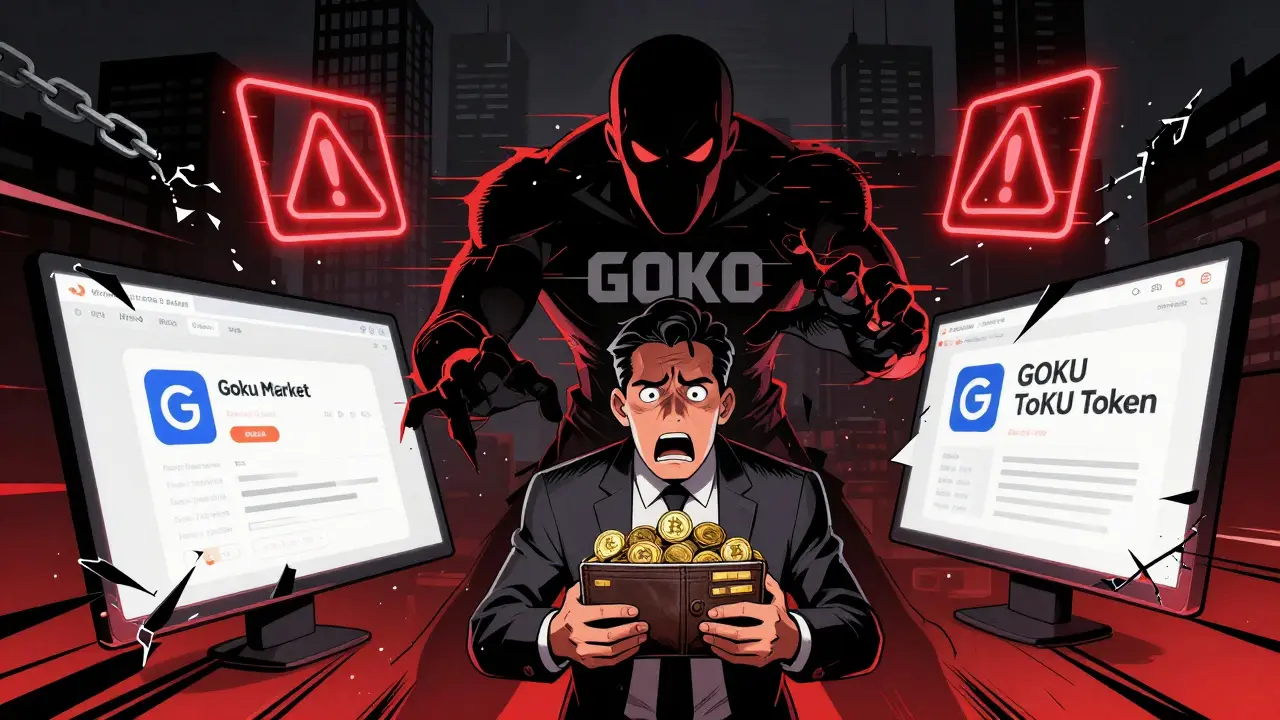
There’s no such thing as a reliable GOKO crypto exchange-at least not one you can trust with your money. If you’re searching for reviews on GOKO, you’re probably seeing mixed signals, vague websites, and confusing links to something called Goku Market or the GOKU token. That’s not an accident. Many people get tripped up by the similarity in names, and that’s exactly where the danger lies.
What Even Is GOKO?
No official website, no verified team, no regulatory license, and no credible documentation exists for a crypto exchange called GOKO. A quick search turns up a few low-quality blogs and forum posts, but none from trusted sources like CoinMarketCap, CoinGecko, or CryptoCompare. That’s a red flag. Legitimate exchanges don’t disappear from major tracking platforms. They’re listed, reviewed, and monitored. If GOKO doesn’t show up there, it’s because it doesn’t exist as a real, operating exchange.What you’re likely seeing is confusion with Goku Market, a platform that had serious issues as early as 2022. Cryptowisser’s review flagged it for users being unable to withdraw funds for months. Transactions vanished from blockchains. Customer support was silent. Trustpilot ratings hovered around 3.0 out of 5-not because users were unhappy, but because they were locked out of their own money.
Why People Get Confused
The name GOKO sounds like GOKU, which is a popular cryptocurrency token. GOKU is a meme coin with no real utility, no team, and no roadmap. It’s traded on a few small decentralized exchanges, but never on any major platform like Binance or Coinbase. Some shady websites mix up the names to trick people into thinking GOKO is a legitimate exchange tied to GOKU. That’s a classic scam tactic: create a name that sounds similar to something real, then vanish with your deposits.There’s also Goku Market, which tried to rebrand itself with a decentralized exchange (Goku DEX) and a cashback app that rewards users in Bitcoin and GMC tokens. But even those features don’t fix the core problem: users couldn’t get their money out. If an exchange can’t handle withdrawals, nothing else matters.
What You Should Know About Withdrawal Problems
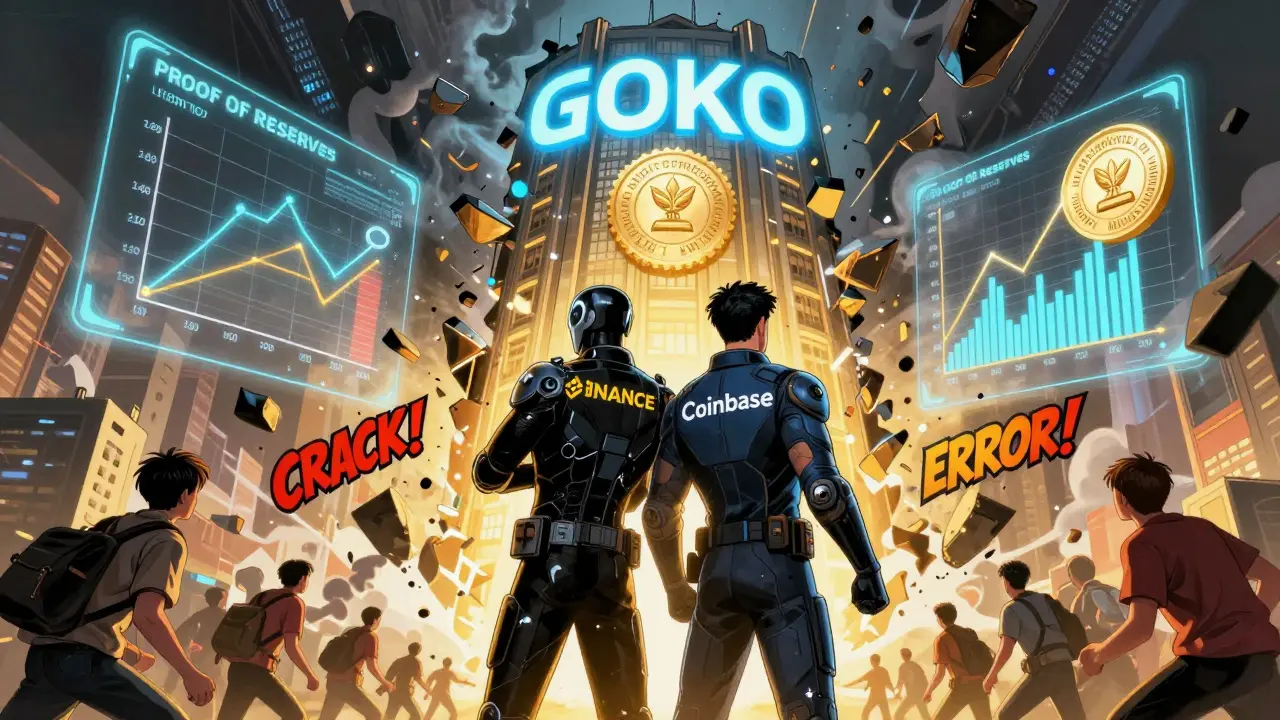
In crypto, withdrawals are the ultimate test. If you can’t pull your funds out, you don’t own them-you’re just holding a digital IOU. In 2025, the industry standard is clear: top exchanges publish Proof of Reserves monthly. Gate.io, for example, showed 128.58% reserves in 2025, meaning they held more assets than they owed users. Coinbase and Kraken do the same. They’re transparent. They’re audited.Goku Market never published Proof of Reserves. They didn’t release audit reports. They didn’t even acknowledge the scale of the problem publicly. When users complained about funds stuck for over 180 days, the response was vague: “We’re working on it.” That’s not a fix. That’s a delay tactic.
How GOKO Compares to Real Exchanges
| Feature | GOKO / Goku Market | Binance | Coinbase | Kraken |
|---|---|---|---|---|
| Regulatory Compliance | None known | Global, licensed in multiple jurisdictions | Registered with FinCEN, SEC-compliant | Registered with FinCEN, licensed in U.S. states |
| Proof of Reserves | Not published | Published monthly | Published monthly | Published monthly |
| Withdrawal Reliability | Users report months-long delays | Typically under 15 minutes | Typically under 30 minutes | Typically under 20 minutes |
| Supported Tokens | Unknown, likely limited | Over 1,000 | Over 200 | Over 400 |
| User Reviews (Trustpilot) | 3.0/5 (many complaints about withdrawals) | 4.2/5 | 4.5/5 | 4.6/5 |
| Available in U.S. | No | Yes | Yes | Yes |
There’s no comparison. GOKO-or the platform people confuse it with-doesn’t meet basic industry standards. Binance, Coinbase, and Kraken have spent years building trust. They’ve been hacked before, but they’ve recovered transparently. They’ve paid out billions in withdrawals without a glitch. GOKO? No track record. No transparency. No safety net.
What Happens If You Deposit?
If you send crypto to a platform called GOKO, here’s what likely happens:- Your deposit shows up on their internal system-but not on the blockchain.
- You see a balance in your account, but you can’t withdraw.
- After a week, you email support. No reply.
- After a month, you find the site is down or the domain has changed.
- Your funds are gone. No way to recover them.
This isn’t speculation. It’s what happened to users of Goku Market. The same pattern repeats with every fake exchange. They lure you in with fake promises-low fees, high rewards, exclusive tokens-then disappear once you deposit. The crypto space is full of these ghosts. They rise fast. They vanish faster.
Real Alternatives You Can Trust
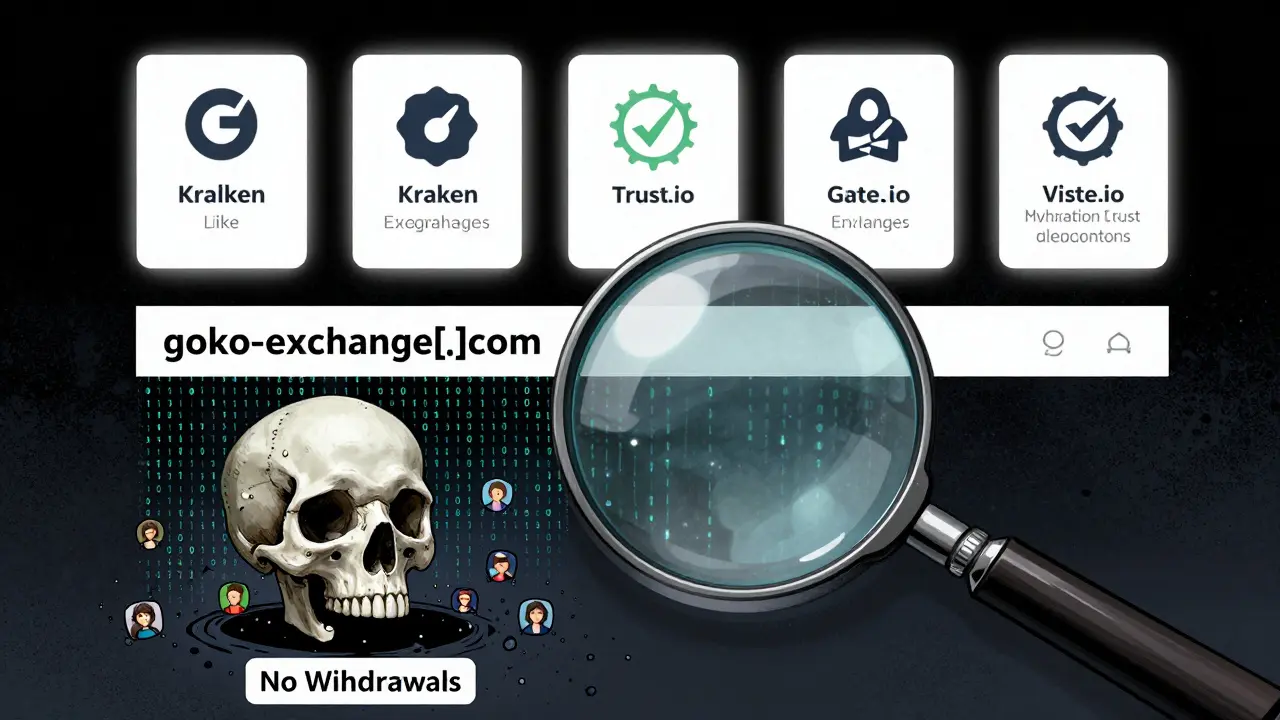
If you’re looking to trade crypto in 2026, you have options that are safe, legal, and reliable:- Binance-Best for advanced traders with low fees and deep liquidity.
- Coinbase-Best for beginners. Simple interface, strong security, U.S.-regulated.
- Kraken-Best for security-focused users. Has never lost user funds to a hack.
- OKX-Great for futures and derivatives trading with high leverage.
- Gate.io-Supports over 3,800 tokens and has strong global presence.
All of these platforms are listed on CoinMarketCap, publish regular audits, and have been operating for years. They don’t need to trick you with confusing names. They’ve earned their place.
How to Spot a Fake Exchange
Here’s how to protect yourself:- Check CoinMarketCap or CoinGecko. If it’s not listed, don’t use it.
- Search for the exchange on Trustpilot and Reddit. Look for patterns in complaints-not just one bad review, but dozens.
- Look for Proof of Reserves. If they don’t publish it, walk away.
- Check if they’re registered with financial regulators (FinCEN, FCA, ASIC, etc.).
- Never trust a platform that uses names like GOKO, GOKU, or similar to popular crypto projects.
Scammers rely on confusion. They count on you not checking. Don’t give them that advantage.
Final Verdict: Avoid GOKO Completely
There is no legitimate GOKO crypto exchange. Any site claiming to be one is either a scam, a copycat, or a phishing page. Even if you think you’re dealing with Goku Market, the history speaks for itself: withdrawal delays, no transparency, zero trust. In 2026, you don’t need to gamble with your crypto on unproven platforms. There are dozens of safe, well-run exchanges with millions of users and clean records.Don’t risk your savings because a website looks nice or has a catchy name. Crypto is risky enough without adding fake exchanges to the mix.
Is GOKO crypto exchange real?
No, GOKO crypto exchange is not real. There is no verified platform by that name. What you’re likely seeing is confusion with Goku Market, which had major withdrawal issues in 2022 and never recovered trust. No official website, regulatory license, or audit records exist for GOKO.
Is GOKO the same as GOKU token?
No. GOKU is a meme token with no utility or team behind it. It’s traded on small decentralized exchanges, but not on any major platform. GOKO is sometimes used to mislead people into thinking it’s a related exchange, but it’s not. This is a common scam tactic using similar-sounding names.
Can I withdraw from Goku Market?
Based on user reports from 2022 to 2024, many users were unable to withdraw funds for months. Transactions disappeared from blockchains, and customer support ignored requests. While the platform claims to have improved, there’s no public proof of resolution. Withdrawals remain unreliable and risky.
What should I use instead of GOKO?
Use Binance, Coinbase, Kraken, OKX, or Gate.io. These exchanges are regulated, publish Proof of Reserves, have strong security, and have been operating for years without losing user funds. They’re trusted by millions and listed on major crypto data platforms.
Why do fake exchanges like GOKO exist?
They exist to steal money. Scammers create fake exchanges with names that sound similar to real ones, lure users with low fees or fake rewards, and then disappear after deposits. They rely on people not checking legitimacy. Always verify before depositing.
Is GOKO available in the United States?
No. Even if it were real, it wouldn’t be available in the U.S. because it doesn’t have any regulatory approval. U.S. users are legally required to use exchanges registered with FinCEN or state regulators. Any platform claiming to serve U.S. users without this is breaking the law.
Rajappa Manohar
January 2, 2026 AT 14:40goko? sounds like a pokemon. dont touch it.
Abhisekh Chakraborty
January 4, 2026 AT 02:08bro i lost 3 btc to goku market in 2023. they ghosted me. no replies. no refunds. just silence. crypto is already risky enough without these fake sites.
Monty Burn
January 4, 2026 AT 17:14the real danger isnt the scam sites its the belief that crypto can ever be safe if you dont control your keys. goko or goku or whatever its all the same game. trust no one not even the big exchanges. the blockchain doesnt lie but the interfaces sure do
christopher charles
January 5, 2026 AT 09:47sooo... if you see a site with 'goko' in the name just close the tab. no questions asked. i dont care how fancy the logo looks. if it sounds like a meme coin and acts like a phishing page... it is.
Amy Garrett
January 5, 2026 AT 19:45i thought goko was a new coin till i saw the withdrawal horror stories. yikes. i’m sticking with coinbase for now. at least i know where my money is.
Antonio Snoddy
January 6, 2026 AT 06:47we live in a world where a name like GOKO can trick people into handing over their life savings because it sounds like a cartoon character. is this capitalism? or just the inevitable collapse of human attention spans? we’ve created a system where the most dangerous thing isn’t the scammer-it’s the fact that we’re all too lazy to check a single domain name. and now we wonder why the world is falling apart. 🤦♂️
Ryan Husain
January 8, 2026 AT 06:20While I appreciate the thorough breakdown of GOKO’s illegitimacy, I must emphasize the importance of education over fear. The crypto space is evolving, and users must be empowered to discern legitimacy through critical analysis-not just avoidance. Platforms like CoinMarketCap and Trustpilot are tools, not substitutes for due diligence. Let’s not reduce complex financial decisions to black-and-white warnings.
dina amanda
January 9, 2026 AT 03:18goko is a government plant. they want you to think its fake so you put all your money in coinbase and they track you. theyre using goku market as a decoy. the real scam is the 'trusted' exchanges. watch your back. they know where you sleep.
rachael deal
January 10, 2026 AT 13:12thank you for this. i was about to try out a site called goko because it had a cool design and low fees. now i’m so glad i read this first. you saved me from a nightmare. crypto is scary enough without fake names tricking us.
alvin mislang
January 11, 2026 AT 17:59you people are idiots. if you can’t tell the difference between goko and goku then you deserve to lose your money. stop blaming the scammers and start blaming yourselves for being too lazy to google. 🤡
Jack and Christine Smith
January 13, 2026 AT 07:59my cousin in delhi got scammed by this goku thing last year. he sent 5000 bucks and now he’s crying every night. we need to warn more people. not just here but in india too. these scams are everywhere and they target people who don’t speak english well. please share this.
Prateek Chitransh
January 13, 2026 AT 20:04interesting how the same pattern repeats: fake name, fake promise, fake support. it’s like watching the same horror movie but with different actors. the real villain? the belief that ‘this time it’s different.’ 🤷♂️
Vernon Hughes
January 15, 2026 AT 19:27if it’s not on coinmarketcap it’s not real. period. end of story. don’t overthink it
Alison Hall
January 17, 2026 AT 07:01just checked my wallet-thank god i never touched goko. i’m sharing this with my mom. she’s been asking about ‘that new crypto site’… she needs to see this.