
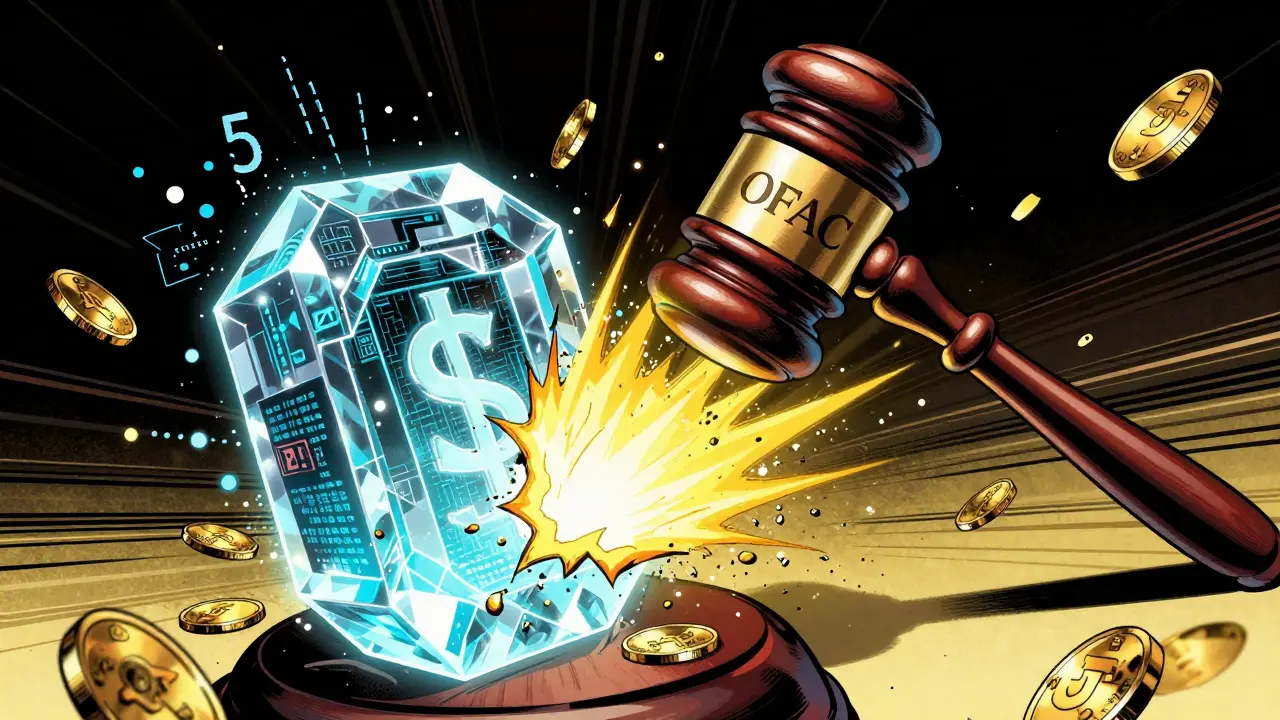
Imagine trying to move money across borders when your country is essentially locked out of the global financial system. For many in Russia, this isn't a hypothetical-it's a daily struggle. Enter Garantex is a cryptocurrency exchange that became a primary lifeline for Russian users looking to bypass Western financial blocks. Despite being hit with heavy sanctions from the U.S. Treasury, the platform hasn't just survived; it has mutated into something far more complex and harder to kill.
The Crackdown on Garantex
The U.S. Department of the Treasury's Office of Foreign Assets Control (OFAC) didn't just tap Garantex on the shoulder; they hit it with a sledgehammer. First sanctioned in April 2022, the exchange was targeted for its role in the Russian financial sector. But by August 14, 2025, the stakes got higher. OFAC re-designated the platform under Executive Order 13694, specifically calling it out for facilitating cybercrime. Treasury Secretary Janet Yellen didn't mince words, stating that the platform directly helped notorious ransomware actors and darknet criminals.
The numbers are staggering. Forensic analysis from the FBI shows that Garantex processed over $100 million in transactions linked to illicit activities. We're talking about a platform that basically served as a digital laundromat for ransomware-as-a-service operations and some of the biggest darknet marketplaces in the world. For the U.S. government, this wasn't just about money; it was about national security.
The Evolution of a "Ghost" Exchange
If you think a few sanctions and a domain seizure would stop a platform like this, you're underestimating the resilience of the crypto underworld. After the U.S. Secret Service and European agencies seized domains and froze $26 million in assets in March 2025, Garantex didn't disappear. Instead, it fragmented. It evolved from a single exchange into a decentralized money laundering system.
Today, the ecosystem relies on several successor platforms to keep the wheels turning. You have Grinex, which was essentially built by former employees to keep the evasion efforts alive. Then there's Exved, a cross-border payment processor based in Moscow-City that helps get "dual-use" goods-tech that can be used for both civilian and military purposes-into Russia. Finally, there is MKAN Coin, a Telegram-based exchange operating out of Dubai that mirrors the original Garantex functions. By spreading across the UAE, Brazil, Georgia, and Hong Kong, the network has made it nearly impossible for any one regulator to shut the whole thing down.
How the Evasion Actually Works
For the average Russian crypto trader, the process is no longer as simple as "click and buy." It has become a multi-step dance designed to keep the "crypto element" invisible to banks. This is the core of Garantex exchange sanctions evasion: creating a paper trail that looks like legitimate trade but is actually a currency swap.
Here is the typical journey a user takes to move funds abroad:
- The Russian user transfers rubles to Feilian Company Limited, a firm registered in Hong Kong.
- Feilian holds an account at Alfa-Bank in Russia, making the initial transfer look like a standard business payment.
- Once the funds hit the Hong Kong entity, they are converted and sent to a foreign exporter in U.S. dollars, Chinese yuan, or USDT (Tether).
- The exporter then sends the crypto or cash to the final destination, effectively scrubbing the Russian origin of the money.
This isn't a fast process. New users often need 3 to 4 weeks of guidance from Telegram groups to understand how to navigate these intermediaries. Official support is gone; in its place are basic Telegram bots and community forums where traders share the latest "working" routes.
The Cost of Doing Business Underground
While the system works, it isn't free. Russian traders are paying a "sanctions tax." Before the major 2025 law enforcement actions, transaction fees were relatively low, around 0.1%. Now, users on forums like BitBrothers report fees jumping to as high as 1.5%. When you're moving millions, that's a massive hit, but for many, it's the only way to access international markets.
| Feature | Pre-2025 Status | Post-2025 Status |
|---|---|---|
| Structure | Centralized Exchange | Decentralized Network (Grinex, Exved, MKAN) |
| Typical Fees | ~0.1% | Up to 1.5% |
| Onboarding Time | 1-2 Weeks | 3-4 Weeks |
| Primary Token | Mixed | Heavy reliance on USDT |
| Support | Official Channels | Telegram Bots & Community |
The Broader Impact on the Russian Market
Is Garantex just a niche for criminals? Not quite. While the Treasury focuses on the $100 million linked to ransomware, the scale of general usage is much larger. Estimates suggest that Garantex and its sister platforms process roughly $300 million every month. That's about 15% of all Russia's cryptocurrency-based international transfers.
Surprisingly, these restrictions haven't killed the appetite for crypto in Russia. In fact, it's the opposite. As of June 2025, the Central Bank of Russia reported 18.7 million crypto users-a 22% increase from the previous year. When traditional banking fails, people turn to the alternatives, even if those alternatives are risky or sanctioned.
However, this growth comes with a dark side. The FBI reported that crypto fraud surged 66% in 2024, with losses hitting nearly $10 billion. Because the Garantex ecosystem operates in the shadows, it's a breeding ground for scams. Traders are often forced to trust intermediary agents and "verified" Telegram admins with their life savings, with very little recourse if they get cheated.
The Endless Game of Cat and Mouse
The U.S. government is still playing hardball. The Department of State has offered rewards totaling $6 million for information leading to the arrest of key figures like Aleksandr Mira Serda. One high-ranking leader, Aleksej Besciokov, was already snagged in India back in March 2025. But for every head the regulators chop off, two more appear in Dubai or Hong Kong.
Industry analysts, including those at Chainalysis, suggest we are entering a new era of financial warfare. The old tools-blacklisting a website or freezing a bank account-aren't as effective when the "exchange" is actually a series of fragmented bots and offshore shell companies. The result is a more sophisticated, harder-to-track money laundering system that evolves faster than the legislation can keep up with.
Why does Garantex use USDT (Tether) so heavily?
USDT is a stablecoin pegged to the US dollar, making it the ideal vehicle for sanctions evasion. It provides the stability of the dollar without requiring a traditional US bank account, allowing traders to move large sums of value across borders without the volatility of Bitcoin.
Is it legal for Russian citizens to use these successor platforms?
Within Russia, the government often turns a blind eye to these platforms because they help the economy bypass Western sanctions. However, from an international perspective, using these platforms can lead to severe legal consequences, and funds moving through them are often flagged as illicit by global monitors.
How did the "Feilian Company Limited" scheme work?
It worked by masquerading as a legitimate trade payment. A Russian user would send rubles to Feilian's account at Alfa-Bank. Because it looked like a payment for goods (like electronics), it didn't trigger red flags. Feilian then converted those rubles into foreign currency or crypto and sent them to the final recipient abroad.
What happened to the original Garantex domains?
In March 2025, a joint operation involving the U.S. Secret Service and law enforcement from Germany and Finland seized the primary domains and confiscated servers, freezing $26 million. This forced the operation to migrate to decentralized alternatives like Grinex and MKAN Coin.
Who is Aleksandr Mira Serda?
He is one of the founders of Garantex. Due to the platform's role in facilitating cybercrime and sanctions evasion, the U.S. government has offered a reward of up to $5 million for information leading to his arrest.
Noel Mandotah
May 1, 2026 AT 02:57Oh, shocker. The US tries to play whack-a-mole with a decentralized tech and loses. Groundbreaking stuff. 🙄
Ralph Espinosa
May 2, 2026 AT 22:41The use of USDT is actually a textbook example of how stablecoins bridge the gap between fiat and crypto in high-inflation or sanctioned environments... It's quite fascinating how they've optimized the friction points!!!
Andrew Todd
May 3, 2026 AT 02:47These people are just criminals. Period. US needs to stop playing around and just shut every single one of these bots down. Pathetic.
Arun Prabhu
May 4, 2026 AT 04:13The sheer audacity of these financial charlatans is almost impressive, if it weren't so utterly repugnant. We are witnessing a digital carnival of greed where the laws of sovereign nations are treated as mere suggestions by some basement-dwelling opportunists in Dubai. It's truly a kaleidoscopic display of moral bankruptcy, wrapped in the sterile language of "blockchain innovation." The irony is thick enough to choke on, as they preach about liberation while essentially building a high-tech laundromat for the most vile ransomware scum on the planet. I find it exhausting that we even have to discuss the "resilience" of such parasitic entities. They aren't innovators; they are just cockroaches with an internet connection, scurrying from one offshore shell company to another to avoid the inevitable light of justice. Honestly, the level of sophistry used to justify these "evasion dances" is simply grating to anyone with a modicum of ethical standing. It's a race to the bottom of the ocean, and we're all just watching the wreckage sink while the architects count their Tether in the shadows. Truly a grotesque era of finance.
Gabrielle Danis
May 4, 2026 AT 17:49It is important to note that the Feilian Company Limited scheme relies heavily on the complicity of internal bank staff at Alfa-Bank to ensure the transfers are coded as commercial trade payments. Without that specific institutional gap, the ruble-to-dollar pipeline would be significantly more visible to automated AML systems.
Michael Repak
May 6, 2026 AT 09:48Great breakdown of the mechanics!!! It really shows how adaptable these networks can be... keep digging into this!!!
April D Thompson
May 7, 2026 AT 00:09There is something so poetic and terrifying about the way money just... flows... like water through a cracked pipe. We think we can build walls with sanctions, but the human desire to trade is like a river that will always find the smallest gap to leak through. It makes you wonder if the concept of a "national border" even exists anymore in the digital age, or if we're all just nodes in a giant, chaotic web of value exchange where the only rule is survival. It's wild!
Nitin Gupta
May 8, 2026 AT 20:23I think the shift toward Telegram-based exchanges like MKAN Coin is a strategic move to leverage the platform's encrypted nature and massive user base, which makes monitoring much harder for external agencies.
Iestyn Lloyd
May 10, 2026 AT 10:11The fragmented nature of these successor platforms is quite similar to how certain shadow banking networks operated in Asia during the 90s. It is a classic case of diversification to minimize systemic risk.
Kara Spadone
May 11, 2026 AT 09:15Typical greed leading to more scams. The universe just balances itself out when you try to cheat the system 🧘♀️✨
Pramendra Singh
May 12, 2026 AT 13:54It's hopeful to see people finding ways to support their families despite these hard restrictions.
AP Fisher
May 13, 2026 AT 15:02So if they use bots now, does that mean the humans are just managing the bots from elsewhere?
Arti Jain
May 14, 2026 AT 19:09Western sanctions are just a joke. They can't stop us.
Kathleen Warren
May 16, 2026 AT 01:36I feel for the regular people who just want to send money home and end up getting scammed by these "verified" admins. It's such a scary situation for them.
Chloe Fletcher
May 16, 2026 AT 13:08That 1.5% fee is a total rip-off! 😱 But I guess when you're desperate, you pay whatever they ask 💸
Amanda Macy
May 17, 2026 AT 21:04The evolution from a centralized exchange to a decentralized network is an inevitable response to state-level pressure.
Veronica Bago
May 17, 2026 AT 21:59Everything about the Telegram bot setup sounds so chaotic but weirdly efficient.
Barbara Jones
May 18, 2026 AT 16:35i think its crazy how much money is moveing thru these things without anyone realy stopping them lol
Andrew Todd
May 19, 2026 AT 12:58Because they're criminals! Stop making excuses for them!