
Tokenomics Health Checker
Evaluate your tokenomics design against 2025 standards for sustainability, regulation, and real utility. Enter key metrics to get an assessment based on the four rules of sustainable tokenomics.
Tokenomics used to be simple: mint a token, set a supply cap, and hope people buy in. That was 2018. Today, in 2025, tokenomics is the backbone of entire economic systems - not just crypto projects, but bridges to real-world finance, governance, and asset ownership. The future isn’t about hype cycles or pump-and-dumps. It’s about tokenomics design that lasts - built on sustainability, regulation, and real utility.
From Speculation to Substance
Early blockchain projects treated tokens like lottery tickets. If the price went up, the project was successful. If it crashed, everyone blamed the market. But in 2025, that’s no longer enough. Tokenomics now has to prove it creates lasting value. Projects that survive are the ones where tokens do something essential: they pay for services, grant voting rights, unlock access to exclusive features, or represent ownership in real assets. Take a decentralized cloud storage network. Instead of just selling tokens as an investment, the token pays miners for storage space, rewards users for sharing unused bandwidth, and lets holders vote on pricing tiers. That’s not speculation - that’s a functioning economy. The token isn’t a symbol of hope. It’s the currency of operation.Real-World Assets Are Now Tokenized
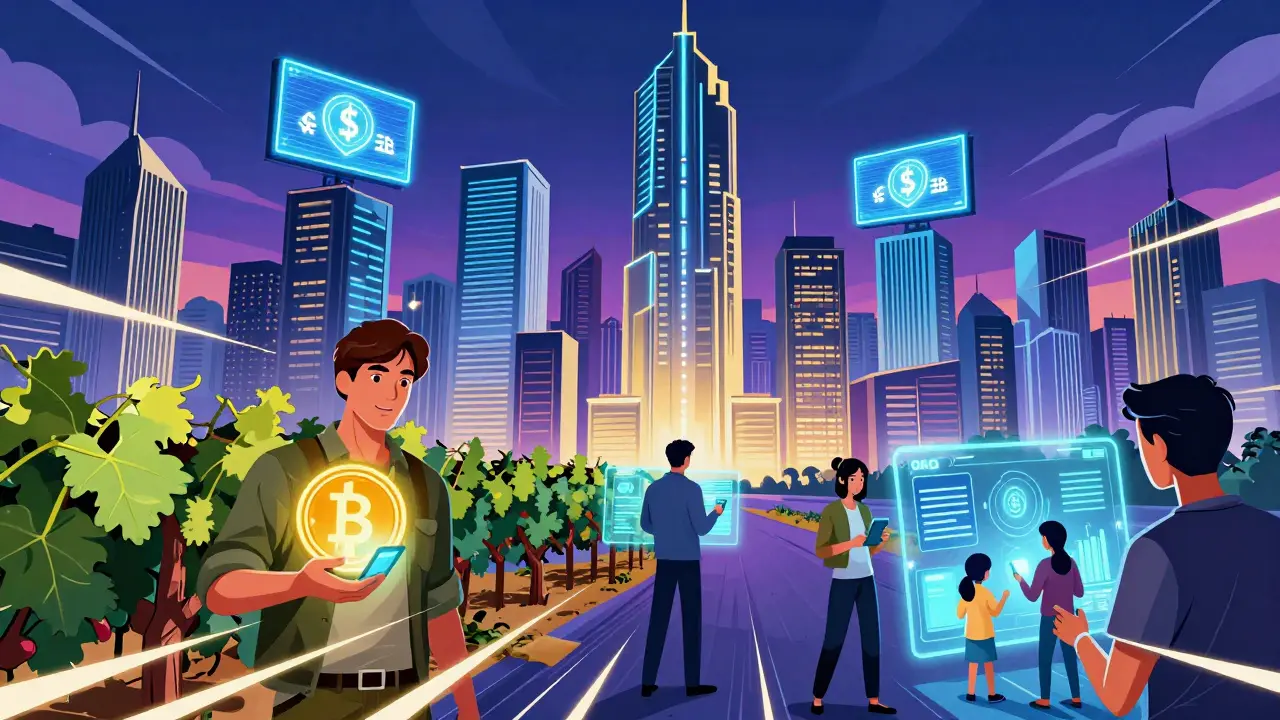
By 2025, over $800 billion in real-world assets - from commercial real estate to farmland, fine art, and even solar farms - have been tokenized on blockchain networks. This isn’t theoretical. It’s happening. A property in Berlin, a vineyard in Napa, and a wind farm in Chile now have digital tokens representing fractional ownership. These tokens trade on regulated exchanges, pay dividends in stablecoins, and are audited on-chain. This shift changes everything. Tokenomics isn’t just about crypto-native demand anymore. It’s about attracting institutional investors, pension funds, and family offices who’ve spent decades trusting traditional asset classes. The token becomes the bridge. And for that to work, the design must be bulletproof: clear legal structure, transparent ownership records, and mechanisms to handle taxes, transfers, and regulatory reporting - all built into the token’s logic.Regulation Isn’t the Enemy - It’s the Foundation
In 2023, many crypto projects ignored regulators. In 2025, they’re designing with them in mind. The EU’s MiCA regulation and the SEC’s clearer stance on securities have forced a reset. Projects that built tokenomics around compliance now have a massive advantage. Look at how token distribution works now. Instead of dumping 30% of supply to venture capitalists upfront, successful projects allocate tokens through gradual vesting, community airdrops, and liquidity mining with clear rules. They use on-chain identity verification for whitelisting, lock tokens in smart contracts to prevent early dumping, and publish quarterly economic reports showing token velocity, burn rates, and usage metrics. Regulation didn’t kill innovation. It cleaned up the noise. Now, when you see a token, you can ask: Is this compliant? Is the team transparent? Are the incentives aligned? That’s the new standard.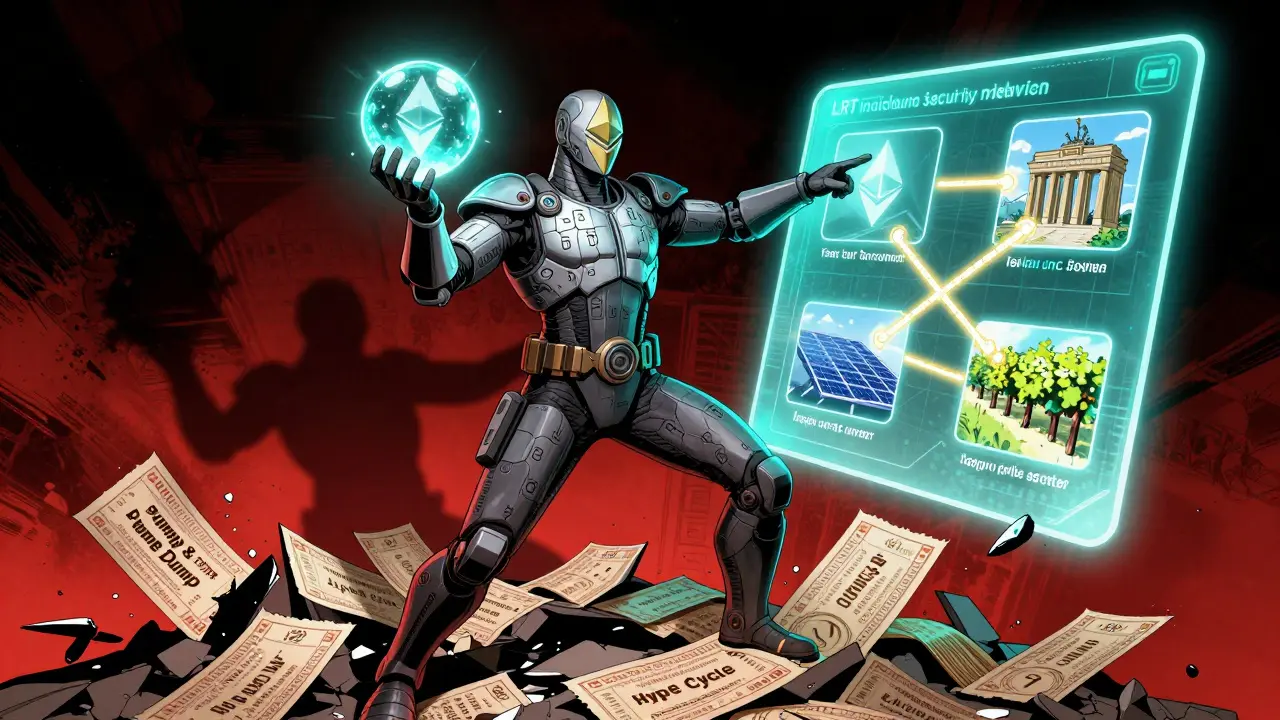
DAOs and DeFi Are Merging
Decentralized Autonomous Organizations (DAOs) used to be voting clubs with slow decision-making. Now, they’re financial engines. The biggest shift? DAO tokens are no longer just for voting. They’re being used as collateral in DeFi protocols, staked for yield, and even used to borrow against. Imagine a DAO that governs a decentralized lending platform. Holders of its token can stake it to earn interest, vote on which assets to lend, and get a cut of the fees generated. That’s not a governance token - it’s a financial instrument. And because it’s integrated with DeFi, it gains liquidity, utility, and real economic value. This convergence is creating new models. Some DAOs now issue two tokens: one for governance (voting power), and one for utility (used to pay for services). Others use liquid staking to let holders earn yield without locking up voting rights. The goal? Keep people engaged, not just holding.Liquid Restaking Tokens Are the New Frontier
One of the most exciting developments in 2025 is the rise of Liquid Restaking Tokens (LRTs). These let you stake your ETH to secure Ethereum’s network - and then use that staked ETH as collateral to earn yield on other chains, like Polygon or Arbitrum, without giving up your security role. Think of it like renting out your house. You still own it, but you’re letting someone else use it to generate income. LRTs do the same with blockchain security. Companies like EigenLayer have turned this into a multi-billion-dollar ecosystem. The tokenomics here are complex: rewards come from multiple sources, risks are distributed across protocols, and governance adjusts payout rates dynamically based on network demand. This isn’t just clever tech. It’s a new economic model: pooled security. Instead of every blockchain needing its own set of validators, they share security from Ethereum - and pay for it with tokens. That’s efficiency. That’s scalability. That’s the future.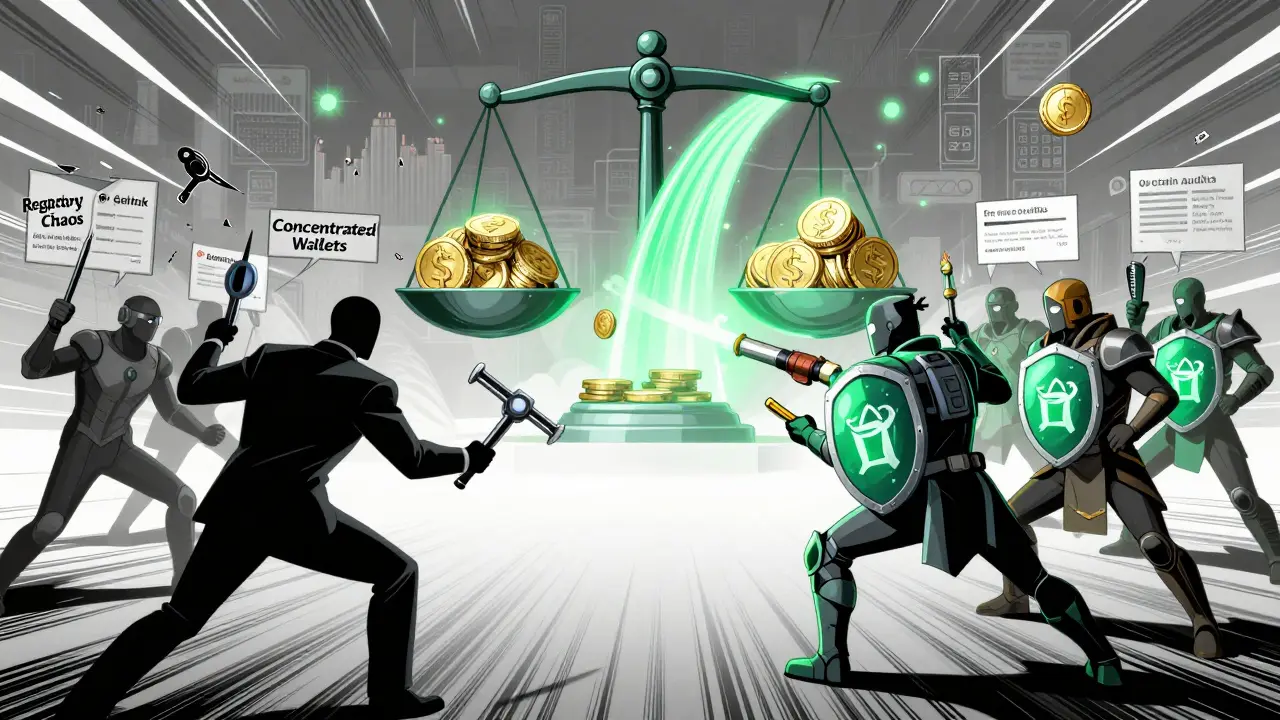
Four Rules for Sustainable Tokenomics
Not every token will survive. The ones that do follow four non-negotiable rules:- Continuous value generation - Tokens must create or capture value every day. Whether it’s fees from transactions, rewards for participation, or dividends from asset income, there has to be a constant inflow.
- Balanced supply and demand - Burning tokens isn’t enough. You need real demand. That means utility: can the token be used to pay for something? Access something? Own something?
- Risk mitigation - Smart contracts must be audited. Token distribution must avoid concentration. A single wallet holding 20% of supply is a red flag - it’s a single point of failure for governance and price stability.
- Transparent governance - If decisions are made behind closed doors, trust dies. Successful projects use on-chain voting, public proposal logs, and clear timelines for implementation. People need to see how and why changes happen.
The Demand Problem - And How to Solve It
Many tokens fail because they rely on speculative demand. People buy because they think someone else will pay more later. That’s a house of cards. The future belongs to tokens with inherent demand. For example:- A token that pays for bandwidth on a decentralized internet network - you need it to use the service.
- A token that gives you priority access to AI models on a decentralized compute platform - you need it to get faster results.
- A token that represents a share of rental income from tokenized real estate - you hold it for the cash flow.
Who Wins in 2025?
The winners aren’t the projects with the flashiest whitepapers or the most influencers. They’re the ones that treat tokenomics like a business model - not a marketing tactic. They’re the teams that:- Build token utility into core product features, not as an afterthought.
- Use regulation as a competitive advantage, not a hurdle.
- Integrate with DeFi to unlock liquidity and yield.
- Design for long-term participation, not short-term hype.
What makes tokenomics different from regular economics?
Tokenomics is economics built into code. While traditional economics relies on banks, laws, and physical institutions, tokenomics uses smart contracts, blockchain networks, and decentralized governance. It automates incentives - like rewarding users for contributing data or securing a network - without middlemen. The rules are transparent, immutable, and enforced by code.
Can tokenomics work without cryptocurrency?
Yes - but only if you’re using blockchain. Tokens are digital assets on a blockchain, so they’re inherently tied to crypto infrastructure. However, the value they represent doesn’t have to be crypto. Tokens can represent real estate, shares in a company, or access to a service. The underlying asset can be traditional; the mechanism is digital.
Why do so many token projects fail?
Most fail because they focus on selling tokens instead of building value. If the token has no real use - no way to earn, spend, or govern - demand vanishes when hype fades. Poor token distribution, lack of transparency, and unbalanced incentives also kill projects. It’s not the market that kills them. It’s bad design.
Are token burns still useful?
They can be - but only as part of a bigger system. Burning tokens reduces supply, which can increase scarcity. But if demand isn’t growing, burning alone won’t help. The best projects combine burns with utility: for example, burning a portion of transaction fees while using the rest to fund development or reward users. That creates a feedback loop: more usage → more burns → more value.
How do I evaluate a tokenomics model?
Ask four questions: Does the token have a clear, necessary use? Is supply controlled in a fair way? Are incentives aligned with long-term growth? Is governance transparent and open? Look at on-chain data: who holds the tokens? How often are they used? Is the token being burned or accumulated? Real data beats marketing claims every time.
Scott Sơn
December 8, 2025 AT 14:18Bro. Tokenomics in 2025 isn't just design-it's alchemy. Turning code into cash flow, governance into gold. I seen projects die with 10k Twitter followers but live with 300 real users who actually USE the token to pay for coffee. That's the shift. No more vaporware. Real utility or GTFO.
Stanley Wong
December 10, 2025 AT 06:29It's interesting how the whole concept has evolved from speculative gambling to actual economic architecture where tokens function like shares bonds and utility passes all rolled into one smart contract i mean think about it if you can stake your token to get voting rights and also earn yield from a decentralized cloud network and also use it to pay for bandwidth it's not just a currency anymore it's a whole ecosystem of incentives that self regulate and that's kind of beautiful in a weirdly bureaucratic way
Cristal Consulting
December 11, 2025 AT 03:50This is the energy we needed. Finally someone gets it. Utility over hype. Real value over pump charts. Keep sharing this. 🙌
Ben VanDyk
December 13, 2025 AT 02:01They said 'regulation is the enemy' for years. Now they're like 'oh wow regulation is kinda cool actually'. Classic.
michael cuevas
December 14, 2025 AT 14:30So we're just calling it 'economics with a blockchain skin' now? Cool. I'm sure the SEC loves that.
Nina Meretoile
December 15, 2025 AT 03:09Tokenomics = digital feudalism 🌱💸 but at least the peasants can vote now. Also LRTs are wild. Staking ETH to earn on Polygon? That’s like renting your car to Uber and still keeping the keys. Mind blown. 🤯
Barb Pooley
December 15, 2025 AT 16:09Regulation? 'Bulletproof design'? Please. This is just Wall Street in a hoodie. They’re just rebranding pump-and-dumps with compliance paperwork. You think pension funds care about 'on-chain audits'? They care about quarterly returns and lawyers. This whole thing is a facade.
Shane Budge
December 16, 2025 AT 07:04What’s the token velocity like on these new models?
sonia sifflet
December 16, 2025 AT 13:54You Americans think you invented economics. Tokenomics has been around since ancient Indian trade guilds used digital ledgers. Blockchain is just the new abacus. You call it innovation. We call it rediscovery.
Adam Bosworth
December 18, 2025 AT 03:31So now we're supposed to trust 'transparent governance'? Lol. Last time I checked, the 'DAO' that voted on the token burn had 3 wallets holding 80% of the votes. And the 'audit' was done by the dev's cousin. This isn't evolution. It's rebranding fraud.
Uzoma Jenfrancis
December 18, 2025 AT 15:22Tokenomics? We have our own system in Nigeria. We call it 'market day'. You trade, you barter, you trust your neighbor. No blockchain needed. Your crypto is just digital cowrie shells. We don't need your fancy contracts to survive.
Renelle Wilson
December 19, 2025 AT 16:01It’s truly remarkable how the convergence of decentralized governance, real-world asset tokenization, and DeFi primitives is creating a new class of economic instruments that are not only programmable but also inherently resilient. The key lies in aligning incentives across multiple stakeholders-users, validators, institutional investors, and regulators-so that the system doesn’t just function, but thrives sustainably. This isn’t just innovation; it’s the redefinition of value itself.
Elizabeth Miranda
December 21, 2025 AT 11:38I love how this post doesn’t just throw jargon around. It actually explains why this matters. Tokenomics as infrastructure. Not a gimmick. That’s huge.
Chloe Hayslett
December 21, 2025 AT 18:05Oh wow, regulation is 'the foundation'? Next you'll tell me the Fed is a nice guy. 🙄
Jonathan Sundqvist
December 23, 2025 AT 08:27Token burns? Yeah right. Just like deleting your Instagram posts and thinking you’re 'cleaning your feed'. Doesn’t fix the fact you’re still a mess.
Thomas Downey
December 24, 2025 AT 01:47One must question whether the elevation of tokenomics to the status of 'economic architecture' is not merely a rhetorical overreach, designed to lend intellectual gravitas to what remains, at its core, a speculative financial instrument dressed in the garb of decentralization. The invocation of 'sustainability' rings hollow when the underlying incentive structures remain fundamentally extractive.
Noriko Robinson
December 25, 2025 AT 14:37I love how you broke this down. I was skeptical until I saw a friend use a token to pay for her daughter’s tutoring on a decentralized platform. It’s real. It’s working. Not perfect, but real. Thank you for this.
Mariam Almatrook
December 26, 2025 AT 01:07So you’ve managed to convince yourself that MiCA and SEC compliance are signs of progress? This is not evolution-it’s capitulation. You traded freedom for a badge. The moment you start designing for regulators, you’ve already lost the soul of decentralization. This isn’t the future. It’s the funeral.
Chris Mitchell
December 27, 2025 AT 18:34Tokenomics is just economics with better accounting. The real win is making value creation visible and automated. That’s the breakthrough.
nicholas forbes
December 29, 2025 AT 02:50Most people don’t even know what 'token velocity' means. But they still buy it. That’s the problem.
Regina Jestrow
December 30, 2025 AT 04:08Imagine if your rent payment also gave you voting rights in your building’s renovation fund. That’s what this is. Wild.
Martin Hansen
December 31, 2025 AT 10:00They call it 'sustainable tokenomics'. I call it 'crypto with a corporate job'. Where's the chaos? Where's the rebellion? Now it's just ETFs with a blockchain sticker.
Lore Vanvliet
January 1, 2026 AT 09:28So LRTs are the new DeFi? Cool. Next they'll tokenize your emotions and sell them as NFTs. 😭💸
Cristal Consulting
January 3, 2026 AT 03:27Love this thread. I’ve seen so many projects die because they treated tokens like IPOs. This is the right path. Keep going. 💪