
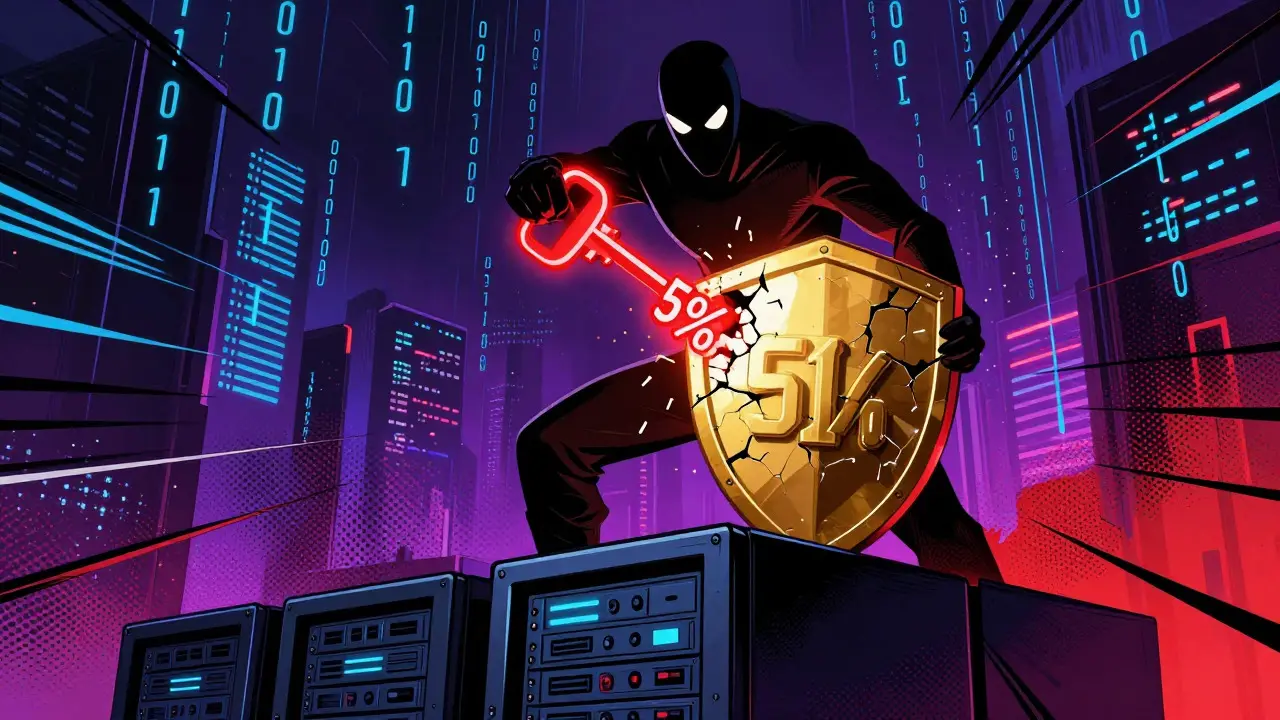
The idea that a blockchain is unhackable feels like a comforting myth until you see the numbers. For years, we treated a 51% attack as a theoretical risk reserved for obscure altcoins. Then August 2025 happened. When a single mining pool took control of more than half of Monero's network hashrate, the crypto world woke up to a harsh reality: if it’s cheap enough, someone will try it.
As we move through 2026, the conversation around blockchain security has shifted from "if" to "how." It’s no longer just about protecting small networks; it’s about understanding why even major protocols have weak points and what engineers are doing to patch them. The tools available today are better, but the threats are smarter. Let’s look at how these attacks work, why they’re becoming more common, and what the future holds for keeping your digital assets safe.
What Actually Happens During a 51% Attack?
To understand the defense, you first need to grasp the offense. In a proof-of-work (PoW) system like Bitcoin or Monero, miners compete to solve complex mathematical puzzles. The first one to solve it gets to add the next block of transactions to the chain and receives a reward. This process secures the network because changing history requires redoing all that work.
A 51% attack occurs when a single entity-or a coalition-controls more than 50% of the network’s total computing power (hashrate). When you hold the majority, you don’t just influence the network; you dictate it. You can:
- Double-spend coins: Send cryptocurrency to an exchange, receive fiat currency, then secretly mine a parallel chain where that transaction never happened. Once your secret chain becomes longer than the public one, the network accepts it as truth, erasing your payment.
- Censor transactions: Block specific addresses from sending or receiving funds, effectively freezing their assets.
- Reorganize the chain: Roll back recent blocks, undoing confirmed transactions. The deeper the rollback, the more chaos ensues.
Satoshi Nakamoto assumed in his 2008 whitepaper that acquiring 51% of the network would be economically impossible for any single actor. That assumption held true for Bitcoin for over a decade. But for smaller chains, the math changed. If the cost of renting hash power is lower than the potential profit from double-spending, the attack becomes a rational business decision, not just a technical glitch.
The Monero Incident: A Wake-Up Call for 2025
If you want a case study in vulnerability, look at Monero. Designed with privacy in mind, Monero uses the RandomX algorithm, which was created to favor consumer CPUs over specialized ASIC hardware. The goal was decentralization. However, this design choice had an unintended side effect: it made the network’s total hashrate relatively low compared to Bitcoin.
In August 2025, a mining pool called Qubic reportedly controlled 54.3% of Monero’s hashrate. This wasn’t a brief spike; it was sustained dominance. Qubic executed deep reorganizations, rolling back up to 1,200 blocks. They successfully double-spent approximately 1,842 XMR, worth around $921,000 at the time.
The impact was immediate. Monero’s price dropped 22.7% within 72 hours. Users faced transaction delays lasting days. Trust evaporated. This incident proved that even well-designed algorithms aren’t immune to concentration risks. If a single pool can amass enough CPU power, the "decentralized" nature of the network becomes irrelevant. It highlighted a critical flaw: security isn’t just about code; it’s about economics and distribution.
Why Bitcoin Remains (Mostly) Safe
So, why hasn’t Bitcoin suffered a similar fate? The answer is brute force economics. As of early 2025, Bitcoin’s network hashrate reached 650 exahashes per second (EH/s). To attack Bitcoin, you’d need to acquire or rent hardware capable of matching that output.
The estimated cost? Around $12.7 billion in hardware, plus roughly $48 million daily in electricity bills. For most attackers, that’s a losing bet unless they plan to destroy the entire ecosystem rather than profit from it. Furthermore, Bitcoin’s mining ecosystem is geographically dispersed. While the top five pools (Foundry USA, Antpool, F2Pool, ViaBTC, and Binance Pool) control about 63.2% of the hashrate collectively, individual miners can switch pools quickly-often within minutes-if they detect suspicious activity.
This agility acts as a natural defense. If one pool starts acting aggressively, miners flee to others, diluting the attacker’s power. Bitcoin’s resilience comes from its sheer size and the high barrier to entry. But remember: "mostly safe" doesn’t mean "invincible." Layer-2 solutions like the Lightning Network remain vulnerable because they rely on Bitcoin’s base layer for finality. If the base layer is compromised, the layers above it crumble.

The Economics of Renting Hash Power
You don’t need to buy millions of dollars in ASICs to launch a 51% attack anymore. Thanks to platforms like NiceHash, attackers can rent hashrate on demand. This has democratized destruction. Researchers from MIT Digital Currency Initiative found that for coins with a market cap under $100 million, the average cost to execute a 51% attack was just $28,500. Meanwhile, the potential profit from double-spending averaged $85,000.
This economic imbalance creates a persistent threat. Small-cap projects are essentially sitting ducks. Unless they implement alternative consensus mechanisms or significant architectural changes, they remain vulnerable to sub-$100,000 attacks. This reality has forced many developers to rethink their security models. Relying solely on PoW without considering hash rate distribution is no longer sufficient.
Defense Strategies Evolving in 2026
The industry is responding. We’re seeing a shift from passive monitoring to active defense. Here are the key strategies emerging in 2026:
- Real-Time Monitoring: Over 78% of top 50 proof-of-work chains now use systems that trigger alerts when a single pool exceeds 40% hashrate. Early detection allows communities to react before damage is done.
- Adaptive Confirmation Thresholds: Instead of a fixed number of confirmations, some protocols are exploring dynamic thresholds. If network concentration rises, the required confirmations increase automatically. This makes double-spending slower and less profitable.
- Fibonacci Checkpoints: Proposed for Bitcoin, this mechanism exponentially increases the cost of reorganizing older blocks. It adds a mathematical penalty to deep rollbacks, making long-chain attacks economically unviable.
- Geographic Diversification: Successful networks now aim to keep hashrate below 35% in any single country. This reduces the risk of government intervention or localized infrastructure failures compromising the network.
Enterprise adoption is also accelerating. By mid-2025, 83% of major exchanges implemented multisignature hot wallet architectures, up from 47% the previous year. These wallets require multiple keys to authorize transactions, adding a layer of security independent of the underlying blockchain’s consensus.
| Factor | Bitcoin (2025) | Monero (2025) | Small-Cap Altcoins |
|---|---|---|---|
| Network Hashrate | 650 EH/s | 2.1 GH/s | < 1 TH/s |
| Estimated Attack Cost | $12.7 Billion+ | ~$50,000 - $100,000 | $10,000 - $50,000 |
| Top Pool Concentration | ~15% (Individual) | 54.3% (During Attack) | Often > 40% |
| Primary Defense Mechanism | Economic Barrier | Emergency Checkpoints | None / Basic Monitoring |
Future Protocols and Hybrid Models
The future of blockchain security lies in hybrid approaches. Ethereum’s proposed "Hybrid PoW/PoS Fallback" mechanism, slated for a 2026 upgrade, aims to combine the energy efficiency of proof-of-stake with the proven security of proof-of-work during crises. Similarly, academic research from MIT is exploring "Proof-of-Stake Bridging," which would allow PoW chains to leverage the security of larger PoS networks.
Regulatory pressure is also playing a role. Following the Monero attack, the U.S. SEC issued guidance requiring exchanges to disclose hash rate concentration risks. This transparency forces projects to address vulnerabilities proactively rather than hiding them until disaster strikes.
However, challenges remain. Implementing comprehensive monitoring systems takes 3-6 months for most development teams. Expertise in distributed systems and real-time data processing is scarce. Platforms offering pre-built modules are helping, but the gap between theory and implementation is wide.
What Should You Do?
If you’re holding cryptocurrency, especially smaller caps, take these steps:
- Check Hasrate Distribution: Use sites like Blockchain.com or CryptoCompare to monitor pool concentrations. Avoid coins where one pool controls >40%.
- Wait for Confirmations: For large transactions, wait for more than the standard 6 confirmations. On volatile networks, 20+ might be safer.
- Diversify Storage: Don’t keep everything on exchanges. Use hardware wallets with multisig capabilities.
- Stay Informed: Follow security bulletins from firms like Chainalysis and Halborn. Knowledge is your best defense against unexpected attacks.
The era of assuming blockchain immutability is over. Security is a continuous process, not a one-time setup. By understanding the mechanics of 51% attacks and staying vigilant, you can protect your assets in an increasingly complex digital landscape.
Can Bitcoin ever suffer a 51% attack?
While theoretically possible, a 51% attack on Bitcoin is currently economically prohibitive due to its massive hashrate of 650 EH/s and the associated costs exceeding $12 billion. However, indirect attacks via Layer-2 solutions remain a concern if base-layer integrity is compromised.
What caused the Monero 51% attack in 2025?
The attack was driven by the concentration of hashrate in a single mining pool, Qubic, which controlled 54.3% of the network. Monero's RandomX algorithm, designed for CPU mining, resulted in a lower total hashrate compared to Bitcoin, making it cheaper to dominate.
How much does it cost to rent hash power for an attack?
For small-cap cryptocurrencies with a market cap under $100 million, the average cost to rent sufficient hash power for a 51% attack is approximately $28,500, according to MIT DCI research from April 2025.
What are Fibonacci checkpoints?
Fibonacci checkpoints are a proposed consensus rule enhancement for Bitcoin that exponentially increases the computational cost required to reorganize older blocks, thereby deterring deep-chain 51% attacks.
Are Layer-2 solutions like Lightning Network safe from 51% attacks?
Not entirely. While Lightning processes transactions off-chain, it relies on the base layer (Bitcoin) for final settlement. A successful 51% attack on Bitcoin could reverse on-chain transactions that close Lightning channels, potentially leading to significant losses.