

Merkle Trees aren't just a blockchain buzzword-they're the invisible backbone that lets you trust a system without trusting anyone. Imagine being able to verify that your transaction is part of a block containing millions of others, without downloading the whole thing. That’s the power of Merkle Trees. And while they’ve been quietly powering Bitcoin and Ethereum for over a decade, their real future isn’t in just confirming transactions-it’s in reshaping how entire digital systems operate.
How Merkle Trees Work (Simply)
At its core, a Merkle Tree turns a pile of data into a single hash. Each piece of data-like a transaction-is hashed individually. These hashes are paired, combined, and hashed again. Keep doing this until you’re left with one final hash: the Merkle Root. This root is stored in the block header. To prove a transaction exists, you don’t need the whole block. You just need the transaction hash and a short list of sibling hashes-the Merkle Path. Rehash them together, and if you get the Merkle Root, the transaction is verified. It’s like proving you’re in a crowd by showing a photo of your face and a few people next to you, until you trace back to the group photo.
Why This Matters for Blockchain Scaling
Bitcoin blocks hold up to 1.4MB of transactions. But to verify one transaction, you don’t need all of it. With a Merkle Tree, you only need about 80 bytes of data. That’s the difference between downloading a movie and checking a single frame. This is why light wallets on your phone can sync in seconds instead of hours. But as blockchains grow, this efficiency starts to strain. A Merkle proof for a billion transactions? It’s about 4KB. That’s still manageable, but multiply that by millions of users, and bandwidth becomes a bottleneck.
The Rise of Verkle Trees
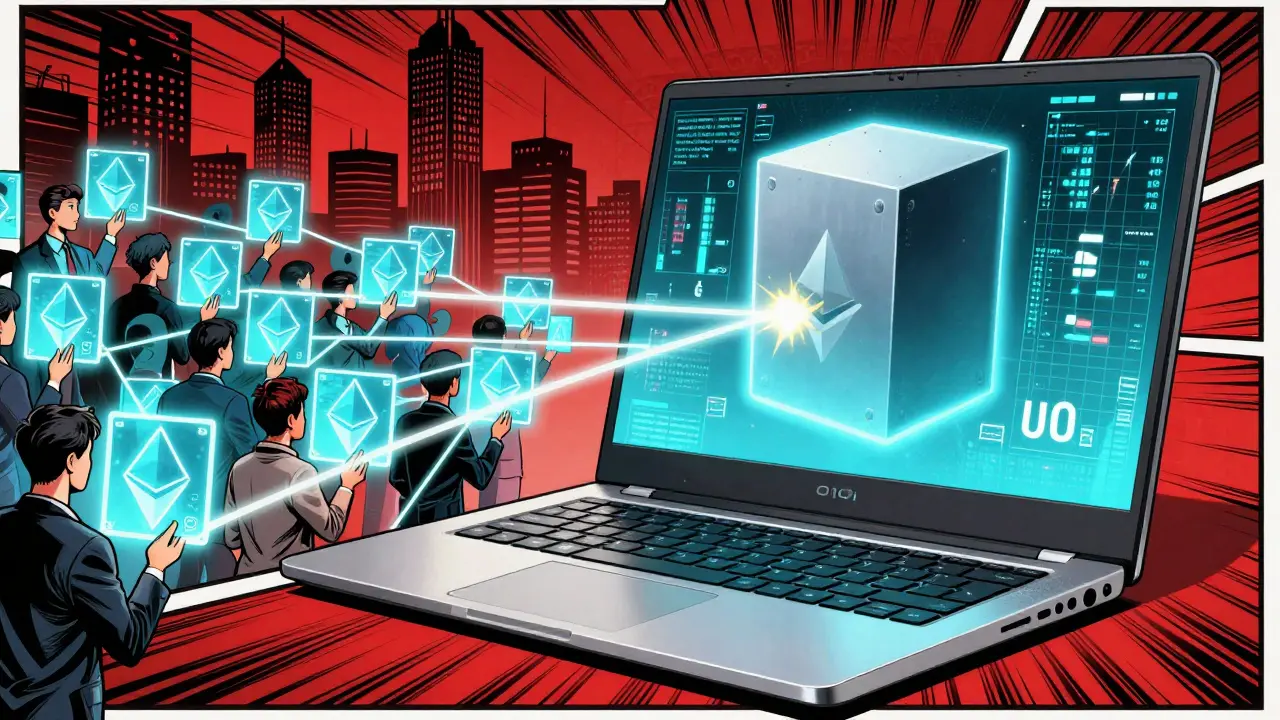
The next evolution isn’t a replacement-it’s a smarter cousin: Verkle Trees. Where Merkle Trees use hashes, Verkle Trees use polynomial commitments. Sounds complex? Here’s the punchline: for the same billion-transaction dataset, Verkle proofs shrink from 4KB to under 150 bytes. That’s a 27x reduction. Ethereum is betting big on this. Their statelessness upgrade, launching in Q2 2026, will let validator nodes verify transactions without storing the entire 1.2TB blockchain state. Instead, they’ll use tiny Verkle proofs. This could mean running a full node on a $300 laptop instead of a $3,000 server. It’s not just about cost-it’s about decentralization. More people can participate. More nodes = more secure network.
Proof-of-Reserves: Trust Without Disclosure
When you deposit crypto on an exchange, how do you know they actually have your coins? Traditionally, you trust them. Now, companies like JPMorgan’s Onyx are using Merkle Trees to prove reserves without revealing customer balances. They take all customer deposits, hash them, build a Merkle Tree, and publish the root. You can then check your own deposit against that root using your personal Merkle Path. No one sees anyone else’s data. But everyone can verify the total. The SEC is catching on. By Q3 2025, every registered crypto exchange in the U.S. will be required to use this system. That’s over $1.2 trillion in assets being verified cryptographically, not through audits or promises.
Beyond Finance: Digital Identity and Supply Chains
Merkle Trees are moving into areas far beyond money. Digital identity systems are using them to let you prove you’re over 18 without showing your ID. Supply chains are embedding Merkle Roots into product records. If a shipment of pharmaceuticals moves from manufacturer to warehouse to pharmacy, each step logs a hash. The final Merkle Root proves the entire chain hasn’t been tampered with. A 2024 IDC report found 67% of Fortune 500 companies now use distributed ledgers with Merkle-based integrity checks. The biggest adopters? Logistics (31%), auditing (29%), and identity (24%).

Real-World Impact: Gamers, Wallets, and Developers
Online casinos are using Merkle Trees to prove games are fair. Bitcasino.io lets players verify 1,000 game outcomes in under 0.2 seconds using a single root hash. Compare that to the old way: 45 seconds of manual checks. User retention jumped 22%. Mobile wallets are seeing similar wins. Developers who switched to Merkle Mountain Ranges-a variation optimized for streaming data-reported 30-40% faster sync times. But it’s not all smooth. GitHub data shows 34% of blockchain bugs are from incorrect Merkle proof generation. Most developers use Bitcoin Core’s library (73% adoption) or Ethereum’s mpt.js (19%). Newer implementations? Often poorly documented. One developer on Reddit called debugging Merkle paths “like solving a puzzle blindfolded.”
What’s Next? Quantum, AI, and Adaptive Trees
Looking ahead, Merkle Trees are evolving in three directions. First, quantum resistance. If quantum computers break current hash functions, Merkle Trees could be vulnerable. NIST is testing lattice-based cryptography as a replacement. Early versions keep 95% of today’s efficiency while being quantum-safe. Second, AI optimization. ConsenSys Labs ran experiments where AI adjusted tree structure in real time based on network load. Result? Proof sizes dropped 18.7% during traffic spikes. Third, adaptive branching. Instead of always using binary trees, future versions might switch to 4-branch or 8-branch trees depending on data size. This could cut verification time by up to 60% for large datasets. And yes, researchers are already testing 512-bit hashes for petabyte-scale systems. Why? To make collision risk drop from 1 in 2^128 to 1 in 2^256-effectively zero.
The Bottom Line
Merkle Trees won’t disappear. They’ll just get smarter. The future isn’t about keeping the old structure-it’s about evolving it. Verkle Trees are already here. Statelessness is coming. Proof-of-reserves is becoming law. And the systems we trust-banks, supply chains, identity platforms-are all moving toward cryptographic verification built on this foundation. The next five years won’t be about inventing new tech. It’ll be about upgrading the plumbing. And Merkle Trees? They’re the pipes.
What is a Merkle Tree used for in blockchain?
In blockchain, Merkle Trees are used to efficiently verify that a transaction is included in a block without downloading the entire block. Each transaction is hashed, then paired and hashed repeatedly until a single Merkle Root is created. This root is stored in the block header. To prove a transaction exists, only a small set of sibling hashes (the Merkle Path) is needed. This reduces data requirements from megabytes to just a few hundred bytes.
How are Verkle Trees different from Merkle Trees?
Verkle Trees replace cryptographic hashes with polynomial commitments, which allow for much smaller proof sizes. While a Merkle Tree proof for a billion records is around 4KB, a Verkle Tree proof is under 150 bytes. This makes Verkle Trees ideal for stateless clients-nodes that don’t store the full blockchain state. Ethereum’s upcoming upgrade relies on Verkle Trees to let validators operate on consumer-grade hardware instead of expensive servers.
Why is the SEC requiring Merkle-based proof-of-reserves by 2025?
The SEC’s requirement aims to prevent exchanges from fraudulently claiming they hold customer funds. By using Merkle Trees, exchanges can publicly prove they hold enough assets to cover all customer balances-without revealing individual account details. This creates transparency without sacrificing privacy. It’s a cryptographic guarantee, not a paper audit. Over 247 U.S. exchanges will need to comply, covering an estimated $1.2 trillion in assets.
Can Merkle Trees be hacked or manipulated?
Merkle Trees themselves can’t be manipulated if the underlying hash function is secure. SHA-256 and Keccak-256 are designed to make it computationally impossible to find two different inputs that produce the same hash. The risk comes from implementation errors-like generating incorrect Merkle Paths or using weak hash functions. Real-world attacks have targeted buggy wallets or poorly coded verification tools, not the Merkle structure itself.
Will Merkle Trees survive the quantum computing era?
Current Merkle Trees rely on hash functions that quantum computers could break. But researchers are already developing quantum-resistant versions using lattice-based cryptography. Early prototypes preserve over 95% of today’s efficiency while being secure against quantum attacks. These new variants are being tested by NIST and are expected to replace current implementations by 2030, ensuring Merkle Trees remain viable for decades.
How do developers implement Merkle Trees today?
Most developers use battle-tested libraries rather than building from scratch. Bitcoin Core’s implementation is used by 73% of developers, according to GitHub data. Ethereum’s mpt.js library is used by 19%. Newer projects often struggle due to poor documentation-only 2.8/5 on average, compared to Bitcoin Core’s 4.2/5. Common mistakes include mishandling odd-numbered leaf nodes and generating incorrect proof paths. The best advice? Use established code, test thoroughly, and avoid reinventing the wheel.
John Doyle
February 14, 2026 AT 15:56Michelle Cochran
February 15, 2026 AT 18:13monique mannino
February 16, 2026 AT 21:54Peggi shabaaz
February 17, 2026 AT 02:40Tammy Chew
February 17, 2026 AT 17:39Lindsey Elliott
February 17, 2026 AT 22:39Santosh kumar
February 18, 2026 AT 19:27Claire Sannen
February 20, 2026 AT 16:09Christopher Wardle
February 20, 2026 AT 21:00Donna Patters
February 21, 2026 AT 22:29Keturah Hudson
February 22, 2026 AT 02:40Joe Osowski
February 22, 2026 AT 19:31Gaurav Mathur
February 23, 2026 AT 05:41Jeremy Lim
February 24, 2026 AT 09:21kelvin joseph-kanyin
February 25, 2026 AT 19:55Elizabeth Choe
February 26, 2026 AT 20:48Crystal McCoun
February 28, 2026 AT 08:29Elijah Young
March 1, 2026 AT 00:23