
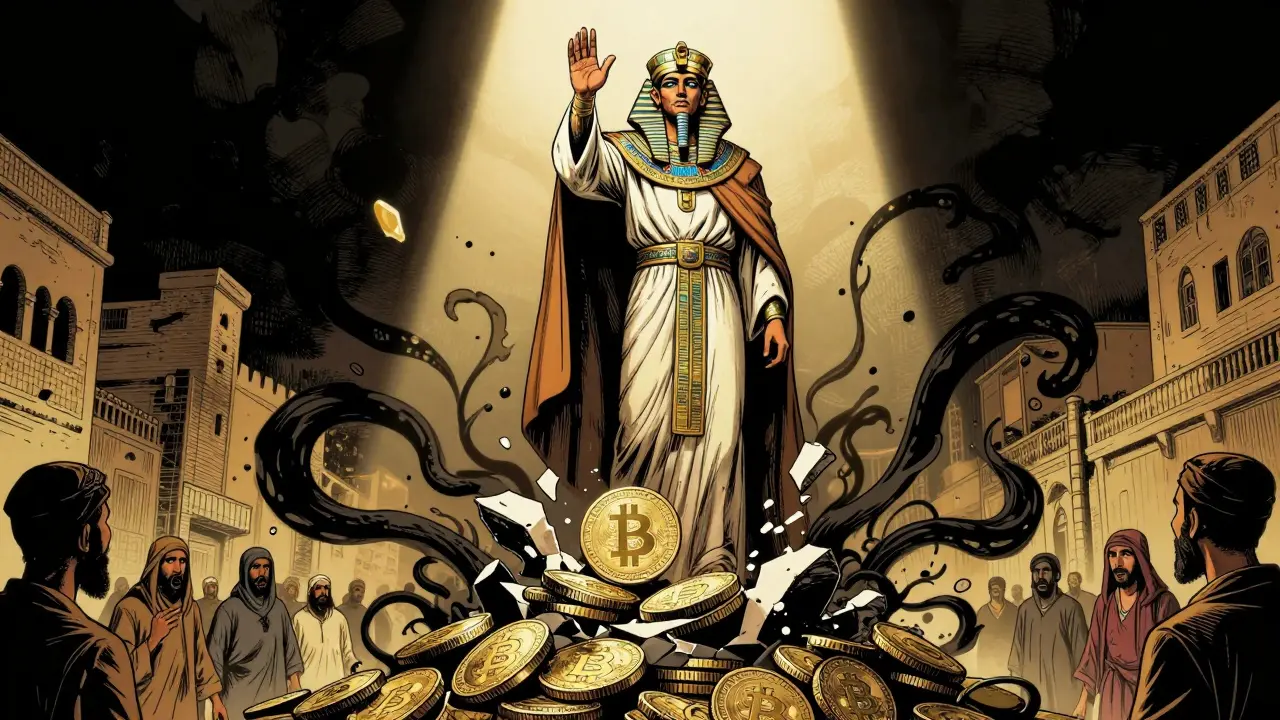
When Egypt’s Grand Mufti Shawky Ibrahim Allam declared Bitcoin haram in December 2017, it wasn’t just a religious opinion-it was a legal barrier for millions of Muslims in Egypt and beyond. The ruling came from Dar al-Ifta, the official Islamic legal body under al-Azhar University, one of the most respected institutions in Sunni Islam. This wasn’t a casual comment. It was a full-fatwa: a binding religious decree that banned every form of cryptocurrency activity-buying, selling, mining, trading, or even using it to pay for goods.
Why? The reasoning wasn’t about fear of technology. It was about Islamic finance principles. The fatwa said Bitcoin fails as money because it has no physical form, no central authority backing it, and no stable value. In Islamic law, any financial transaction must be clear, certain, and tied to real value. Bitcoin, the ruling argued, is built on uncertainty-what scholars call gharar. If you don’t know what you’re buying, or if its value can swing 30% in a day, it’s not a valid exchange under Sharia.
But the fatwa went further. It didn’t just call Bitcoin risky-it called it dangerous. The document specifically mentioned that Bitcoin was being used by ISIS, drug cartels, and money launderers to hide transactions. That wasn’t just a footnote. It was a core argument. The absence of government oversight meant there was no way to trace illegal activity, no way to protect consumers, and no way to enforce accountability. For Egypt, a country with a strong state-controlled financial system, that was unacceptable.
Compare this to other Islamic scholars. Mufti Faraz Adam, a leading expert in Islamic fintech, says Bitcoin can be halal-if you treat it like a digital asset with real utility. He argues that classical scholars would judge something by its function, not its form. If people use it to buy food, pay rent, or send money across borders, then it’s acting like money. And if it’s functioning as money, then it’s subject to the same rules: pay zakat on it, avoid speculation, and don’t use it for fraud. Adam’s view opens the door for Sharia-compliant crypto exchanges and wallets that filter out coins tied to gambling or illegal use.
So why does Egypt’s ruling still matter today? Because it’s not just about Egypt. Al-Azhar’s influence stretches across the Muslim world-from Indonesia to Nigeria to Pakistan. Many banks, Islamic finance firms, and religious schools follow Egypt’s lead. If you’re a Muslim in Cairo, you can’t legally use Binance or Coinbase without risking a violation of religious law. Even if you’re in Kuala Lumpur or Dubai, some institutions still treat the 2017 fatwa as the gold standard.
The practical impact is real. Egyptian Muslims who follow this fatwa are locked out of a growing global financial tool. They can’t earn interest on crypto savings accounts. They can’t use stablecoins to protect their savings from inflation. They can’t invest in blockchain startups. Meanwhile, Muslims in countries like Malaysia and Turkey are building Sharia-compliant crypto platforms that charge fees, audit coins for compliance, and even issue zakat calculators for digital assets.
There’s also a generational divide. Younger Muslims in Egypt are tech-savvy and see crypto as a way to bypass corrupt banks or send money home without high fees. But they’re caught between family pressure, religious authority, and their own financial needs. Some use VPNs to trade on foreign exchanges, hiding their activity. Others simply avoid crypto altogether, fearing they’re committing a sin.
The fatwa also ignores how the crypto world has changed since 2017. Back then, Bitcoin was mostly used for speculation and illicit trade. Today, there are regulated exchanges in the U.S., Europe, and even Saudi Arabia. Central bank digital currencies (CBDCs) are being tested in over 100 countries. Ethereum and other blockchains now support smart contracts that can automatically enforce Sharia rules-like blocking interest-based lending or ensuring asset-backed tokens.
Yet Egypt hasn’t updated its stance. No new fatwa has been issued. No review has been announced. The 2017 ruling still stands-broad, absolute, and unchanged. That makes it harder for Muslim entrepreneurs to build compliant crypto products in the region. Banks refuse to work with crypto firms. Investors stay away. Even if a coin is backed by gold or real estate, if it’s digital and decentralized, it’s still seen as haram under Egyptian guidance.
This creates a strange paradox. On one hand, Islamic finance is one of the fastest-growing sectors in global banking-worth over $3 trillion. On the other, the same system that promotes ethical investing refuses to adapt to digital innovation. The contradiction is clear: you can invest in halal real estate or ethical stocks, but not in a digital ledger that records every transaction transparently.
Some scholars are pushing back. Academic papers argue that Egypt’s fatwa didn’t fully apply the principles of maslahah (public benefit) or urf (custom). If crypto helps the poor send remittances cheaply, isn’t that a public good? If blockchain reduces fraud in charity donations, isn’t that aligned with Islamic values? These questions aren’t being answered in Cairo.
For now, the divide remains wide. One side says: crypto is a tool, and tools can be good or bad depending on how you use them. The other says: crypto is inherently flawed because it breaks the rules of certainty, ownership, and oversight that define Islamic finance.
What’s next? If Egypt ever revisits this ruling, it won’t be because Bitcoin became stable. It’ll be because enough Muslims demanded a new interpretation-one that doesn’t reject technology outright, but guides its use within faith. Until then, the fatwa stands as a wall: not just against digital money, but against the possibility of rethinking how faith meets the modern world.
Tracey Grammer-Porter
January 11, 2026 AT 21:09It's just numbers moving. The real issue is how people use it, not the tool itself.
Katrina Recto
January 12, 2026 AT 02:22Veronica Mead
January 14, 2026 AT 02:10Tiffani Frey
January 15, 2026 AT 07:33Tre Smith
January 15, 2026 AT 10:20Ritu Singh
January 16, 2026 AT 02:01kris serafin
January 16, 2026 AT 11:49Jordan Leon
January 18, 2026 AT 03:20Allen Dometita
January 18, 2026 AT 18:17Brittany Slick
January 19, 2026 AT 09:20greg greg
January 19, 2026 AT 12:57LeeAnn Herker
January 19, 2026 AT 16:34Sherry Giles
January 20, 2026 AT 15:56Andy Schichter
January 22, 2026 AT 08:06