
You see a crypto exchange promising 0% fees. It sounds too good to be true, right? That is exactly the hook DYORSwap (Plasma) uses to attract traders looking for quick gains in the volatile world of meme coins. But when you look past the marketing, things get murky. We are talking about a platform with zero regulatory oversight, questionable liquidity data, and almost no user community. If you are thinking about connecting your wallet here, you need to know what you are walking into.
This isn't just another shiny new DEX on Ethereum or Solana. DYORSwap operates exclusively on the Plasma blockchain, which is a niche ecosystem focused heavily on speculative tokens and meme coins rather than established assets. While major exchanges like Uniswap handle billions in daily volume with transparent metrics, DYORSwap sits in the shadows. In this review, we break down whether this platform is a hidden gem for early adopters or a high-risk trap for inexperienced traders.
The Promise: Zero Fees and Niche Access
Let's start with the headline feature. Most decentralized exchanges charge a standard fee of around 0.3% per trade. You pay this to cover liquidity providers and protocol operations. DYORSwap claims to charge 0.00% for both makers and takers. On paper, that is a massive advantage if you are trading small amounts frequently.
However, there is always a catch in crypto. The "catch" here is accessibility. Because it runs on the Plasma blockchain, you cannot just plug in any MetaMask wallet and go. You need specific wallets compatible with this newer chain. Furthermore, the token selection is extremely limited. As of late 2024, the platform listed only about eight primary trading pairs. These aren't Bitcoin or Ethereum. They are obscure tokens like "trillions," "GOD ♱," and various AI-themed meme coins.
If you are hunting for brand-new meme coins before they hit major aggregators, DYORSwap might offer that first-mover access. But for anyone wanting to trade standard cryptocurrencies, this platform is useless. It is a specialist tool, not a general-purpose exchange.
Red Flags: Liquidity and Transparency Issues
Here is where you need to slow down. Trading volume numbers can be misleading, especially in the meme coin sector. CoinMarketCap reported some pairs on DYORSwap had tens of millions in daily volume. For example, the U Plasma USD₡/XP pair showed over $216 million in volume. That sounds huge. But dig deeper, and the picture changes.
Data from Liquidity Finder often contradicts these figures, showing near-zero liquidity for many listed coins. Why the discrepancy? Often, this happens due to wash trading-where bots buy and sell tokens to themselves to inflate volume stats-or incomplete indexing by data providers. Blockchain researcher Alex Saunders noted in September 2024 that these listings show "concerning patterns of low liquidity depth despite high reported volumes." This suggests potential manipulation, a common tactic to lure retail investors into illiquid pools.
Another major red flag is how analytics tools view the platform. On DexScreener, a popular charting tool for DeFi, DYORSwap is labeled as an "unknown DEX." This means it lacks proper integration with standard blockchain analytics. When a platform is "unknown" to the tools traders rely on for safety checks, it raises serious transparency concerns. You are essentially flying blind regarding real-time order book depth and slippage risks.
| Feature | DYORSwap (Plasma) | Uniswap / PancakeSwap |
|---|---|---|
| Trading Fees | 0.00% | ~0.30% |
| Regulation | None identified | Varies (mostly unregulated but audited) |
| Liquidity Depth | Low / Questionable | High / Verified |
| Analytics Integration | Poor ("Unknown DEX") | Excellent (Full support) |
| Token Selection | Niche Meme Coins | Thousands of assets |
Security Risks and Regulatory Vacuum
In the world of centralized finance, you check if a broker is regulated by bodies like the SEC or FCA. In decentralized finance (DeFi), regulation is rare, but audits are common. DYORSwap has neither. According to FxVerify, the company does not appear to be regulated by any government authority. More importantly, there are no public security audits, whitepapers, or GitHub repositories available for the smart contracts powering the swap functionality.
Without code audits, you have no way of knowing if the contract contains backdoors. Could the developers pull liquidity at any moment? Could they halt trading? With anonymous teams and no technical documentation, the risk of an "exit scam" or "honeypot" scenario is significantly higher than on established platforms.
Industry analyst Maria Gomez warned in October 2024 that exchanges requiring manual verification of contract addresses from multiple unofficial sources (like Twitter or random websites) typically carry a high risk of being scams. At DYORSwap, users often have to copy-paste contract addresses manually because the interface doesn't auto-verify them against trusted databases. This adds a layer of friction that protects the platform from easy bot attacks but exposes users to human error and phishing risks.
User Experience: Clunky and Confusing
If you are used to the sleek interfaces of Raydium or Uniswap, DYORSwap will feel outdated. There is no mobile app. There is no desktop client. It is a web-only platform with minimal design polish.
The process to trade is convoluted. Users report having to visit external sites to find the correct token contract address, then manually entering it into the swap box. You type in how much XPL (the native asset) you want to spend, and the site calculates the output. It works, but it feels fragile. One wrong character in that contract address, and you could send your funds to a dead wallet or a fake token.
Support infrastructure is virtually nonexistent. There is no help center, no live chat, and no active Discord or Telegram community dedicated to troubleshooting. If something goes wrong with your transaction, you are on your own. This lack of community also means there is no collective wisdom to warn you about bad tokens. On larger platforms, Reddit threads and Twitter alerts quickly identify rug pulls. Here, silence reigns.
Who Should Use DYORSwap?
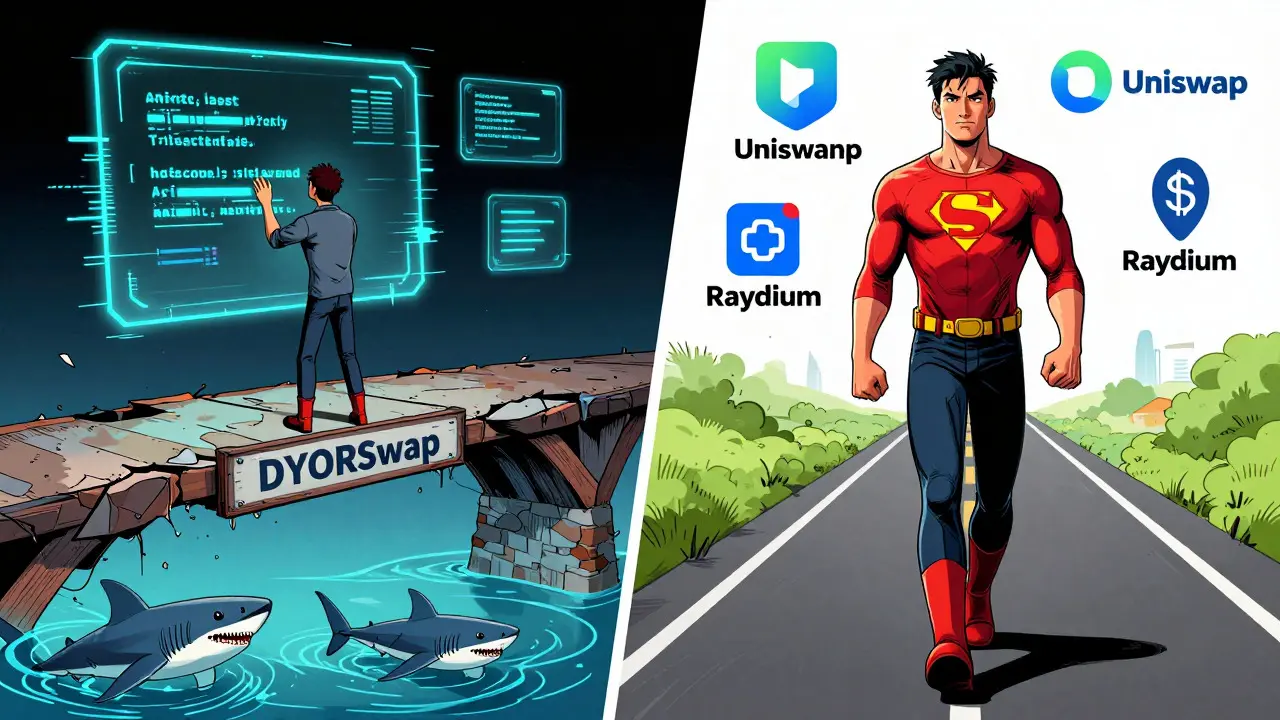
Given the risks, who is this platform actually for? It is not for beginners. It is not for long-term investors holding blue-chip crypto. It is strictly for:
- Speculative Traders: Those willing to risk small amounts chasing high-reward meme coins on the Plasma chain.
- Early Adopters: Users who believe the Plasma blockchain itself will gain traction and want exposure to its native DEX.
- Experienced DeFi Users: People who know how to verify contract addresses, check liquidity pools on block explorers, and manage gas fees independently.
For everyone else, the risks outweigh the benefits of saving 0.3% on fees. The potential loss of principal due to slippage, scams, or illiquidity far exceeds the cost of trading on a reputable exchange.
Alternatives to Consider
If you want to trade meme coins or new tokens safely, consider these alternatives:
- Uniswap (Ethereum/L2s): The gold standard for DEXs. Higher fees, but immense liquidity and security.
- Raydium (Solana): Great for fast, low-cost meme coin trading with better analytics integration.
- DYOR.io (TON Blockchain): If you like the DYOR brand, their TON-based platform is more established and integrated with the Telegram ecosystem, though still niche.
These platforms may charge fees, but they offer transparency, deep liquidity, and robust community support. In crypto, paying for security is usually cheaper than losing everything to a hack.
Is DYORSwap regulated?
No. As of 2024, DYORSwap (Plasma) is not regulated by any known government financial authority. It operates as an unregistered decentralized exchange, meaning users have little to no legal recourse if issues arise.
Why are the trading fees 0%?
The 0% fee structure is likely a marketing strategy to attract users to the niche Plasma ecosystem. However, this may come at the cost of lower liquidity depth and higher slippage, which can effectively increase your trading costs beyond the nominal fee savings.
Can I use MetaMask on DYORSwap?
Not directly. Since DYORSwap operates on the Plasma blockchain, you need a wallet that supports this specific network. Standard Ethereum wallets may require custom RPC configuration or a bridge to interact with Plasma assets, adding complexity to the user experience.
Is DYORSwap safe for beginners?
Generally, no. The platform lacks intuitive safeguards, requires manual contract address verification, and has poor integration with standard analytics tools. Beginners are advised to stick to well-established DEXs with user-friendly interfaces and verified security audits.
What is the Plasma blockchain?
Plasma is a newer, niche blockchain ecosystem primarily focused on hosting meme coins and speculative tokens. It is distinct from the more widely adopted Layer-2 scaling solutions also named Plasma. Its limited adoption means fewer users and less liquidity compared to networks like Ethereum or Solana.
Why is DYORSwap labeled as "Unknown" on DexScreener?
This label indicates that the exchange has not been fully integrated into DexScreener's database. This often happens with very new or obscure DEXs. It makes it harder for traders to analyze historical price data and liquidity trends, increasing the risk of making uninformed trades.