
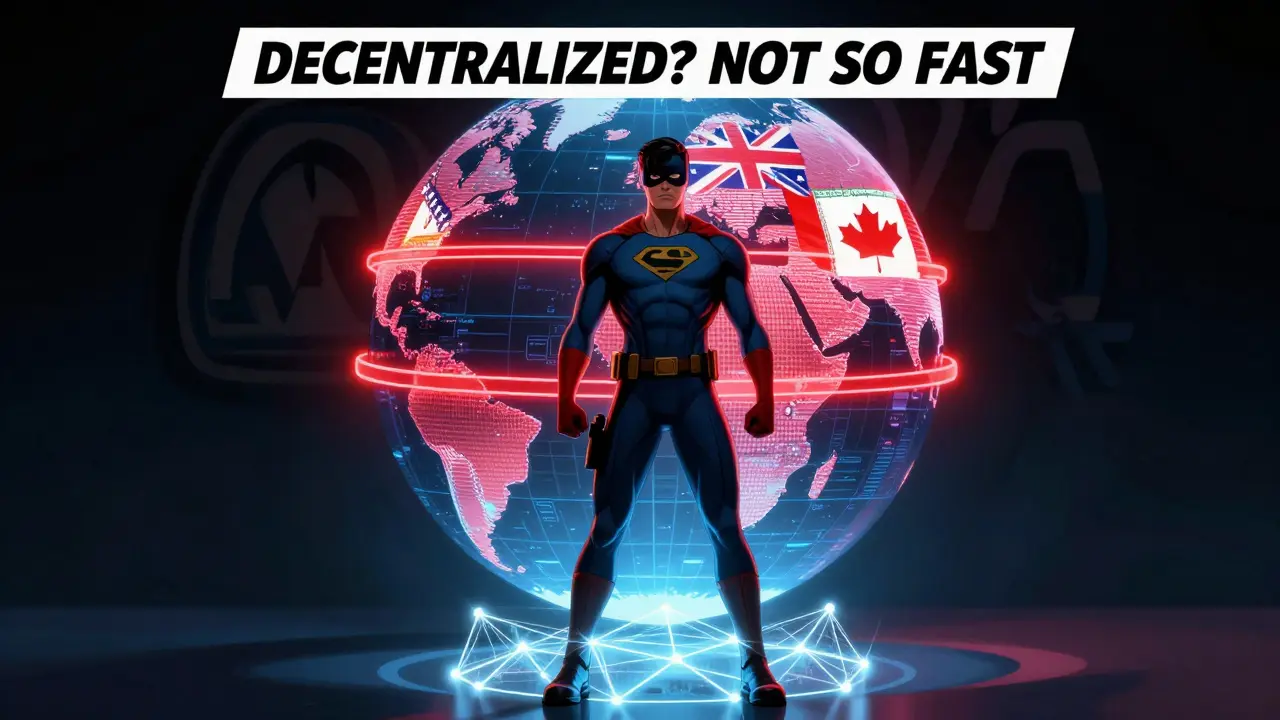
When you hear "decentralized exchange," you probably imagine a system with no bosses, no headquarters, and no government rules. No one can shut it down. No one can say you can’t trade. But dYdX-a platform marketed as a fully decentralized crypto derivatives exchange-has a surprising secret: it blocks users from over 20 countries, including the U.S., U.K., Canada, and Iran. And if you try to sneak in using a VPN, it doesn’t just say no-it locks your account permanently.
How dYdX Claims to Be Decentralized
dYdX was founded in 2017 by Antonio Juliano, a former Coinbase engineer and Princeton computer science grad. It lets users trade perpetual contracts on Bitcoin, Ethereum, Solana, and other top cryptos without a middleman. The trades happen on-chain, using smart contracts. That part is real. Your funds never leave your wallet. Orders are matched by automated code. No one holds your crypto. That’s the textbook definition of decentralization. But here’s the catch: the website you use to access dYdX-dydx.trade-isn’t decentralized. It’s run by dYdX Operations Services Ltd. (DOS), a company based in the British Virgin Islands. This is the same entity that runs the app, manages the user interface, and enforces all the rules. And those rules include geo-blocking.The Countries dYdX Blocks
If you’re in one of these places, you won’t be able to open new trades on dYdX:- United States
- United Kingdom
- Canada
- Iran
- Cuba
- North Korea
- Syria
- Myanmar (Burma)
- Crimea
- Donetsk
- Luhansk
- Iraq
- Libya
- Mali
- Democratic Republic of Congo
- Cote D’Ivoire
- Nicaragua
- Somalia
- Sudan
- Yemen
- Zimbabwe
What Happens When You’re Blocked
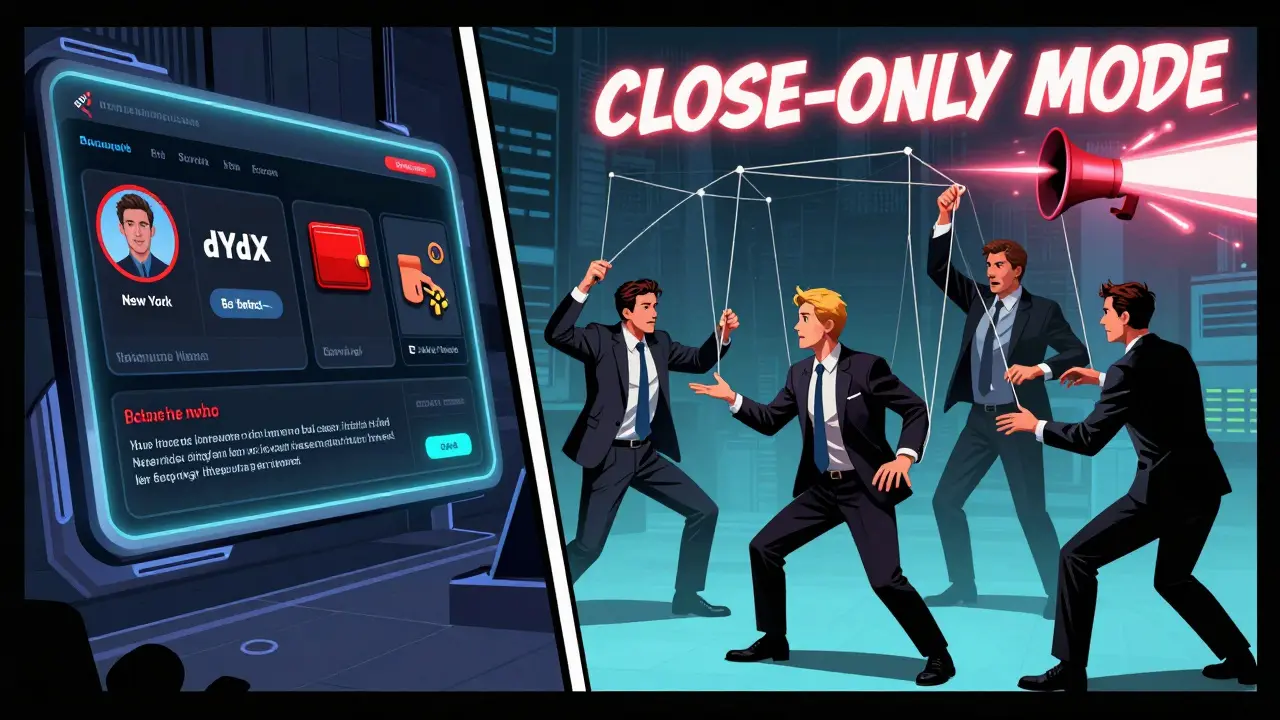
It’s not enough to just get a "403 Forbidden" message. dYdX has a multi-stage enforcement system:- Close-only mode: You can’t deposit, withdraw, or open new trades. All you can do is reduce your existing positions. If you’re long Bitcoin, you can sell. That’s it.
- Warning banners: Red alerts appear across the interface saying you’re in a restricted region. Your wallet is flagged.
- Seven-day countdown: If you stay in close-only mode for a week, your account auto-locks.
- Blocked status: You lose access to your trading history, subaccounts, and the ability to withdraw funds via the frontend. The only thing left? Exporting your Secret Recovery Phrase to move your funds off-chain manually.
The Centralized Core Behind the Decentralized Front
dYdX’s structure is split into three parts:- dYdX Trading Inc. - Based in New York. Handles legal compliance, investor relations, and regulatory filings.
- dYdX Foundation - Based in Zug, Switzerland. Manages the DYDX token, grants, and protocol upgrades.
- dYdX Operations Services Ltd. - Runs the website, enforces geo-blocks, and monitors user behavior.
Why This Matters for DeFi
dYdX is the most visible example of a hard truth: you can’t be both decentralized and compliant with traditional finance. True DeFi protocols like Uniswap or Aave don’t have frontends they control. They don’t have legal entities. They don’t have CEOs who answer to regulators. If someone in Iran uses Uniswap, there’s no way to stop them-because no one is in charge. dYdX chose a different path. It wanted to operate legally in places like the U.S. and U.K. So it built a corporate structure. It hired lawyers. It built geo-blocking. And in doing so, it gave regulators the tools to shut it down if needed. That’s not decentralization. That’s regulatory arbitrage.
What Users Should Know
If you’re outside the U.S., U.K., or Canada, you might still be able to use dYdX. But don’t assume it’s safe forever. The list of restricted countries changes. In 2023, Nigeria was briefly blocked, then unblocked. In 2024, Brazil added new reporting rules that forced dYdX to tighten controls. Always check the dYdX Terms of Service before trading. If you’re in a gray-area country, assume you’re at risk. Use a non-custodial wallet. Never store large amounts on dYdX. And never, ever use a VPN to bypass restrictions. The system is designed to catch you.The Bigger Picture
dYdX proves something uncomfortable: most "decentralized" platforms aren’t. They’re hybrids. They use blockchain for efficiency, but rely on corporations for survival. The result? You get better features, deeper liquidity, and cleaner UIs-but you also get rules, limits, and surveillance. If you want true decentralization, you need to go further. Use protocols that have no company, no headquarters, no CEO. Use tools that can’t be turned off. Because once a platform has a legal entity, it’s no longer beyond regulation. It’s just another financial service with a blockchain logo.What’s Next for dYdX?
dYdX is now competing with centralized exchanges like Binance and Bybit-not because it’s better, but because it has more liquidity and lower fees. To keep that edge, it must stay in good standing with regulators. That means more restrictions, not fewer. Some developers are working on fully decentralized alternatives-like LayerZero-powered derivatives platforms that don’t rely on any single frontend. But they’re still in early stages. For now, if you want to trade crypto derivatives with real volume, dYdX is one of the few options left. Just know: you’re not trading on a decentralized network. You’re trading on a regulated exchange that uses smart contracts.Why does dYdX block users from the U.S. if it’s decentralized?
dYdX blocks U.S. users because its corporate entities-dYdX Trading Inc. (New York) and dYdX Foundation (Switzerland)-are subject to U.S. financial regulations. Even though trades happen on-chain, the company that runs the website, handles customer support, and issues the DYDX token must comply with OFAC sanctions. If they didn’t, they’d risk fines, asset freezes, or criminal charges. Decentralization doesn’t protect them from legal liability.
Can I use a VPN to access dYdX if I’m in a restricted country?
Technically, yes-but don’t. dYdX’s system tracks wallet addresses, not just IP addresses. If your wallet has ever been used from a restricted region, it gets flagged. Using a VPN won’t erase that history. You’ll enter "close-only mode," and after seven days, your account will be permanently blocked. You’ll lose access to your trading history and won’t be able to withdraw funds through the interface. Only your Secret Recovery Phrase will still work.
Are there any decentralized exchanges that don’t block countries?
Yes-but they’re not as user-friendly. Protocols like Uniswap, SushiSwap, and GMX operate without centralized frontends. Anyone with a wallet can interact with them. No KYC. No geo-blocks. But they lack customer support, have higher gas fees, and offer fewer trading tools. dYdX gives you a polished app. Truly decentralized platforms give you freedom-but you’re on your own.
Why are countries like China and Russia allowed on dYdX?
dYdX’s restrictions are based on U.S. sanctions, not global ones. China and Russia aren’t on the OFAC sanctions list in the same way Iran or North Korea are. While those countries have their own crypto rules, dYdX doesn’t see them as immediate legal threats. This isn’t about ethics-it’s about risk. The company avoids countries where U.S. regulators can act, not countries where crypto is banned.
What happens to my funds if my dYdX account gets blocked?
Your funds are still on the blockchain. They’re not lost. But once your account is blocked, you can’t access them through the dYdX website or app. You’ll need to export your Secret Recovery Phrase (the 12- or 24-word backup) and import it into a non-custodial wallet like MetaMask. From there, you can withdraw your assets manually. This is why keeping your recovery phrase secure is critical.
McKenna Becker
February 22, 2026 AT 17:24Samantha Stultz
February 22, 2026 AT 18:06George Suggs
February 23, 2026 AT 07:43Dianna Bethea
February 23, 2026 AT 09:46Shannon Holliday
February 23, 2026 AT 16:29Vishakha Singh
February 25, 2026 AT 01:26Andrew Hadder
February 26, 2026 AT 13:29Molley Spencer
February 27, 2026 AT 20:23Cameron Pearce Macfarlane
March 1, 2026 AT 02:11Carl Gaard
March 1, 2026 AT 02:38Paul Reinhart
March 2, 2026 AT 22:59Amita Pandey
March 3, 2026 AT 16:21Jan Czuchaj
March 4, 2026 AT 20:05KingDesigners &Co
March 4, 2026 AT 23:25Shannon Black
March 6, 2026 AT 18:56Trenton White
March 8, 2026 AT 07:01Cheryl Fenner Brown
March 8, 2026 AT 20:14Michael Teague
March 10, 2026 AT 13:16kati simpson
March 11, 2026 AT 15:47Cory Derby
March 13, 2026 AT 07:36lori sims
March 15, 2026 AT 07:04Reggie Fifty
March 15, 2026 AT 20:10