
Swapping stablecoins on Ethereum mainnet used to cost more than the profit you’d make. That changed when Curve Finance deployed its protocol on Optimism Layer-2. If you are trading USDC for DAI or managing large volumes of stable assets, this specific deployment is likely the most cost-effective option available today. But is it safe? Is the governance too complex? And does the low fee structure actually hold up against competitors like Uniswap?
This review breaks down the real-world performance of Curve on Optimism as of mid-2026. We look at the hard numbers: transaction costs, slippage metrics, and Total Value Locked (TVL). We also examine the risks, including the unique voting mechanics that confuse many new users. Whether you are a high-frequency trader or just looking to park your stables with better yield options, here is what you need to know before you bridge your funds.
Key Takeaways
- Cost Efficiency: Average transaction fees on Curve (Optimism) are approximately $0.0004, compared to ~$1.27 on Ethereum mainnet.
- Slippage Advantage: Standard stablecoin swaps incur only 0.04% slippage, significantly lower than Uniswap’s typical 0.3%.
- Market Dominance: Curve holds a 67.3% market share in stablecoin swaps across all networks, making it the industry standard for low-volatility assets.
- Governance Complexity: The veCRV locking mechanism is powerful but difficult; 37% of new users report suboptimal lock duration choices.
- Security Profile: Backed by Optimism’s fraud proof mechanism and Curve’s 4-of-7 multi-sig governance, offering a robust security layer.
Why Use Curve on Optimism?
The core value proposition of a decentralized exchange protocol specializing in stablecoin and low-volatility asset swaps is simple: efficiency. When you swap two assets that are pegged to the same value (like USDT and USDC), you don’t want to pay high gas fees or suffer from price impact. Curve’s Automated Market Maker (AMM) algorithm is specifically designed for these pairs. It uses an adaptive curve technology that optimizes pool parameters based on real-time volatility. This means if the market gets choppy, the pool adjusts to keep your slippage minimal.
Deploying this on Optimism solves the second major pain point: speed and cost. Optimism uses an optimistic rollup architecture, which processes transactions off-chain and submits compressed data to Ethereum mainnet. For the user, this translates to near-instant settlement times of about 2 seconds, compared to 15 seconds on Ethereum L1. More importantly, the gas fee drops drastically. While you might pay $1.27 to swap on Ethereum, the same action on Optimism costs fractions of a cent. For traders doing multiple swaps a day, this difference compounds quickly. One user on Reddit reported saving over $2,000 in monthly gas fees by switching their arbitrage strategy to the Optimism chain.
Performance Metrics and Volume
Numbers matter in DeFi because they indicate liquidity depth and network health. As of early 2025, Curve’s Optimism deployment held a TVL of $842 million. While this is less than the total TVL across all chains ($4 billion+), it represents a significant portion of activity. The network processes roughly 18,400 daily transactions. In terms of volume, Curve (Optimism) handled $427 million in 24-hour trading volume recently, accounting for nearly 40% of Curve’s total cross-chain activity.
How does this compare to the competition? Uniswap remains the king of general token swapping with massive TVL, but its edge disappears in stablecoin markets. On stable pairs, Curve’s 0.04% fee and low slippage beat Uniswap’s 0.3% fee. Balancer, another major competitor, charges between 0.5% and 1.0%, making it a poor choice for frequent stablecoin swaps. However, if you are trading volatile assets like ETH or SOL, Curve becomes inefficient. Its concentrated liquidity model works best when assets stay close in value. So, stick to Curve for stables, and use Uniswap or Raydium for everything else.
| Feature | Curve (Optimism) | Uniswap (Ethereum/Optimism) | Balancer (Ethereum) |
|---|---|---|---|
| Average Fee | 0.04% | 0.30% | 0.50% - 1.00% |
| Typical Slippage (Stables) | < 0.05% | ~0.30% | Varies, often higher |
| Gas Cost (Approx.) | $0.0004 | $0.05 - $1.27 | $1.00 - $2.00 |
| Best For | High-volume stablecoin swaps | Volatile asset pairs | Complex basket swaps |
| Settlement Time | ~2 seconds | ~15 seconds (L1) / ~2s (L2) | ~15 seconds |
Security and Risk Assessment
Is your money safe? Curve has been operational since 2020 and has survived several major market cycles. The protocol relies on a multi-sig governance system requiring 4-of-7 signatory approval for critical changes. This reduces the risk of a single admin key being compromised. On the infrastructure side, you are relying on Optimism’s fraud proof mechanism. This includes a 7-day challenge period where validators can dispute invalid state transitions. While not immune to bugs, this is one of the most battle-tested L2 solutions currently available.
However, there is a specific risk unique to Curve: veTokenomics. To participate in governance and earn boosted rewards, you must lock your CRV tokens into veCRV. This creates a concentration of power. Data from late 2024 showed that 62.3% of voting power was held by just 15 entities. Critics argue this centralization could lead to decisions that favor large holders over small users. Additionally, the SEC classified CRV as a security in certain jurisdictions in October 2024, which adds a layer of regulatory uncertainty. While this doesn't stop you from using the exchange, it impacts how centralized exchanges list the token and may affect long-term adoption.
User Experience and Getting Started
Getting started with Curve on Optimism requires moderate DeFi knowledge. You cannot simply deposit fiat; you need an Ethereum-compatible wallet like MetaMask or Ledger. Here is the basic workflow:
- Bridge Assets: Move ETH or your stablecoins from Ethereum Mainnet to Optimism using the official bridge. This process takes 1-2 hours due to finality checks.
- Connect Wallet: Go to the Curve interface and select the Optimism network. Connect your wallet.
- Select Pool: Choose the stablecoin pair you want to trade (e.g., USDC/DAI).
- Execute Swap: Enter the amount and confirm. The transaction will settle in seconds.
The learning curve is the biggest hurdle for beginners. According to Koinly’s 2025 guide, it takes 8-12 hours to fully understand the basics, including LP tokens and impermanent loss. Impermanent loss is minimal for stablecoins because the prices stay close, but you still need to understand that you are providing liquidity, not just buying and selling. Documentation quality is rated 4.3/5 by EthDocs, but beginner tutorials are sparse. Most users rely on community support via Discord, which has over 45,000 active members. Simple queries are usually resolved within 24 hours, but complex governance questions can take up to 72 hours.
The CRV Token and Governance
You can’t talk about Curve without mentioning the CRV token. It serves as the governance mechanism for the protocol. As of early 2025, CRV traded around $0.86 with a market cap of $1.08 billion. It is down significantly from its all-time high of $60.50 in 2020, reflecting the broader DeFi winter and the shift away from pure yield farming incentives.
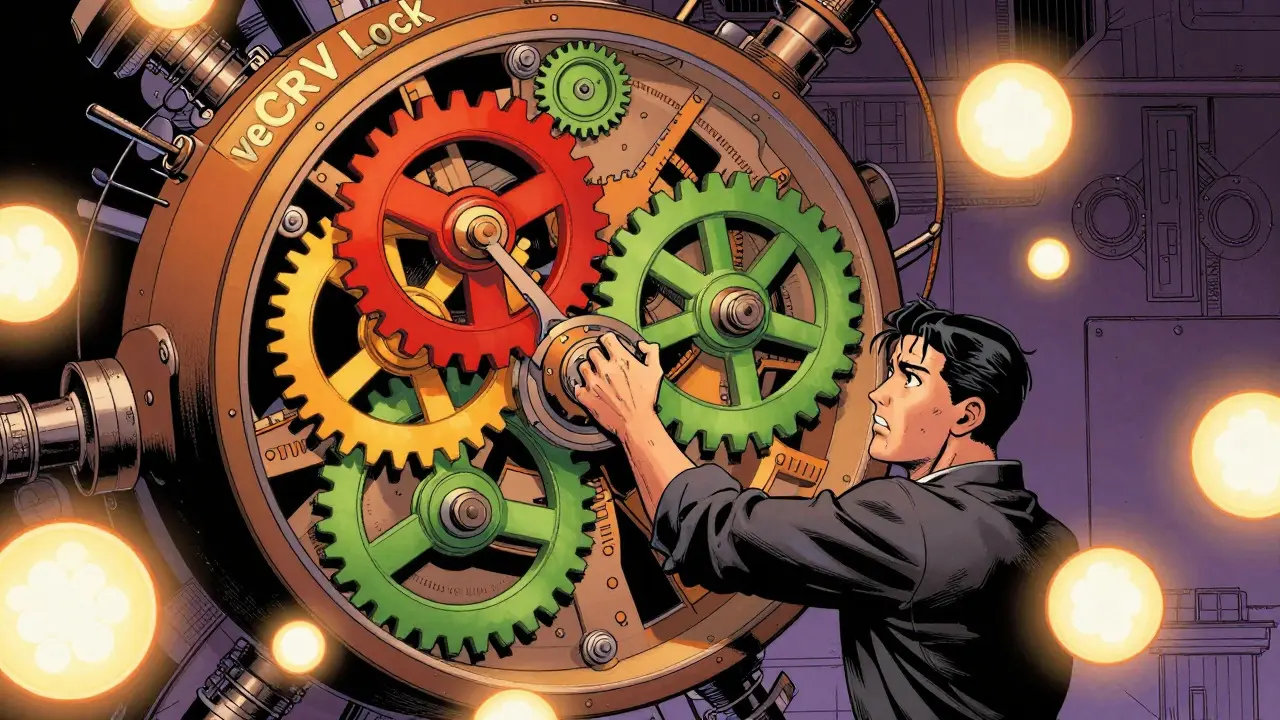
The veCRV system is the engine of the protocol. When you lock CRV, you get voting rights and a share of protocol fees. The longer you lock, the more rewards you get. This incentivizes long-term holding but locks up capital. Many users complain about the complexity. A common mistake is miscalculating the lock time, leading to missed reward boosts. If you plan to hold CRV long-term, this is a powerful feature. If you are just a casual swapper, you might ignore governance entirely and focus solely on the low fees.
Frequently Asked Questions
Is Curve (Optimism) safer than using Ethereum Mainnet?
Generally, yes, for smart contract risk related to gas costs, but you introduce L2 bridge risk. Optimism uses fraud proofs to secure the chain. The main risk is the time required to withdraw funds back to Ethereum (7 days). If you need instant liquidity, L2 might be a drawback. However, the underlying Curve contracts are the same, so the protocol logic risk remains identical.
What is the minimum amount needed to start trading on Curve Optimism?
There is no strict minimum, but practical limits apply. Since gas fees are negligible (~$0.0004), you can technically swap very small amounts. However, bridging assets to Optimism usually requires a minimum of 0.01-0.05 ETH to cover initial costs. For meaningful arbitrage or yield farming, most users start with at least $100-$500 to make the effort worthwhile.
Can I use Curve (Optimism) for volatile assets like Bitcoin or Ethereum?
You can, but it is not recommended. Curve’s AMM is optimized for stable assets. Swapping volatile pairs on Curve results in higher slippage and potential impermanent loss compared to protocols like Uniswap. Stick to Curve for USD-pegged assets and use other DEXs for crypto-to-crypto swaps.
How long does it take to withdraw funds from Optimism back to Ethereum?
The standard withdrawal period is 7 days. This is part of Optimism’s security model to allow for fraud proof challenges. If you use third-party fast bridges, you can reduce this time, but you add counterparty risk. Plan your liquidity needs accordingly if you might need to exit quickly.
Is the CRV token a good investment right now?
This depends on your view of DeFi’s future. CRV is down 98% from its highs, which some see as undervalued and others as a sign of fading relevance. Regulatory classification as a security in some regions adds risk. If you believe in the long-term dominance of stablecoin infrastructure, CRV offers exposure to the protocol’s success through governance rewards. Diversify and do your own research.