

When you trade Bitcoin, earn staking rewards, or swap an NFT, the IRS isn’t just watching - it’s counting. As of 2025, every single crypto transaction, no matter how small, must be reported. There’s no more hiding behind the idea that "it was just $5 worth of Ethereum." The days of guessing or ignoring crypto taxes are over. The IRS now has tools, data, and legal backing to track your digital assets like never before.
Everything You Own in Crypto Is Taxable Property
The IRS doesn’t treat cryptocurrency like cash. It’s property. That means every time you sell, trade, or spend crypto, you might owe taxes. Even if you traded one coin for another - say, Bitcoin for Solana - that’s a taxable event. You’re not just moving money around. You’re selling one asset and buying another, and the IRS wants to know the profit or loss.
Here’s how it breaks down:
- Capital gains: If you hold crypto for more than a year before selling, you pay long-term capital gains tax - 0%, 15%, or 20% depending on your income.
- Short-term gains: If you hold it less than a year, it’s taxed as ordinary income - up to 37%.
- Ordinary income: Staking rewards, airdrops, mining income, and crypto paid for services are taxed at your regular income rate the moment you receive them.
Let’s say you bought 0.5 BTC for $20,000 in January 2023. In June 2024, you sold it for $35,000. That’s a $15,000 gain. Since you held it over a year, you’d pay long-term capital gains tax on that amount. But if you sold it in March 2024 - less than a year later - you’d pay your full income tax rate on the gain.
Form 1099-DA: The New Crypto Tax Tracker
Before 2025, crypto exchanges only reported big transactions - like those over $20,000 - using Form 1099-K. That left most users on their own to track every single trade, swap, and reward. Now, the IRS introduced Form 1099-DA (Digital Assets), and it’s changing everything.
Starting January 1, 2025, all centralized exchanges like Coinbase, Kraken, and Gemini must report gross proceeds from every sale or exchange. That means if you sold Bitcoin for $1,200, they report $1,200 - even if you originally bought it for $800. You’re still responsible for reporting the $400 profit, but now the IRS has a record of the full amount.
Starting January 1, 2026, these same exchanges will also report your cost basis - the original price you paid, plus fees. So if you bought 1 ETH for $1,500 and paid a $50 fee, your cost basis is $1,550. If you sold it for $2,000, the exchange will tell the IRS: "This user bought at $1,550 and sold at $2,000."
This eliminates the biggest headache for most taxpayers: manually tracking purchases across multiple wallets and exchanges. Before, the average crypto user used 3.2 different platforms. Now, with Form 1099-DA, you get one clean report from each exchange you use.
What You Still Have to Track Yourself
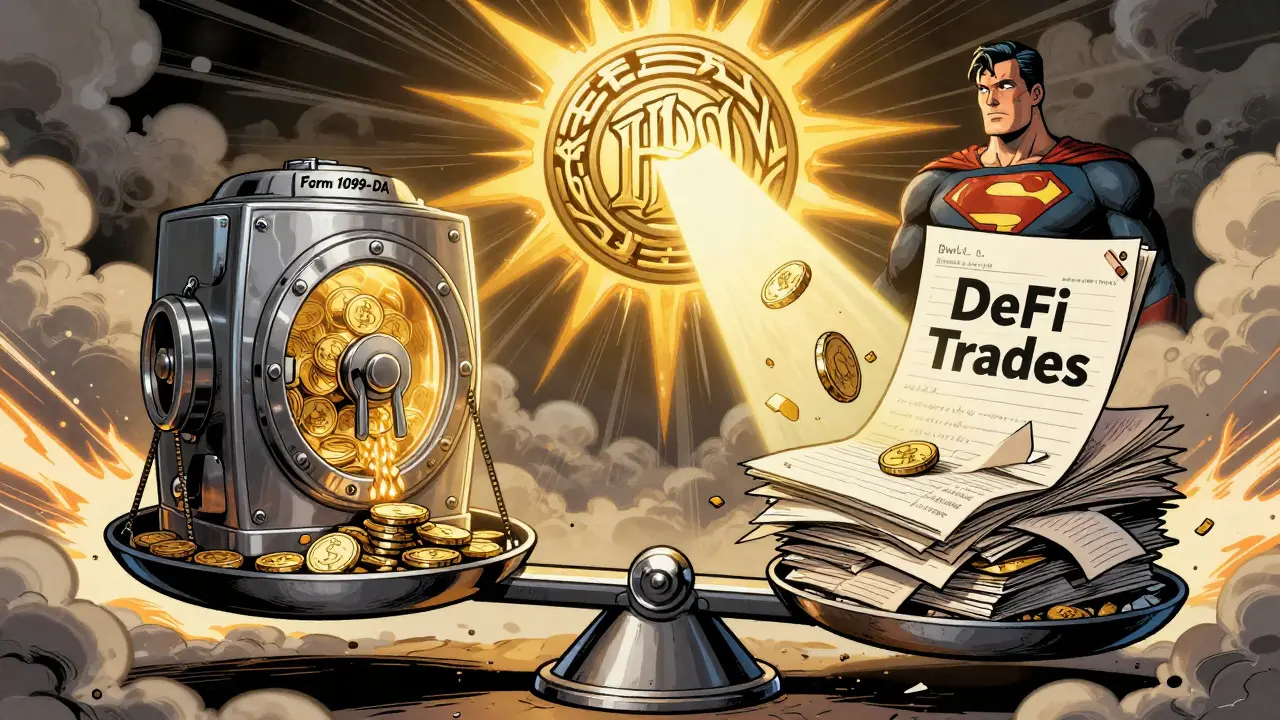
Not all crypto activity is covered by exchanges. If you use decentralized platforms like Uniswap, PancakeSwap, or a DeFi protocol, those platforms don’t report to the IRS. Why? Because they don’t hold your assets. You control the keys. That means you are responsible for tracking every swap, liquidity pool deposit, or yield farm.
Here’s what you need to log:
- Swaps between tokens on DeFi platforms
- Staking rewards earned from non-custodial wallets
- Airdrops received into your personal wallet
- NFT purchases and sales
- Crypto received as payment for freelance work
Even if you didn’t cash out to USD, you still owe tax. If you bought an NFT for 2 ETH and later sold it for 3 ETH, that’s a $1,000 gain - even if you never touched fiat currency.

How to Report Crypto on Your Tax Return
You don’t file a separate crypto tax form. You report everything on your regular Form 1040. Here’s where:
- Form 8949: List every crypto sale, trade, or disposal. Include date bought, date sold, cost basis, and proceeds.
- Form Schedule D: Summarizes your total capital gains and losses from Form 8949.
- Form Schedule 1: Report crypto income (staking, airdrops, payments) as "other income".
- Form Schedule C: If you run a business and get paid in crypto, report it here as self-employment income.
And yes - the IRS now has a clear question on the top of Form 1040: "At any time during [year], did you receive, sell, exchange, or otherwise dispose of a digital asset?" Answer "Yes," and you’ll need to attach Forms 8949 and Schedule D.
Penalties Are Real - And Getting Worse
Ignoring crypto taxes isn’t a victimless act. The IRS has built a whole enforcement unit just for digital assets. Since 2016, they’ve issued over 10,000 summonses to exchanges like Coinbase and Kraken to hand over user data. In 2024 alone, they conducted 1,200 audits focused on crypto.
If you underreport or fail to report:
- You could owe up to 75% of the unpaid tax in penalties
- You’ll pay interest on the amount owed - compounded daily
- Repeated or intentional evasion can lead to criminal charges - including jail time
And it’s not just about audits. The IRS uses blockchain analytics firms like Chainalysis to trace transactions across wallets. They’ve already matched 83% of anonymized crypto transactions to real identities in pilot tests. Your wallet address isn’t as hidden as you think.
What’s Not Covered - And Why
Not everything is taxed. Here’s what’s safe:
- Buying crypto with USD - no tax event
- Transferring crypto between your own wallets - no sale, no tax
- Gifting crypto under $18,000 per person in 2025 - no tax for giver or receiver
But here’s the catch: if you gift crypto worth more than $18,000, you must file a gift tax return - even if you don’t owe tax. And if the recipient later sells it, they’ll owe capital gains tax based on your original cost basis.
DeFi platforms are still exempt from reporting. That’s because of a law signed in April 2025 that explicitly removed reporting obligations for non-custodial platforms. But that doesn’t mean you’re exempt from paying taxes on your DeFi activity. You still owe.
Tools That Actually Help
Trying to track 200 crypto transactions manually? You’ll make mistakes. The good news: specialized software has exploded in use. Tools like Koinly, CoinTracker, and TokenTax now serve over 4 million users - up 300% since 2020.
These tools connect to your wallets and exchanges, auto-import transactions, calculate gains and losses, and generate Form 8949 and Schedule D. Most cost $50-$150 per year. For most users, it’s cheaper than hiring a CPA to fix a crypto tax error.
One study found 87% of crypto users had no idea they needed to report staking rewards or NFT sales. That’s not ignorance - it’s a gap in education. But the IRS isn’t waiting for you to catch up.
What’s Coming in 2026 and Beyond
By 2026, Form 1099-DA will include full cost basis reporting. That means the IRS will have accurate data on your crypto purchases. They’ll cross-check it with what you report. If you say you bought Bitcoin at $10,000 but the exchange says $15,000 - you’ll get a notice.
The Congressional Budget Office projects this will reduce crypto tax errors by 60% and bring in $12.3 billion more in revenue each year. The IRS has allocated $1.2 billion in 2025 just for crypto enforcement - 10% of its total enforcement budget.
Expect more audits, more data sharing with foreign governments, and more pressure on exchanges to report everything. The era of "I didn’t know" is ending.
Bottom Line: Don’t Wait
If you’ve ever bought, sold, or earned crypto - even once - you have a tax obligation. The IRS isn’t bluffing. They’ve spent years building the systems to catch you. Now they’re using them.
Your move: Gather all your transaction history. Use a crypto tax tool. Report everything. Pay what you owe. If you’re unsure, talk to a tax pro who’s handled crypto before - not just any accountant.
Because in 2026, the IRS won’t care if you "didn’t know." They’ll have the data. And they’ll know exactly what you didn’t report.
Do I have to report crypto if I didn’t sell it?
Yes - if you received staking rewards, airdrops, or got paid in crypto, you owe tax on the fair market value at the time you received it. Even if you never sold it, the IRS treats it as income. Buying crypto with USD isn’t taxable, but any other activity - swapping, spending, or gifting - is.
What if I lost money on crypto trades?
You can deduct crypto losses to offset gains. If you lost more than you gained, you can deduct up to $3,000 against your ordinary income each year. Any extra losses roll over to future years. But you still have to report every trade - even losing ones - on Form 8949.
Do I need to report crypto on my business taxes?
Yes. If you accept crypto as payment for goods or services, you must report it as business income on Schedule C. The value is based on the fair market value in USD at the time of receipt. You also need to track cost basis if you later sell that crypto.
Is crypto taxed differently if I hold it in a wallet vs. on an exchange?
No. Where you hold crypto doesn’t change the tax rules. Whether it’s in a Coinbase account, a Ledger wallet, or a DeFi protocol, every sale, swap, or reward is taxable. The only difference is who reports it - exchanges report for you, but if you hold it yourself, you’re responsible for tracking and reporting.
What happens if I don’t report crypto at all?
The IRS has already matched thousands of crypto transactions to taxpayer IDs. If you don’t report, you’ll likely get a notice. Penalties can include 75% of unpaid tax, daily interest, and in extreme cases, criminal prosecution. The IRS has a dedicated team and blockchain analytics tools - ignoring crypto taxes is a high-risk gamble.
christopher luke
March 2, 2026 AT 00:22maya keta
March 2, 2026 AT 09:51Tracy Peterson
March 2, 2026 AT 18:40Dianna Bethea
March 4, 2026 AT 10:55aaron marp
March 5, 2026 AT 17:37Patrick Streeb
March 6, 2026 AT 01:38Phillip Marson
March 7, 2026 AT 07:04Alyssa Herndon
March 8, 2026 AT 20:44Ifeanyi Uche
March 9, 2026 AT 18:01Elana Vorspan
March 11, 2026 AT 09:32Kenneth Genodiala
March 11, 2026 AT 22:10Danny Kim
March 12, 2026 AT 17:16Cathy Sunshine
March 13, 2026 AT 00:03Shannon Black
March 13, 2026 AT 23:57Dee Resin
March 15, 2026 AT 04:51Tanvi Atal
March 16, 2026 AT 14:40Sony Sebastian
March 18, 2026 AT 11:42Brian Lemke
March 19, 2026 AT 16:08Megan Lavery
March 21, 2026 AT 14:32Mae Young
March 22, 2026 AT 08:58Trenton White
March 22, 2026 AT 12:41Cheryl Fenner Brown
March 22, 2026 AT 14:23Kristi Emens
March 23, 2026 AT 00:33